
The Mechanics of the North Rim's Collapse: How the Grand Canyon is Rebuilding One Year After the Dragon Bravo Fire
One year after a catastrophic wildfire destroyed the Grand Canyon's North Rim infrastructure, the park faces a complex operational crisis. Rebuilding requires untangling a web of destroyed water systems, lost workforce housing, and intense political scrutiny over fire management.
By Factlen Editorial Team
- Park Administration & Recovery Teams
- Focused on phased safety, infrastructure modernization, and securing funding for critical operational needs.
- Government Accountability Advocates
- Demanding transparency and independent investigations into the NPS's initial fire management strategy.
- Ecologists & Conservationists
- Emphasizing the natural resilience of the Kaibab Plateau and the long-term ecological benefits of the fire.
What's not represented
- · Local tourism businesses in Southern Utah and Northern Arizona affected by the closure
- · Concessionaire employees who lost their seasonal jobs
Why this matters
The operational collapse of the North Rim offers a masterclass in the fragility of remote infrastructure. Understanding how a national park rebuilds its water, housing, and logistics networks reveals the hidden mechanics that make modern outdoor recreation possible.
Key points
- The July 2025 Dragon Bravo Fire destroyed 114 structures on the North Rim, including the historic Grand Canyon Lodge.
- The loss of the water treatment plant and workforce housing has created a massive operational bottleneck for the park.
- The National Park Service is facing political scrutiny and demands for an investigation over its initial fire management strategy.
- The North Rim has partially reopened for 2026, but offers no overnight lodging or food services.
- The Grand Canyon Conservancy is raising millions to fund a modernized North Kaibab Trailhead and new employee housing.
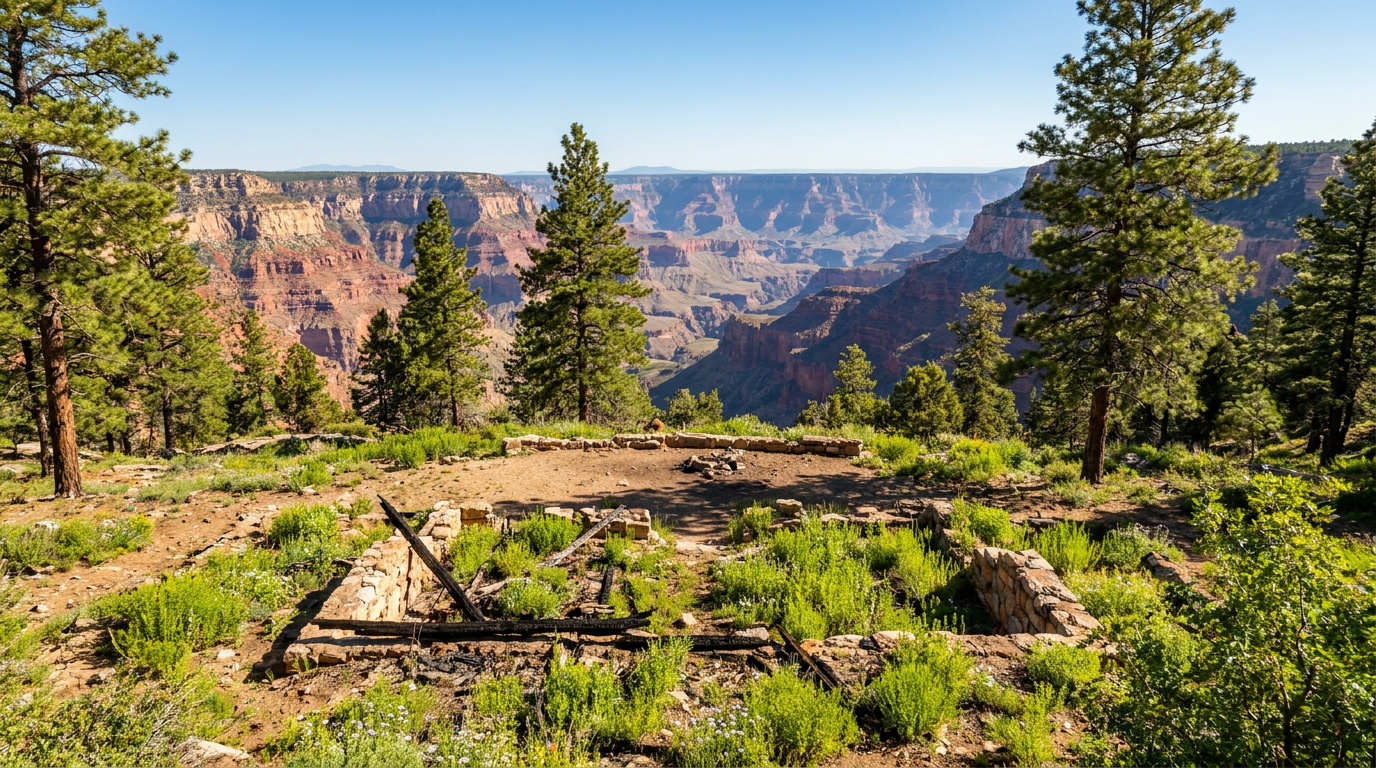
July 2026 marks exactly one year since the Dragon Bravo Fire fundamentally altered the North Rim of Grand Canyon National Park. Today, the landscape presents a stark duality: waist-high aspens and rebounding vegetation signal ecological recovery, while the absence of the historic 1937 Grand Canyon Lodge leaves a gaping hole in the park's human footprint. The North Rim has partially reopened to visitors for the 2026 season, offering access to the campground and select trails, but the operational reality behind the scenes is one of profound strain. Rebuilding a remote, high-altitude national park is not simply a matter of pouring concrete; it requires untangling a complex web of water infrastructure, workforce housing, and logistical bottlenecks.[1][6]
The crisis began on July 4, 2025, when a lightning strike ignited the Dragon Bravo Fire in a remote section of the park. Initially managed under a "contain and confine" strategy to allow natural fuels to burn, the fire exploded days later when shifting winds and record-low humidity pushed it beyond control lines. Over the next two months, the megafire consumed more than 145,000 acres across the park and the adjacent Kaibab National Forest. It destroyed 114 structures, including the iconic Grand Canyon Lodge, the visitor center, the gas station, and critical administrative buildings. The sheer speed of the fire's advance forced the emergency evacuation of 500 visitors and staff, abruptly ending the 2025 season.[5][7][8]
In the year since the blaze, a parallel administrative crisis has unfolded regarding how the fire was initially handled. Investigative reports, most notably by The Arizona Republic, alleged that park officials ignored critical weather thresholds in their own fire management plan during the early days of the blaze. In response to these allegations, National Park Service staff and Interior Department officials have maintained a strict public silence, declining to comment on the fire's initial management. This communication blackout has drawn bipartisan political ire, with Arizona Governor Katie Hobbs and congressional representatives demanding a comprehensive, independent investigation into the decision-making process that allowed the fire to reach the developed rim.[3][4]

The physical mechanics of operating the North Rim have been crippled by the loss of utility infrastructure, most notably the water treatment plant. When the fire overran the facility, it caused a catastrophic failure of the chemical storage systems, triggering a hazardous chlorine gas leak. Chlorine gas, which can cause severe lung injury, forced an immediate halt to firefighting operations in the sector and necessitated the emergency evacuation of inner-canyon hikers at Phantom Ranch. The destruction of this plant means the park currently lacks the mechanical capacity to treat and pump potable water for flush toilets, camp showers, or large-scale visitor services, fundamentally limiting how many people the rim can support.[1][8]
This localized destruction compounds an already precarious water situation for the entire Grand Canyon. The park's primary water source—the 12.5-mile Transcanyon Waterline built in the 1960s—has suffered dozens of catastrophic breaks in recent years and is currently undergoing a massive $208 million rehabilitation project. The logistics of repairing a pipeline suspended in a mile-deep gorge are staggering, requiring helicopter drops and specialized rigging. To facilitate this critical infrastructure work, the National Park Service will be forced to close the North Kaibab Trail entirely in October 2026, temporarily ending the possibility of the iconic Rim-to-Rim hike and further squeezing the North Rim's operational window.[1]
This localized destruction compounds an already precarious water situation for the entire Grand Canyon.
Even if the water systems were fully operational, the North Rim faces a severe human bottleneck: the loss of workforce housing. The Dragon Bravo Fire disproportionately destroyed National Park Service employee residences, while leaving concessionaire housing largely untouched. Because the North Rim is situated at 8,000 feet in elevation and is located hours from the nearest major town, staff cannot simply commute to work. Without on-site housing, the park cannot deploy the maintenance crews, rangers, and administrative staff required to manage a full reopening. The Grand Canyon Conservancy has identified the construction of a new six-unit, year-round apartment building as a critical priority, noting that limited housing capacity remains the single biggest barrier to accelerating recovery efforts.[2]

The operational collapse also extended to the park's heavy equipment fleet, which is essential for managing the North Rim's extreme winter conditions. The fire destroyed the park's primary snowplow and maintenance vehicles. Because the North Rim receives an average of 140 inches of snow annually, clearing the 44-mile stretch of State Route 67 from Jacob Lake to the rim is a monumental logistical hurdle required before any spring reopening can occur. To prevent a total failure of the 2026 season, the Grand Canyon Conservancy had to step in and privately fund the purchase of a replacement Sno-Cat vehicle to support critical winter operations and allow assessment teams to reach the burn scar.[2]
While the human infrastructure struggles to recover, the ecological mechanics of the Kaibab Plateau are already demonstrating remarkable resilience. Initial assessments by federal Burned Area Emergency Response teams revealed that despite the catastrophic loss of buildings, the majority of the fire's footprint burned at a low to moderate severity. This mosaic burn pattern left many mature ponderosa pines intact while clearing out decades of accumulated underbrush. Biologists and local conservation groups report that the forest floor is already greening, with pioneer species like aspen saplings taking root in the nutrient-rich ash, signaling the beginning of a natural succession cycle that will ultimately rejuvenate the forest ecosystem.[3][6]
For visitors arriving in the summer of 2026, the North Rim experience is drastically different from years past. The National Park Service has implemented a phased reopening, allowing access to the North Rim Campground, Point Imperial, and Cape Royal, but mandating that visitors be entirely self-sufficient. There is no overnight lodging, no visitor center, and no food service available within the park boundaries. The North Kaibab Trail has reopened for foot traffic only, but hikers must navigate a scarred landscape with ongoing hazards, including dead standing trees and the potential for flash flooding in areas where the fire baked the soil into a water-repellent crust.[1][5]

Rather than simply replicating the 1930s footprint, park planners and philanthropic partners are treating the tragedy as a rare opportunity to modernize the North Rim's infrastructure. The Grand Canyon Conservancy is spearheading a $2.8 to $4.8 million initiative to completely redesign the North Kaibab Trailhead. Prior to the fire, the trailhead suffered from severe overcrowding, with parking demand routinely exceeding capacity by 400 percent, forcing vehicles onto fragile road shoulders. The proposed redesign will expand parking, improve traffic circulation, and integrate future shuttle systems, creating a safer and more accessible gateway to the inner canyon.[2]
The Dragon Bravo Fire also serves as a mechanical case study in how climate change is rewriting the rules of wildland firefighting. The traditional park strategy of allowing naturally ignited fires to clear underbrush—a scientifically sound practice in historical conditions—is increasingly colliding with the reality of modern megafires. Prolonged droughts, record-high energy release components, and extreme wind events mean that a fire can transition from a beneficial, creeping ground burn to an uncontrollable crown fire in a matter of hours. The ongoing political scrutiny over the North Rim fire is likely to force a system-wide reevaluation of when and where "contain and confine" strategies can be safely deployed in an era of extreme weather.[3][4]
The complete restoration of the North Rim will likely take the remainder of the decade. The National Park Service is currently engaged in long-range planning to rebuild visitor services and lodging, with a formal public comment period scheduled for the fall of 2026. Until those massive capital projects are funded and completed, the North Rim will remain a rugged, limited-service destination. The ongoing operational crisis serves as a stark mechanical explainer of what happens when a modern megafire collides with aging, remote infrastructure, forcing a beloved national park to rebuild its literal and administrative foundations from the ground up.[1][2]
How we got here
July 4, 2025
A lightning strike ignites the Dragon Bravo Fire on the North Rim.
July 12-13, 2025
The fire explodes, destroying the Grand Canyon Lodge, visitor center, and 114 total structures.
August 2025
The Arizona Republic publishes an investigation questioning the NPS's initial fire management strategy.
May 15, 2026
The North Kaibab Trail reopens for foot traffic, marking the beginning of a phased recovery.
June 1, 2026
The North Rim Campground reopens to self-sufficient visitors.
October 2026
Scheduled closure of the North Kaibab Trail to facilitate $208 million Transcanyon Waterline repairs.
Viewpoints in depth
Park Administration & Recovery Teams
Focusing on phased safety and infrastructure modernization.
For the National Park Service and its philanthropic partners, the immediate priority is stabilizing the rim and replacing critical operational infrastructure like workforce housing and water treatment. They view the destruction of the 1930s-era facilities as a forced but necessary opportunity to redesign the park's footprint for modern visitation levels, prioritizing shuttle integration and sustainable building practices over rapid, identical reconstruction.
Government Accountability Advocates
Demanding transparency regarding the initial fire management strategy.
Local politicians, investigative journalists, and some residents argue that the destruction of the North Rim was preventable. They point to the NPS's initial 'contain and confine' strategy, arguing that officials ignored critical weather warnings and dry fuel loads. This camp is pushing for independent investigations and a fundamental overhaul of how the agency manages natural ignitions during peak drought conditions.
Ecologists & Conservationists
Emphasizing the natural resilience and long-term health of the Kaibab Plateau.
Environmental scientists and conservation groups view the megafire through a longer ecological lens. While acknowledging the tragic loss of human history, they note that the Kaibab Plateau's ponderosa pine forests evolved with fire. They focus on the rapid rebound of pioneer species like aspen and the clearing of decades of dangerous underbrush, arguing that the ecosystem is already resetting itself.
What we don't know
- Whether the National Park Service will rebuild the Grand Canyon Lodge in its original historic style or opt for a modernized facility.
- The findings of any potential independent investigation into the NPS's initial handling of the Dragon Bravo Fire.
- How the October 2026 closure of the North Kaibab Trail for waterline repairs will impact the 2027 hiking season.
Key terms
- Contain and Confine
- A wildland fire management strategy that allows a fire to burn within a defined area to clear natural fuels, rather than immediately extinguishing it.
- Energy Release Component (ERC)
- A metric used by fire managers to estimate the potential heat release of a fire based on the dryness and flammability of local vegetation.
- Burned Area Emergency Response (BAER)
- A rapid assessment conducted by federal experts to identify imminent post-fire threats to human life, safety, and critical resources.
- Pioneer Species
- Hardy plant species, such as aspen trees, that are the first to colonize a disrupted or damaged ecosystem, beginning the chain of ecological succession.
Frequently asked
Is the Grand Canyon North Rim open in 2026?
Yes, but in a highly limited capacity. The campground and select scenic roads are open, but visitors must be entirely self-sufficient as there is no lodging, food service, or visitor center available.
Will the Grand Canyon Lodge be rebuilt?
Long-range planning is currently underway. The National Park Service will open a public comment period in the fall of 2026 to discuss the redevelopment of visitor services and lodging.
Can I hike Rim-to-Rim this year?
Rim-to-Rim hiking is possible until mid-October 2026. After October 15, the North Kaibab Trail will close for critical repairs to the Transcanyon Waterline, making the crossing impossible.
Why are park staff facing an operational crisis?
The fire destroyed the majority of the National Park Service's employee housing and critical infrastructure like the water treatment plant and snowplows, making it logistically impossible to support a full staff.
Sources
Source coverage
8 outlets
3 viewpoints surfaced








[1]National Park ServicePark Administration & Recovery Teams
North Rim Status Update and Phased Reopening
Read on National Park Service →[2]Grand Canyon ConservancyPark Administration & Recovery Teams
North Rim Recovery and Renewal Projects
Read on Grand Canyon Conservancy →[3]KNAUGovernment Accountability Advocates
Assessment of Dragon Bravo Fire shows mostly 'low' burn severity
Read on KNAU →[4]National Parks TravelerGovernment Accountability Advocates
Interior Department Officials Committed To Rebuilding Grand Canyon's North Rim
Read on National Parks Traveler →[5]BackpackerEcologists & Conservationists
A Lightning Strike Ignited a New Fire Along the Canyon's North Rim
Read on Backpacker →[6]Grand Canyon TrustEcologists & Conservationists
Grand Canyon wildfires burned across more than 200,000 acres in 2025
Read on Grand Canyon Trust →[7]AP NewsEcologists & Conservationists
Wildfires force evacuations at Grand Canyon's North Rim and Colorado national park
Read on AP News →[8]Western PrioritiesEcologists & Conservationists
Wildfire destroys a historic Grand Canyon lodge and other structures
Read on Western Priorities →
Every angle. Every day.
Get travel stories with full source coverage and perspective breakdowns delivered to your inbox.