
Court-Supervised Auction Process Liquidating Spirit Airlines' Fleet and Slots
Following the collapse of a $500 million government rescue deal and a fatal spike in jet fuel prices, Spirit Airlines ceased operations in May 2026. Now, the aviation industry is watching a complex court-supervised auction to absorb the ultra-low-cost carrier's remaining planes, airport slots, and intellectual property.
By Irina Belova

Share this story
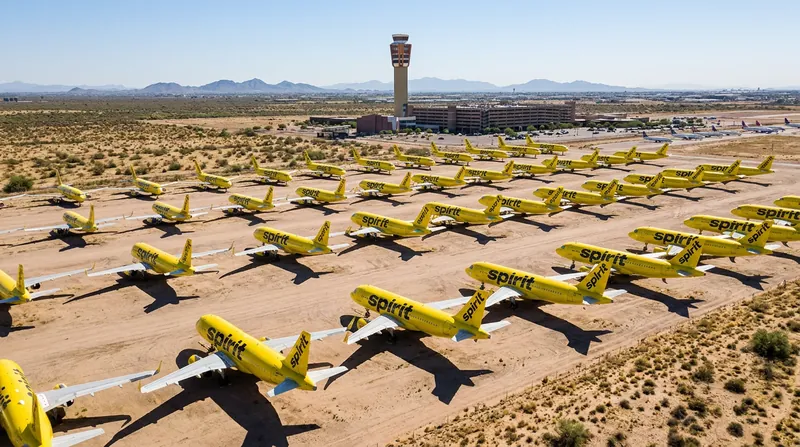
In July 2026, the aviation industry is picking over the remains of Spirit Airlines. The pioneer of the United States ultra-low-cost model abruptly ceased operations on May 2, and now its physical and intellectual assets are on the auction block.
The centerpiece of the liquidation is a multi-track auction overseen by the U.S. Bankruptcy Court for the Southern District of New York. On July 9, the carrier put its most valuable operating assets up for bid, including aircraft, spare engines, and highly coveted takeoff and landing slots.
A second auction scheduled for July 22 will liquidate the company's corporate campus in Dania Beach, Florida. This court-supervised wind-down marks the final chapter for an airline that once employed 17,000 people and operated hundreds of daily flights across the Americas.
To understand how an airline with $8.6 billion in assets is dismantled, one must look at the mechanics of aviation bankruptcy. Airlines are unusually asset-light and claim-heavy; most of Spirit's 114 Airbus A320-family jets were leased rather than owned outright.
Of that final fleet, 66 aircraft belong to leasing companies, while Spirit owns 28 that are part of the current liquidation process. The bankruptcy court set a "stalking horse" bid—a baseline offer that other bidders must exceed—of $533.5 million for the owned aircraft and 18 spare engines.
The most fiercely contested assets, however, are intangible: 22 slot pairs at New York's LaGuardia Airport. Because the federal government strictly limits flights at LaGuardia to manage congestion, these slots rarely hit the open market and were valued by Spirit at nearly $87 million.
Rival carriers like Frontier and American Airlines have shown intense interest in acquiring these slots, which support about a dozen daily round trips. The winning bidder will ultimately decide which routes return to the New York hub, dictating how Spirit's former market share is absorbed.
The auction also includes the intellectual property of the Free Spirit loyalty program. While the airline is no longer flying, the customer data and brand architecture hold residual value for competitors looking to acquire a massive database of budget-conscious travelers.
How did Spirit reach this point? The carrier's demise was a cascading failure of structural vulnerabilities and external shocks. After a federal judge blocked a $3.8 billion merger with JetBlue in 2024 on antitrust grounds, Spirit was left to navigate mounting debt alone.[3]
The airline filed for Chapter 11 bankruptcy twice in less than a year—first in November 2024, and again in August 2025. While the first restructuring converted $795 million of debt to equity, it failed to fix the underlying operating model, which relied on razor-thin margins.
In March 2026, Spirit filed a reorganization plan targeting an early summer exit from bankruptcy. The plan would have reduced the fleet to 80 aircraft and slashed debt obligations from $7.4 billion to roughly $2 billion, focusing on profitable routes in Florida and Detroit.
But the model could not survive contact with a massive external shock: a global spike in jet fuel prices triggered by the 2026 U.S.-Israel war on Iran. Jet fuel surged 80% to over $4.50 a gallon, a cost increase that Spirit's ultra-low-cost structure simply could not absorb.[2]
As liquidity evaporated in late April, the Trump administration attempted to engineer a last-minute rescue. The White House proposed a $500 million federal financing package that would have given the U.S. government warrants equivalent to a 90% equity stake in the airline.[1]
President Donald Trump publicly championed the deal, comparing it to the government's previous investment in semiconductor manufacturer Intel, and argued that the government could resell the airline for a profit once fuel prices stabilized.[2][3]
The bailout ultimately collapsed due to fierce opposition from Spirit's bondholders, including major financial institutions like Citadel and Ares Management. Creditors argued that the government's demand for absolute priority repayment would wipe out their positions, violating their fiduciary duties to investors.[1][2]
With no go-forward financing available and a counterproposal rejected by the government, Spirit's executives and Commerce Secretary Howard Lutnick agreed during a 15-minute phone call that the airline had run out of alternatives.[1]
The shutdown was tightly choreographed to avoid mid-air chaos. Spirit made its going-out-of-business announcement at 3:00 a.m. on May 2, ensuring that its final flight—from Detroit to Dallas—was safely on the ground before operations ceased.
A skeleton crew of roughly 130 employees was retained to secure the aircraft and coordinate the logistics of the liquidation. Meanwhile, other U.S. carriers launched rescue fares and extended travel pass benefits to help stranded Spirit crew members return home.[1]
The ripple effects of Spirit's collapse continue to reshape the industry. A coalition of budget airlines has since petitioned the Transportation Department for $2.5 billion in federal assistance to bridge the gap caused by the ongoing fuel crisis.
Key points
- Spirit Airlines ceased operations on May 2, 2026, after a $500 million federal rescue deal collapsed.
- The bankruptcy court is currently auctioning the carrier's remaining assets, including 28 owned Airbus jets and 22 LaGuardia slot pairs.
- The airline's final reorganization attempt was derailed by an 80% spike in jet fuel prices linked to the Middle East conflict.
- Competitors are actively bidding on Spirit's assets while simultaneously lobbying for $2.5 billion in federal fuel assistance.
Open questions
- Which rival airlines will ultimately win the highly coveted LaGuardia takeoff and landing slots.
- Whether the buyer of the Free Spirit loyalty program will honor any portion of customers' existing points.
- How the removal of Spirit's ultra-low-cost capacity will affect baseline airfares across the U.S. domestic market.
Timeline
Nov 2024
Spirit files for its first Chapter 11 bankruptcy, converting $795 million of debt to equity.
Aug 2025
The airline files for Chapter 11 a second time amid mounting losses and lease terminations.
March 2026
Spirit proposes a reorganization plan to exit bankruptcy by early summer.
April 2026
Jet fuel prices spike 80%, draining the airline's remaining liquidity.
May 2, 2026
A $500 million federal rescue deal collapses, and Spirit ceases all flight operations.
July 9, 2026
The bankruptcy court begins auctioning Spirit's aircraft and LaGuardia airport slots.
- Secured Creditors
- Prioritized recovering asset value over accepting a government deal that would wipe out their equity.
- Federal Policymakers
- Sought to intervene with taxpayer funds to preserve jobs and maintain market competition.
- Aviation Competitors
- Viewed the collapse as an opportunity to acquire restricted assets while seeking sector-wide fuel relief.
Perspectives this story doesn't cover
- Stranded passengers
- Laid-off Spirit employees
Sources
Source coverage
3 outlets
3 viewpoints surfaced



- [1]The GuardianFederal Policymakers
Spirit airlines is dead and a bus travel boom looks likely – but will Greyhounds ever be cool again?
Read on The Guardian → - [2]ForbesSecured Creditors
‘They Do As I Say’ Trump Says Of Israel Amid Disagreement Over Iran Deal
Read on Forbes → - [3]PBSFederal Policymakers
Trump says administration weighing Spirit Airlines bailout
Read on PBS →
More in Travel
See all →Aviation Finance
Why Apollo Outbid Castlelake in the $7.7 Billion Takeover Fight for EasyJet
9 sources
Aviation Safety
Boeing 737 Safety Review: How Ryanair Engine Debris Shattered a Cabin Window
9 sources
Aviation Logistics
Why Regional Airspace Restrictions and Funnel Effects Trigger Mass Flight Delays at DXB
3 sources
Aviation Economics
The $1.7 Billion Carve-Up: How Spirit Airlines' Remaining Assets Are Being Auctioned Off
3 sources
Comments
Every angle. Every day.
Get Travel stories with full source coverage and perspective breakdowns, free every day.