
The Mechanics of the Non-Resident Surcharge: How the NPS's New $250 Pass Reshapes International Access to US National Parks
Starting in 2026, international visitors to 11 major US National Parks face a new $100 per-person surcharge, alongside a $250 non-resident annual pass. The policy aims to fund maintenance backlogs while shifting the cost burden away from US taxpayers, prompting a major adjustment for the global tour industry.
By Kabir Mehra


- US Policymakers & NPS
- Federal officials argue the new fees create a more equitable system for American taxpayers.
- International Tour Operators
- The inbound travel industry is concerned about logistical hurdles and sudden cost increases.
- Conservation Advocates
- Supporters of park preservation welcome new funding streams to manage over-tourism.
Why this matters
For international tourists and the commercial operators who guide them, the cost of a multi-park US road trip just increased significantly. However, understanding the mechanics of the new $250 annual pass can save families hundreds of dollars while directly funding the preservation of America's most iconic landscapes.
Key points
- A new $100 per-person surcharge applies to non-U.S. residents at 11 major national parks.
- The $80 America the Beautiful pass is now restricted to U.S. citizens and permanent residents.
- A new $250 Non-Resident Annual Pass covers standard entry and waives the $100 surcharge.
- The $250 pass covers the passholder and up to three additional adults in the same vehicle.
- Revenue from the fees will fund maintenance backlogs and facility upgrades.
- Commercial tour operators cannot currently bulk-purchase the passes for their clients.
The era of uniform entry fees at America's most famous natural landmarks has officially ended. Beginning in 2026, the Department of the Interior has implemented a dual-pricing structure designed to shift the financial burden of park maintenance away from domestic taxpayers and onto international visitors. The policy introduces a $100 per-person surcharge for non-U.S. residents at 11 of the country's most heavily trafficked national parks, fundamentally altering the economics of the classic American road trip for millions of global tourists.[2][8]
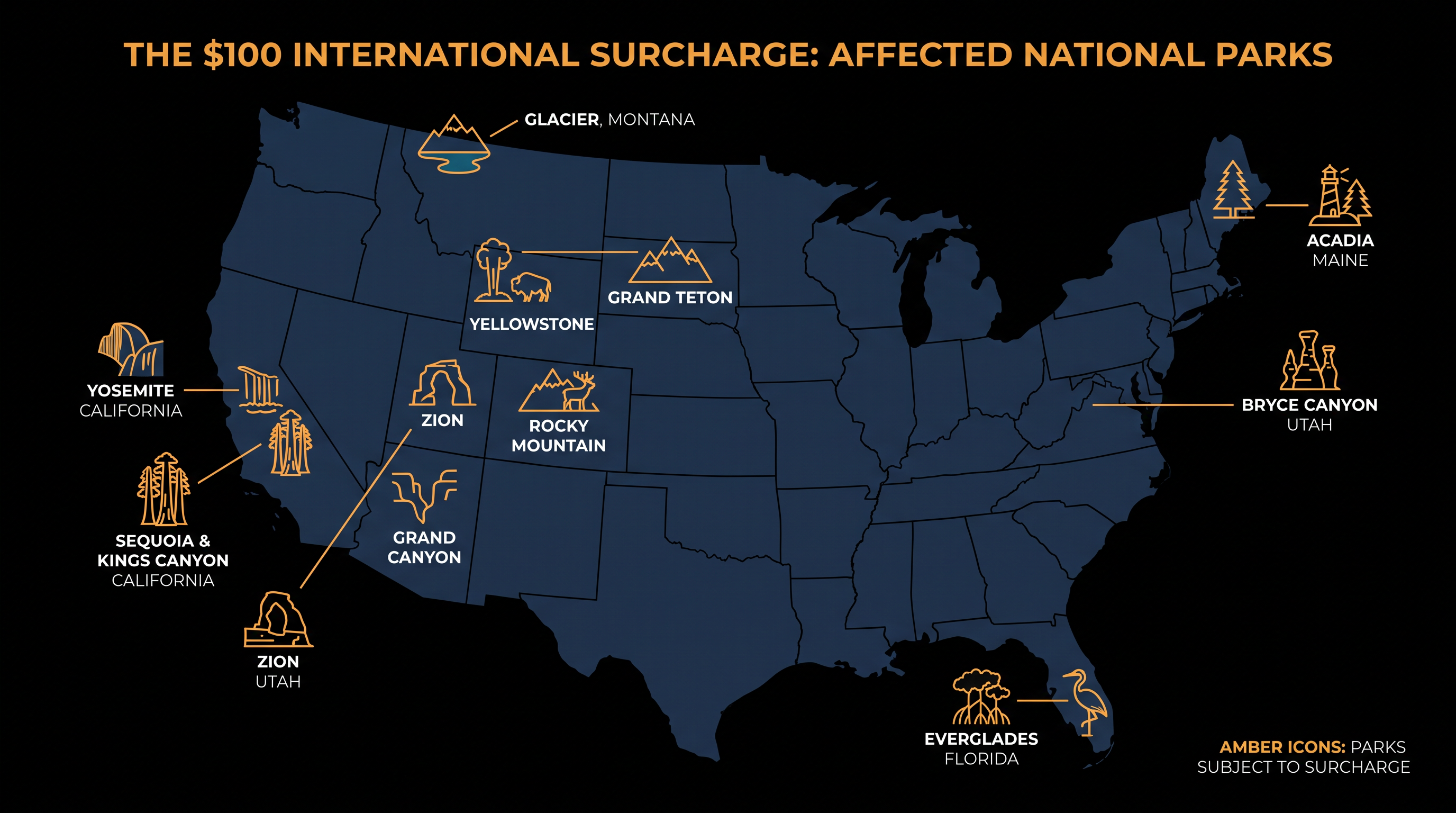
The new fee structure targets the "crown jewels" of the National Park System. The $100 surcharge applies to visitors aged 16 and older entering Acadia, Bryce Canyon, Everglades, Glacier, Grand Canyon, Grand Teton, Rocky Mountain, Sequoia & Kings Canyon, Yellowstone, Yosemite, and Zion. At the other 400-plus sites managed by the National Park Service, standard entry fees remain unchanged for all nationalities.[1][4]
The mechanism of the surcharge is straightforward but steep. Previously, a vehicle full of international tourists entering Yosemite would pay a flat $35 entrance fee. Now, that same vehicle must pay the $35 base fee plus $100 for every non-resident adult inside. For a family of four with teenagers, a single visit to the Grand Canyon jumps from $35 to $435.[3][7]
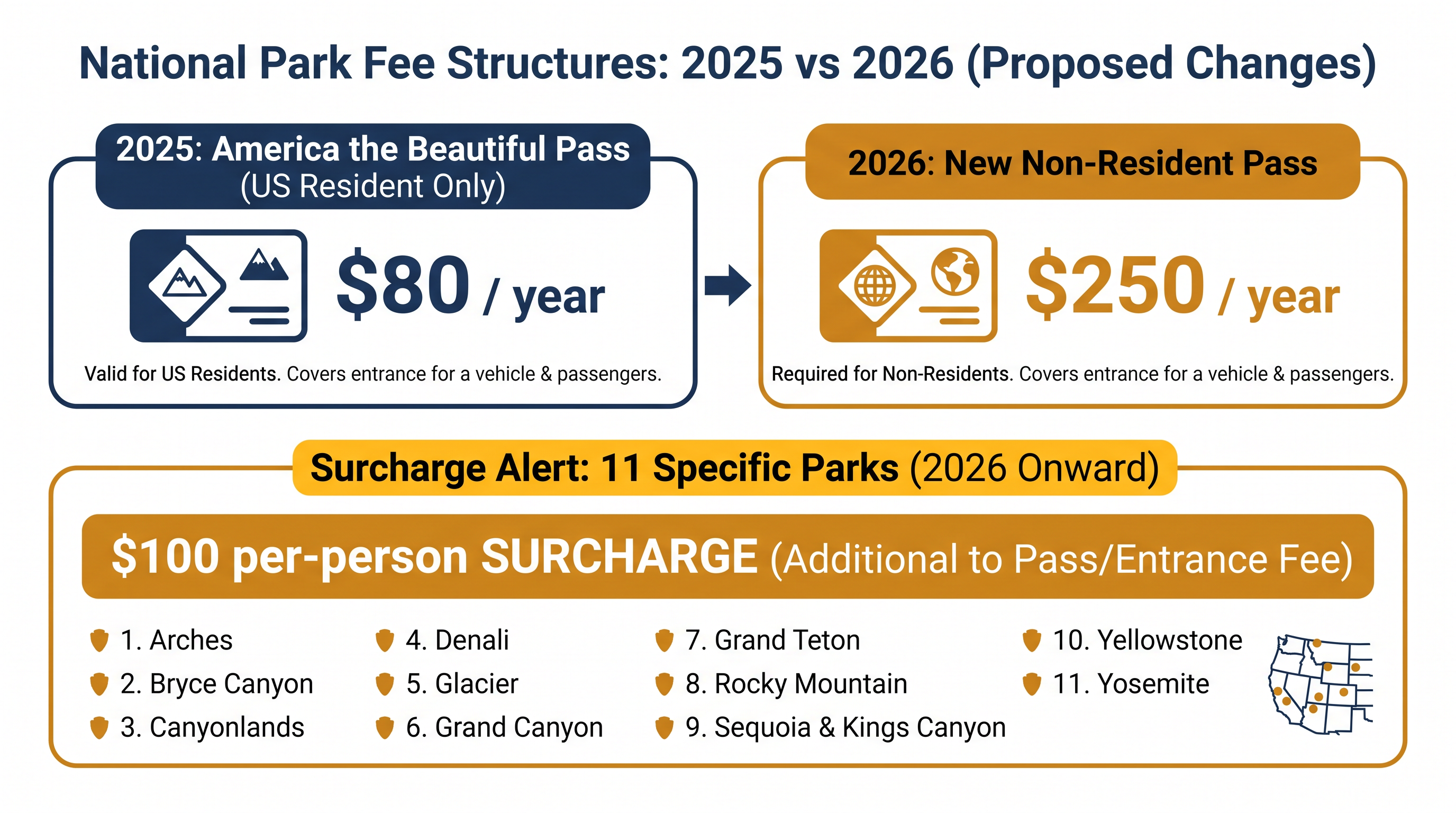
To mitigate this impact for multi-park travelers, the National Park Service introduced the America the Beautiful Non-Resident Annual Pass, priced at $250. Prior to 2026, anyone regardless of nationality could purchase the standard $80 annual pass. That $80 tier is now strictly reserved for U.S. citizens and permanent residents, who must show a state-issued ID, U.S. passport, or Green Card at the gate.[1][2][3]
The $250 Non-Resident Pass serves as the primary financial workaround for international tourists. According to official National Park Service guidance, this pass covers the standard vehicle entry fee and waives the $100 surcharge for the passholder and up to three additional adults traveling in the same private vehicle. For international families planning to visit more than one of the 11 affected parks, purchasing the pass immediately pays for itself.[1]
The $250 Non-Resident Pass serves as the primary financial workaround for international tourists.
Despite the mathematical advantage of the new pass, its rollout has triggered widespread anxiety across the global inbound travel industry. Tour operators and destination marketing organizations have spent months scrambling to adjust their 2026 pricing models. Because the National Park Service does not currently allow commercial tour operators to purchase the $250 passes in bulk on behalf of their clients, the logistical burden has fallen directly on the tourists.[4][6]
Companies like Southwest Adventure Tours have had to issue urgent notices to their international clients, clarifying that the operators cannot collect or process the new fees in advance. Instead, tourists arriving on commercial motorcoaches must either purchase the $250 pass individually on Recreation.gov beforehand or pay the $100 per-person surcharge in person at the park gates, creating potential bottlenecks at popular entrances.[6]
The confusion has been compounded by conflicting information within the travel sector itself. While official federal guidelines confirm the $250 pass waives the $100 surcharge for up to four people, some regional tour guides initially published guidance warning that the pass only covered standard entry and that the surcharge would still apply. Industry groups like the National Tour Association have had to actively lobby for clarification and secure assurances regarding how the pass applies to commercial groups.[1][5][7]
At the park level, enforcement relies on a newly digitized verification system. Field staff have received updated training to check residency documents at the gates. Visitors who cannot produce a U.S. government-issued ID are automatically assessed the foreign visitor surcharge unless they present the digital or physical Non-Resident Pass. Furthermore, the traditional "fee-free" days on patriotic holidays—such as Memorial Day and Independence Day—are now exclusively free for U.S. residents.[2][3]
The Department of the Interior frames the policy as a necessary correction to a long-standing imbalance. Officials argue that American taxpayers already subsidize the National Park System through federal income taxes, and that it is inequitable for international tourists to pay the same heavily subsidized entry rates while contributing to the wear and tear of the infrastructure.[2][8]
Revenue generated from the new pricing tiers is legally earmarked to be invested directly back into the parks. The funds are targeted at a multi-billion-dollar deferred maintenance backlog, supporting upgrades to visitor facilities, trail repairs, and improved digital services nationwide. For parks like Yosemite and Yellowstone, which have struggled with extreme overcrowding and staffing shortages, the capital injection is viewed as critical to long-term preservation.[2][3][8]
While the immediate reaction from the international travel sector has been one of sticker shock, the move aligns with a broader global trend in tourism management. From Venice's day-tripper tax to Mount Fuji's new climbing fees, highly sought-after destinations worldwide are increasingly adopting user-pays models to manage capacity and fund conservation. For the U.S. National Parks, the $250 pass represents a new equilibrium: asking the world to pay a premium to access America's best idea.[4][5]
How we got here
Late 2025
The Department of the Interior announces the new fee structure for international visitors.
January 1, 2026
The $100 surcharge and the $250 Non-Resident Annual Pass officially go into effect.
February 16, 2026
The first major fee-free day (President's Day) operates under the new rules, restricting free entry to U.S. residents only.
Viewpoints in depth
US Policymakers & NPS
Federal officials argue the new fees create a more equitable system for American taxpayers.
The Department of the Interior views the dual-pricing model as a necessary correction. Because the National Park System is heavily subsidized by federal tax dollars, officials argue that U.S. citizens have already paid for their access long before they reach the gate. By charging international visitors a premium, the NPS can generate vital revenue to address a massive deferred maintenance backlog—repairing roads, upgrading visitor centers, and protecting fragile ecosystems—without raising costs for domestic families.
International Tour Operators
The inbound travel industry is concerned about logistical hurdles and sudden cost increases.
For commercial operators who package U.S. road trips for European and Asian markets, the sudden quadrupling of entry costs has caused significant friction. Industry groups point out that the inability to bulk-purchase the $250 passes forces operators to either pass the $100 per-park surcharge directly to consumers or rely on tourists to navigate Recreation.gov individually. There is widespread concern that the "sticker shock" could deter international travelers from booking multi-park itineraries, pushing them toward cheaper destinations.
Conservation Advocates
Supporters of park preservation welcome new funding streams to manage over-tourism.
Many conservationists see the fee increase as a pragmatic tool to manage the crushing visitation numbers at parks like Zion and Yellowstone. While they acknowledge the burden on international tourists, advocates argue that high-visitation parks require massive capital to maintain sustainable infrastructure. Implementing a user-pays model for global visitors aligns with international norms—such as fees in Venice or the Galapagos—ensuring that those who travel across the world to see these natural wonders contribute directly to their survival.
What we don't know
- Whether the increased costs will lead to a measurable decline in international tourism to the U.S.
- When or if the National Park Service will implement a bulk-purchasing system for commercial tour operators.
- If the $100 surcharge will eventually be expanded to other high-visitation parks beyond the initial 11.
Key terms
- America the Beautiful Pass
- An annual interagency pass that grants access to more than 2,000 federal recreation sites across the United States.
- Deferred Maintenance Backlog
- The total cost of necessary repairs and maintenance to park infrastructure that has been delayed due to budget constraints.
- Recreation.gov
- The centralized federal portal where visitors can purchase digital park passes, book campsites, and secure permits.
Frequently asked
Does the $250 pass cover the $100 surcharge?
Yes. The $250 Non-Resident Annual Pass waives the $100 surcharge for the passholder and up to three additional adults traveling together.
Which parks charge the $100 fee?
The fee applies to 11 parks: Acadia, Bryce Canyon, Everglades, Glacier, Grand Canyon, Grand Teton, Rocky Mountain, Sequoia & Kings Canyon, Yellowstone, Yosemite, and Zion.
How do parks verify U.S. residency?
Visitors must present a U.S. passport, a state-issued driver's license or ID, or a Permanent Resident Card (Green Card) at the entrance gate.
Are children charged the $100 surcharge?
The $100 surcharge applies to non-U.S. residents who are 16 years of age and older.
Sources
Source coverage
8 outlets
3 viewpoints surfaced






[1]National Park ServiceUS Policymakers & NPS
America the Beautiful Passes and Nonresident Fees
Read on National Park Service →[2]Department of the InteriorUS Policymakers & NPS
New Fee Policies to Support National Park Upgrades
Read on Department of the Interior →[3]KQEDConservation Advocates
Trump's $100 National Park Fee for International Tourists is Now in Effect. What to Know.
Read on KQED →[4]Inbound TravelInternational Tour Operators
Update: DOI Announces New International Visitor Surcharge
Read on Inbound Travel →[5]Black Hills & Badlands TourismConservation Advocates
New National Park Entrance Fees for International Visitors
Read on Black Hills & Badlands Tourism →[6]Southwest Adventure ToursInternational Tour Operators
Important information for non-U.S. residents
Read on Southwest Adventure Tours →[7]Estes Park Tour GuidesInternational Tour Operators
2026 Changes to National Park Service Fees
Read on Estes Park Tour Guides →[8]NPRConservation Advocates
National Park Service hiking fees for international tourists
Read on NPR →
Every angle. Every day.
Get travel stories with full source coverage and perspective breakdowns delivered to your inbox.