
'Dating Recession': Landmark Study Finds Only 30% of Young Adults Are Active Daters, With 52% Citing Money as the Biggest Barrier
A comprehensive new report reveals a nationwide 'dating recession,' as soaring costs and emotional burnout push young adults out of the romantic marketplace despite their desire for connection.


- Young Adult Singles
- Focus on the lived experience of financial strain, app fatigue, and the emotional burnout of modern vetting.
- Sociologists & Family Researchers
- Focus on the structural decline in household formation and the need for dating education to build resilience.
- Dating Industry Analysts
- Focus on the commercialization of dating, the high cost of dates, and declining user engagement on major apps.
Why this matters
The collapse of the active dating pool isn't just a cultural curiosity; it represents a fundamental shift in how a generation builds households, wealth, and community. Understanding the financial and emotional barriers driving this 'recession' is crucial for anyone navigating the dating market, as it normalizes the struggle and highlights pathways to more sustainable connections.
Key points
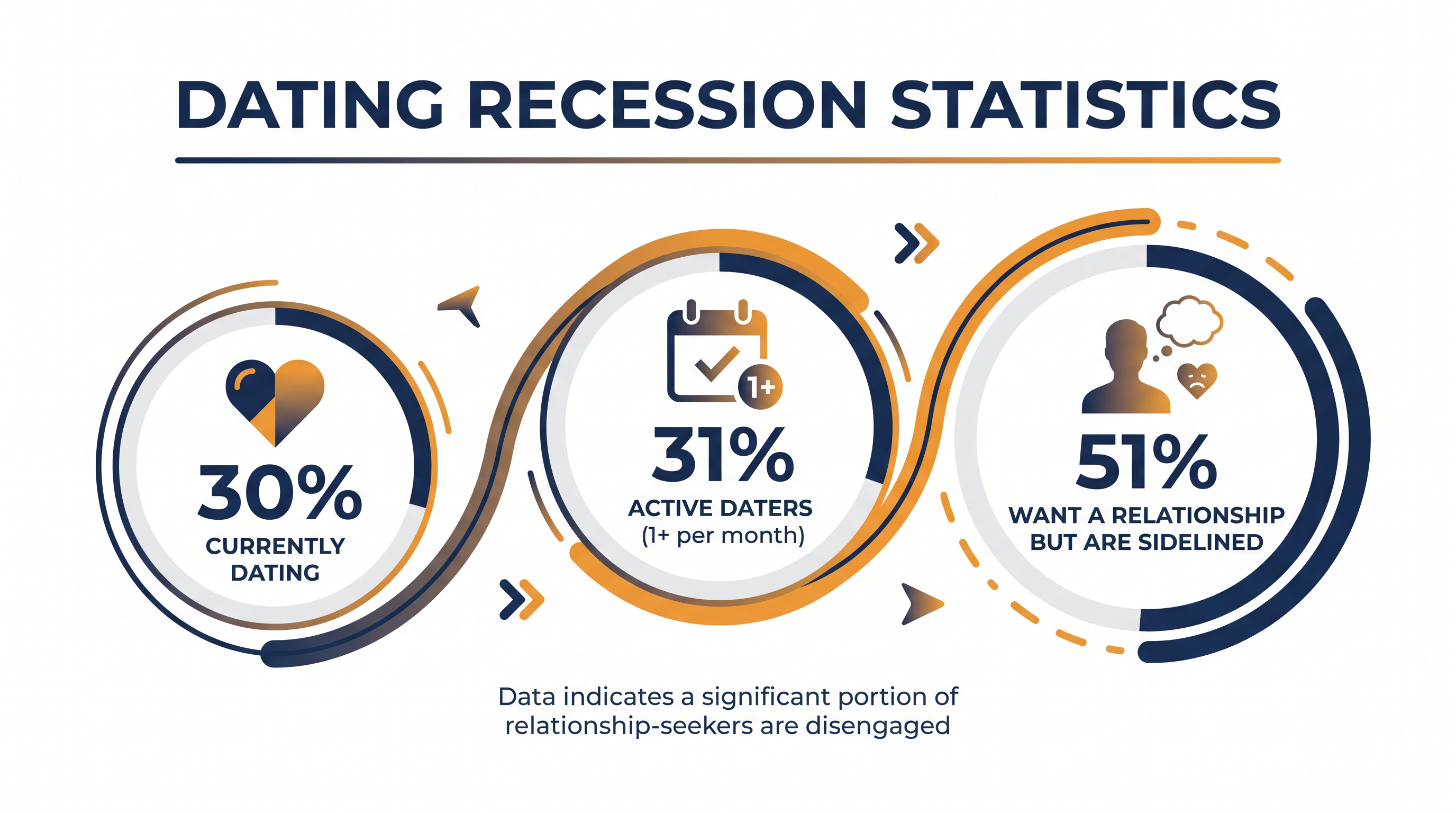
- Only 30% of young adults aged 22 to 35 are currently dating, marking a widespread 'dating recession.'
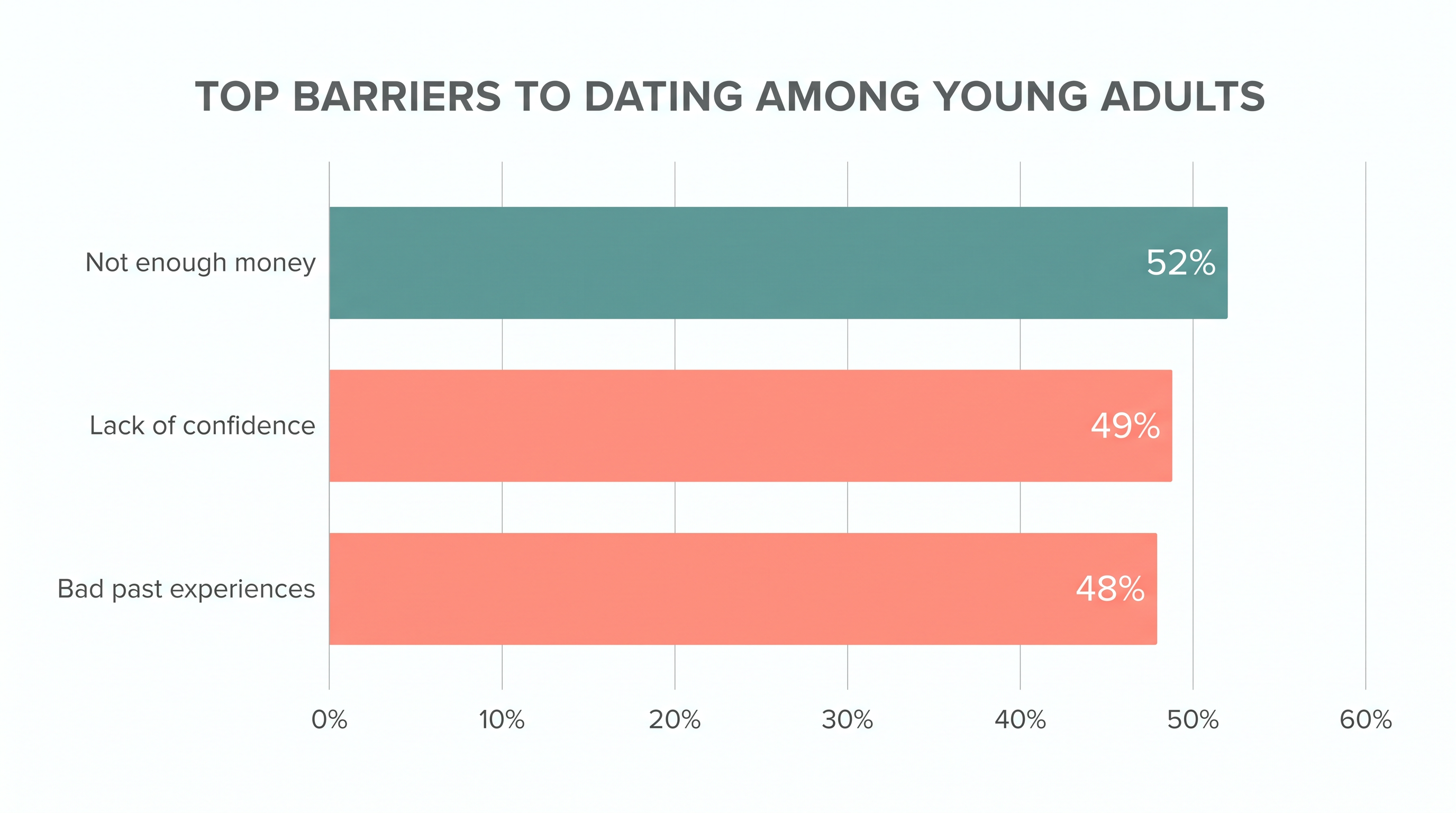
- A staggering 52% of respondents cite a lack of money as their primary barrier to entering the dating pool.
- Despite the decline in dating, 51% of single young adults still actively desire a long-term relationship.
- The average cost of a date has surged to $189, turning the search for a partner into a luxury expense.
- Experts are calling for 'dating education' and a cultural shift toward low-cost, low-pressure first dates to reverse the trend.
The cultural narrative often paints modern young adults as hyper-individualistic, terminally online, and largely uninterested in traditional romance. But new data reveals a vastly different reality: the rising generation desperately wants connection, but they simply feel they cannot afford the modern mechanics of finding it. A perfect storm of economic pressure, app-induced fatigue, and social burnout has fundamentally altered how people in their twenties and thirties approach courtship. According to the landmark "State of Our Unions 2026" report, released jointly by the Institute for Family Studies and the Wheatley Institute, the United States has entered a profound "dating recession."[1][2]
The comprehensive study, which surveyed over 5,200 unmarried adults between the ages of 22 and 35, paints a stark picture of a demographic that is retreating from the romantic marketplace en masse. The hard numbers from the report illustrate the depth of this withdrawal. Currently, only 30 percent of young adults report that they are dating, either casually or exclusively. Even more striking, a mere 31 percent qualify as "active daters," which researchers define as going on at least one date per month. For comparison, just over a decade ago, more than half of young adults dated regularly.[1][2][3]
Crucially, this retreat is not driven by a lack of desire for companionship. The survey data shows that 51 percent of these single young adults actively want to start a relationship. Furthermore, the vast majority of respondents still view dating as the primary and most effective pathway to long-term commitment and marriage. They want to participate, but they are stuck on the sidelines, paralyzed by a system that no longer serves them. When researchers asked respondents what was keeping them from entering the dating pool, the most common answer was not a fear of commitment or a preference for independence.[1][2]
The primary barrier was entirely financial. The economic realities of the post-pandemic world have transformed dating from a casual social activity into a significant line item in a personal budget. Over half of the respondents—52 percent—explicitly cited "not having enough money" as their biggest barrier to dating. This financial anxiety is slightly more pronounced among men, at 58 percent, but it remains a major hurdle for 46 percent of women as well. Contemporary dating has become highly commercialized, and young adults simply feel they cannot afford the price of admission required to even begin searching for a partner.[1][2][3]
Industry analysts point out that the cost of a typical date has skyrocketed, making the financial barrier more daunting than ever. According to recent financial surveys tracking consumer behavior, the average cost of a date in 2026 has surged to $189, representing a 12.5 percent increase from the previous year. For a generation grappling with inflation, stagnant entry-level wages, and soaring housing costs, spending nearly two hundred dollars on a single evening with a stranger is increasingly viewed as an unjustifiable financial risk. The economics of romance have simply outpaced the earning power of the average young adult.[5]
Industry analysts point out that the cost of a typical date has skyrocketed, making the financial barrier more daunting than ever.
This exorbitant price tag is inextricably linked to the mechanics of modern dating apps. Because these platforms facilitate connections between strangers with no shared social context, first dates often require a "production-quality" environment—such as expensive dinners or upscale cocktail bars—to establish safety and signal value. The "vetting cost" of app culture has effectively turned the search for a partner into a luxury good. As a result, major dating platforms are reporting consecutive months of user decline, as singles experience diminishing returns and opt out of the expensive vetting cycle entirely.[5][6]
Beyond the wallet, the dating recession is heavily fueled by a severe deficit in social confidence and emotional exhaustion. Nearly half of the surveyed young adults, 49 percent, reported that a lack of confidence prevents them from dating. Only about one in three young adults expressed any real faith in their dating skills, highlighting a widespread anxiety about approaching potential partners and navigating the early stages of romance. Close behind this lack of confidence is the heavy weight of history, with 48 percent of respondents citing bad past dating experiences as a primary barrier to trying again.[1][2][4]
The volume-based nature of modern dating apps—characterized by ghosting, mismatched expectations, and superficial judgments—often leads to profound emotional burnout. The report highlights a critical lack of what researchers call "dating resilience." Only 28 percent of young adults feel they have the emotional bandwidth to stay positive after a bad date or a relationship setback. Furthermore, 55 percent admit that their past breakups have made them highly reluctant to begin new romantic relationships, creating a self-perpetuating cycle of avoidance that keeps them isolated despite their desire for connection.[1][2]
While internet discourse often frames modern dating as a bitter gender war, the data reveals remarkable similarity in the struggles of young men and women. Both demographics report feeling overwhelmed by the commercial expectations and the emotional vulnerability required to date today. In response to these findings, sociologists and relationship researchers are advocating for a new approach: "dating education." Experts suggest that the interpersonal skills required for romantic connection—such as initiating conversations, handling rejection gracefully, and communicating boundaries—should be treated as learned competencies rather than innate talents.[1][2][6]
Breaking the dating recession will also require a cultural pivot away from high-stakes, expensive first encounters. Analysts and relationship coaches are increasingly urging singles to normalize low-cost, low-pressure dates. Shifting the default first date from a $189 dinner to a $5 coffee or a walk in a public park could dramatically lower the barrier to entry. Ultimately, the dating recession is a rational response to an irrational market. By recognizing that the barriers to romance are largely structural and financial, young adults can reject the commercialization of courtship and return to more sustainable, authentic ways of connecting.[4][5]
How we got here
Early 2010s
Dating apps popularize high-volume, stranger-based matchmaking, shifting cultural norms away from organic community dating.
2020–2022
Pandemic lockdowns disrupt organic social gathering, heavily entrenching app-based dating as the default method for singles.
2023–2025
Inflation and the rising cost of living dramatically increase the financial burden of traditional 'production-quality' first dates.
February 2026
The 'State of Our Unions' report officially identifies the 'dating recession,' noting only 30% of young adults are actively dating.
Viewpoints in depth
Sociologists & Family Researchers
Researchers view the dating recession as a structural crisis that threatens future household formation and community health.
Sociologists argue that the decline in dating is not a temporary blip but a fundamental deficit in social connection. Without intervention—such as formal 'dating education' to build resilience and interpersonal skills—the long-term consequences will include lower marriage rates and increased isolation. They emphasize that young adults are not inherently anti-relationship, but rather lack the institutional support and social scaffolding that previous generations relied upon to meet partners.
Young Adult Singles
For those in the dating pool, the recession is a rational response to an unaffordable and emotionally exhausting landscape.
Singles report that the expectations of modern dating are simply out of reach. Between the financial pressure of $189 average dates and the psychological toll of app-based ghosting, many feel that stepping back is the only way to protect their peace and their bank accounts. For this demographic, opting out is less about giving up on love and more about refusing to participate in a system that feels rigged against their financial and emotional well-being.
Dating Industry Analysts
Market observers point to the commercialization of romance as the primary driver of the current dating fatigue.
Analysts note that the apps themselves have created a high-volume, high-cost vetting environment. As users experience diminishing returns on major platforms, the industry is seeing consecutive months of user decline. This is forcing a reckoning about how technology has monetized—and perhaps broken—the initial stages of courtship, prompting calls for platforms to pivot toward facilitating lower-stakes, community-based interactions.
What we don't know
- Whether the decline in dating app usage will lead to a resurgence in organic, community-based matchmaking.
- How the long-term decrease in dating frequency will ultimately impact marriage and birth rates over the next decade.
- If public or private institutions will successfully implement 'dating education' to rebuild social confidence among young adults.
Key terms
- Active Dater
- A demographic classification for individuals who go on at least one date per month.
- Dating Recession
- A widespread sociological trend characterized by a sharp decline in the number of young adults actively participating in the dating pool.
- Dating Resilience
- The psychological ability to remain optimistic and continue pursuing relationships after experiencing a bad date or a breakup.
- Vetting Cost
- The financial and emotional expenditure required to assess a stranger's suitability as a romantic partner, heavily amplified by modern dating apps.
Frequently asked
What exactly is the 'dating recession'?
It is a demographic trend identified in 2026 where a significant majority of young adults (ages 22-35) have stopped actively dating, despite still desiring long-term romantic relationships.
Why are young people opting out of dating?
The primary barrier is financial, with 52% of young adults stating they do not have enough money to date. Other major factors include a lack of social confidence and emotional burnout from past negative experiences.
How much does a typical date cost in 2026?
According to recent financial surveys, the average cost of a date has reached $189, driven by the expectation of 'production-quality' first impressions when meeting strangers from dating apps.
Is this trend different for men and women?
While men cite financial barriers slightly more often than women (58% vs. 46%), the overall decline in dating frequency and the lack of dating resilience are remarkably similar across both genders.
Sources
Source coverage
6 outlets
3 viewpoints surfaced






[1]Institute for Family StudiesSociologists & Family Researchers
State of Our Unions 2026: The Dating Recession
Read on Institute for Family Studies →[2]Wheatley InstituteSociologists & Family Researchers
State of Our Unions 2026: The Dating Recession
Read on Wheatley Institute →[3]USA HeraldYoung Adult Singles
A new 2026 report reveals that only 30% of young Americans are dating
Read on USA Herald →[4]Psychology TodayDating Industry Analysts
The Dating Recession: Why Young Adults Are Opting Out
Read on Psychology Today →[5]AisuruDating Industry Analysts
Only 31% of young adults date monthly. Half of single Americans say it's no longer worth the cost.
Read on Aisuru →[6]The Queen ZoneYoung Adult Singles
Dating doesn't just feel 'hard' right now; it feels like a whole second job
Read on The Queen Zone →
Every angle. Every day.
Get lifestyle stories with full source coverage and perspective breakdowns delivered to your inbox.