
The Mechanics of Student Loan Repayment: Navigating the SAVE Plan Expiration and Avoiding Default
With federal student loan defaults hitting a record 9.5 million, the legally mandated end of the SAVE plan has triggered a critical 90-day window for borrowers to select new repayment options.
By Factlen Editorial Team
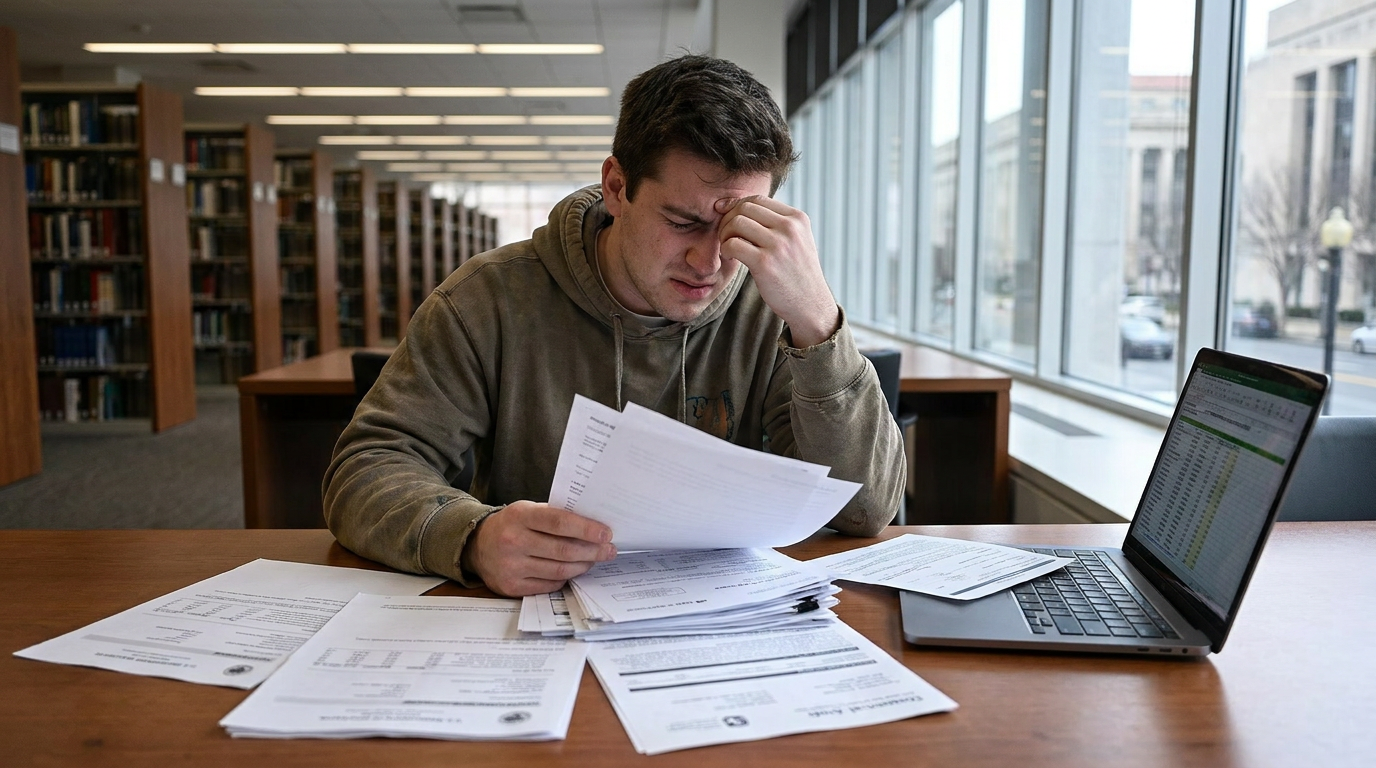
- Borrower Advocates
- Advocacy groups argue the transition places an unfair administrative and financial burden on vulnerable households.
- Financial Planners
- Wealth advisors focus on the mechanical reality of mitigating credit damage and tax liabilities.
- Fiscal Conservatives
- Legal and fiscal conservatives view the end of the SAVE plan as a necessary restoration of the rule of law.
What's not represented
- · Current College Students
- · Higher Education Administrators
Why this matters
With the legal termination of the SAVE plan, millions of borrowers have just 90 days to select a new repayment plan or face automatic enrollment in the costly Standard Plan. Understanding the new Repayment Assistance Plan (RAP) is essential to avoiding a default that could severely damage your credit score and housing prospects for up to seven years.
Key points
- Federal student loan defaults have surged to a record 9.5 million following the end of pandemic-era protections.
- A March 2026 court order officially terminated the SAVE plan, forcing millions of borrowers to find alternative repayment options.
- Borrowers are receiving notices starting July 1, 2026, giving them a 90-day window to select a new income-driven plan.
- Failure to choose a new plan will result in automatic enrollment in the Standard Plan, which typically carries much higher monthly payments.
- The new Repayment Assistance Plan (RAP) is now available, but borrowers must actively apply through StudentAid.gov.
The federal student loan system is undergoing its most turbulent transition in a decade, culminating in a record 9.5 million borrowers falling into default as of mid-2026. This surge means that roughly one in five federal borrowers is now more than 270 days behind on their payments, representing $233.3 billion in delinquent debt. The spike is the mathematical result of two colliding forces: the expiration of pandemic-era payment pauses and the sudden legal termination of the Biden administration's Saving on a Valuable Education (SAVE) plan.[1]
For millions of households, the transition has been marked by confusion and administrative whiplash. When the broader pandemic moratorium ended, the Department of Education instituted a 12-month "on-ramp" period that shielded missed payments from credit bureaus. That grace period expired in late 2025, starting a 270-day clock for borrowers who could not resume payments. Because federal student loans officially enter default after nine months of nonpayment, the first massive wave of post-pandemic defaults materialized in early to mid-2026.[2]
The financial consequences of crossing the 270-day threshold are severe. According to Liberty Street Economics, borrowers who recently defaulted saw their credit scores plummet by an average of 91 points, dropping from 567 to 473. This impairment effectively locks them out of the housing market, funnels them toward subprime auto loans, and even increases the cost of renter's insurance. Furthermore, defaulted borrowers face the looming threat of wage garnishment and the withholding of tax refunds, though the Treasury Department has temporarily delayed aggressive collection measures while the system stabilizes.[2]

The default crisis is highly concentrated geographically. An Associated Press analysis revealed that the highest default rates are disproportionately located in Southern and Appalachian states. Mississippi leads the nation with a 28.3 percent default rate, followed closely by Louisiana, Alabama, West Virginia, and Oklahoma. Financial advocates note that in these regions, the combination of lower median incomes and inflation has made the resumption of student loan bills particularly devastating.[2]
Compounding the crisis is the official demise of the SAVE plan, which had enrolled roughly 7.5 million borrowers by offering the lowest income-driven monthly payments in the program's history. Following a protracted legal battle led by a coalition of Republican attorneys general, a federal court entered a judgment in March 2026 that vacated the rules creating SAVE. The Department of Education, under the Trump administration, agreed to a settlement with the state of Missouri that accelerated the program's termination, pulling it off the books entirely.
Borrowers who were enrolled in SAVE were temporarily placed in an administrative forbearance, meaning their payments were paused and interest was waived. However, that protective holding pattern is now ending. Starting on July 1, 2026, federal loan servicers began sending notices to former SAVE participants, informing them that their forbearance is expiring. Once a borrower receives this official notification, a strict 90-day countdown begins.
This 90-day window is the most critical action period for affected borrowers. Within this timeframe, individuals must log into their federal student aid portals and actively select a new repayment plan. The Department of Education has warned that borrowers who fail to make a selection before the clock runs out will be automatically enrolled in the Standard Repayment Plan or the new Tiered Standard Plan.[3]

This 90-day window is the most critical action period for affected borrowers.
Defaulting to the Standard Plan is a dangerous trap for those already struggling financially. Unlike income-driven options, the Standard Plan calculates monthly bills based purely on the total loan balance and interest rate, amortized over a fixed 10-year period. For a borrower who was paying $50 a month under SAVE based on their income, the automatic switch to the Standard Plan could suddenly result in a $400 or $500 monthly bill, drastically increasing the likelihood of delinquency.
To avoid this shock, borrowers must navigate a newly restructured menu of income-driven options. The centerpiece of the 2026 landscape is the Repayment Assistance Plan (RAP), which officially became available on July 1. RAP is designed to replace the sunsetting SAVE, Pay As You Earn (PAYE), and Income-Contingent Repayment (ICR) plans. While RAP offers a safety net by capping payments at a percentage of discretionary income, financial planners note its terms are generally less generous than the defunct SAVE program.
Borrowers with older loans also have the option to enroll in the updated Income-Based Repayment (IBR) plan. However, the rules have been bifurcated: IBR is only available for loans disbursed prior to July 1, 2026. Anyone taking out new federal student loans for the 2026–2027 academic year and beyond will be restricted entirely to the RAP or the Standard Plan. This simplification of the menu was intended to reduce borrower confusion, but the transition period requires careful calculation to determine which legacy plan yields the lowest monthly obligation.
Beyond the immediate monthly payment shock, borrowers must also prepare for a resurrected "tax bomb" on forgiven debt. Under the American Rescue Plan Act of 2021, student loan forgiveness was temporarily excluded from federal taxable income. That provision expired at the end of 2025 and was not renewed. Consequently, borrowers who eventually reach the 20- or 25-year forgiveness finish line under RAP or IBR will likely have the canceled balance treated as taxable income by the IRS, requiring proactive tax planning.

The regulatory overhaul also introduces strict new borrowing limits that will reshape how families finance graduate education. Under the new rules, the definitions of "professional" and "graduate" students have been narrowed. Many master's degree candidates—such as those pursuing MBAs or Master of Education degrees—are now capped at $20,500 annually, losing access to the higher $50,000 limits reserved for a select group of doctoral programs.
For the 9.5 million Americans already in default, the immediate priority is utilizing the government's remaining rehabilitation programs to pull their loans back into good standing before aggressive collections resume. For the millions more currently exiting the SAVE forbearance, the mandate is clear: ignoring the servicer notices is no longer an option. Actively selecting a sustainable repayment plan within the 90-day window is the only guaranteed mechanism to protect credit scores, avoid the Standard Plan payment shock, and maintain long-term financial stability.[2][3]
The transition also carries significant implications for those pursuing Public Service Loan Forgiveness (PSLF). During the SAVE administrative forbearance, the months of paused payments did not count toward the 120 qualifying payments required for PSLF. Borrowers working in government or nonprofit sectors who want to resume their progress toward forgiveness must transition to RAP or IBR immediately, as lingering in forbearance only delays their eventual debt cancellation.
Executing the switch requires borrowers to log into their StudentAid.gov accounts and use the Federal Student Aid Loan Simulator. This tool allows users to input their current income, family size, and tax filing status to run a side-by-side comparison of the RAP, IBR, and Standard plans. Financial counselors emphasize that borrowers should update their income information accurately, as a recent drop in earnings could qualify them for a $0 monthly payment under the new IDR frameworks, keeping them out of default legally and safely.[3]
How we got here
June 2023
The Supreme Court strikes down the initial mass debt cancellation, leading to the creation of the SAVE plan.
October 2023
Federal student loan payments officially resume after a three-year pandemic pause.
September 2024
The 12-month 'on-ramp' period ends, allowing missed payments to be reported to credit bureaus.
March 2026
A federal court order officially terminates the SAVE plan following a settlement with Missouri.
July 2026
Servicers begin issuing 90-day notices to former SAVE borrowers to select a new repayment plan.
Viewpoints in depth
Borrower Advocates
Advocacy groups argue the transition places an unfair administrative and financial burden on vulnerable households.
Organizations representing student debtors emphasize that the whiplash of moving from the pandemic pause to the SAVE plan, and now to the RAP plan, has set borrowers up to fail. They point to the 9.5 million defaults as evidence that the system is structurally broken, arguing that the 90-day auto-enrollment into the Standard Plan will push millions more into financial distress simply because they missed an email or misunderstood the complex new rules.
Fiscal Conservatives
Legal and fiscal conservatives view the end of the SAVE plan as a necessary restoration of the rule of law.
Critics of the Biden-era debt relief efforts argue that the SAVE plan was an unconstitutional executive overreach designed to bypass Congress. By successfully suing to terminate the program, these groups assert they have protected taxpayers from subsidizing hundreds of billions of dollars in backdoor loan forgiveness, returning the system to standard repayment contracts that borrowers originally agreed to when taking out the debt.
Financial Planners
Wealth advisors focus on the mechanical reality of mitigating credit damage and tax liabilities.
For financial professionals, the ideological battle over student debt is secondary to the immediate mechanical risks. They are urgently advising clients to run the math on the new RAP plan versus legacy IBR options. Furthermore, planners are sounding the alarm on the expiration of the ARPA tax exclusion, warning that borrowers must start saving now for the 'tax bomb' that will hit when their remaining balances are eventually forgiven under income-driven plans.
What we don't know
- It remains unclear if the Treasury Department will resume aggressive wage garnishments for defaulted borrowers in late 2026.
- The exact number of borrowers who will successfully navigate the 90-day transition window without falling into the Standard Plan trap is unknown.
Key terms
- Default
- The status of a federal student loan when a borrower fails to make a payment for 270 days, triggering severe collection actions and credit damage.
- Repayment Assistance Plan (RAP)
- The new income-driven repayment plan introduced in 2026 to replace the sunsetting SAVE, PAYE, and ICR programs.
- Standard Repayment Plan
- A fixed repayment schedule that divides the total loan balance into equal monthly payments over 10 years, regardless of the borrower's income.
- Administrative Forbearance
- A temporary pause on loan payments and interest accumulation initiated by the Department of Education, often during legal or administrative transitions.
Frequently asked
What happens if I don't pick a new repayment plan?
If you do not select a new plan within 90 days of receiving your notice, you will be automatically enrolled in the Standard Plan, which often has much higher monthly payments.
Is student loan forgiveness still tax-free?
No. The temporary tax exemption expired at the end of 2025, meaning future forgiveness under income-driven plans may be treated as taxable income.
Do the months in SAVE forbearance count toward PSLF?
No. The Department of Education has stated that the administrative forbearance period for the SAVE plan does not count toward the 120 payments required for Public Service Loan Forgiveness.
How much does a student loan default affect my credit score?
According to Liberty Street Economics, borrowers who recently defaulted saw their credit scores drop by an average of 91 points.
Sources
Source coverage
3 outlets
3 viewpoints surfaced



[1]PLANSPONSORFinancial Planners
Defaults on Student Loans Reach Record High
Read on PLANSPONSOR →[2]PBSBorrower Advocates
A wave of student loan borrowers have entered default since pandemic-era protections lapsed
Read on PBS →[3]StudentAid.govFinancial Planners
SAVE Plan Court Actions and Next Steps for Borrowers
Read on StudentAid.gov →
Every angle. Every day.
Get finance stories with full source coverage and perspective breakdowns delivered to your inbox.