
The Mandatory Durability Label: How the EU's New Guarantee Standard Will Force Manufacturers to Grade Product Lifespan at the Point of Sale
Starting September 2026, the European Union will require retailers to display standardized durability labels and guarantee notices at the point of sale, ending vague 'built to last' marketing and empowering consumers to choose longer-lasting products.
By Factlen Editorial Team
- Consumer Protection Advocates
- Groups arguing that standardized labels end deceptive marketing and empower shoppers.
- Compliance & Legal Experts
- Analysts focused on the operational challenges for retailers updating their storefronts.
- European Regulators
- Policymakers aiming to transition the EU to a circular economy by mandating transparency.
- Sustainable Manufacturers
- High-quality producers who welcome the rules as a competitive advantage.
What's not represented
- · Non-EU manufacturers navigating import compliance
- · Small retailers facing the cost of updating physical store displays
Why this matters
For decades, shoppers have had to guess how long an appliance or gadget would actually last based on marketing buzzwords. This new visual standard forces manufacturers to put their money where their mouth is, making product lifespan a transparent, competitive feature rather than hidden fine print.
Key points
- The EU is introducing a standardized 'GARAN' durability label for products guaranteed to last longer than two years.
- Retailers must also display a mandatory notice reminding shoppers of their baseline two-year legal guarantee.
- Vague marketing claims like 'built to last' or 'eco-friendly' are banned unless backed by concrete guarantees.
- The rules apply equally to physical stores and e-commerce platforms.
- The directive aims to combat planned obsolescence and save consumers an estimated €20 billion by 2030.
The era of vague "built to last" marketing is officially coming to an end in Europe. Starting September 27, 2026, the European Union will enforce a sweeping new visual compliance standard that forces manufacturers to explicitly grade the lifespan of their products at the point of sale.[1][4]
Driven by the Empowering Consumers for the Green Transition (ECGT) Directive, the new rules introduce a highly prescriptive labeling regime designed to combat planned obsolescence and greenwashing. The centerpiece of this initiative is the "GARAN" label—a standardized, harmonized commercial guarantee of durability that manufacturers must use if they want to market a product's longevity.[1][2][5][6]
For decades, shoppers have navigated a minefield of unsubstantiated claims. A winter jacket might be labeled "eco-friendly" or a washing machine "ultra-durable" without any binding commitment from the brand. Under the new directive, advertising a product as durable without offering a concrete commercial guarantee of repair or replacement is strictly prohibited.[5][6]

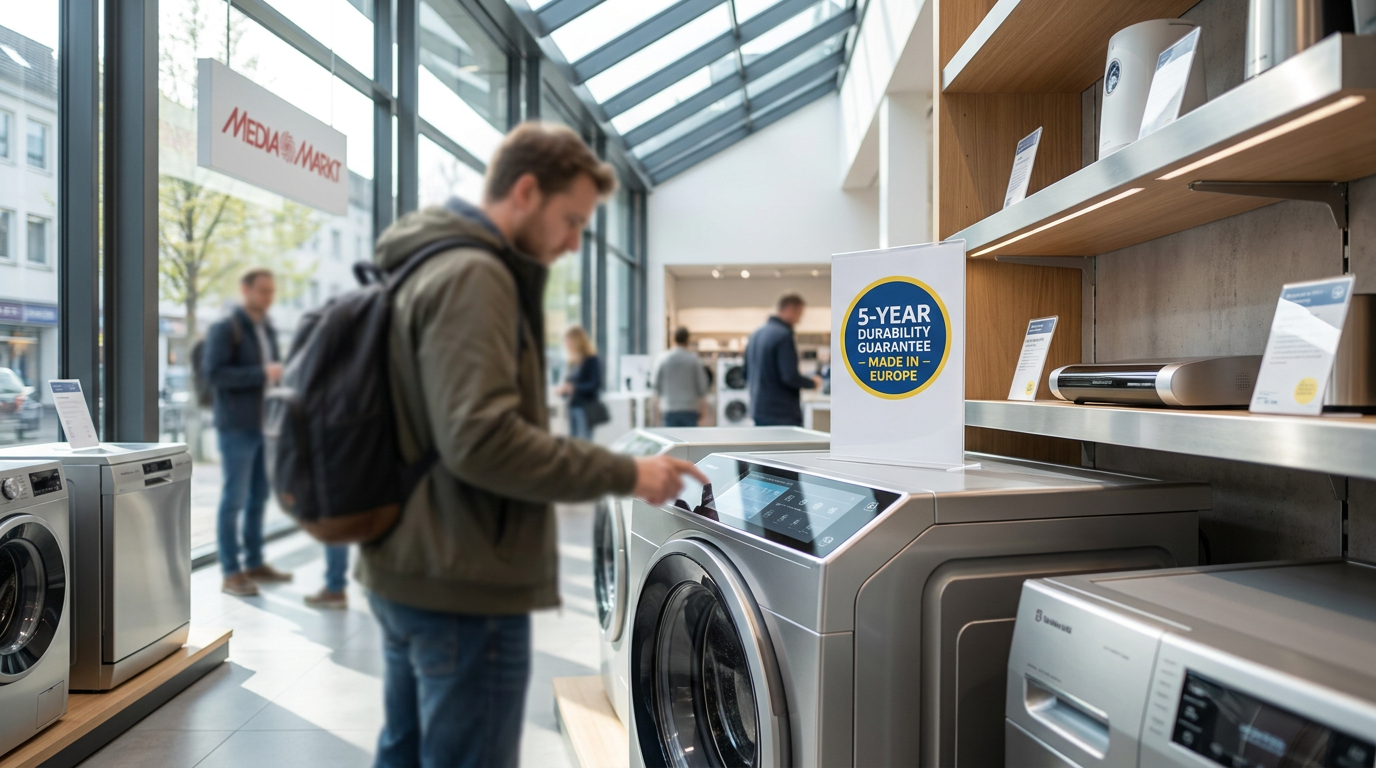
The GARAN label is entirely voluntary to adopt, but its format is mandatory for any brand offering a commercial durability guarantee exceeding two years. The European Commission has mandated a strict design: a specific Pantone Reflex Blue and Yellow color scheme, a calendar symbol denoting the exact number of guaranteed years, and a QR code linking to the "Your Europe" consumer rights portal.[1][2][4]
Legal experts note that this represents a massive shift for multi-market product catalogs. Businesses can no longer satisfy the law with "house-style" graphics or buried terms and conditions. The label must be displayed prominently—either directly on the packaging, on the store shelf, or immediately visible upon the first click or roll-over in an online shopping cart.[4]
Legal experts note that this represents a massive shift for multi-market product catalogs.
Alongside the voluntary GARAN label, the EU is introducing a mandatory "harmonised notice" that must be displayed in all retail environments, both physical and digital. This standardized A4-minimum poster or digital banner serves as a universal reminder that all products sold in the EU carry a minimum two-year legal guarantee of conformity.[1][2][3]

The mandatory notice is designed to stop a common deceptive practice: marketing the legally required two-year warranty as a "unique" or "special" feature. By standardizing the baseline, the EU hopes to stimulate genuine competition among manufacturers to offer superior, longer-lasting goods.[1][3][6]
The financial stakes are significant. The European Commission estimates that extending product lifespans and reducing electronic waste could save citizens approximately €20 billion by 2030. By making durability a highly visible, standardized metric, the market will naturally reward companies that invest in quality over those relying on a throwaway model.[6][7]
Compliance teams and testing laboratories are already bracing for the September 2026 deadline. Brands must review their entire product information pipelines, ensuring that packaging, online listings, and point-of-sale materials align perfectly with the new regulations. A visually compliant GARAN label accompanied by unsupported guarantee terms would immediately trigger regulatory penalties.[2][3][4]

The durability label is just one pillar of a broader European strategy that includes the Ecodesign for Sustainable Products Regulation (ESPR) and the upcoming Digital Product Passport. Together, these initiatives are systematically dismantling the economic incentives for planned obsolescence.[6][7]
For consumers, the shift means an end to the guesswork. Whether buying a smartphone, a winter coat, or a kitchen appliance, shoppers will be able to instantly compare the guaranteed lifespan of competing products. The GARAN label transforms durability from a marketing buzzword into a binding, measurable contract at the exact moment of purchase.[4][5][6]
How we got here
March 2024
The Empowering Consumers for the Green Transition Directive enters into force.
September 2025
The European Commission adopts the specific design and content rules for the harmonised labels.
March 2026
Deadline for EU member states to transpose the directive into national law.
September 27, 2026
The new visual compliance rules and greenwashing bans become fully enforceable.
Viewpoints in depth
European Regulators
Policymakers aiming to transition the EU to a circular economy by mandating transparency.
EU officials view the durability label as a critical mechanism for achieving the broader European Green Deal. By standardizing how product lifespan is communicated, regulators hope to correct a market failure where consumers lack the information needed to reward sustainable engineering. The ultimate goal is to systematically dismantle the economic incentives for the throwaway model, reducing electronic waste and resource consumption across the continent.
Consumer Protection Advocates
Groups arguing that standardized labels end deceptive marketing and empower shoppers.
Consumer groups argue that for too long, the burden of verifying product quality has fallen on the buyer. By forcing brands to use a standardized visual language, the GARAN label eliminates the confusion caused by proprietary 'eco-icons' and vague marketing copy. Advocates believe this transparency will naturally drive the market toward higher-quality goods, as consumers can instantly calculate the long-term value of their purchases.
Compliance & Legal Experts
Analysts focused on the operational challenges for retailers updating their storefronts.
Legal analysts warn that the transition will not be simple. Because the EU has mandated exact Pantone colors, minimum physical sizes, and specific digital nesting behaviors, brands cannot simply update their terms and conditions. Every piece of packaging, point-of-sale display, and e-commerce product page must be audited. Experts note that a visually compliant label paired with unsupported backend guarantee terms will immediately trigger regulatory penalties.
Sustainable Manufacturers
High-quality producers who welcome the rules as a competitive advantage.
Companies that already invest heavily in durable materials and repairable designs see the new directive as a long-overdue leveling of the playing field. Previously, cheap competitors could use the same 'long-lasting' buzzwords without the engineering to back it up. The GARAN label provides sustainable brands with a government-backed, instantly recognizable badge that justifies higher upfront price points by proving long-term value.
What we don't know
- How strictly national authorities will enforce the new rules on smaller e-commerce platforms.
- Whether the standardized label will significantly alter consumer purchasing habits in price-sensitive categories like fast fashion.
Key terms
- GARAN Label
- The EU's harmonised label for commercial guarantees of durability, indicating a product is guaranteed for more than two years.
- Harmonised Notice
- A mandatory standardized display reminding consumers of their baseline two-year legal right to repair or replacement.
- Greenwashing
- The deceptive practice of making unsubstantiated or misleading claims about a product's environmental benefits or durability.
- Planned Obsolescence
- The practice of designing products to fail or become outdated quickly to force repeat purchases.
- Empowering Consumers Directive (EmpCo)
- The EU law updating consumer rights to ensure transparent information regarding product lifespan and sustainability.
Frequently asked
Is the new durability label mandatory for all products?
No. The GARAN label is voluntary, but its standardized format is mandatory if a manufacturer chooses to offer a commercial durability guarantee longer than two years.
What happens if a brand claims a product is 'built to last' without the label?
Under the new rules, vague durability claims are banned unless backed by a concrete commercial guarantee or a recognized third-party certification.
Does this apply to online shopping?
Yes. E-commerce sites must display the harmonised notice and use the specific digital format for the GARAN label upon the first click or roll-over.
When do these rules take effect?
The regulations become fully enforceable across all EU member states on September 27, 2026.
Sources
Source coverage
7 outlets
4 viewpoints surfaced





[1]European CommissionEuropean Regulators
Commission Implementing Regulation (EU) 2025/1960 on the design and content of the harmonised notice and label
Read on European Commission →[2]Bureau VeritasCompliance & Legal Experts
Summary of Commission Implementing Regulation (EU) 2025/1960
Read on Bureau Veritas →[3]UL SolutionsCompliance & Legal Experts
Consumer Products: EC Publishes Notices and Labels to Raise Consumer Rights Awareness
Read on UL Solutions →[4]Bird & BirdCompliance & Legal Experts
A new visual compliance layer for product sales in the EU
Read on Bird & Bird →[5]CarbonfactSustainable Manufacturers
EU Empowering Consumers Directive: What Apparel Brands Need to Know
Read on Carbonfact →[6]SustenutoConsumer Protection Advocates
The Empowering Consumers Directive (EmpCo) explained
Read on Sustenuto →[7]EcoPVConsumer Protection Advocates
EU Ecodesign Regulation and the Repairability Index
Read on EcoPV →

Every angle. Every day.
Get shopping stories with full source coverage and perspective breakdowns delivered to your inbox.