
Arab Gulf States Face Pressure to Fund $300 Billion Iranian Reconstruction Under Ceasefire Deal
A newly signed U.S.-Iran ceasefire framework relies on Arab Gulf states to finance a massive $300 billion reconstruction fund for Tehran, sparking deep frustration among regional allies who suffered billions in damages during the conflict.
By Factlen Editorial Team
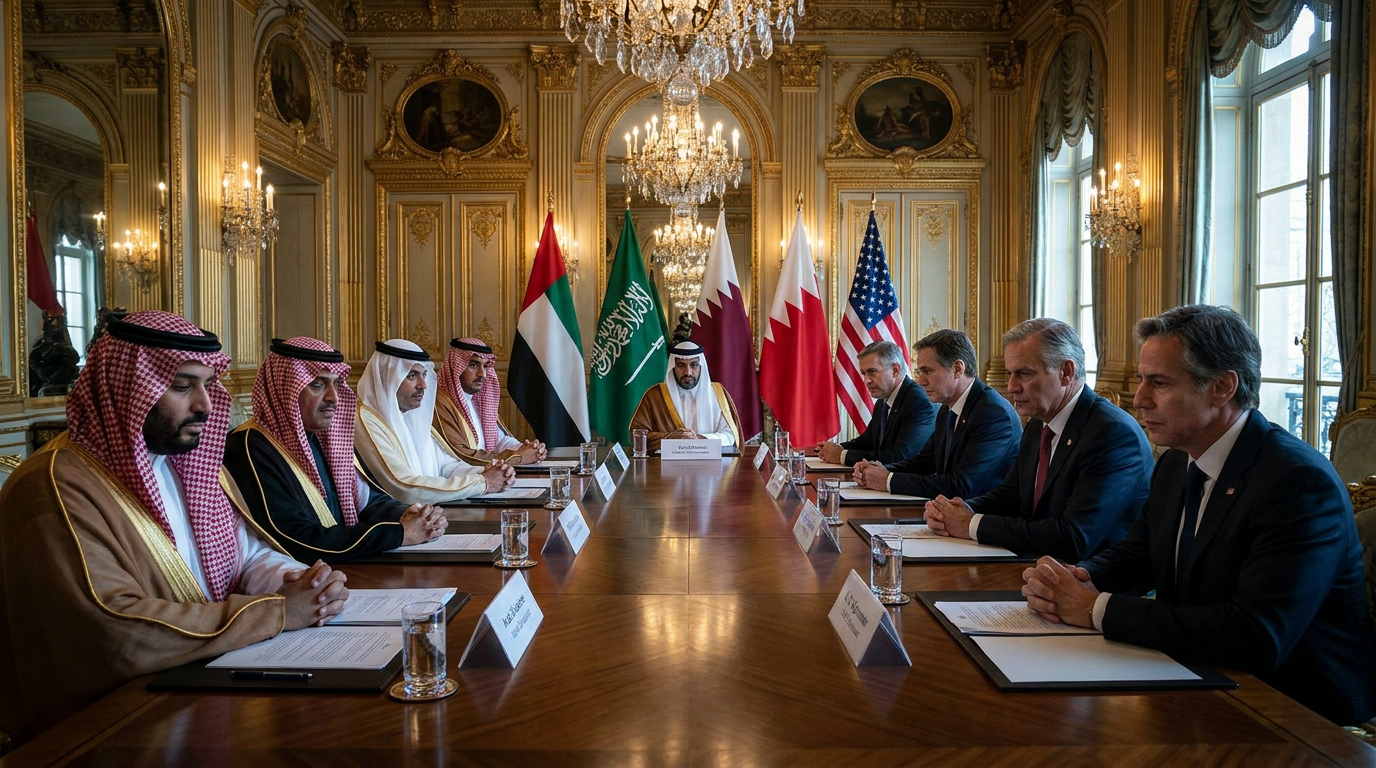
- Arab Gulf States
- Views the mandate as an unfair financial burden that forces them to subsidize the recovery of a hostile neighbor after suffering unprovoked collateral damage.
- U.S. Administration
- Argues the reconstruction fund is a necessary, non-U.S.-taxpayer-funded mechanism to secure Iranian compliance and long-term regional peace.
- Regional Security Analysts
- Warns that the rapid influx of capital and sanctions relief could embolden Tehran's proxy networks and permanently alter the Middle East's balance of power.
What's not represented
- · Iranian civilian population
- · European energy importers
Why this matters
The financial terms of the U.S.-Iran ceasefire are fundamentally reshaping Middle Eastern alliances. By forcing Gulf states to pay for the recovery of a hostile neighbor, the agreement risks alienating America's closest regional partners and injecting massive capital into Iranian proxy networks.
Key points
- The U.S.-Iran ceasefire agreement mandates a $300 billion reconstruction fund for Iran.
- The Trump administration insists U.S. taxpayers will not contribute, shifting the cost to Arab Gulf states.
- Gulf nations are frustrated, having already suffered $25 billion in damages from Iranian retaliatory strikes.
- U.S. diplomats are touring the Gulf to reassure skeptical allies and secure financial commitments.
- Security experts warn the massive capital influx could embolden Tehran's proxy networks.
- The financing mechanism must be finalized within a strict 60-day transitional window.
The newly signed ceasefire framework between the United States and Iran has exposed a deepening and bitter rift between Washington and its traditional Arab Gulf allies, who are now facing intense diplomatic pressure to finance a massive $300 billion reconstruction fund for Tehran. The mandate, embedded within the peace agreement that halted months of devastating regional warfare, has stunned leaders in Riyadh, Abu Dhabi, and Doha. For decades, these nations have relied on an unwritten strategic pact with the United States for their ultimate security. Now, they find themselves squeezed between the demands of their primary military guarantor and the reality of an emboldened Iranian neighbor. The diplomatic fallout threatens to permanently alter the balance of power and the architecture of alliances across the Middle East, as Gulf capitals weigh the staggering cost of underwriting the recovery of a state they view as their primary geopolitical adversary.[1][3][6]
The controversy centers on Point 6 of the 14-point Memorandum of Understanding (MoU) signed electronically by U.S. and Iranian leadership at the Palace of Versailles. The document explicitly commits the United States and its "regional partners" to develop a definitive, mutually agreed economic recovery plan for the Islamic Republic worth a minimum of $300 billion. The mechanism for this unprecedented wealth transfer must be finalized within a strict 60-day transitional window. While the agreement halts military operations across multiple theaters and lifts the American naval blockade of Iranian ports, it leaves the specifics of the financial burden intentionally vague in the text. However, subsequent statements from Washington have made it abundantly clear exactly who is expected to provide the capital, transforming a theoretical reconstruction framework into an immediate diplomatic crisis for the wealthy energy-producing nations of the Arabian Peninsula.[1][4][5]
The Trump administration has moved aggressively to distance American taxpayers from any financial responsibility for rebuilding the Iranian infrastructure destroyed during the conflict. President Donald Trump publicly dismissed reports of direct U.S. payments as "Fake News," insisting that the agreement serves American interests by lowering global oil prices without draining the national treasury. Vice President JD Vance was even more explicit, confirming in broadcast interviews that the capital would be sourced from a "Gulf coast coalition" alongside private equity vehicles eager to access Iran's massive, newly reopened energy markets. By structuring the $300 billion package as a regional and private-sector obligation, the White House has effectively shifted the multi-trillion-dollar costs of post-war stabilization onto the shoulders of regional actors, framing the payment as a necessary and fair trade for securing long-term peace in their immediate neighborhood.[1][6][7]

For the Gulf states, the mandate has landed as a profound betrayal, compounding the deep frustrations that accumulated over the course of the conflict. Throughout the months-long war, nations like Saudi Arabia, the United Arab Emirates, and Qatar explicitly denied Washington the use of their sovereign airspace and territory for offensive strikes against Iran, desperate to avoid being dragged into a direct confrontation. Despite these clear refusals, the United States utilized its sprawling network of regional bases anyway to project power and launch sorties. That operational decision drew immediate and devastating Iranian retaliation. In a matter of days, Iranian ballistic missiles and suicide drones struck targets across 11 regional countries, demonstrating Tehran's reach and its willingness to hold its neighbors accountable for American military actions launched from their soil.[3][6]
For the Gulf states, the mandate has landed as a profound betrayal, compounding the deep frustrations that accumulated over the course of the conflict.
The economic toll of that collateral damage was staggering, making the current demands for reconstruction funding particularly difficult for Gulf populations to swallow. Iranian retaliatory strikes successfully targeted critical civilian and energy infrastructure, including desalination plants and Saudi Arabia's largest oil refinery. Production was abruptly halted, and vital energy exports were stalled for weeks. Financial analysts estimate that the economic losses across Saudi Arabia, the United Arab Emirates, and Qatar reached a staggering $25 billion in the month of March alone. Now, having absorbed these heavy direct and indirect hits, these same nations are being coerced into subsidizing the recovery of the very state that attacked them. As one regional security analysis noted, the Gulf states have become the involuntary financiers of Iran's rehabilitation, paying the price for an American security framework that ultimately failed to protect them from the crossfire.[4][6]

Recognizing the severe strain this dynamic has placed on America's most critical Middle Eastern alliances, the State Department has launched an emergency diplomatic intervention. U.S. diplomats embarked on a rapid, high-stakes tour of the United Arab Emirates, Kuwait, and Bahrain this week. The mission was explicitly designed to reassure deeply skeptical allies and secure their commitment to the MoU's financial mechanisms before the 60-day window expires. U.S. officials and their counterparts issued joint statements reaffirming that reopening the Strait of Hormuz to free and unrestricted navigation remains essential to global security, while acknowledging that lasting peace requires addressing the full spectrum of Tehran's capabilities. However, behind closed doors, Gulf officials have reportedly expressed intense frustration that they are being treated as an endless source of capital to solve a crisis they actively tried to prevent.[4][5]
Beyond the immediate financial sting of the $300 billion price tag, Gulf capitals and regional security analysts harbor deep strategic anxieties about the broader concessions embedded within the Versailles framework. The agreement provides massive, front-loaded economic benefits to Tehran, including the termination of broad categories of U.S. sanctions, the immediate easing of restrictions on Iranian crude and petroleum exports, and access to tens of billions of dollars in previously frozen overseas assets. Experts warn that this rapid influx of unrestricted capital will inevitably empower the Islamic Revolutionary Guard Corps (IRGC) and its sprawling network of proxy militias. There is a well-founded fear across the region that the financial terms of the ceasefire will simply resupply and reinforce the very asymmetric threats the war was ostensibly meant to neutralize, leaving the Gulf states more vulnerable than before.[2][4][5]
The structural implications of the agreement extend far beyond the financial ledger, fundamentally altering the geopolitical architecture of the Middle East. The framework leaves Iran's institutional claims over the vital Strait of Hormuz largely intact, requiring future administration of the waterway to be negotiated directly with Oman and the Gulf states rather than asserting international control. Furthermore, the MoU controversially couples the U.S.-Iran truce directly with a ceasefire in Lebanon, implicitly legitimizing Tehran's proxy meddling in Lebanese state affairs and granting Iran a recognized role in shaping outcomes on Israel's northern border. For the Gulf states, these provisions signal a broader American retreat from its traditional role as the unquestioned guarantor of regional security, forcing them to recalibrate their foreign policies and prepare for a multipolar environment where they must manage a newly enriched and defiant Iran largely on their own.[3][4]

As the 60-day negotiating window ticks down, the Gulf states face a stark and highly uncomfortable geopolitical calculus. While they are deeply reluctant to fund the $300 billion reconstruction package and resent the coercive nature of Washington's demands, their domestic economies and populations cannot easily absorb a return to open hostilities. The temporary pause in fighting has allowed vital energy exports to resume and maritime traffic to slowly return to the Strait of Hormuz, providing a desperately needed economic lifeline. Ultimately, leaders in Riyadh, Abu Dhabi, and Doha must decide whether to quietly underwrite their adversary's rehabilitation as the unavoidable price of de-escalation, or push back against the American mandate and risk collapsing a fragile peace that currently holds the entire region hostage.[2][4][6]
How we got here
Early 2026
U.S. launches military operations against Iran using bases in the Arab Gulf, despite objections from host nations.
March 2026
Iran retaliates by striking infrastructure across 11 regional countries, causing an estimated $25 billion in damages to Gulf states.
June 17, 2026
The U.S. and Iran sign a 14-point ceasefire Memorandum of Understanding at the Palace of Versailles.
Late June 2026
Details emerge that Point 6 of the MoU requires regional partners to fund a $300 billion reconstruction plan for Iran.
Late June 2026
U.S. diplomats tour the UAE, Kuwait, and Bahrain to manage diplomatic fallout from the funding mandate.
Viewpoints in depth
The U.S. Administration's Calculus
Washington views Gulf financing as a pragmatic solution to secure peace without burdening American taxpayers.
For the Trump administration, the $300 billion fund represents a diplomatic victory that shifts the financial burden of post-war stabilization onto regional actors who have a vested interest in a quiet neighborhood. By structuring the package around private equity and Gulf state contributions, the White House avoids the domestic political toxicity of sending American tax dollars to Tehran. Officials argue that this massive economic incentive is the only viable lever to ensure Iran dismantles its nuclear program and adheres to the ceasefire terms over the long haul.
The Gulf States' Dilemma
Regional partners feel abandoned by Washington and coerced into paying reparations to an adversary.
Leaders in Riyadh, Abu Dhabi, and Doha view the arrangement as a profound betrayal of their decades-old security pact with the United States. Having suffered billions in infrastructure damage and lost oil revenue due to Iranian retaliatory strikes—strikes provoked by U.S. military operations launched from Gulf bases against their wishes—they are now being asked to foot the bill for Iran's recovery. This dynamic has accelerated a strategic recalibration in the Gulf, with nations increasingly questioning the reliability of the American security umbrella and exploring more independent foreign policies.
Security Analysts' Warnings
Experts caution that the deal's financial terms may inadvertently fund future regional instability.
Defense analysts and regional observers are raising alarms over the structural implications of the Memorandum of Understanding. They point out that while the agreement defers action on Iran's nuclear program and ballistic missile arsenal, it provides immediate, front-loaded sanctions relief and access to frozen assets. The concern is that a $300 billion capital injection will not just rebuild civilian infrastructure, but will inevitably flow into the coffers of the Islamic Revolutionary Guard Corps (IRGC) and its network of proxy militias across Lebanon, Syria, and Yemen, effectively subsidizing the very threats the war aimed to eliminate.
What we don't know
- Whether the Gulf states will ultimately agree to fully fund the $300 billion package or attempt to renegotiate the terms.
- How the reconstruction funds will be monitored to ensure they are not diverted to Iran's military or proxy networks.
- What specific consequences will follow if the 60-day window expires without a finalized financing mechanism.
Key terms
- Memorandum of Understanding (MoU)
- A formal agreement outlining the terms of the ceasefire between the U.S. and Iran, including sanctions relief and the reconstruction fund.
- Strait of Hormuz
- A critical maritime chokepoint between the Persian Gulf and the Gulf of Oman through which roughly one-fifth of the world's oil supply passes.
- Sanctions Relief
- The lifting of economic restrictions previously placed on Iran by the U.S., allowing Tehran to resume international trade and oil exports.
Frequently asked
Why is the U.S. not paying for the reconstruction fund?
The Trump administration has explicitly stated that U.S. taxpayers will not finance the package, shifting the burden to a "Gulf coast coalition" and private investors to avoid domestic political backlash.
How much damage did Gulf states suffer during the war?
Gulf nations, including Saudi Arabia, the UAE, and Qatar, suffered an estimated $25 billion in economic losses in March alone after Iranian missiles targeted refineries and infrastructure.
What happens if the fund isn't finalized?
The Memorandum of Understanding mandates that the financing mechanism be finalized within a 60-day window; failure to do so could collapse the fragile ceasefire and reignite hostilities.
Sources
Source coverage
7 outlets
3 viewpoints surfaced







[1]South China Morning PostU.S. Administration
Who pays for Iran's recovery? US$300 billion fund emerges as flashpoint in ceasefire deal
Read on South China Morning Post →[2]The Jerusalem PostRegional Security Analysts
Gulf states reluctant to fund $300b. Iran reconstruction
Read on The Jerusalem Post →[3]El PaísArab Gulf States
The fragility of the US-Gulf pact becomes evident amid Iran war
Read on El País →[4]JINSARegional Security Analysts
The US-Iran Memorandum of Understanding: Strategic Implications
Read on JINSA →[5]Iran InternationalRegional Security Analysts
The reconstruction fund: Will the Islamic Republic trade with the 'Great Satan'?
Read on Iran International →[6]SeaPRwireArab Gulf States
Gulf states forced to back US-Iran ceasefire 300 billion
Read on SeaPRwire →[7]The WhistlerU.S. Administration
Trump Dismisses $300bn US Payment To Iran As 'Fake News'
Read on The Whistler →
Every angle. Every day.
Get news politics stories with full source coverage and perspective breakdowns delivered to your inbox.