
The End of the Supercomputer Monopoly: How AI Models Took Over Global Weather Forecasting
Major meteorological agencies like NOAA and the ECMWF have officially operationalized AI-driven weather models, marking a historic shift that delivers faster, more accurate forecasts while using a fraction of the energy.
By Factlen Editorial Team
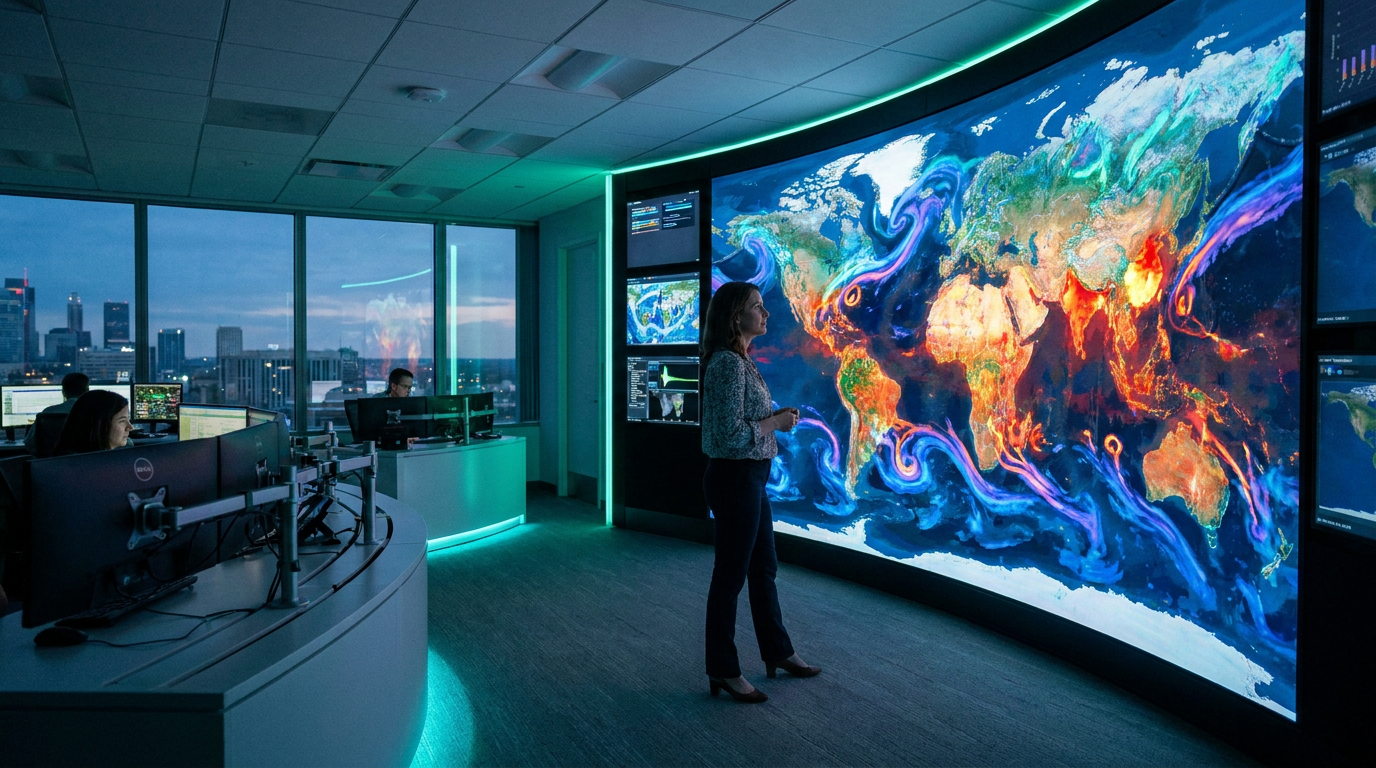
- Operational Meteorologists
- Focused on public safety, reliability, and integrating AI into existing hybrid forecasting workflows.
- Commercial Forecasters
- Prioritizing speed, frequent updates, and hyper-local accuracy for energy and logistics markets.
- Climate & AI Researchers
- Focused on advancing model architecture and democratizing high-resolution forecasting globally.
What's not represented
- · Developing Nation Meteorological Agencies
- · Renewable Energy Grid Operators
Why this matters
By slashing the computing cost of a 10-day forecast from thousands of dollars to pennies, AI is democratizing high-accuracy weather prediction. This allows developing nations, renewable energy grids, and emergency responders to anticipate severe events faster and with unprecedented precision.
Key points
- Major meteorological agencies, including NOAA and the ECMWF, have officially integrated AI weather models into their daily operational workflows.
- AI models can generate a 10-day global forecast in seconds on a single GPU, compared to the hours required by supercomputers.
- The energy consumption for a single forecast run has plummeted from roughly 8,400 kWh to just 0.25 kWh.
- AI systems are outperforming traditional models in medium-range accuracy, including tropical cyclone tracking and heatwave prediction.
- Forecasters are adopting a hybrid approach, using AI for speed and ensemble generation while relying on physics models for unprecedented extreme events.
For more than half a century, predicting the weather has been a brute-force mathematical exercise. Meteorologists relied on Numerical Weather Prediction (NWP), a method that uses massive supercomputers to solve complex fluid dynamics and thermodynamics equations across three-dimensional grids of the Earth's atmosphere. It was a system that demanded billion-dollar infrastructure, immense power consumption, and hours of processing time, effectively granting a forecasting monopoly to a handful of well-funded national agencies. But as of mid-2026, that paradigm has fundamentally fractured as a new technology takes the helm.[1]
Artificial intelligence models have officially moved out of experimental laboratories and into the daily operational workflows of the world's premier meteorological organizations. The European Centre for Medium-Range Weather Forecasts (ECMWF) and the US National Oceanic and Atmospheric Administration (NOAA) are now running AI-driven forecasting systems alongside their traditional physics-based models. This transition marks the most significant leap in meteorological science since the introduction of satellite imaging, fundamentally altering how humanity anticipates the atmosphere and democratizing access to world-class weather data.
The mechanism behind these new systems represents a complete departure from traditional meteorology. Instead of calculating the physics of the atmosphere step-by-step, AI models like the ECMWF's Artificial Intelligence Forecasting System (AIFS) and Google DeepMind's GraphCast use deep neural networks. These models have been trained on decades of historical weather observations—primarily the ECMWF's ERA5 reanalysis dataset—learning the complex, non-linear patterns of how weather systems evolve over time rather than manually solving the underlying equations. By recognizing these historical patterns, the AI can instantly predict the next state of the global atmosphere.
The most immediate impact of this shift is a staggering reduction in computational cost and energy usage. A traditional high-resolution forecast run on an ECMWF supercomputer takes hours to complete and consumes approximately 8,400 kilowatt-hours of electricity. In contrast, a modern AI weather model can generate a highly accurate 10-day global forecast in seconds using a single desktop GPU, consuming roughly 0.25 kilowatt-hours. This represents an energy reduction of nearly 1,000 times per simulation, freeing up massive amounts of capital and computing power for other scientific endeavors.[1]

This efficiency is not coming at the expense of accuracy. In fact, the AI models are consistently outperforming their physics-based predecessors on key metrics. During the European heatwaves of 2024 and 2025, the ECMWF's AIFS correctly predicted the spatial extent and intensity of the extreme temperatures up to ten days in advance, matching or exceeding the accuracy of the agency's gold-standard High Resolution (HRES) model. The AI models are particularly adept at tracking large-scale atmospheric patterns, proving that machine learning can grasp the macro-dynamics of the Earth's climate.
In fact, the AI models are consistently outperforming their physics-based predecessors on key metrics.
NOAA has followed a similarly aggressive timeline to integrate these tools into its daily operations. By January 2026, the agency updated its operational environment to include newly developed AI products, including the Artificial Intelligence Global Forecast System (AIGFS) and its ensemble variants. These tools are now actively used by forensic meteorologists and forecasters to evaluate storm tracks, with AI models showing up to a 20 percent improvement in predicting the paths of tropical cyclones compared to traditional models. This enhanced accuracy translates directly into better early warning systems for coastal communities.[2]
The speed of AI forecasting has also revolutionized the practice of 'ensemble' modeling. Because traditional models are so computationally heavy, agencies can only afford to run a limited number of slightly varied simulations to gauge uncertainty. AI models are so fast that meteorologists can now run thousands of variations in the exact same timeframe, creating a much richer probabilistic map of where a storm might go or how severe a drought might become. This allows emergency managers to prepare for a wider range of potential scenarios with much greater confidence.

Beyond government agencies, the commercial sector is rapidly capitalizing on the technology to build highly specialized forecasting products. Companies like Jua.ai have deployed proprietary models like EPT-2, which update 24 times a day—compared to the twice-daily updates of traditional global models. For energy traders managing volatile wind and solar portfolios, operating on stale, 12-hour-old forecasts is no longer necessary. They can now adjust to shifting weather fundamentals in real-time, optimizing grid performance, preventing blackouts, and saving millions of dollars in operational inefficiencies.[1]
The democratization of this technology is perhaps its most profound global consequence. Historically, developing nations in the Global South could not afford the billion-dollar supercomputing infrastructure required for localized, high-resolution Numerical Weather Prediction. Now, researchers in Southeast Asia are deploying Physics-Informed Neural Networks (PINNs) and Convolutional LSTMs to predict rapid cyclone intensification and extreme rainfall on standard commercial hardware. By lowering the barrier to entry, AI is allowing countries that bear the brunt of climate change to build their own state-of-the-art early warning systems, directly supporting disaster resilience in highly vulnerable regions.
Despite the breakthroughs, meteorologists are quick to note that artificial intelligence has not completely 'solved' the weather. Pure machine learning models can struggle with unprecedented extreme events—'black swan' weather anomalies that do not exist in their historical training data. Because they learn from the past, a climate that is rapidly warming can occasionally produce conditions the AI has never seen. They can also underperform when predicting highly localized, fine-scale phenomena like sudden pop-up thunderstorms, which are currently better captured by high-resolution regional physics models like NOAA's High-Resolution Rapid Refresh (HRRR).[1]

Because of these blind spots, no major meteorological agency is unplugging its supercomputers just yet. The consensus approach for 2026 is a tightly integrated hybrid operational environment. Forecasters use AI models for rapid, medium-range global guidance and massive ensemble generation, while relying on traditional physics models for hyper-local, short-range severe weather alerts. Furthermore, the AI models still require the traditional physics engines to provide the initial, meticulously assimilated atmospheric data that the neural networks need to start their predictive runs.
As researchers continue to develop hybrid architectures that embed physical conservation laws directly into neural networks, the performance gap between the two approaches is rapidly closing. These Physics-Informed Neural Networks prevent the AI from generating physically impossible forecasts, marrying the speed of machine learning with the reliability of fluid dynamics. The era of the supercomputer monopoly is officially over, replaced by a faster, cheaper, and more accessible forecasting ecosystem that promises to make the entire world significantly more resilient to an increasingly volatile climate.[1]
How we got here
July 2023
Huawei's Pangu-Weather model demonstrates the ability to run 10,000 times faster than conventional models in peer-reviewed tests.
2024
The ECMWF officially moves its Artificial Intelligence Forecasting System (AIFS) into operational status.
February 2025
ECMWF adds the ensemble version of its AI model (AIFS-ENS) to its daily production runs.
January 2026
NOAA updates its operational environment to include newly developed AI products like AIGFS and HRRR-Cast.
Viewpoints in depth
National Meteorological Agencies
Prioritizing reliability and the integration of AI alongside traditional physics models.
For organizations like NOAA and the ECMWF, the priority is public safety and operational reliability. They view AI not as a complete replacement for Numerical Weather Prediction, but as a powerful new tool in a hybrid ecosystem. By running AI models alongside traditional physics engines, agencies can cross-reference outputs, using AI for rapid ensemble generation while relying on physics models to catch unprecedented extreme events that the AI might miss.
Commercial Energy & Logistics
Leveraging the speed of AI to gain a competitive edge in real-time markets.
Commercial forecasters and energy traders are aggressively adopting AI models because of their speed and frequency. Traditional models update every 6 to 12 hours, leaving traders to operate on stale data. AI models can update dozens of times a day, allowing renewable energy grids to optimize wind and solar output minute-by-minute, and shipping companies to reroute vessels dynamically as weather patterns shift.
Climate & AI Researchers
Pushing the boundaries of physics-informed neural networks to eliminate AI blind spots.
Academic and private-sector AI researchers are focused on solving the remaining weaknesses of machine learning in meteorology. Because pure AI models struggle to predict 'black swan' events they haven't seen in their training data, researchers are developing Physics-Informed Neural Networks (PINNs). These architectures embed the fundamental laws of thermodynamics and fluid dynamics directly into the AI, preventing it from generating physically impossible forecasts.
What we don't know
- How pure AI models will perform when confronted with unprecedented climate extremes that fall entirely outside their historical training data.
- Whether AI models can eventually match the accuracy of traditional high-resolution regional models for highly localized, short-fuse severe weather like tornadoes.
- How the rapid democratization of forecasting will impact the business models of private weather companies that previously relied on proprietary supercomputing infrastructure.
Key terms
- Numerical Weather Prediction (NWP)
- The traditional method of forecasting that uses supercomputers to solve complex mathematical equations of atmospheric physics.
- Ensemble Forecasting
- Running multiple simulations with slightly different starting conditions to determine the probability of various weather outcomes.
- ERA5
- A comprehensive dataset produced by the ECMWF containing decades of historical global climate and weather data, used to train AI models.
- Physics-Informed Neural Networks (PINNs)
- AI models that incorporate the fundamental laws of physics into their learning process to prevent physically impossible predictions.
Frequently asked
Did AI completely replace traditional weather models?
No. Major agencies are using a hybrid approach, running AI models alongside traditional physics-based models to ensure reliability during unprecedented extreme events.
Why are AI models so much faster?
Instead of calculating complex fluid dynamics equations step-by-step for every grid cell on Earth, AI models use pattern recognition learned from decades of historical data to instantly predict the next state of the atmosphere.
Can I run these AI models at home?
Yes, many of the leading AI weather models are open-source and can generate a global forecast in seconds on a standard desktop computer equipped with a modern GPU.
Do AI models struggle with anything?
AI models can struggle to predict highly localized events like sudden pop-up thunderstorms, and they sometimes underpredict 'black swan' extreme weather events that were not present in their training data.
Sources
Source coverage
2 outlets
3 viewpoints surfaced


[1]Jua AICommercial Forecasters
NWP Accuracy in 2026: Traditional Models vs AI Leaders
Read on Jua AI →[2]NOAA Global Systems LaboratoryOperational Meteorologists
NOAA Moves AI Models Into Operational Use
Read on NOAA Global Systems Laboratory →

More in ai
See all 5 stories →AI Regulation
How 42 State Attorneys General Are Using Consumer Law to Regulate OpenAI
6 sources
Silicon Sovereignty
$1 Trillion AI Chip Selloff Follows Wave of Custom Silicon Shipments, Reshaping Compute Market
7 sources

Macroeconomics
Federal Reserve Raises US Growth Forecast, Citing Surging AI Infrastructure Investment
4 sources
Every angle. Every day.
Get ai stories with full source coverage and perspective breakdowns delivered to your inbox.