
The End of 'Eco-Friendly' Labels: How the EU's Greenwashing Directive Will Change How You Shop for Sustainable Products
Starting September 27, 2026, the EU's Empowering Consumers for the Green Transition Directive bans generic terms like 'eco-friendly' and 'carbon neutral' unless backed by verified, third-party data. The landmark law aims to eliminate greenwashing and force brands to replace marketing storytelling with scientific proof.
By Factlen Editorial Team
- Consumer Protection Advocates
- Argue that the ban is necessary because shoppers are overwhelmed by meaningless green leaves and deceptive 'eco' buzzwords.
- Corporate Sustainability Officers
- View the directive as a forcing function to align marketing with actual supply chain data, ending the era of storytelling over science.
- SME and Boutique Brands
- Express concern over the high cost of third-party certifications and life cycle assessments required to prove their genuine sustainability efforts.
What's not represented
- · Non-EU manufacturers who must adapt global packaging for the European market.
- · Carbon offset project developers facing a collapse in demand from retail brands.
Why this matters
If you've ever felt skeptical of a product claiming to be 'sustainable' or 'climate positive,' this law validates your doubts. By forcing companies to prove their environmental claims, the directive ensures that when you pay a premium for a green product, you are actually funding sustainable practices, not just a clever marketing campaign.
Key points
- The EU's ECGT Directive takes full effect on September 27, 2026, banning generic environmental claims.
- Terms like 'eco-friendly,' 'green,' and 'sustainable' are prohibited unless backed by recognized third-party certifications.
- Product-level 'carbon neutral' claims based solely on purchasing carbon offsets are strictly banned.
- The law applies to any company selling to EU consumers, forcing a global redesign of product packaging.
For years, walking down a supermarket aisle or browsing a fast-fashion website has meant navigating a forest of green leaves, earth tones, and bold declarations. Products are routinely marketed as "eco-friendly," "climate neutral," or "conscious." But behind the earthy packaging, the actual environmental impact has often been impossible for the average shopper to verify. Starting September 27, 2026, the European Union is pulling the plug on this era of unchecked greenwashing.[7]
The mechanism driving this change is the Empowering Consumers for the Green Transition (ECGT) Directive, a landmark piece of legislation that amends existing EU consumer protection laws. Under the new rules, generic environmental claims are strictly prohibited across all 27 member states unless they are backed by recognized, excellent environmental performance.[1][7]
The directive was born out of necessity. A comprehensive 2024 study by the European Commission revealed that over 53 percent of environmental claims made by companies were vague, misleading, or entirely unverified. Consumers who actively wanted to make responsible purchasing decisions were being actively deceived by marketing departments exploiting the lack of clear definitions.[4]
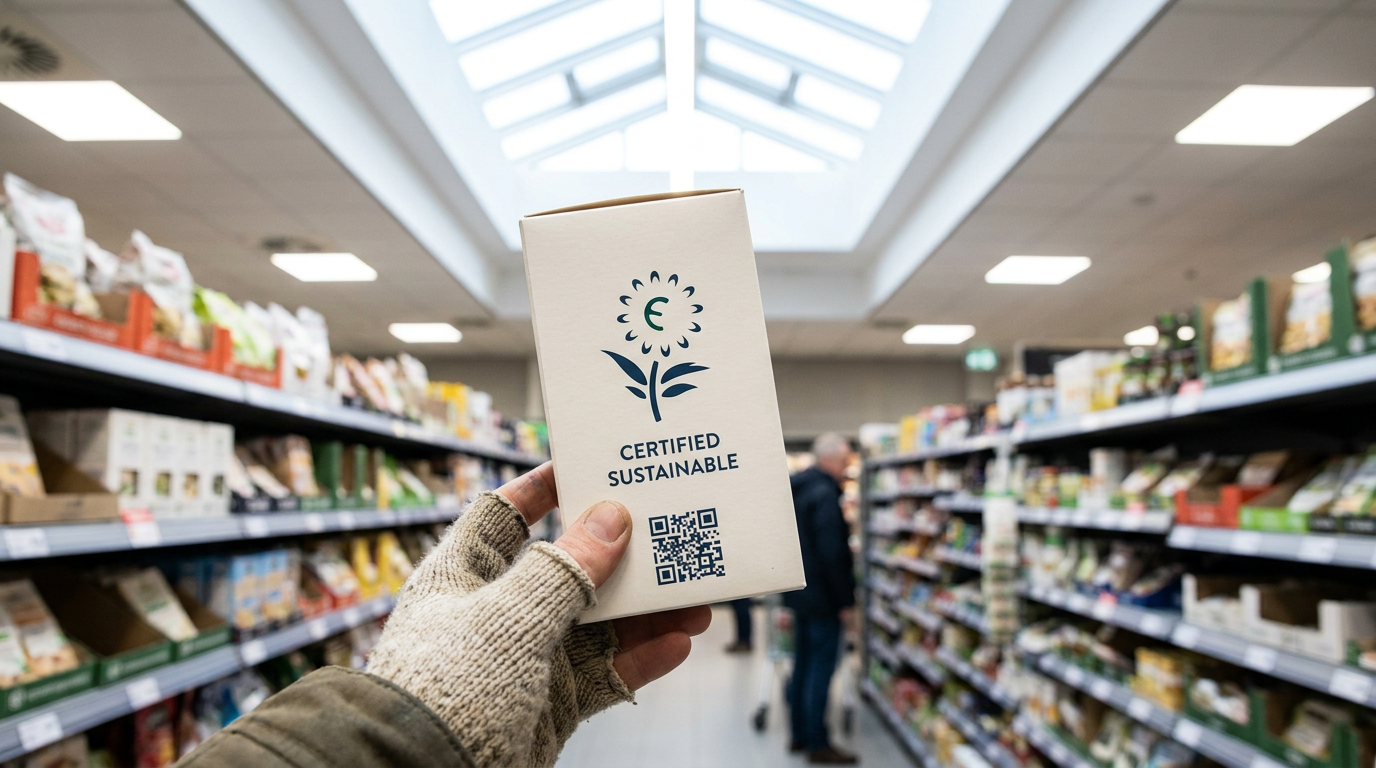
The most immediate casualty of the ECGT Directive is the generic buzzword. Terms like "green," "sustainable," "environmentally friendly," and "biodegradable" can no longer be used as standalone marketing copy. If a brand wants to use these words, they must be accompanied by specific, verifiable data on the same label, or be supported by a recognized Type I eco-label, such as the EU Ecolabel or Germany's Blue Angel.[5]

Perhaps the most significant shift involves the term "carbon neutral." For the past decade, countless brands have achieved "climate neutrality" not by reducing their actual emissions, but by purchasing cheap carbon offsets—often tied to short-term reforestation projects of dubious quality. The ECGT Directive outright bans product-level carbon neutrality claims that rely solely on greenhouse gas offsetting.[3][6]
Self-created sustainability logos are also on the chopping block. Brands can no longer design their own green seals of approval to stamp on their packaging. Any sustainability label must now be based on an independent, third-party certification scheme that features transparent rules and objective monitoring.[1][5]
Self-created sustainability logos are also on the chopping block.
The scope of the directive extends far beyond European borders. The law applies to any business-to-consumer commercial practice targeting the EU market. This means that American tech giants, Asian fast-fashion retailers, and global cosmetics brands must all overhaul their packaging and online marketing if they want to continue selling to European shoppers.[6]
The penalties for non-compliance are severe, designed to ensure that the cost of greenwashing outweighs the marketing benefits. National authorities can levy fines of up to 4 percent of a company's annual turnover, confiscate revenues generated from non-compliant claims, and exclude violators from public procurement contracts for up to a year.[6]

There has been some confusion in the corporate world regarding the status of these rules, stemming from the European Commission's June 2025 decision to pause a separate, more stringent proposal known as the Green Claims Directive. While that specific proposal—which would have required mandatory pre-market approval for all claims—was withdrawn, the ECGT Directive is already law and fully enforceable.[6]
For the packaging industry, the September 2026 deadline has triggered a massive operational shift. Brands are currently auditing thousands of product SKUs, stripping away unverified claims, and redesigning artwork. The focus is shifting from broad narratives to precise data, such as specific percentages of recycled content or QR codes linking to full Life Cycle Assessments.[5]
The fashion and beauty sectors, which have heavily relied on terms like "conscious collections" and "clean beauty," are facing a particularly steep learning curve. Companies must now build robust data infrastructures to trace the environmental impact of their supply chains down to the individual garment or lotion bottle, replacing vague promises with structured environmental data.[2]

While consumer advocates have celebrated the directive, some smaller, genuinely sustainable brands have voiced concerns. Obtaining rigorous third-party certifications like ISO 14024 can be expensive and time-consuming, potentially creating a barrier for boutique companies that lack the compliance budgets of multinational conglomerates.[7]
Despite these growing pains, the long-term impact on the retail landscape is overwhelmingly positive. Just as the GDPR forced a global reckoning on data privacy, the ECGT Directive is poised to set a new worldwide standard for environmental marketing. When consumers see a green claim in 2026 and beyond, they will finally have the legal assurance that the product actually lives up to its packaging.[7]
How we got here
March 2024
The European Union officially adopts the Empowering Consumers for the Green Transition (ECGT) Directive.
June 2025
The European Commission withdraws the separate, stricter Green Claims Directive, leaving the ECGT as the primary enforcement tool.
March 2026
Deadline for all 27 EU member states to transpose the ECGT Directive into their national consumer protection laws.
Sept 2026
The ECGT Directive takes full effect, and enforcement against non-compliant packaging and marketing begins across the EU.
Viewpoints in depth
Consumer Protection Advocates
Advocates argue that the ban is necessary because shoppers are overwhelmed by meaningless green leaves and deceptive 'eco' buzzwords.
Consumer rights organizations have long argued that the proliferation of unregulated green marketing has created a 'wild west' on supermarket shelves. When 53 percent of environmental claims are misleading, consumers who actively want to make sustainable choices are effectively penalized, paying premiums for products that do not deliver real environmental benefits. For these advocates, the ECGT Directive is a necessary market correction that restores trust by forcing companies to prove their claims before they print them.
Corporate Sustainability Officers
Sustainability leaders view the directive as a forcing function to align marketing with actual supply chain data.
For professionals working in corporate sustainability, the directive is largely seen as a victory for science over storytelling. For years, sustainability teams have struggled to compete with marketing departments that favored cheap carbon offsets and vague buzzwords over the hard, expensive work of decarbonizing supply chains. By banning offset-based 'carbon neutral' claims and requiring verifiable data, the law empowers sustainability officers to demand real operational changes and rigorous Life Cycle Assessments from their executive boards.
SME and Boutique Brands
Smaller brands express concern over the high cost of third-party certifications required to prove their genuine sustainability efforts.
While multinational corporations have the budgets to hire compliance teams and pay for expensive ISO 14024 Type I certifications, small and medium-sized enterprises (SMEs) face a daunting financial burden. Many boutique brands that were founded on genuinely sustainable principles fear they will have to strip their packaging of environmental claims simply because they cannot afford the rigorous third-party audits required by the new law. This has sparked concerns that the directive could inadvertently favor large corporations that can afford the 'price of admission' for green marketing.
What we don't know
- How strictly national authorities in all 27 member states will enforce the 4% turnover fines in the first year.
- Whether multinational brands will create EU-specific packaging or apply the strict new standards globally.
- How the ban on offset-based claims will impact the global voluntary carbon market.
Key terms
- ECGT Directive
- The Empowering Consumers for the Green Transition Directive, the EU law taking effect in 2026 that bans unsubstantiated environmental claims.
- Greenwashing
- The practice of making misleading or unsubstantiated claims about the environmental benefits of a product or company.
- Carbon Offsetting
- Purchasing credits to compensate for greenhouse gas emissions, which can no longer be used as the sole basis for 'carbon neutral' product claims under the new law.
- ISO 14024 Type I
- A globally recognized standard for third-party verified environmental labels, such as the EU Ecolabel or Germany's Blue Angel.
- Life Cycle Assessment (LCA)
- A scientific methodology used to measure the environmental impact of a product across its entire lifespan, from raw materials to disposal.
Frequently asked
Can a company still claim a product is 'carbon neutral'?
Only if the claim is based on actual, verified emission reductions within the product's value chain. Claims based solely on purchasing carbon offsets are strictly prohibited.
Does this law apply to brands outside of Europe?
Yes. Any company marketing or selling products to consumers within the European Union must comply with the directive, regardless of where the company is headquartered.
What happened to the 'Green Claims Directive'?
The separate, stricter 'Green Claims Directive' was paused and withdrawn in 2025. However, the Empowering Consumers for the Green Transition (ECGT) Directive is already law and takes effect in September 2026.
How will this change the packaging of products I buy?
You will see fewer generic buzzwords like 'eco-friendly' and fewer self-designed green logos. Instead, packaging will feature specific, data-backed claims and official third-party certifications.
Sources
Source coverage
7 outlets
3 viewpoints surfaced







[1]Linklaters
Empowering Consumers Directive: Commission updates FAQs on green claims in brand names
Read on Linklaters →[2]CarbonfactCorporate Sustainability Officers
Empowering Consumers Directive (EmpCo): What Fashion Brands Need to Know
Read on Carbonfact →[3]Climate Impact PartnersCorporate Sustainability Officers
Navigating the EU's Empowering Consumers for the Green Transition Directive
Read on Climate Impact Partners →[4]Hanken School of EconomicsConsumer Protection Advocates
Empowering Consumers for the Green Transition - Directive and Winds of Change
Read on Hanken School of Economics →[5]PackaSME and Boutique Brands
EU Greenwashing Directive 2026: Which Packaging Claims Are Banned
Read on Packa →[6]AsueneSME and Boutique Brands
The EU ECGT Directive Takes Effect in 2026: What It Means for Corporate Claims
Read on Asuene →[7]Factlen Editorial Team
Synthesis by Factlen editorial team
Read on Factlen Editorial Team →

More in shopping
See all 6 stories →Consumer Tech Law
The End of Glued-In Batteries: How the EU's 2027 Mandate Will Force a Global Redesign of Every Smartphone and Tablet
6 sources

Green Financing
The 2026 PACE Loan Overhaul: How New CFPB Rules Protect Homeowners Financing Solar and Energy Upgrades
8 sources

E-Commerce Tariffs
The €3 Per-Item Tax: How the EU's New Customs Duty Changes the Economics of Low-Value E-Commerce Shopping
8 sources

Trade Policy
CBP Suspends $800 De Minimis Rule, Forcing Tariffs and Compliance on All Low-Value E-Commerce Imports
8 sources
Every angle. Every day.
Get shopping stories with full source coverage and perspective breakdowns delivered to your inbox.