
The Biomechanics of the Calf Kick: How One Strike Rewrote the Rules of Mixed Martial Arts
Once a niche technique, the calf kick has become MMA's great equalizer by targeting a vulnerable nerve to instantly paralyze an opponent's leg. As fighters adapt, the sport is undergoing a radical evolution in stance and defense.
By Factlen Editorial Team
- Striking Purists
- Advocate for traditional Muay Thai stances and aggressive checking to deter the kick.
- Modern MMA Adapters
- Emphasize stance-switching, distance management, and evasive counters over absorbing damage.
- Sports Medicine Experts
- Focus on the biomechanical damage to the peroneal nerve and the dangers of compounding swelling.
What's not represented
- · Wrestling Coaches
- · Athletic Commissions
Why this matters
Understanding the calf kick transforms how you watch combat sports, revealing the hidden chess match of footwork and anatomy that dictates who wins and loses before a single punch is thrown.
Key points
- The calf kick targets the common peroneal nerve, causing temporary paralysis known as 'drop foot.'
- Unlike thigh kicks, calf kicks require less windup and are harder for wrestlers to catch.
- The rise of the calf kick exploited the wide, boxing-heavy stances that dominated MMA in the 2010s.
- Fighters are adapting by utilizing evasive footwork, stance switching, and bone-on-bone checking.
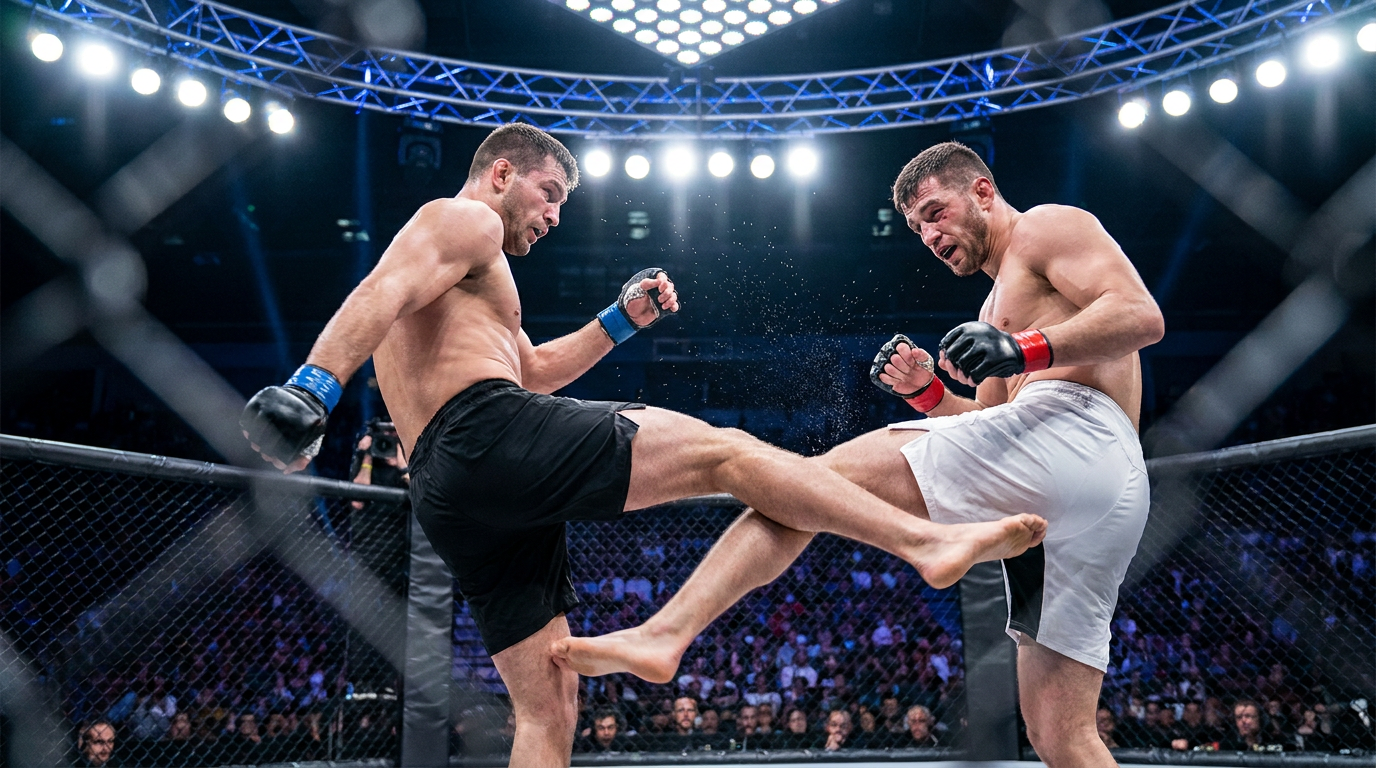
The visual of a fighter suddenly collapsing without taking a single punch to the head has become a defining image of modern mixed martial arts. Over the past decade, the sport has been quietly revolutionized by a strike that barely leaves the ground. What was once viewed as a minor nuisance or a setup technique has transformed into a devastating finishing blow, capable of dismantling world champions in a matter of minutes.[6]
The calf kick—a sharp, chopping blow to the lower leg—has evolved from a niche martial arts technique into MMA's great equalizer. It is rewriting the tactical playbook, forcing fighters to abandon decades-old stances and fundamentally altering how striking defense is taught across the globe. To the untrained eye, it looks like a simple trip, but the biomechanics behind the strike reveal a highly calculated assault on the human nervous system.[2][4]
To understand why the calf kick is so devastating, one must look beneath the skin. Unlike traditional low kicks that target the thick, dense quadriceps muscle of the thigh, the calf kick bypasses the muscular armor entirely. It targets the neurological infrastructure of the lower leg, turning the body's own wiring against itself.[3]

The primary target is the common peroneal nerve, a branch of the sciatic nerve that runs superficially along the outside of the calf, just below the knee. Because this specific area lacks the thick muscle and fat that protect the upper leg, the nerve sits dangerously exposed against the fibula bone. It is a structural vulnerability that humans evolved without needing to protect from lateral blunt-force trauma.[3][5]
When a fighter lands a shin bone accurately on this nerve, the result is often immediate and catastrophic. The trauma causes a condition known medically as "drop foot"—a temporary paralysis of the dorsiflexor muscles. The recipient loses the ability to lift their foot, causing their toes to literally drag across the canvas and instantly destroying their mobility.[1][4]
Beyond the nerve damage, the structural impact is immense. The lower leg has very little room to accommodate swelling. When the calf is struck repeatedly, swelling compounds rapidly within the tight muscular compartments, creating intense pressure that limits blood flow. Even if the nerve isn't fully paralyzed, the sheer mechanical pressure completely destroys a fighter's ability to push off, pivot, or maintain stability.[1][3]
If the calf kick is so effective, why did it take so long to dominate the sport? The answer lies in the evolution of MMA footwork. In traditional Muay Thai, fighters stand tall with square hips, remaining light on their lead foot. This posture allows them to easily lift their knees to block low kicks before they land.[1][4]

If the calf kick is so effective, why did it take so long to dominate the sport?
However, as MMA evolved, fighters adopted wider, "bladed" stances heavily influenced by boxing and wrestling. A wide stance with a heavy lead leg is optimal for defending takedowns and generating massive punching power. But this specialized posture comes with a fatal flaw: it leaves the lead calf completely exposed, anchored to the floor, and incredibly difficult to withdraw quickly.[1][2]
The mechanics of the calf kick perfectly exploit this modern vulnerability. It requires less hip rotation and windup than a traditional roundhouse kick, making it faster and harder to read. Furthermore, because the strike is targeted so low to the ground, it is incredibly difficult for wrestlers to catch the leg and secure a takedown, removing the traditional deterrent against kicking.[1][4]
The strike's devastating potential was previewed in 2017 when Jeremy Stephens landed 32 leg kicks against Gilbert Melendez at UFC 215. The sustained assault left Melendez with a massive hematoma and severe drop foot, forcing him to collapse repeatedly as his leg simply refused to support his weight.[3]
But the true "meta-breaking" moment occurred at UFC 257 in January 2021. Dustin Poirier utilized just 18 calf kicks to completely immobilize Conor McGregor. McGregor, fighting out of a wide, boxing-heavy karate stance, found his lead leg shut down entirely. The famously elusive striker was turned into a stationary target, leading to the first knockout loss of his career.[2][4]
As the calf kick became ubiquitous, the sport was forced to adapt rapidly. The most traditional defense is "the check"—a technique where the defender turns their knee and shin outward to meet the attacker's incoming kick bone-on-bone. It is a brutal, high-stakes game of physical chicken.[1][2]

Checking is excruciating for both fighters. If the defender successfully intercepts the kick with the upper, thicker part of their shin, the attacker absorbs the brunt of the impact. This bone-on-bone collision carries the very real risk of snapping the attacker's leg entirely, a gruesome injury that has ended multiple high-profile careers.[1][4]
Because checking is so physically costly, modern fighters have developed evasive counters. Popularized by Brazilian strikers, the "retreat counter" involves hinging the knee to slide the lead foot backward just as the kick lands, causing it to miss entirely. The defender then immediately fires back with a straight cross or hook while the attacker is momentarily off-balance.[1]
Another widespread adaptation is constant stance switching. Elite strikers now seamlessly shift between orthodox and southpaw stances mid-combination. By constantly changing which leg is forward, they hide the damaged limb and prevent an opponent from accumulating damage on a single nerve, turning a defensive necessity into dynamic offensive footwork.[4]

The rise of the calf kick is even forcing a slight regression in MMA stances. We are beginning to see fighters abandon the extreme wide stances of the 2010s, returning to slightly narrower, more squared-up postures. This hybrid stance attempts to balance the takedown defense of wrestling with the ability to quickly lift the lead leg like a traditional kickboxer.[2][4]
The calf kick is not a passing trend; it is a permanent evolution in the geometry of combat sports. It serves as a brutal reminder that in mixed martial arts, the most efficient way to dismantle an opponent isn't always to target the head, but to sever their connection to the ground.[6]
How we got here
Pre-2015
MMA striking is dominated by boxing-heavy stances and traditional Muay Thai thigh kicks.
September 2017
Jeremy Stephens lands 32 leg kicks against Gilbert Melendez at UFC 215, showcasing the devastating potential of targeting the lower calf.
January 2018
Douglas Lima uses brutal calf kicks to dismantle Rory MacDonald's lead leg in Bellator 192.
January 2021
Dustin Poirier uses 18 calf kicks to immobilize and defeat Conor McGregor at UFC 257, cementing the strike as a mainstream meta-breaker.
2024-2026
Fighters universally adopt stance-switching and retreat-counters as mandatory defenses against the now-ubiquitous calf kick.
Viewpoints in depth
Sports Medicine Experts
Focus on the biomechanical damage to the peroneal nerve and the dangers of compounding swelling.
Medical professionals view the calf kick as a fascinating study in human anatomy. Unlike head trauma, which causes concussive damage, the calf kick attacks the peripheral nervous system. Experts emphasize that the rapid swelling in the lower leg—which lacks the expansive tissue of the thigh—can create immense pressure on the peroneal nerve. While temporary 'drop foot' is the most common outcome, severe cases require careful monitoring to ensure fighters do not develop compartment syndrome or long-term neuropathy.
Striking Purists
Advocate for traditional Muay Thai stances and aggressive checking to deter the kick.
Traditional striking coaches argue that the calf kick epidemic is a symptom of poor MMA footwork. They advocate for a return to narrower, squared-up Muay Thai stances that allow fighters to remain light on their lead foot. From this posture, a fighter can easily lift and turn their shin outward to 'check' the kick. Purists believe that if a fighter successfully checks a calf kick bone-on-bone a few times, the sheer pain and risk of fracture will force the attacker to abandon the strategy entirely.
Modern MMA Adapters
Emphasize stance-switching, distance management, and evasive counters over absorbing damage.
The new generation of MMA coaches views the traditional 'check' as too physically costly and risky. Instead, they teach evasive footwork and stance fluidity. Adapters train fighters to slide their lead leg out of range at the last millisecond, using the attacker's momentary loss of balance to land devastating counter-punches. Furthermore, by constantly switching between orthodox and southpaw stances, these fighters distribute the damage and refuse to give their opponent a stationary target, turning defense into an offensive setup.
What we don't know
- Whether the long-term accumulation of peroneal nerve strikes will lead to chronic neuropathy in retired fighters.
- If the sport will eventually see a complete abandonment of the wide, bladed stance in favor of traditional Muay Thai footwork.
Key terms
- Peroneal Nerve
- A branch of the sciatic nerve running down the outside of the lower leg, responsible for movement and sensation in the foot.
- Drop Foot
- A temporary paralysis of the muscles that lift the foot, causing the toes to drag and destroying a fighter's mobility.
- Checking
- A defensive technique where a fighter turns their shin outward to block an incoming kick bone-on-bone.
- Bladed Stance
- A sideways fighting posture, common in boxing and wrestling, that places heavy weight on the lead leg.
- Southpaw
- A fighting stance where the right hand and right foot are forward, often used to protect a damaged left leg.
Frequently asked
Why are calf kicks more effective than thigh kicks?
Thigh kicks target thick quadriceps muscle and require accumulated damage. Calf kicks target the exposed peroneal nerve, causing immediate temporary paralysis and structural instability.
Is the calf kick legal in MMA?
Yes. Under the Unified Rules of MMA, kicks to the legs are completely legal, provided they do not strike the knee joint directly or the groin.
How do fighters defend against it?
The most common defenses are 'checking' (turning the shin outward to block bone-on-bone), switching stances to hide the lead leg, or sliding the leg back to counter-punch.
Can a calf kick cause permanent damage?
While rare, severe trauma to the peroneal nerve can cause long-term neuropathy or require surgery to relieve compartment syndrome, though most fighters recover fully with proper medical care.
Sources
Source coverage
6 outlets
3 viewpoints surfaced






[1]MMAailmStriking Purists
Calf kick in MMA: why it works, best setups, and real counters
Read on MMAailm →[2]FightStyleStriking Purists
The hidden danger of the calf kick
Read on FightStyle →[3]TheSportsterSports Medicine Experts
The Medical Reasons Behind The Effectiveness Of Calf Kicks In MMA
Read on TheSportster →[4]MMA GuidrModern MMA Adapters
Is the Calf Kick Here to Stay? The Evolution of MMA Stances
Read on MMA Guidr →[5]Mount Sinai Health SystemSports Medicine Experts
Common peroneal nerve dysfunction
Read on Mount Sinai Health System →[6]Factlen Editorial TeamModern MMA Adapters
Synthesis by Factlen editorial team
Read on Factlen Editorial Team →
More in sports
See all 17 stories →Standings
Grand Chess Tour Race: Keymer Vaults Into Top Three as Caruana Maintains Lead
6 sources

Injury
Global Netball Injury Report: Key Returns and Replacements Reshape Domestic Leagues
7 sources
Standings
Standings Watch: Southern Steel Break Drought as West Coast Fever Surge in Global Netball Playoffs
6 sources

Injury
AFL Injury Updates: Weitering, Day, and Key Defenders Headline Mid-Season Returns
6 sources

Every angle. Every day.
Get sports stories with full source coverage and perspective breakdowns delivered to your inbox.