
The 2026 Guide to Buying an E-Bike: Understanding Motors, Batteries, and Classifications
As electric bicycles reshape modern transportation, navigating the technical specifications of motors, battery capacities, and legal classes is essential for finding the right ride.
By Factlen Editorial Team

- Urban Commuters
- Prioritize low maintenance, affordability, and throttle assistance for stop-and-go city traffic.
- Performance & Cargo Cyclists
- Prioritize high torque, natural ride feel, and balanced weight distribution for hills and heavy loads.
- Safety & Regulatory Advocates
- Focus on UL battery certifications and strict adherence to class speed limits to ensure multi-use path safety.
What's not represented
- · Traditional acoustic bicycle purists
- · Pedestrian advocates concerned about multi-use path speeds
Why this matters
An e-bike is a significant financial investment that can replace a car, improve cardiovascular health, and eliminate commute anxiety. Understanding the technical specifications before buying prevents costly mistakes and ensures the bike actually fits your daily terrain and local laws.
Key points
- Hub motors are affordable and low-maintenance, making them ideal for flat urban commutes.
- Mid-drive motors leverage the bike's gears, providing superior torque for steep hills and heavy cargo.
- Battery capacity is measured in watt-hours (Wh), with a typical 500 Wh battery delivering 20 to 50 miles of range.
- Class 1 and 2 e-bikes are limited to 20 mph, while Class 3 models can reach 28 mph for faster commuting.
- Safety certifications like UL 2849 are critical to ensure the battery and electrical system are protected against fire risks.
E-bikes have transitioned from a niche novelty to a mainstream transportation powerhouse, fundamentally reshaping how people commute, exercise, and explore. By flattening hills and eliminating headwinds, electric bicycles make cycling accessible to a broader demographic, allowing riders to travel further with less sweat. However, the surge in popularity has flooded the market with a dizzying array of options, leaving many first-time buyers overwhelmed by technical jargon. Navigating the showroom floor requires understanding a few core concepts: motor placement, battery capacity, and legal classifications.[7]
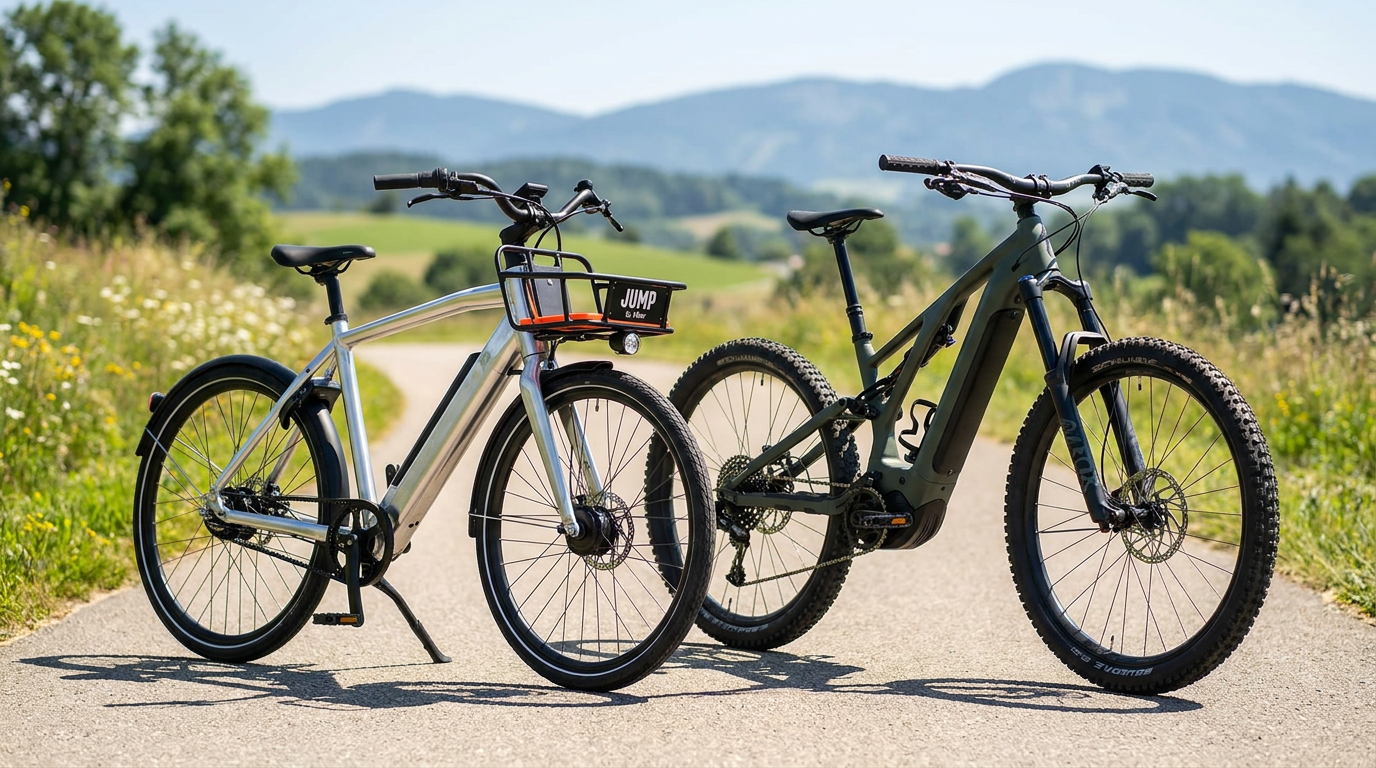
The defining characteristic of any electric bicycle is its motor, which generally falls into two distinct categories: hub-drive and mid-drive. Hub motors are housed directly inside the center of the front or rear wheel. Because they deliver power straight to the wheel independently of the bicycle's gears, they represent a simpler, more affordable engineering solution. This direct-drive mechanism makes hub motors exceptionally low-maintenance, as they do not place additional stress on the bike's chain or cassette.[2][4][6]
For riders navigating relatively flat urban environments or seeking a budget-friendly entry point, hub motors are often the ideal choice. They provide a smooth, quiet push that feels somewhat like being propelled by a gentle tailwind. However, because they operate on a single gear ratio, hub motors can struggle on steep inclines, drawing excessive current and potentially overheating if pushed too hard on mountainous terrain. Additionally, placing the heavy motor in the rear wheel can make the bike feel tail-heavy, slightly compromising handling during tight turns.[2][6]

In contrast, mid-drive motors are positioned at the bottom bracket, directly between the pedals. Instead of powering the wheel, a mid-drive motor drives the crankset, feeding its power through the bicycle's existing chain and gears. This integration allows the motor to leverage the bike's mechanical advantage. When a rider downshifts for a steep hill, the motor also downshifts, allowing it to spin at an efficient RPM while delivering massive torque to the rear wheel.[2][4]
The mechanical synergy of a mid-drive system makes it the undisputed champion for hilly terrain, heavy cargo hauling, and off-road mountain biking. Furthermore, placing the heaviest component low and dead-center on the frame results in a perfectly balanced center of gravity, yielding predictable, stable handling that mirrors a traditional bicycle. The trade-off for this performance is cost and maintenance; mid-drive systems are significantly more expensive and accelerate the wear and tear on the chain and gear cassette.[2][4][6]
Beyond motor placement, the way an e-bike decides when to deliver power is governed by its sensors. Entry-level models typically rely on cadence sensors, which act essentially as an on/off switch. Once the pedals start turning, the motor kicks in at a predetermined power level, regardless of how hard the rider is pushing. While effective, this can sometimes feel jerky or unnatural, particularly when navigating tight spaces or starting from a dead stop.[7]
Premium e-bikes utilize torque sensors, which measure the actual physical force the rider is applying to the pedals. The motor then amplifies that specific effort in real-time. If you pedal lightly, the motor provides a gentle assist; if you stand up and mash the pedals on a steep climb, the motor surges with proportional power. This creates a seamless, bionic feeling that seamlessly blends human and electric power, making torque sensors highly desirable for enthusiasts and mountain bikers.[7]
Premium e-bikes utilize torque sensors, which measure the actual physical force the rider is applying to the pedals.
The motor's capability is entirely dependent on the battery, which acts as the e-bike's fuel tank. While manufacturers often advertise voltage (V) and amp-hours (Ah), the most critical metric for a buyer to understand is watt-hours (Wh). Watt-hours represent the total energy capacity of the battery, calculated simply by multiplying the voltage by the amp-hours. For example, a 48-volt, 10-amp-hour battery possesses a capacity of 480 watt-hours.[3][4]

Understanding watt-hours is the only reliable way to estimate an e-bike's true range. As a general rule of thumb, a standard e-bike consumes between 10 and 20 watt-hours per kilometer, depending on the level of pedal assist, the rider's weight, and the terrain. Therefore, a typical 500 Wh battery will reliably deliver between 20 and 50 miles of range per charge. Riders planning long-distance tours or heavy cargo routes should look for batteries exceeding 700 Wh, or models that support dual-battery configurations.[3][4]
Battery safety has also become a paramount concern in 2026, following highly publicized incidents involving cheap, uncertified lithium-ion packs. Experts strongly advise buyers to verify that an e-bike's electrical system carries recognized safety certifications, such as UL 2849 or EN 15194. These rigorous testing standards ensure that the battery management system, charger, and motor are protected against overcharging, short circuits, and thermal runaway, providing critical peace of mind for indoor storage and charging.[1]
Once the hardware is understood, buyers must navigate the legal classifications that dictate where and how an e-bike can be ridden. In the United States, the industry has largely standardized around a three-class system. Class 1 e-bikes provide motor assistance only while the rider is actively pedaling, and the motor cuts off entirely once the bike reaches 20 miles per hour. Because they lack a throttle and operate at moderate speeds, Class 1 bikes enjoy the widest legal access, permitted on almost all traditional bike paths and multi-use trails.[1][5]

Class 2 e-bikes share the 20 mph speed limit but introduce a throttle, allowing the rider to propel the bike without pedaling at all. This feature is incredibly useful for getting a heavy cargo bike moving from a dead stop at a traffic light, or providing a brief respite for riders with knee pain or limited mobility. However, because they can operate like low-speed mopeds, some municipalities restrict Class 2 bikes from unpaved nature trails or dedicated pedestrian paths.[1][5]
Class 3 e-bikes are designed for speed and efficiency, providing pedal assistance up to 28 miles per hour. These are the ultimate commuter machines, allowing riders to safely keep pace with urban traffic and cover long distances in a fraction of the time. Due to their higher top speed, Class 3 bikes are generally restricted to roads and dedicated on-street bike lanes, and many jurisdictions require riders to wear a helmet and meet minimum age requirements.[1][5]
Frame geometry is the final piece of the puzzle. Historically, step-through frames were marketed exclusively as 'ladies' bikes,' but in the e-bike era, they have become the pragmatic standard for all riders. A step-through frame allows the rider to mount and dismount without swinging a leg over a high top tube—a crucial advantage when the bike is loaded with groceries, child seats, or heavy panniers. Step-over frames remain popular for aggressive mountain biking, where the traditional triangle design offers superior structural rigidity.[7]

Ultimately, choosing the right e-bike requires matching the machine's specifications to the rider's daily mission. A flat-city commuter might perfectly align with a low-maintenance, Class 2 hub-drive model with a 400 Wh battery. Conversely, a rider tackling steep suburban hills with a child seat will likely require the torque of a mid-drive motor, the safety of a Class 1 designation for trail access, and a battery exceeding 600 Wh. By cutting through the marketing hype and focusing on these core mechanical truths, buyers can confidently invest in a vehicle that will transform their daily transit.[7]
Viewpoints in depth
Urban Commuters
Prioritize low maintenance, affordability, and throttle assistance.
For riders navigating flat city streets, the mechanical simplicity of a hub motor is a major draw. These systems require far less maintenance than mid-drives because they don't wear down the bicycle's chain or cassette. Commuters also heavily favor Class 2 e-bikes; the inclusion of a throttle allows riders to accelerate from a dead stop at traffic lights without exerting effort, ensuring they arrive at the office without breaking a sweat.
Performance & Cargo Cyclists
Prioritize high torque, natural ride feel, and balanced weight.
Mountain bikers and parents hauling children require a fundamentally different machine. For these riders, the mid-drive motor is non-negotiable. By routing power through the bike's gears, mid-drives can multiply their torque to conquer steep, sustained climbs that would cause a hub motor to overheat. Furthermore, these riders demand torque sensors rather than cadence sensors, as the proportional power delivery ensures the bike feels like an extension of the rider's own body rather than a motorized scooter.
Safety Regulators
Focus on battery fire prevention and strict adherence to class speed limits.
As e-bike adoption skyrockets, regulatory bodies and safety advocates are pushing for stricter oversight. Their primary concern is the proliferation of cheap, uncertified lithium-ion batteries that pose severe fire risks; they strongly advocate for mandatory UL 2849 certification. Additionally, regulators are focused on managing the friction between e-bikes and pedestrians on multi-use paths, emphasizing that high-speed Class 3 models must remain on the road to preserve the safety of traditional trails.
What we don't know
- When solid-state battery technology will become affordable enough to replace current lithium-ion packs, potentially halving e-bike weights.
- Whether local municipalities will begin heavily enforcing speed limits and class restrictions on crowded multi-use pedestrian paths.
Key terms
- Watt-hour (Wh)
- A measure of total energy capacity, calculated by multiplying voltage by amp-hours, which determines an e-bike's range.
- Mid-drive motor
- An electric motor positioned at the bike's pedals that powers the chain, allowing it to leverage the bicycle's gears for better hill climbing.
- Hub motor
- An electric motor housed directly inside the center of the front or rear wheel, offering a simpler, direct-drive propulsion.
- Torque sensor
- A device that measures how hard the rider is pedaling and provides a proportional amount of electric assistance for a natural ride feel.
- Cadence sensor
- A basic sensor that detects when the pedals are turning and delivers a fixed amount of motor power, acting like an on/off switch.
Frequently asked
How far can I ride on a single charge?
A typical 500Wh battery provides 20 to 50 miles of range, depending on the level of motor assistance, rider weight, and terrain.
Do I need a license to ride an e-bike?
In most regions, Class 1 and Class 2 e-bikes do not require a license or registration. Class 3 e-bikes may have age restrictions and helmet requirements due to their 28 mph top speed.
Can a hub motor climb steep hills?
While hub motors can handle moderate inclines, they lack the mechanical advantage of the bike's gears. For very steep or sustained hills, a mid-drive motor is significantly more efficient.
What does UL 2849 certification mean?
It is a rigorous safety standard that ensures the e-bike's battery, motor, and charger have been tested to prevent electrical fires and thermal runaway.
Sources
Source coverage
7 outlets
3 viewpoints surfaced







[1]Bicycle ColoradoSafety & Regulatory Advocates
E-Bike Buying Guide and Classifications
Read on Bicycle Colorado →[2]EveloPerformance & Cargo Cyclists
Mid-Drive vs. Hub Motor eBikes: Which is Best?
Read on Evelo →[3]Ampler BikesSafety & Regulatory Advocates
The Complete E-Bike Battery Guide
Read on Ampler Bikes →[4]KirbebikeSafety & Regulatory Advocates
Understanding E-Bike Battery Capacity: Ah vs Wh Explained
Read on Kirbebike →[5]AventonUrban Commuters
The Difference Between Class 1, 2, and 3 Ebikes
Read on Aventon →[6]Polygon BikesPerformance & Cargo Cyclists
How Electric Bike Motors Work: Mid-Drive vs Hub-Drive
Read on Polygon Bikes →[7]Factlen Editorial TeamUrban Commuters
Synthesis by Factlen editorial team
Read on Factlen Editorial Team →


Every angle. Every day.
Get shopping stories with full source coverage and perspective breakdowns delivered to your inbox.