
Supreme Court Hears Landmark Arguments on Whether Cities Can Sue Big Oil Over Climate Damages
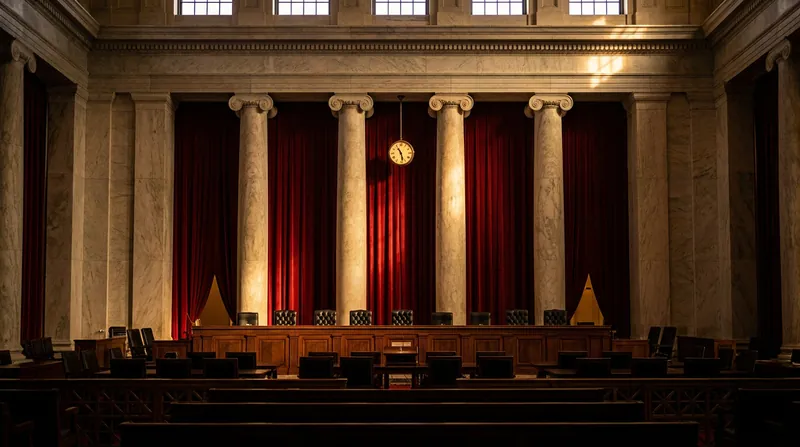
The U.S. Supreme Court opened its fall term on Monday by hearing arguments in a pivotal case that could determine whether local governments can use state laws to sue fossil fuel companies for climate-related damages.
By Hailey Scott

The U.S. Supreme Court opened its fall 2026 term on Monday by hearing oral arguments in a high-stakes jurisdictional battle that will decide if fossil fuel giants can be tried in state courts for the localized costs of global climate change. The justices heard Suncor Energy v. Board of County Commissioners of Boulder County.[1][2][4]
The proceedings commenced before an eight-member bench following the recusal of Justice Samuel Alito, a reliable conservative who stepped away from the case in late September. Alito's absence raises the distinct possibility of a 4-4 deadlock, which would automatically affirm the lower court's ruling and allow Boulder's lawsuit to proceed to trial.[2][4]
Boulder and its co-plaintiffs originally sued ExxonMobil and Suncor Energy in 2018, arguing that the companies knowingly contributed to climate change while executing a decades-long campaign to deceive the public. The municipalities are seeking financial compensation to cover the mounting costs of climate adaptation, including infrastructure repairs and emergency responses.[4]
Local communities in Colorado have faced severe financial burdens from extreme weather events exacerbated by rising global temperatures. In Boulder alone, officials estimate that necessary climate mitigation and adaptation efforts could cost taxpayers upwards of $157 million by 2050, a bill they argue should be shared by the corporations that profited from fossil fuels.
The human toll of these localized impacts was highlighted by supporters of the lawsuit, pointing to devastating events like the August 2025 Lee Fire. That blaze scorched 98 percent of a 2,000-acre ranch owned by Kathleen Kelley, a fourth-generation rancher who subsequently backed the novel legal strategy targeting the world's biggest oil producers.[2]
The Federal Preemption Defense
At the heart of Monday's arguments was the legal doctrine of federal preemption. Attorneys for the energy companies argued that greenhouse gas emissions are an inherently interstate and international issue governed exclusively by federal laws, such as the Clean Air Act, rather than a patchwork of state-level consumer protection statutes.[1][4]
The defense relied heavily on previous Supreme Court precedents, which established that federal common law displaces state claims over interstate emissions. The oil companies warned the justices that allowing state-level lawsuits would permit a single county's jury to effectively dictate national energy policy and bypass diplomatic channels for international climate agreements.[2][4]
Jason Isaac, CEO of the American Energy Institute, expressed confidence that the Court would side with the Constitution over what he termed courtroom lawfare. He argued that the power to dictate energy policy for the entire country belongs to Congress, not a courtroom in Boulder.
The U.S. Department of Justice, operating under the Trump administration, filed a brief supporting the energy companies. The federal government cautioned the Court against allowing individual municipalities to use state law to set nationwide production rules, arguing that such a move would severely disrupt the balance of federalism and domestic energy security.
The Tobacco and Opioid Playbook
Conversely, attorneys representing Boulder maintained that their lawsuit does not seek to regulate emissions, impose a carbon tax, or halt fossil fuel production. Instead, they framed the case strictly around corporate accountability and fraud, arguing that the companies violated state laws by intentionally misleading consumers to inflate demand and profits.[2]
The plaintiffs' legal strategy is explicitly modeled after the mass tort claims that successfully targeted the tobacco and opioid industries in the 1990s and 2000s. By focusing on the alleged concealment of known dangers rather than the act of pollution itself, Boulder hopes to bypass federal environmental regulations and secure billions in damages.[2]
Before reaching the merits of the preemption argument, the justices also grappled with a fundamental procedural question regarding their own authority. The Court asked both sides to weigh in on whether it actually has statutory jurisdiction to decide the Boulder case, given that the Colorado Supreme Court's decision was interlocutory rather than a final judgment.[2][4]
A Bellwether for Nationwide Litigation
The outcome of the Suncor case will serve as a definitive bellwether for the broader climate litigation movement. More than 60 similar lawsuits have been filed by blue states, counties, and municipalities across the country, all seeking to hold the fossil fuel industry financially liable for the localized impacts of global warming.[2]
Among the most prominent of these parallel cases is a 2023 lawsuit filed by the state of California against the five largest oil companies. California Attorney General Rob Bonta alleged a decades-long campaign of deception, arguing that the industry privately knew the truth about climate change but fed the public lies to protect record-breaking profits.[2]
A broad ruling in favor of the energy companies would likely extinguish these pending cases, shielding the industry from state-level financial liability. UCLA law professor Alejandro Camacho noted that a ruling against the county would essentially end all similar suits, leaving the public to foot the bill for climate disasters before the cases can even be heard.[2]
However, if the Supreme Court rules that federal law does not preempt these claims, or if the justices split evenly, the energy sector will face a wave of discovery and trials across multiple state jurisdictions. Such an outcome would fundamentally alter the financial risk landscape for global oil producers and potentially reshape how communities fund climate adaptation.[2][4]
Key points
- The Supreme Court heard oral arguments on whether local governments can use state laws to sue fossil fuel companies for climate damages.
- Justice Samuel Alito recused himself from the case, leaving an eight-member bench and the possibility of a 4-4 tie.
- Energy companies argue that greenhouse gas emissions are a global issue governed by federal law, warning against allowing local juries to dictate national energy policy.
- A ruling in favor of the energy companies could extinguish dozens of similar climate lawsuits filed by states and municipalities nationwide.
What we don’t know
- How the eight-member Supreme Court will vote, and whether a 4-4 tie will ultimately leave the Colorado Supreme Court's ruling intact.
- Whether the justices will issue a narrow ruling specific to Boulder's claims or a broad decision that explicitly preempts all state-level climate liability lawsuits nationwide.
- If the Court rules in favor of Boulder, how state courts will quantify the specific financial damages attributable to the deception campaigns of individual oil companies.
How we got here
April 2018
Boulder County and the City of Boulder file a lawsuit in state court against ExxonMobil and Suncor Energy over climate change damages.
May 2025
The Colorado Supreme Court rules 5-2 that federal law does not preempt Boulder's claims, allowing the case to proceed under state law.
February 2026
The U.S. Supreme Court agrees to review the Colorado decision at the request of the oil companies.
September 2026
Justice Samuel Alito recuses himself from the case, leaving an eight-member bench.
October 5, 2026
The Supreme Court hears oral arguments to determine if the state-level lawsuits can move forward.
- Local Governments & Climate Advocates
- Argues that communities are bearing the massive financial burden of climate change and that fossil fuel companies should pay for the damages caused by their alleged decades of public deception.
- Fossil Fuel Industry
- Contends that greenhouse gas emissions are a global issue requiring federal regulation, and that state-level tort lawsuits are an unconstitutional attempt to bypass Congress.
- Federal Executive Branch
- Warns that allowing individual municipalities to penalize multinational energy companies under state law would disrupt the balance of federalism and domestic energy security.
Perspectives this story doesn't cover
- Insurance companies bearing the cost of climate disasters
- International climate diplomats
Sources
Source coverage
4 outlets
3 viewpoints surfaced




- [1]CBS NewsFossil Fuel Industry
Supreme Court to weigh energy companies' bid to end Boulder climate-change lawsuit
Read on CBS News → - [2]Los Angeles TimesLocal Governments & Climate Advocates
At Supreme Court: Can oil companies be forced to pay for climate woes?
Read on Los Angeles Times → - [3]NOTUSFederal Executive Branch
The justices hear oral arguments Monday in a major environmental case over fossil fuel company liability
Read on NOTUS → - [4]WikipediaFossil Fuel Industry
Suncor Energy (U.S.A.) Inc. v. County Commissioners of Boulder County
Read on Wikipedia →
More in News & Politics
See all →Executive Power
Trump Directs $2 Billion From Medicare Fund for $90 Senior Rebates Ahead of Midterms
7 sources
Federal Savings Programs
Treasury Department Completes Automatic Enrollment of 60 Million Children in Trump Accounts
8 sources
Executive Power
Trump Cancels $810 Million in Domestic Spending Using 'Pocket Rescission' Maneuver
5 sources

Defense Supply Chain
US Congress Opens Probe as Diverted F-35 Stealth Fighter Parts Reach Chinese Possession
7 sources

Comments
Every angle. Every day.
Get News & Politics stories with full source coverage and perspective breakdowns, free every day.