
SPACECOM Prepares for Cislunar Operations and Defense Against Attacks on Space Ground Segments
U.S. Space Command's 2040 assessment outlines a dual mandate: expanding operations into the vast cislunar sphere while hardening vulnerable terrestrial ground stations against cyber and kinetic attacks.
By Layla Zaher

In short
- U.S. Space Command's 2040 assessment expands its focus to cislunar space, the 450,000-kilometer volume between Earth and the Moon.
- Operating in deep space requires entirely new architectures for positioning, navigation, and space domain awareness.
- The assessment highlights that terrestrial ground segments are often more vulnerable to attack than the satellites they control.
U.S. Space Command is fundamentally rearchitecting its operational posture to account for two emerging realities: the expansion of its area of responsibility into cislunar space, and the growing vulnerability of the terrestrial ground segments that control orbital assets. This shift is codified in the newly circulated "Space Warfighting Environment 2040" assessment, which moves the military's focus beyond traditional geosynchronous orbit (GEO) to encompass the vast volume between Earth and the Moon.
The document serves as a foundational framework, challenging existing assumptions and forcing military planners to treat space not as an isolated domain, but as a continuous, integrated system where terrestrial anchors are just as critical as the satellites they command.[1][3]
Cislunar space represents a massive volumetric leap for military operations. While geosynchronous orbit sits roughly 35,786 kilometers above the equator, the cislunar sphere extends to approximately 450,000 kilometers, encompassing the Moon and its Lagrange points—positions where the gravitational pull of the Earth and Moon balance out.
Operating in this expanded volume introduces severe physical and logistical constraints. Traditional GPS signals degrade rapidly beyond GEO, requiring entirely new architectures for positioning, navigation, and timing (PNT). Without these foundational capabilities, coordinating complex maneuvers or maintaining secure communications across lunar distances becomes nearly impossible.[2][3]
Space domain awareness—the ability to track objects and characterize intent—also becomes exponentially more difficult in the cislunar regime. A sensor network designed to monitor low Earth orbit cannot simply be pointed outward to cover a volume a thousand times larger. The physics of deep space require specialized optical and radar systems capable of detecting faint objects against the glare of the Moon or the vastness of the star field. This requires a fundamental redesign of how the military collects, processes, and disseminates space tracking data.[2][3]
Consequently, organizations like the Mitchell Institute for Aerospace Studies have recommended a dedicated $250 million annual investment and the addition of 200 specialized personnel specifically to develop cislunar infrastructure and doctrine. They warn that failing to act proactively could cede the domain to authoritarian competitors who view the Moon and its surrounding orbits through a strictly territorial lens. Establishing a robust military and logistical presence now is seen as the only viable way to ensure long-term freedom of navigation and prevent the establishment of exclusionary zones in deep space.[2][3]
The civilian sector is simultaneously pushing for deep-space development. The White House's National Cislunar Science & Technology Strategy reinforces the need for resilient, interoperable systems, prioritizing scalable communications that can bridge the gap between Earth-bound operators and lunar-distance assets. This whole-of-government approach views cislunar space as the next major economic frontier, emphasizing that military capabilities must ultimately support and protect peaceful scientific and commercial exploration. Establishing transparent norms of behavior now is seen as critical to preventing the Moon from becoming a contested territorial flashpoint.[3]
However, the expansion into deep space is only half of the 2040 equation. The other half is firmly rooted on Earth. Space Command's assessment highlights a stark reality: an adversary does not need to shoot down a multi-billion-dollar satellite if they can simply sever its terrestrial tether.
Ground segments—the antennas, control stations, data processing centers, and fiber-optic links that operate space systems—are often far more accessible and vulnerable than the orbital assets they support. A cyberattack on a control server or a kinetic strike on a transmission dish can render a satellite entirely useless.[1][3]
A cyberattack on a control server or a kinetic strike on a transmission dish can render a satellite entirely useless.
Targeting a ground station offers significant strategic advantages to an adversary. Most importantly, it avoids the creation of orbital debris. Kinetic anti-satellite (ASAT) weapons generate thousands of pieces of high-speed shrapnel that indiscriminately threaten all spacefaring nations, including the attacker's own assets. By focusing on the terrestrial and link segments, an adversary can achieve the same operational denial without crossing the threshold of environmental catastrophe in orbit. This makes ground-segment attacks a highly probable vector in any future great-power conflict.[3]
To mitigate this terrestrial vulnerability, military planners are emphasizing the rapid development of disaggregated architectures. Rather than relying on a few massive, centralized control nodes that present obvious targets, future networks will distribute command and control across multiple, redundant pathways. If one ground station is compromised, the system can seamlessly route data through alternative commercial or allied antennas. This resilience requires a fundamental shift in how the military procures and integrates space technology, moving away from closed, proprietary systems toward open standards that allow for dynamic rerouting.[1]
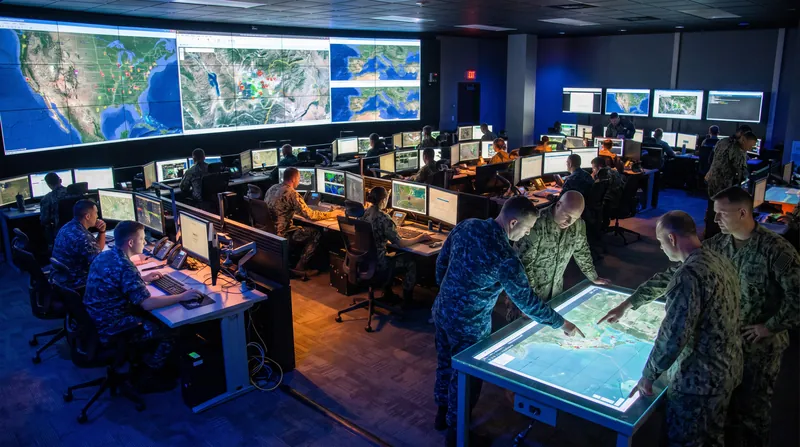
This shift toward disaggregation also demands a much broader understanding of the modern battlespace. Space Command operators must now coordinate intimately with U.S. Cyber Command to protect the vulnerable digital links connecting the terrestrial ground stations to the orbital satellites. The electromagnetic spectrum itself becomes a highly contested zone, where sophisticated jamming and signal spoofing can sever the invisible tethers that keep the architecture functioning. Defending this link segment against electronic warfare is just as critical to mission success as defending the physical hardware on the ground or in orbit.[1][3]
Ultimately, securing the future of space operations requires a dual approach. Space Command must extend its protective umbrella outward to the Moon, developing the propulsion, navigation, and sensing technologies required to operate in the cislunar sphere. Simultaneously, it must harden the terrestrial anchors that keep the entire architecture from drifting into the dark. The 2040 warfighting environment will not be defined solely by who has the most advanced satellites, but by who can maintain the unbroken chain of data flowing between the Earth, the Moon, and the void between them.[1][2][3]
Key terms
- Cislunar Space
- The region of space beyond geosynchronous orbit that is under the gravitational influence of both the Earth and the Moon.
- Ground Segment
- The terrestrial infrastructure, including antennas and control centers, required to operate and communicate with satellites.
- Space Domain Awareness
- The ability to detect, track, and characterize objects and activities in space to understand intent and prevent collisions.
- Geosynchronous Orbit (GEO)
- An orbit approximately 35,786 kilometers above Earth's equator where a satellite's orbital period matches the Earth's rotation.
- Positioning, Navigation, and Timing (PNT)
- A combination of capabilities, typically provided by GPS, essential for accurate movement, targeting, and synchronization of systems.
Frequently asked
What is cislunar space?
It is the three-dimensional volume of space between Earth and the Moon, extending approximately 450,000 kilometers from Earth.
Why are ground segments vulnerable?
Ground segments, such as control stations and antennas, are fixed terrestrial targets that can be attacked via cyber, electronic, or kinetic means without creating orbital debris.
How does operating in cislunar space differ from Earth orbit?
Cislunar operations require entirely new architectures for navigation and communication, as traditional GPS signals and sensor networks do not effectively reach beyond geosynchronous orbit.
What is Space Command's 2040 assessment?
It is a foundational document outlining the future space warfighting environment, emphasizing the need to operate in cislunar space and protect terrestrial space infrastructure.
Viewpoints in depth
Space Command Strategists
Military planners focused on securing the expanded operational volume and protecting vulnerable infrastructure.
For Space Command, the 2040 environment is defined by the need to project power and maintain domain awareness across a vastly larger area. Strategists argue that failing to establish a presence in cislunar space cedes the high ground to adversaries, while neglecting ground segment vulnerabilities leaves multi-billion-dollar orbital assets defenseless against terrestrial cyber or kinetic attacks.
Cislunar Infrastructure Advocates
Think tanks and policy groups pushing for immediate, dedicated funding for deep-space capabilities.
Organizations like the Mitchell Institute emphasize that the U.S. is already in a race to establish norms and infrastructure around the Moon. They argue that modest, early investments in cislunar positioning, navigation, and timing (PNT) and communications are essential to prevent authoritarian nations from establishing territorial claims or exclusionary zones in deep space.
Civil Space and Scientific Communities
Researchers and civilian agencies prioritizing peaceful exploration and sustainable development.
The civilian sector, guided by frameworks like the National Cislunar Science & Technology Strategy, views the expansion into cislunar space primarily as an economic and scientific opportunity. While acknowledging security concerns, this camp prioritizes interoperability, transparency, and international cooperation, warning that overly aggressive militarization could stifle commercial growth and scientific discovery.
- Military Strategists
- Focused on securing the expanded operational volume and protecting vulnerable infrastructure.
- Infrastructure Advocates
- Pushing for immediate, dedicated funding for deep-space capabilities.
- Civil Space Community
- Prioritizing peaceful exploration and sustainable development.
Perspectives this story doesn't cover
- Commercial satellite operators who rely on shared ground infrastructure
- International regulatory bodies governing the peaceful use of outer space
Sources
Source coverage
3 outlets
3 viewpoints surfaced



- [1]Breaking DefenseMilitary Strategists
Space war 2040: SPACECOM preps for attacks on ground segments, eyes cislunar ops
Read on Breaking Defense → - [2]Mitchell Institute for Aerospace StudiesInfrastructure Advocates
Securing Cislunar Space and the First Island Off the Coast of Earth
Read on Mitchell Institute for Aerospace Studies → - [3]Factlen Editorial TeamMilitary Strategists
Synthesis by Factlen editorial team
Read on Factlen Editorial Team →
More in Defense & Security
See all →Nuclear Deterrence
The Bus, the Post-Boost Vehicle, and the Reentry Vehicles: How a MIRV System Delivers Multiple Warheads to Separate Targets
6 sources

International Law
The Two Exceptions to the UN Charter's Prohibition on the Use of Force: How Article 51 and Chapter VII Authorize Military Action
8 sources

Air Defense Procurement
U.S. Clears $2.68 Billion Air Defense Sale to Ukraine Featuring 'S-300 Clone' Missiles
4 sources
Arctic Defense
U.S., Denmark, and Greenland Sign Security Accord Expanding American Military Presence in the Arctic
4 sources

Comments
Every angle. Every day.
Get Defense & Security stories with full source coverage and perspective breakdowns, free every day.