
Smart Glasses vs. Mixed Reality Headsets: The 2026 Buyer's Guide
As wearable technology fractures into two distinct paths, buyers must choose between the frictionless convenience of AI smart glasses and the deep immersion of mixed reality headsets.

In short
- The 2026 wearable market is divided between low-friction smart glasses and high-immersion headsets.
- Smart glasses prioritize all-day comfort and ambient AI access, weighing as little as 35 grams.
- Mixed reality headsets offer unmatched spatial computing and gaming but introduce physical and social friction.
The wearable computing market in 2026 has fractured into two distinct philosophies. Instead of a single spatial computing device that does everything, consumers are forced to choose between deep immersion and low friction.[2]
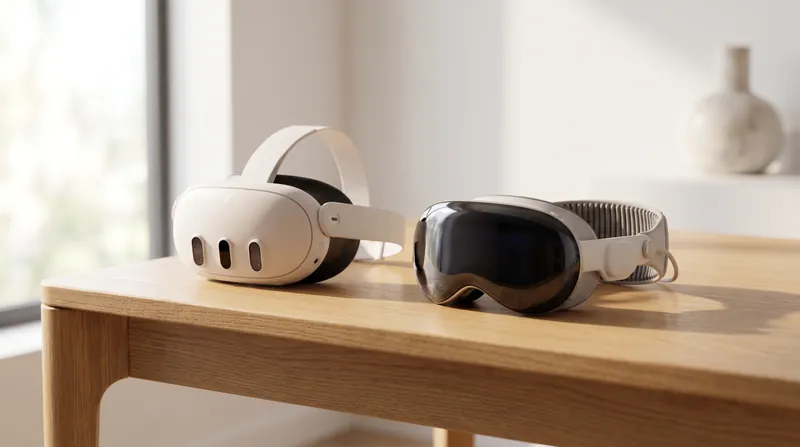
The dividing line is clear. On one side are Mixed Reality (MR) headsets like the Meta Quest 3 and Apple Vision Pro. On the other are lightweight smart glasses, led by the Meta Ray-Ban Gen 2 and display-equipped models from Rokid and Xreal.[1]
The core trade-off comes down to weight and wearability. Smart glasses prioritize a form factor that mimics traditional eyewear. Devices like the Meta Ray-Ban Gen 2 weigh just 50 grams, while titanium-framed alternatives push down to 35 grams.
Evidence supporting the smart glasses approach centers on frequency of use. Because they are socially acceptable and comfortable enough for all-day wear, users actually keep them on. They serve as a frictionless conduit for AI voice assistants, real-time translation, and hands-free camera capture.[2]
However, the argument against smart glasses is their lack of true spatial computing. Most AI glasses lack a display entirely, relying on audio. Even those with micro-LED displays, like the Rokid Glasses or Xreal One Pro, offer a limited field of view—typically around 50 degrees—and function more as a static heads-up display than a reactive digital environment.
Conversely, the case for Mixed Reality headsets is built on absolute immersion and spatial freedom. Headsets like the Meta Quest 3 and Apple Vision Pro utilize high-resolution passthrough cameras to blend digital objects with the physical room, offering a 110-degree field of view.
The evidence for MR headsets shines in productivity and gaming. Users can spawn multiple massive virtual monitors, manipulate 3D objects with hand tracking, and experience six-degrees-of-freedom (6DoF) movement. For dedicated virtual workspaces or simulation gaming, the headset form factor remains entirely unmatched.[1]
The primary argument against MR headsets is the physical and social friction they introduce. Weighing upwards of 500 grams, these devices inevitably cause neck fatigue and facial pressure after one to two hours of use.[2]
Furthermore, headsets inherently isolate the user. Even with excellent passthrough video, wearing a bulky visor in a public space like a coffee shop or on a commute remains socially prohibitive. The friction of putting the device on, adjusting straps, and managing battery life means they are often relegated to dedicated sessions rather than ambient use.[2]
Price also plays a significant role in this trade-off. The smart glasses category has established a mature entry tier, with highly capable AI glasses starting around $379 and premium display models reaching $799.
Mixed Reality headsets offer a wider, but often more expensive, spectrum. While the entry-level Meta Quest 3S provides a gateway at roughly $300, premium spatial computing experiences like the Apple Vision Pro demand a $3,500 investment, making the financial risk of adoption significantly higher.
A hybrid middle ground is emerging in 2026, though it comes with its own compromises. Devices like the Meta Ray-Ban Display attempt to bridge the gap by adding a small in-lens screen and a neural wristband for input, but at $799, they still cannot replicate the expansive canvas of a true VR headset.[2]
Ultimately, the decision requires buyers to honestly assess their daily habits. Smart glasses fit well when a user wants ambient AI assistance, seamless POV photo capture, or a private screen for media consumption on flights, all without sacrificing environmental awareness or social grace.[1]
Smart glasses do not fit well when the goal is immersive gaming, complex multi-monitor productivity, or any application that requires precise spatial tracking and hand-gesture manipulation.
Conversely, Mixed Reality headsets fit well when a user needs a dedicated, distraction-free environment for deep work, 3D design, or full-scale virtual reality entertainment. They are the definitive choice for users who want to replace their physical limitations with a boundless digital canvas.
MR headsets do not fit well for users seeking a wearable companion for their daily commute, outdoor activities, or ambient notifications. If the device feels like a chore to put on, the friction will ultimately defeat the immersion.[2]
Terms to know
- Spatial Computing
- A technology that blends digital content with the physical world, allowing users to interact with 3D interfaces using their eyes and hands.
- Passthrough
- A feature in VR headsets that uses exterior cameras to show the wearer a real-time video feed of their physical surroundings.
- 6DoF (Six Degrees of Freedom)
- Tracking technology that allows a device to monitor movement forward/backward, up/down, and left/right, plus rotation.
- Micro-OLED
- An advanced display technology used in premium headsets and glasses that offers extremely high resolution and contrast in a tiny physical footprint.
- Field of View (FoV)
- The extent of the observable world that is seen at any given moment through a display, measured in degrees.
Questions readers ask
Can smart glasses replace a VR headset for gaming?
No. Smart glasses lack the 6DoF tracking and immersive field of view required for true virtual reality gaming.
Do I need a prescription for smart glasses?
Most major smart glasses, including the Meta Ray-Ban series and Viture Pro, offer prescription lens options or built-in myopia adjustments.
Are mixed reality headsets safe to wear outside?
While devices like the Quest 3 have passthrough cameras, they restrict peripheral vision and are not designed for safe outdoor mobility.
Do smart glasses require a monthly subscription?
Core features on devices like the Meta Ray-Bans do not require a subscription, though some third-party AI apps or cloud services may charge fees.
Different angles
Frictionless Wearable Advocates
Argue that frequency of use is the most important metric, favoring lightweight glasses that can be worn all day.
This camp believes that the best technology is the technology you actually use. They point out that while VR headsets offer incredible experiences, their bulk and isolation mean they spend most of their time sitting on a shelf. By prioritizing a 50-gram form factor that looks like normal eyewear, smart glasses eliminate the friction of adoption. Proponents argue that ambient AI access and hands-free cameras provide more cumulative daily value than occasional deep-immersion gaming sessions.
Spatial Computing Purists
Maintain that true mixed reality requires full immersion and 6DoF tracking to fundamentally change computing.
For this group, smart glasses are merely a smartphone accessory, not a paradigm shift. They argue that true spatial computing requires the ability to completely replace or augment the user's environment with high-fidelity digital objects. By accepting the 500-gram weight penalty of a headset, users unlock boundless virtual workspaces, immersive simulation gaming, and precise hand-tracking that a pair of Ray-Bans simply cannot replicate. They view headsets as the inevitable successor to the desktop PC.
Display-First Pragmatists
Focus on the utility of tethered AR glasses as portable monitors for laptops and gaming handhelds.
Sitting between the two extremes, this camp values screen real estate over both ambient AI and full virtual reality. They champion devices like the Xreal One Pro and Viture Pro, which use micro-OLED displays to project a massive virtual screen in front of the user. While acknowledging these glasses lack the environmental awareness of AI frames and the 6DoF tracking of VR headsets, they argue that having a private, 200-inch monitor on an airplane or in a hotel room is the most practical use case for wearable displays today.
- Frictionless Wearable Advocates
- Argue that frequency of use is the most important metric, favoring lightweight glasses that can be worn all day over bulky headsets.
- Spatial Computing Purists
- Maintain that true mixed reality requires full immersion, high-resolution passthrough, and 6DoF tracking to fundamentally change computing.
- Display-First Pragmatists
- Focus on the utility of tethered AR glasses as portable monitors for laptops and gaming handhelds, prioritizing screen size over AI or full VR.
Perspectives this story doesn't cover
- Optometrists and Eye Care Professionals
- Privacy Advocates
Sources
Source coverage
2 outlets
3 viewpoints surfaced


- [1]ZDNETDisplay-First Pragmatists
Latest info on AR and MR glasses in 2026
Read on ZDNET → - [2]VR ExpertFrictionless Wearable Advocates
Meta Ray-Ban Display Glasses review: A hands-on deep dive
Read on VR Expert →

More in Content Types
See all →Tablet Tech
E-Ink Tablets vs. iPads: The 2026 Buyer's Guide for Deep Work
3 sources

Mixed Reality
Meta Quest 3 vs. Apple Vision Pro: The 2026 Spatial Computing Buyer's Guide
3 sources
CMS Architecture
Evaluating Headless CMS Against Managed Monolithic Architectures for Independent Publishers
6 sources

Publishing Platforms
Evaluating Ghost Against Substack: The Revenue Crossover Point for Independent Publishers
6 sources

Comments
Every angle. Every day.
Get Content Types stories with full source coverage and perspective breakdowns, free every day.