
Ocean Afforestation Could Backfire as Seaweed Farms Starve Natural Phytoplankton
A new biogeochemical modeling study reveals that large-scale seaweed farming for carbon removal actively competes with phytoplankton for ocean nutrients. This zero-sum dynamic can reduce the net climate benefit of ocean afforestation by up to 100 percent.
By Factlen Editorial Team
- Climate Intervention Researchers
- Focus on modeling the Earth system limits and biogeochemical feedbacks of CDR technologies.
- Marine Ecologists
- Focus on the unintended consequences of geoengineering on existing food webs and natural carbon sinks.
- Policy & Assessment Bodies
- Focus on evaluating the feasibility, accounting, and risks of CDR strategies for global climate goals.
What's not represented
- · Commercial CDR Startups
- · Coastal Fishing Communities
Why this matters
Billions of dollars are flowing into ocean-based carbon removal startups to help meet global net-zero targets. If these interventions inadvertently destroy the ocean's natural carbon sinks, carbon credit markets could be funding projects that provide zero actual climate benefit.
Key points
- Large-scale seaweed farming is being pursued as a major carbon dioxide removal strategy.
- New modeling shows seaweed farms actively compete with natural phytoplankton for scarce ocean nutrients.
- Starving phytoplankton reduces the ocean's natural carbon sequestration capacity.
- This nutrient competition reduces the net climate benefit of seaweed farming by 20% to 100%.
- Current carbon crediting frameworks do not account for this lost natural productivity.
- Seaweed farms must be sited in highly nutrient-rich areas to provide genuine net-negative emissions.
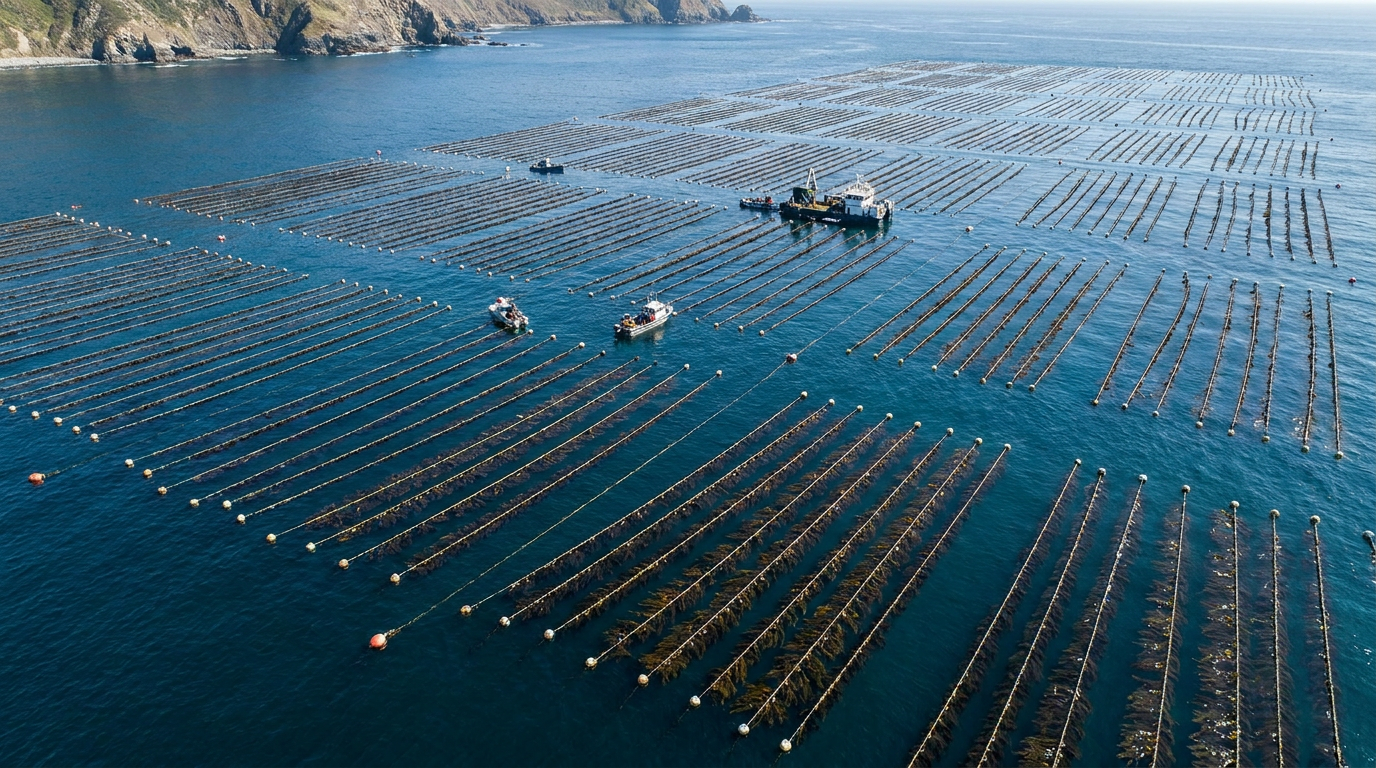
To keep global warming below critical thresholds, the world must actively remove between 100 and 900 gigatons of carbon dioxide from the atmosphere by the end of the century. Among the proposed solutions, "ocean afforestation"—the large-scale cultivation of seaweed in the open ocean—has emerged as a leading candidate. The premise is straightforward: fast-growing macroalgae absorb massive amounts of CO2 during photosynthesis, and if that biomass is deliberately sunk to the deep ocean, the carbon is locked away for centuries.[2][3]
Driven by this potential, a burgeoning industry of climate tech startups has begun deploying pilot projects, hoping to sell carbon credits based on the tonnage of seaweed they sink. However, a comprehensive new biogeochemical modeling study published in Nature Communications reveals a critical flaw in the math. When deployed at a climate-relevant scale, massive seaweed farms actively compete with the ocean's natural carbon scrubbers, triggering a zero-sum game that severely diminishes the net climate benefit.[1][2][6]
The core issue is nutrient limitation. Like any plant, seaweed requires more than just sunlight and carbon dioxide to grow; it relies heavily on macronutrients like nitrate and phosphate, as well as micronutrients like iron. The surface layer of the open ocean contains a finite, often scarce, supply of these essential building blocks.[2][4]
Currently, these nutrients fuel the growth of phytoplankton—microscopic marine algae that form the foundation of the global marine food web. Phytoplankton are the engine of the biological carbon pump. They consume surface nutrients, bloom, die, and sink into the abyss, naturally sequestering billions of tons of carbon every year.[2][5]

The Nature Communications study demonstrates that introducing massive, artificial seaweed canopies into this delicate balance essentially robs phytoplankton of their food supply. The researchers utilized an Earth System Model of intermediate complexity to simulate the global deployment of seaweed farms and track the flow of carbon and nutrients.[2]
The gross numbers initially look promising: the model found that large-scale seaweed cultivation could successfully capture between 0.7 and 1.1 gigatons of carbon annually. But the Earth system pushes back. By aggressively vacuuming up local nitrate, phosphate, and iron, the seaweed farms trigger a widespread collapse in local phytoplankton productivity.[2]
When the researchers subtracted the "lost" natural carbon sequestration of the starved phytoplankton from the "new" carbon sequestered by the seaweed, the net efficacy of the intervention plummeted. Depending on the specific nutrient constraints of the region, the net carbon dioxide removal was reduced by 20% to 100%. In the most nutrient-starved scenarios, the seaweed farms provided zero net climate benefit.[2]

Depending on the specific nutrient constraints of the region, the net carbon dioxide removal was reduced by 20% to 100%.
Iron limitation proved to be a particularly severe bottleneck. In vast stretches of the open ocean, iron is the primary limiting factor for biological growth. The modeling showed that seaweed farms would quickly exhaust these trace iron supplies, halting their own growth while simultaneously suppressing the natural phytoplankton that had adapted to those sparse conditions.[2][4]
Beyond chemical nutrient theft, the physical presence of the farms creates secondary ecological impacts. Massive, dense canopies of cultivated macroalgae block sunlight from penetrating the water column, further inhibiting the photosynthesis of any phytoplankton surviving below.[2]
These findings present a profound challenge for the emerging marine carbon dioxide removal industry. As New Scientist reports, several startups are already attempting to commercialize seaweed sinking, relying on carbon accounting frameworks that measure the carbon contained in the harvested kelp.[1]
Current carbon crediting protocols generally do not account for the "invisible" loss of natural phytoplankton productivity. If a company sinks one ton of seaweed carbon, but its farm prevented half a ton of phytoplankton carbon from sinking naturally, issuing a credit for the full ton represents a dangerous overestimation of the climate benefit.[2][6]
This reality check builds on previous warnings from the scientific community. A landmark 2021 report by the National Academies of Sciences, Engineering, and Medicine estimated that farming 72,900 square kilometers of ocean could sequester 0.1 gigatons of CO2 annually. However, those early estimates often treated seaweed addition in isolation, without fully coupling it to the broader Earth system feedbacks.[3][4]

Subsequent research, including a 2023 study in Communications Earth & Environment, began highlighting that global variations in biophysical constraints would severely limit where seaweed could actually be grown at scale. The new Nature Communications data confirms that even where it can grow, it often does so at the expense of existing ecosystems.[2][4]
The ecological risks extend beyond carbon math. As The Invading Sea notes, altering the ocean's biology carries distinct, far-reaching risks. Depleting nutrients in one oceanic region could disrupt fisheries thousands of miles away, as ocean currents that normally transport those nutrients arrive barren.[5]
This does not mean ocean afforestation is entirely without merit, but it fundamentally shifts how it must be deployed. To achieve genuine net-negative emissions, seaweed farms must be strategically sited in areas with massive nutrient upwelling, where the supply of nitrate and iron exceeds what the natural phytoplankton can consume.[2][6]
Ultimately, the research serves as a stark reminder of the interconnectedness of the Earth's climate system. As policymakers and investors look to the ocean for climate salvation, the biological realities of marine ecosystems dictate that there are no isolated variables, and no free lunches in planetary geoengineering.[2][6]
How we got here
2021
The National Academies publishes a landmark report outlining the potential of ocean-based carbon removal, including seaweed farming.
2023
Early modeling studies begin to highlight biophysical constraints on global seaweed yields.
May 2026
Nature Communications publishes comprehensive modeling showing that nutrient competition severely reduces the net climate benefit of seaweed.
June 2026
Scientific consensus shifts toward requiring whole-ecosystem accounting for marine carbon credits.
Viewpoints in depth
Climate Intervention Researchers
Scientists modeling the complex biogeochemical feedbacks of the Earth system.
This camp argues that single-variable climate solutions—such as simply adding massive amounts of seaweed to the ocean—inevitably trigger systemic pushback. They emphasize that the Earth system operates on strict budgets for nutrients like iron and nitrate. Their modeling demonstrates that scaling up biological interventions without accounting for these hard limits will result in zero-sum outcomes, where artificial carbon sinks merely cannibalize natural ones.
Marine Ecologists
Biologists focused on the fragility and interconnectedness of existing ocean food webs.
Ecologists warn that deploying massive geoengineering infrastructure in the open ocean carries severe risks for marine biodiversity. By starving foundational species like phytoplankton of essential nutrients, and blocking sunlight with massive artificial canopies, ocean afforestation could trigger cascading failures. They caution that disrupting nutrient currents could devastate commercial fisheries thousands of miles away from the actual seaweed farms.
Policy & Assessment Bodies
Organizations tasked with evaluating and regulating carbon dioxide removal strategies.
For assessment bodies, the primary concern is verifiable carbon accounting. If carbon markets are to fund ocean afforestation, the accounting frameworks must be rigorously updated to subtract the 'lost' natural carbon sequestration caused by nutrient theft. They argue that issuing carbon credits based solely on harvested seaweed biomass, without auditing the broader ecosystem impact, risks creating a subprime carbon market that fails to lower atmospheric CO2.
What we don't know
- Whether commercial carbon markets will update their accounting protocols to penalize projects that suppress natural phytoplankton.
- The exact tipping point at which a local seaweed farm begins to measurably starve surrounding marine ecosystems.
- How climate change-induced ocean warming and stratification will further alter the availability of deep-water nutrients over the coming decades.
Key terms
- Ocean afforestation
- The large-scale cultivation of macroalgae (seaweed) in the open ocean to capture and sequester carbon dioxide.
- Phytoplankton
- Microscopic marine algae that form the base of the ocean food web and naturally sequester massive amounts of carbon.
- Carbon Dioxide Removal (CDR)
- Technologies or practices that extract CO2 directly from the atmosphere and store it permanently.
- Biogeochemical modeling
- Computer simulations that track the flow of chemical elements through biological and geological systems.
- Macronutrients
- Essential elements required in large quantities for biological growth, such as nitrate and phosphate.
Frequently asked
Why can't we just add more nutrients to the ocean for both?
Adding nutrients artificially, known as ocean fertilization, carries severe ecological risks, including toxic algal blooms and the creation of oxygen-depleted dead zones.
Does this mean seaweed farming is bad for the climate?
Not necessarily. Seaweed farming still has potential, but its net carbon removal is much lower than previously thought, meaning it must be deployed strategically in naturally nutrient-rich areas.
How do companies currently measure the carbon they remove?
Most current accounting measures the carbon contained in the seaweed that is sunk. They do not yet account for the invisible loss of natural phytoplankton carbon sequestration.
Sources
Source coverage
6 outlets
3 viewpoints surfaced





[1]New ScientistMarine Ecologists
A promising natural technique to remove CO2 could backfire
Read on New Scientist →[2]Nature CommunicationsClimate Intervention Researchers
Efficacy of seaweed-based carbon dioxide removal reduced by iron limitation and nutrient competition with phytoplankton
Read on Nature Communications →[3]National Academies of Sciences, Engineering, and MedicinePolicy & Assessment Bodies
A Research Strategy for Ocean-based Carbon Dioxide Removal and Reliable Sequestration
Read on National Academies of Sciences, Engineering, and Medicine →Large global variations in the carbon dioxide removal potential of seaweed farming due to biophysical constraints
Read on Communications Earth & Environment →[5]The Invading SeaMarine Ecologists
What climate interventions look like and how they could affect marine ecosystems
Read on The Invading Sea →[6]Factlen Editorial TeamPolicy & Assessment Bodies
Synthesis by Factlen editorial team
Read on Factlen Editorial Team →

Every angle. Every day.
Get science stories with full source coverage and perspective breakdowns delivered to your inbox.