
How AI and 'Digital Twins' Are Rewriting the Rules of Olympic Judging
As the 2026 Milano-Cortina Games approach, advanced computer vision and 3D skeletal tracking are transforming how subjective sports are scored and trained.
By Factlen Editorial Team
- Sports Technologists & Governing Bodies
- Believe AI restores trust and accuracy by handling objective physics, allowing humans to focus on artistry.
- Athletes & Coaches
- Value the technology primarily for its real-time training feedback, injury prevention, and ability to push physical boundaries.
- Artistry Advocates & Skeptics
- Worry that over-reliance on data could strip the sport of its emotional resonance and introduce algorithmic bias.
What's not represented
- · Lower-resourced national federations
- · Live broadcast producers
Why this matters
For decades, human error in Olympic judging has sparked global controversies and broken athletes' hearts. The integration of AI promises to eliminate technical scoring errors, making competitions fairer while providing athletes with revolutionary tools to prevent injuries and push the boundaries of human performance.
Key points
- The 2026 Milano-Cortina Olympics will feature unprecedented AI integration to assist figure skating judges.
- Systems track a 'digital twin' of athletes to measure jump height, rotation, and blade angles.
- The technology builds on the Fujitsu Judging Support System, used in gymnastics since 2019.
- AI is strictly used for technical scores, leaving artistic evaluation to human judges.
- Beyond scoring, the technology is revolutionizing training and injury prevention.
For over a century, the Olympic Games have relied on the naked eye to measure the limits of human potential. In sports like figure skating and gymnastics, this reliance has birthed legendary performances, but also bitter controversies. Fractions of a point, decided by subjective human panels, can separate lifelong glory from devastating heartbreak.[7]
But as the world turns its attention to the 2026 Milano-Cortina Winter Olympics, a quiet revolution is taking center stage. Dubbed by technologists as the "First Intelligent Olympics," the upcoming Games will feature unprecedented integration of artificial intelligence and computer vision in the judging process.[1][3]
The shift is not about replacing human judges, but rather giving them a high-tech audit tool to manage cognitive overload. In figure skating, judges have mere seconds to determine if a skater fully rotated a triple axel or launched from the correct edge of a four-millimeter blade while traveling at twenty miles per hour.[1][6]
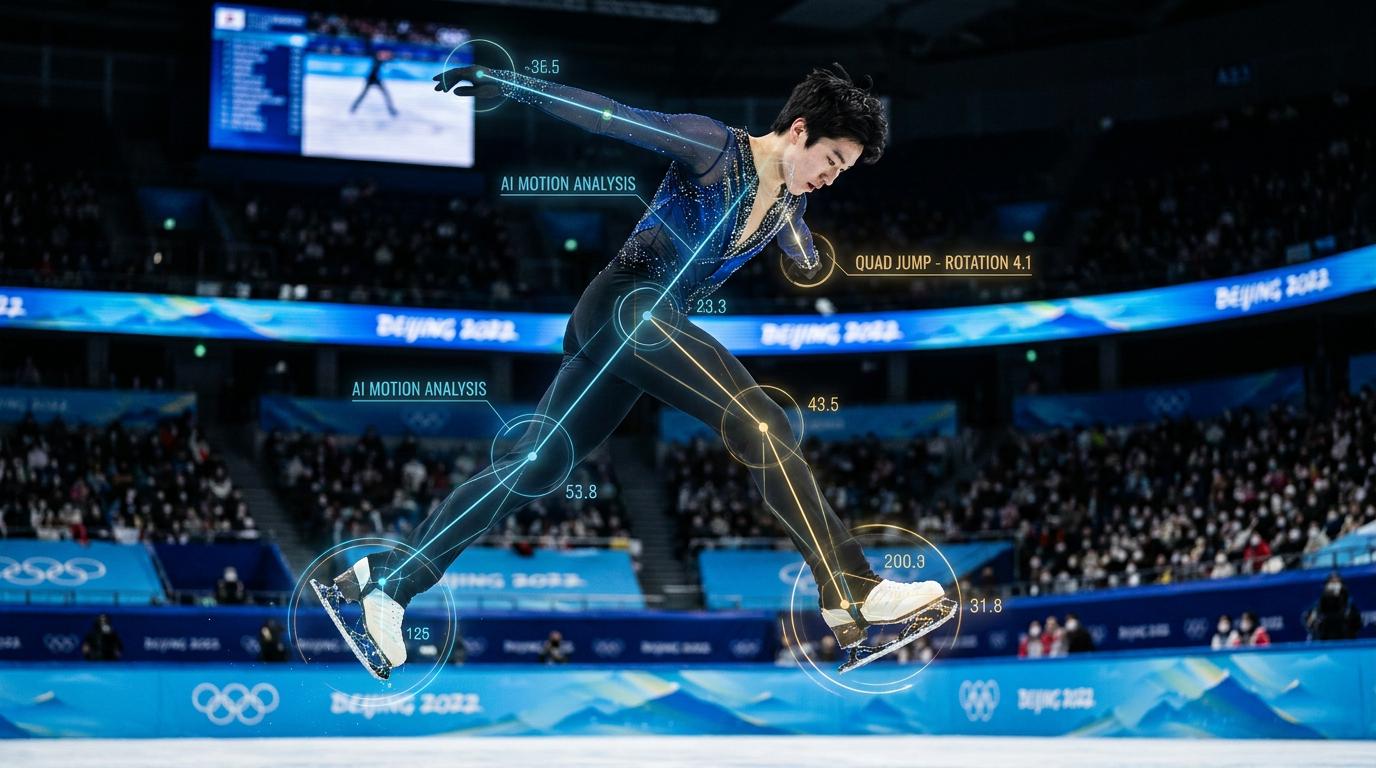
To solve this, the International Skating Union (ISU) and official Olympic timekeeper Omega are deploying advanced AI systems that track a skater's "digital twin." Using an array of high-definition cameras capturing thousands of images per second, the system builds a real-time 3D skeletal model of the athlete on the ice.[1][3]

This computer vision technology can instantly detect the exact angle of a competitor's blade and calculate metrics like jump height, airtime, and rotation with millimeter precision. If a skater is a quarter-rotation short on a quadruple jump, the system flags it immediately, eliminating the need for lengthy, inconclusive slow-motion video reviews.[1][5][6]
The foundation for this winter sports revolution was actually laid on the gymnastics mat. Since 2019, the International Gymnastics Federation (FIG) has partnered with Japanese technology giant Fujitsu to develop the Judging Support System (JSS), which is now capable of scoring all ten gymnastics apparatuses.[2][4][8]
Fujitsu's system originally utilized solid-state Lidar sensors emitting over two million pulses per second to map a gymnast's movements. It has since evolved into an advanced camera-based AI solution that uses proprietary correction algorithms to reduce "jitter"—the estimation error in posture recognition that traditionally plagued deep learning models.[4][8]
Fujitsu's system originally utilized solid-state Lidar sensors emitting over two million pulses per second to map a gymnast's movements.
By comparing the athlete's real-time skeletal data against a vast database of defined skills, the JSS can recognize thousands of different movements with remarkable accuracy. It provides objective biomechanical data to support the "D-Score" (Difficulty), ensuring that a gymnast is properly credited for the exact skills they perform.[4][8]

Beyond the judges' table, this technology is fundamentally altering how elite athletes train. The Japan Skating Federation recently adopted Fujitsu's skeleton recognition AI to analyze jump performances during national training camps, replacing cumbersome marker-based motion capture suits with markerless video analysis.[3][4]
Athletes and coaches now receive instant, data-driven feedback. New AI-powered applications allow skaters to record their practice sessions on a smartphone and immediately see their jump height and rotation speed. This rapid feedback loop is helping athletes push the boundaries of the sport, with some experts predicting that AI optimization could soon lead to the world's first successfully landed quintuple jump.[3][6]
Furthermore, machine learning is being deployed as a preventative medical tool. By analyzing a skater's movement history and detecting microscopic changes in their form, AI systems can predict fatigue and flag potential injury risks—like stress fractures—before the athlete even feels them.[4][6]

Despite the technological leaps, the integration of AI into subjective sports is not without its skeptics. The primary concern revolves around the "soul" of the sport: while an algorithm can count rotations and measure blade angles, it cannot feel the emotional resonance of a performance or evaluate its creative brilliance.[5][7]
Governing bodies have addressed this by strictly dividing the scoring criteria. In figure skating, the AI assists exclusively with the Technical Element Score (TES). The Program Component Score (PCS)—which evaluates composition, presentation, and skating skills—remains entirely in the hands of human judges.[1][7]
There are also valid concerns regarding algorithmic bias. If the AI models are trained on datasets that lack diversity in body types, heights, or skin tones, the system could inadvertently penalize athletes who do not fit the historical mold. Ensuring the training data is comprehensive and representative is a massive ongoing priority for developers.[6][7]

Ultimately, the goal of AI in Olympic judging is not to achieve algorithmic perfection, but to restore trust. By handling the objective physics of a routine, the technology frees human judges to do what they do best: appreciate the artistry, evaluate the expression, and celebrate the human spirit that makes the Games so captivating.[5][6][7]
How we got here
2019
The International Gymnastics Federation first tests Fujitsu's AI judging system.
2022
Early computer vision systems are tested at the Beijing Winter Olympics.
2023
AI scoring is fully deployed across all 10 apparatuses at the World Gymnastics Championships.
2026
The Milano-Cortina Winter Games prepare to integrate AI blade and rotation tracking for figure skating.
Viewpoints in depth
The Technologists' View
Focuses on precision, eliminating human error, and the 'digital twin' concept.
For sports technologists and governing bodies, the introduction of AI is a necessary evolution to protect the integrity of the Games. They argue that human judges simply cannot process the sheer volume of biomechanical data occurring in fractions of a second. By delegating the objective physics—like blade angles and jump rotations—to a flawless 'digital twin,' the sport eliminates the scandals and controversies that have historically plagued subjective scoring.
The Athletes' View
Focuses on instant feedback, injury prevention, and training optimization.
Athletes and coaches view the technology as a revolutionary training partner. Instead of waiting for delayed video analysis, skaters and gymnasts can now receive instant, data-driven feedback on their smartphones. This rapid iteration allows them to safely push the boundaries of human performance, while predictive algorithms monitor their biomechanics to flag fatigue and prevent catastrophic injuries before they occur.
The Traditionalists' View
Focuses on the unquantifiable nature of artistry, musicality, and the risk of algorithmic bias.
Traditionalists and artistry advocates caution against an over-reliance on data. They argue that the essence of sports like figure skating and gymnastics lies in their emotional resonance and creative brilliance—qualities an algorithm cannot measure. Furthermore, they raise concerns about algorithmic bias, warning that if AI models are trained on narrow datasets, they could inadvertently penalize athletes with diverse body types or unconventional styles.
What we don't know
- How seamlessly the AI data will integrate into live Olympic broadcasts for viewers.
- Whether the technology will eventually be used to score the subjective 'artistic' components.
- How quickly smaller, underfunded national federations will gain access to these advanced training tools.
Key terms
- Digital Twin
- A real-time, 3D virtual replica of an athlete generated by AI to analyze biomechanics.
- Technical Element Score (TES)
- The objective portion of a figure skating score, based on the difficulty and execution of specific moves.
- Program Component Score (PCS)
- The subjective portion of a figure skating score, evaluating artistry, composition, and presentation.
- Jitter
- In image analysis, the estimation error or instability in recognizing a subject's posture, which modern AI algorithms attempt to correct.
Frequently asked
Will AI replace human judges at the Olympics?
No. AI is currently used strictly as a support tool to verify objective technical elements, leaving subjective artistic evaluation entirely to human judges.
How does the AI track the athletes?
The systems use high-definition cameras and computer vision to build a real-time 3D skeletal model, or 'digital twin,' tracking key joint angles and equipment positioning.
Which sports are using this technology?
Artistic gymnastics has used AI support since 2019, and figure skating is heavily integrating the technology for the 2026 Milano-Cortina Winter Olympics.
Can AI help prevent sports injuries?
Yes. By analyzing an athlete's movement history, machine learning can detect microscopic changes in form that indicate fatigue or impending injury.
Sources
Source coverage
8 outlets
3 viewpoints surfaced








[1]ForbesSports Technologists & Governing Bodies
AI Integration In Figure Skating Judging
Read on Forbes →[2]CBCAthletes & Coaches
How AI is changing the way sports are judged
Read on CBC →[3]CGTNSports Technologists & Governing Bodies
AI judging in figure skating at Milano Cortina 2026
Read on CGTN →[4]Fujitsu GlobalSports Technologists & Governing Bodies
Fujitsu and the International Gymnastics Federation launch AI-powered Fujitsu Judging Support System
Read on Fujitsu Global →[5]JudgeMateArtistry Advocates & Skeptics
AI in Sports Judging: What Technology Can and Cannot Do
Read on JudgeMate →[6]Maclean'sArtistry Advocates & Skeptics
How AI will impact Olympic figure skating
Read on Maclean's →[7]Suffolk UniversityArtistry Advocates & Skeptics
AI and the Future of Figure Skating Judging
Read on Suffolk University →[8]Washington PostAthletes & Coaches
Gymnastics judging goes high-tech with 3D sensors
Read on Washington Post →
More in sports
See all 17 stories →Standings
Grand Chess Tour Race: Keymer Vaults Into Top Three as Caruana Maintains Lead
6 sources

Injury
Global Netball Injury Report: Key Returns and Replacements Reshape Domestic Leagues
7 sources

Standings
Standings Watch: Southern Steel Break Drought as West Coast Fever Surge in Global Netball Playoffs
6 sources

Injury
AFL Injury Updates: Weitering, Day, and Key Defenders Headline Mid-Season Returns
6 sources

Every angle. Every day.
Get sports stories with full source coverage and perspective breakdowns delivered to your inbox.