
How Haptic Vests and Sensory Floors Are Making Summer Music Festivals Universally Accessible
Major UK and European music festivals are standardizing wearable haptic suits and vibrating dance floors in 2026, allowing deaf and neurodivergent fans to physically feel the music and crowd energy.
By Factlen Editorial Team
- Accessibility Researchers
- Argue that haptic technology is essential for true inclusion and represents the next evolution of live music authenticity.
- Deaf & Disabled Advocates
- Value the multi-sensory experience of feeling the rhythm, transforming exclusionary events into communal celebrations of deaf culture.
- Live Event Producers
- Focus on the scalable deployment of modular floors and wearable tech to modernize venue infrastructure and expand their audience.
What's not represented
- · Grassroots and independent music venues that may lack the budget to install expensive haptic infrastructure.
- · Touring musicians adapting their stage setups to integrate with haptic audio feeds.
Why this matters
For decades, live music has inherently excluded millions of deaf, hard-of-hearing, and neurodivergent individuals. The standardization of haptic technology transforms concerts from purely auditory events into fully inclusive, multi-sensory experiences, ensuring everyone has the right to feel the rhythm and participate in communal joy.
Key points
- Major European music festivals are rolling out haptic technology to improve accessibility for the 2026 summer season.
- Wearable 5G suits and modular vibrating floor tiles convert audio signals into physical sensations.
- Academic field tests reveal that over 80% of users feel the technology provides a more authentic live experience.
- The tech also captures ambient crowd noise, allowing deaf fans to feel the collective energy of the audience.
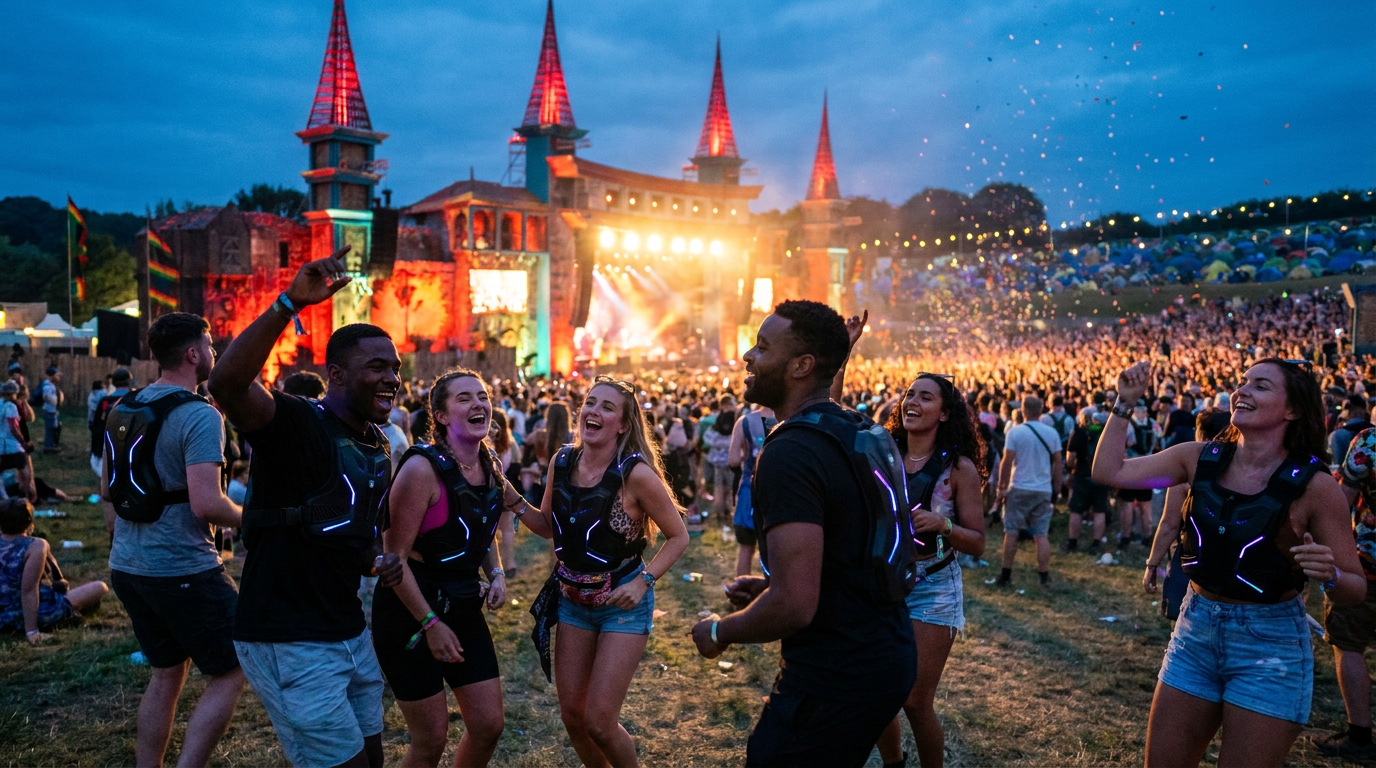
Summer 2026 is marking a watershed moment for live entertainment. Across the UK and Europe, major music festivals are fundamentally redefining what it means to experience a concert. Instead of relying solely on massive speaker arrays, organizers are rolling out haptic technology—wearable vibrating vests and sensory dance floors—to make live music fully accessible to deaf, hard-of-hearing, and neurodivergent fans.[6]
For decades, the live music experience for the deaf community has been fraught with barriers. Fans often had to rely on lip-reading from afar or pressing themselves uncomfortably close to stage subwoofers just to catch the rhythm. Now, a coalition of tech developers, academic researchers, and accessibility advocates are proving that sound is not just an auditory phenomenon, but a deeply tactile one.[1][4]
At the forefront of this movement are wearable haptic suits and modular flooring systems that convert audio signals into physical sensations. Companies like Beat Blocks have developed interlocking floor tiles that translate bass frequencies into powerful vibrations sent directly up through the feet. These scalable floors integrate with existing venue lighting, pulsing with synchronized RGB LEDs while delivering full-spectrum sound integration.[5]

Wearable technology takes the immersion even further. Vodafone, in partnership with Music: Not Impossible, has deployed 5G-enabled haptic suits equipped with 24 distinct touchpoints across the wearer's wrists, ankles, torso, and shoulders. The system isolates different instruments—sending the kick drum to the ankles and the vocals to the chest—allowing users to feel the distinct layers of a track in real-time.[3]
What elevates the 2026 iterations of these suits is their ability to capture the communal energy of a festival. Using machine learning and strategically placed 5G microphones, the software translates ambient crowd noise into a specific "VibraWow" state data. When the audience erupts in applause or sings along, that collective roar is fed back into the suits as a spine-tingling vibration, ensuring deaf fans feel the atmosphere of the crowd just as intensely as the music itself.[3]
The push to standardize this technology is backed by rigorous academic research. The Live Audience Accessibility and Augmentation (LAAA) project, spearheaded by researchers at Falmouth University and the University of Brighton, has spent the last three years conducting field tests at events like Boomtown Fair and the Cheltenham Jazz Festival.[1][2]
The push to standardize this technology is backed by rigorous academic research.
The empirical results have been overwhelmingly positive. In surveys of attendees who utilized Woojer haptic vests and Beat Blocks flooring, over 80 percent reported that the technology significantly improved their appreciation of the musical performance and their sense of inclusion. Furthermore, 85 percent of respondents agreed that the haptic feedback provided a more authentic live music experience.[2]

Crucially, the research highlighted that an assurance of haptic technology provision directly strengthens festival-going intentions among marginalized fans. When audiences know that a venue is equipped with sensory floors or wearable vests, the anxiety of exclusion dissipates, replaced by the anticipation of a genuinely shared communal event.[1][2]
Organizations like Deaf Rave have been instrumental in championing these inclusive spaces. Founded by Troi "DJ Chinaman" Lee MBE, the award-winning cultural movement provides a platform for deaf and disabled artists while hosting events where rhythm and bass are explored through movement and touch. By integrating dedicated haptic zones into their festivals, Deaf Rave has demonstrated that music can be a powerful, multi-sensory celebration of deaf culture.[4]
The impact on the individual level is profound. During initial trials of the 5G haptic suits, one profoundly deaf festival-goer noted that while massive crowds usually drown out sound and make lip-reading impossible, the suit allowed him to keep up with the songs effortlessly. Feeling the crowd's energy travel up his spine, he remarked that the experience made him "feel like Superman."[3]

The benefits of haptic integration extend beyond the deaf and hard-of-hearing communities. Neurodivergent fans, including autistic adults who may experience sensory overload in traditional concert environments, have reported that the tactile feedback provides a grounding physical sensation. By offering a focused, physical connection to the rhythm, the technology helps mitigate the chaotic overstimulation of a festival crowd.[1]
The live music industry is taking notice of this paradigm shift. Trade publications and venue operators increasingly recognize that standing still on accessibility is no longer a viable business model. The integration of British Sign Language (BSL) interpreters, haptic dance floors, and sensory-friendly zones is transitioning from a niche PR initiative into standard infrastructure for the modern "Liveness 4.0" era.[2][7][8]
As the summer 2026 festival season reaches its zenith, the sight of fans dancing on glowing, vibrating floor panels or wearing sleek haptic backpacks is becoming a normalized part of the live music ecosystem. It represents a beautiful evolution in entertainment—one that dismantles invisible barriers and proves that the joy of rhythm, bass, and community is a universal human right meant to be felt by all.[4][5][6]
How we got here
June 2022
Vodafone and Music: Not Impossible debut 5G-enabled haptic suits at the Mighty Hoopla Festival in London.
August 2023
Researchers conduct field tests of Woojer haptic vests at Boomtown Fair and the Deaf Rave Festival, gathering empirical data on audience inclusion.
May 2024
The BEAT BLOCKS multi-sensory interactive flooring system is successfully trialed at the Cheltenham Jazz Festival.
Summer 2026
Major European festivals begin standardizing haptic floors and wearable vests as core accessibility infrastructure.
Viewpoints in depth
Accessibility Researchers
Academics view haptic technology as a crucial step toward 'Liveness 4.0'.
Researchers from institutions like Falmouth University and the University of Brighton argue that traditional music festivals inherently exclude the d/Deaf, disabled, and neurodiverse (MTDDN) communities. By gathering empirical data, they have proven that haptic augmentation does not detract from the 'authenticity' of a live show. Instead, it enhances it, proving that tactile feedback is a valid and necessary component of modern live event infrastructure.
Deaf & Disabled Advocates
Advocacy groups celebrate the shift from passive accommodation to active, multi-sensory participation.
For organizations like Deaf Rave, accessibility is about more than just providing a clear sightline to a sign language interpreter. It is about allowing fans to physically feel the bass, rhythm, and communal energy of a crowd. Advocates emphasize that these technologies empower the deaf community to experience the visceral joy of club culture and live music on their own terms, transforming exclusionary spaces into celebrations of deaf identity.
Live Event Producers
Industry leaders see scalable haptic tech as the new standard for venue infrastructure.
Festival organizers and tech developers approach haptic integration as a necessary modernization of their product. Companies like Beat Blocks and Vodafone highlight the scalability of modular floors and 5G networks. For the live music industry, adopting these inclusive technologies is not just a moral imperative but a strategic move to expand their audience base and future-proof their venues against tightening accessibility regulations.
What we don't know
- How quickly smaller, independent grassroots venues will be able to afford and adopt these advanced haptic systems.
- Whether major streaming platforms will eventually integrate consumer-grade haptic feedback for at-home live concert viewing.
Key terms
- Haptic Technology
- Technology that creates an experience of touch by applying forces, vibrations, or motions to the user.
- Liveness 4.0
- An academic concept describing the next evolution of live events, where digital augmentation and sensory technologies make performances more immersive and accessible.
- Neurodivergent
- An umbrella term for people whose brains function, learn, and process information differently than what is considered typical, including those with autism or ADHD.
- British Sign Language (BSL)
- The sign language used in the United Kingdom, increasingly integrated into live music performances to translate lyrics and tone for deaf audiences.
Frequently asked
How do haptic suits work for live music?
Haptic suits use sensors to convert audio signals from the stage and crowd into physical vibrations, allowing wearers to feel different instruments and ambient energy across their body.
What is a haptic dance floor?
A haptic floor, like the BEAT BLOCKS system, is made of modular tiles that translate bass frequencies into powerful vibrations sent directly up through the feet of the dancers.
Does this technology only benefit the deaf community?
No. While designed for deaf and hard-of-hearing fans, neurodivergent individuals also report that the tactile feedback provides a grounding sensation that helps prevent sensory overload.
Are these devices available at all music festivals?
While not yet universal, major UK and European festivals are increasingly standardizing the technology for the 2026 summer season following highly successful pilot programs.
Sources
Source coverage
8 outlets
3 viewpoints surfaced








[1]Emerald InsightAccessibility Researchers
Live audience accessibility and augmentation project – inclusive haptic futures for music festivals
Read on Emerald Insight →[2]University of BrightonAccessibility Researchers
Visitor Perceptions of Haptic Vests and Accessibility at Music Festivals
Read on University of Brighton →[3]Vodafone UKLive Event Producers
Vodafone unveils 5G-enabled haptic suits allowing deaf fans to experience live music
Read on Vodafone UK →[4]Deaf RaveDeaf & Disabled Advocates
Empowering the Deaf and disabled communities through music
Read on Deaf Rave →[5]Beat BlocksLive Event Producers
BEAT BLOCKS: Intrinsically inclusive haptic floor tiles
Read on Beat Blocks →[6]Factlen Editorial TeamLive Event Producers
Synthesis by Factlen editorial team
Read on Factlen Editorial Team →[7]IQ MagazineLive Event Producers
The 365 Venue: Why standing still on accessibility is no longer an option
Read on IQ Magazine →[8]Music WeekLive Event Producers
Haptic tech rolls out across UK festivals for summer 2026
Read on Music Week →
Every angle. Every day.
Get entertainment stories with full source coverage and perspective breakdowns delivered to your inbox.