
Neuroaesthetics: How Interior Design Physically Alters Your Brain and Mood
An emerging branch of neuroscience is proving that interior design is not just about aesthetics, but a biological tool that can measurably lower stress hormones and improve mental health.
By Factlen Editorial Team
- Neuroaesthetics Researchers
- Scientists mapping the biological circuitry of how the human brain processes beauty and space.
- Evidence-Based Designers
- Practitioners turning brain science into residential and commercial blueprints to improve daily well-being.
- Healthcare Architects
- Specialists applying spatial science to clinical environments to accelerate patient recovery.
- Factlen Editorial
- Synthesizing the intersection of neuroscience and interior design.
What's not represented
- · Neurodivergent Individuals
- · Affordable Housing Developers
Why this matters
As remote work and digital fatigue increase our daily cognitive load, our physical environments play an outsized role in regulating our nervous systems. Understanding how light, color, and texture physically alter brain chemistry empowers anyone to transform their home from a passive backdrop into an active tool for reducing stress and boosting focus.
Key points
- Neuroaesthetics is an emerging scientific field studying how the brain responds to beauty and spatial environments.
- Visual stimuli from interior design trigger direct neural pathways that can alter heart rate, blood pressure, and stress hormones.
- Cooler colors activate the calming parasympathetic nervous system, while warmer tones stimulate the energizing sympathetic nervous system.
- The human brain shows a biological preference for curvilinear shapes and natural textures, which activate pleasure centers.
- Institutions like Johns Hopkins are formalizing 'neuroarchitecture' to improve public health and clinical recovery.
Almost everyone has experienced the sensation of walking into a specific room and feeling an immediate, involuntary sense of relief. The shoulders drop, the breathing slows, and the mind quiets. For centuries, we attributed this feeling to an intangible "vibe" or the subjective magic of good taste. But modern science is revealing a much more mechanical truth: that feeling is not magic, it is biology.[1]
For decades, interior design was largely treated as a superficial luxury—a matter of matching throw pillows, following seasonal trends, and selecting the right paint finish for a photograph. Today, a quiet revolution is bridging the gap between the art of aesthetics and the hard science of human physiology, transforming how we understand the spaces we inhabit.[6]
Welcome to neuroaesthetics, an emerging scientific discipline that studies how our nervous systems respond to beauty, harmony, and spatial environments. By mapping the neural circuitry of aesthetic experiences, researchers are proving that our surroundings profoundly impact our biological circuitry, whether we are consciously aware of it or not.[3]
The core premise of neuroaesthetics is simple but profound: every time you step into a room, your brain is instantly processing its emotional landscape. Within milliseconds, environmental stimuli trigger direct neural pathways that can alter your heart rate, hormone levels, and mood.[6]

The field traces its modern roots to the late 1990s, when advancements in functional magnetic resonance imaging (fMRI) allowed scientists to observe the brain's real-time reactions to visual stimuli. For the first time, researchers could hunt for the exact links between beauty and biology.[5]
What they discovered fundamentally shifted the paradigm. Aesthetic experiences are not merely subjective opinions; they are deeply ingrained evolutionary responses. When we perceive a space as beautiful or harmonious, the brain's reward centers light up, releasing a cascade of feel-good neurotransmitters like dopamine, serotonin, and oxytocin.[3]
Conversely, environments that feel chaotic, sharp, or overly sterile can trigger the amygdala—the brain's fear and stress center. This prompts a low-grade release of cortisol, keeping the body in a subtle but exhausting state of high alert. The architecture itself becomes a source of chronic stress.[7]
Institutions like the International Arts + Mind Lab (IAM Lab) at Johns Hopkins University are at the forefront of this research. They are pioneering "Impact Thinking," a translational framework that applies rigorous, evidence-based brain science to architecture, music, and design interventions.[2]

Institutions like the International Arts + Mind Lab (IAM Lab) at Johns Hopkins University are at the forefront of this research.
Recently, the IAM Lab helped publish the "Intentional Space Roadmap," a comprehensive study calling for the establishment of "neuroarchitecture" as a formalized sector. The report argues that holistically designed spaces represent a cost-effective, life-changing opportunity to improve public health and resilience at scale.[4]
So, how does this science translate into the actual design of a home or office? It begins with the "chromatic code." Color is not just a visual experience; it is a neurological trigger that dictates how much energy our bodies expend in a given space.[6]
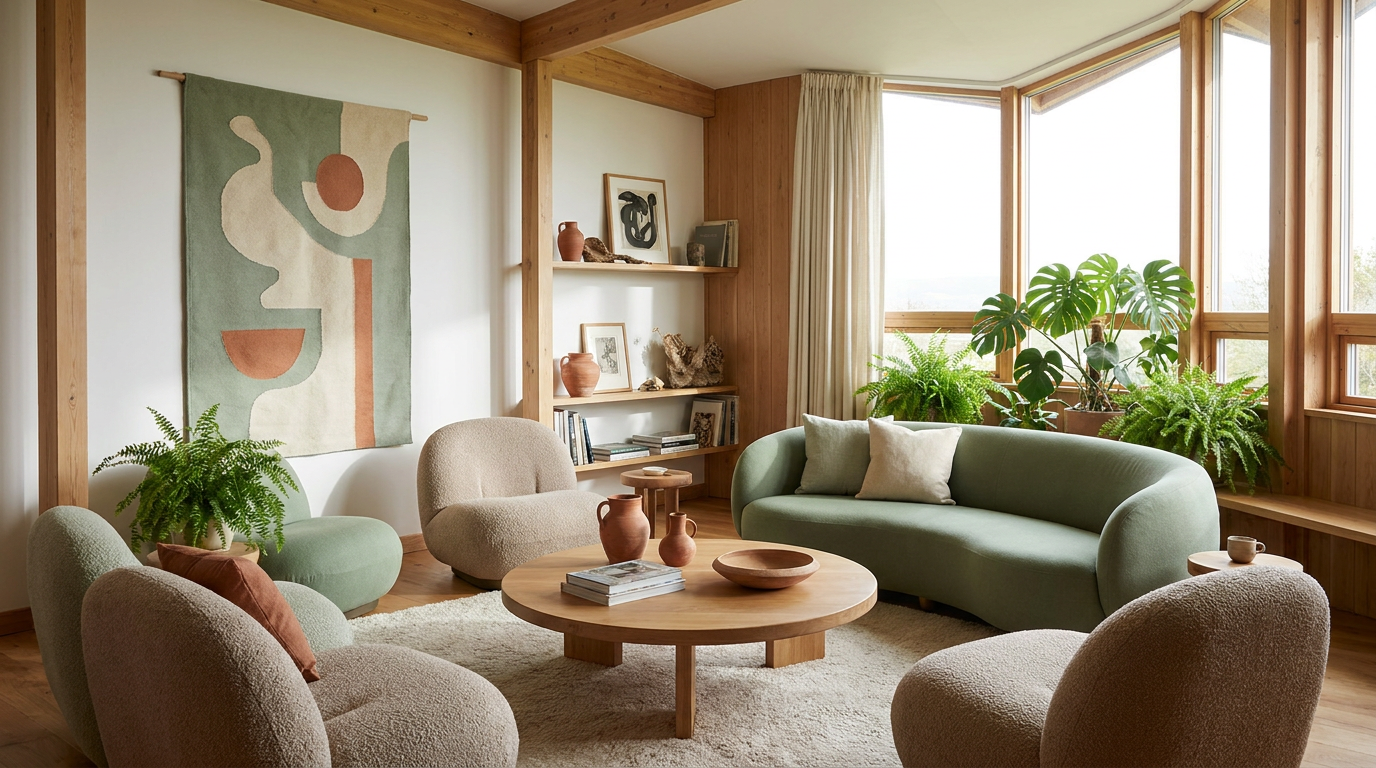
When specific wavelengths of light enter the eye, they stimulate direct neural pathways. Cooler hues like blues and greens activate the parasympathetic nervous system, which slows the heart rate and promotes rest. Warmer tones like reds and oranges stimulate the sympathetic nervous system, increasing alertness, conversation, and vitality.[6]

Shape and form play an equally critical role in our neurological comfort. Studies using EEG and fMRI scans reveal that the human brain strongly prefers curvilinear spaces. Soft edges, rounded furniture, and arched doorways activate the orbitofrontal cortex—a region linked to emotional regulation and pleasure.[7]
Texture and material also speak directly to our biology. The brain instantly interprets surface qualities without us needing to touch them. Visualizing or touching wood grains and woven fabrics stimulates the somatosensory cortex, producing subconscious feelings of warmth, safety, and belonging.[7]
This biological preference for natural elements is known as biophilia. Research consistently demonstrates that incorporating nature-inspired fractal patterns, indoor plants, and natural light can reduce stress hormones by 15 to 20 percent, while simultaneously lowering blood pressure and improving cognitive performance.[6]

The implications of neuroaesthetics extend far beyond residential living rooms. Healthcare architects are increasingly applying these principles to hospitals and behavioral health centers, finding that patients in spaces designed for neurological comfort require less pain medication and recover more quickly than those in windowless, clinical rooms.[5]
As our homes increasingly double as offices, schools, and sanctuaries, the cognitive load placed on our domestic environments has never been higher. A space that constantly triggers low-level stress responses will eventually erode our ability to focus and recharge.[1]
By translating aesthetics into the brain's native language, we can transform our built environments from passive backdrops into active participants in our well-being. Design becomes a scientifically grounded tool for improving quality of life.[7]
The future of interior design is no longer just about making a space look good for a magazine spread. It is about engineering an environment that fundamentally helps us live, heal, and thrive—quietly, every day, and without extra effort.[1]
How we got here
Late 1990s
Advances in brain-scanning technology allow researchers to measure physiological responses to beauty in real-time.
Early 2000s
Neuroscientist Semir Zeki officially coins the term 'neuroaesthetics' to describe the neural circuitry behind artistic perception.
2018
The Academy of Neuroscience for Architecture highlights the shift toward designing medical and residential spaces based on brain science.
2024
Johns Hopkins University's IAM Lab publishes the 'Intentional Space Roadmap,' calling for a formalized neuroarchitecture sector.
Viewpoints in depth
Neuroaesthetics Researchers
Scientists mapping the biological circuitry of beauty.
For researchers at institutions like Johns Hopkins and University College London, interior design is a biological input. They use fMRI machines and biometric sensors to prove that aesthetic experiences are not merely subjective preferences, but evolutionary imperatives. They argue that our brains are hardwired to seek out environments that signal safety, resource abundance, and comfort, and that ignoring these biological needs in modern architecture contributes to chronic stress.
Evidence-Based Designers
Practitioners turning brain science into residential blueprints.
This camp views neuroaesthetics as the ultimate validation of their profession. Rather than relying on intuition or fleeting trends, evidence-based designers use scientific data to justify their choices. They advocate for a 'sensory first' approach, arguing that a room's success should be measured by the occupant's heart rate and cortisol levels rather than its visual perfection in a photograph. For them, design is a form of preventative healthcare.
Healthcare Architects
Specialists applying spatial science to clinical recovery.
Architects designing hospitals and behavioral health centers focus on the therapeutic potential of space. They point to studies showing that patients in rooms with natural light, curvilinear forms, and views of nature require less pain medication and recover faster. This group advocates for overhauling sterile, anxiety-inducing clinical environments, arguing that the building itself should be an active participant in the healing process.
What we don't know
- How individual neurological differences, such as neurodivergence, alter the baseline responses to specific colors and spatial layouts.
- The exact long-term physiological compounding effects of living in a neuroaesthetic environment versus short-term exposure.
- How to perfectly isolate the impact of spatial design from other lifestyle factors in longitudinal health studies.
Key terms
- Neuroaesthetics
- The scientific study of how the brain processes and responds to aesthetic experiences, art, and design.
- Parasympathetic Nervous System
- The network of nerves that relaxes your body after periods of stress or danger, often called the 'rest and digest' system.
- Biophilic Design
- An architectural approach that seeks to connect building occupants more closely to nature through natural light, plants, and organic materials.
- Orbitofrontal Cortex
- A region of the brain involved in emotional regulation and decision-making that lights up when we experience spaces we find beautiful.
- Fractal Patterns
- Complex, repeating geometric patterns found in nature, such as the branching of trees or the veins of a leaf, which the brain finds inherently soothing.
Frequently asked
What exactly is neuroaesthetics?
It is an emerging branch of neuroscience that studies how the human brain processes and responds to beauty, art, and spatial design, measuring physiological changes like heart rate and hormone levels.
How does color physically affect the brain?
Different wavelengths of light trigger distinct neurological responses. Cooler colors activate the calming parasympathetic nervous system, while warm colors stimulate the energizing sympathetic nervous system.
Do I need to buy expensive furniture to apply this?
No. Neuroaesthetic principles can be applied through simple, accessible changes like maximizing natural daylight, incorporating house plants, reducing visual clutter, and using soft, textured fabrics.
Sources
Source coverage
7 outlets
4 viewpoints surfaced







[1]Factlen Editorial TeamFactlen Editorial
Synthesis by Factlen editorial team
Read on Factlen Editorial Team →[2]Johns Hopkins IAM LabNeuroaesthetics Researchers
Center for Applied Neuroaesthetics
Read on Johns Hopkins IAM Lab →[3]National Institutes of HealthNeuroaesthetics Researchers
Neuroaesthetics Evolves: The Biological Impact of Art and Design
Read on National Institutes of Health →[4]Design MilkEvidence-Based Designers
Johns Hopkins University's IAM Lab publishes a report calling for the development of a new interdisciplinary Neuroarchitecture sector
Read on Design Milk →[5]FreethinkHealthcare Architects
Can 'neuroaesthetics' make healthcare more effective?
Read on Freethink →[6]Science in DesignEvidence-Based Designers
The Complete Guide to Neuroaesthetics for Interior Designers
Read on Science in Design →[7]ArchDailyHealthcare Architects
Neuroaesthetics and Neuroarchitecture: Shaping Mental Health Through Space
Read on ArchDaily →
Every angle. Every day.
Get home stories with full source coverage and perspective breakdowns delivered to your inbox.