
Massive 2.5 Million Child Study Finds No Link Between Early MMR Vaccination and Autism Risk
A comprehensive analysis of 2.5 million U.S. children confirms that receiving the MMR vaccine before age two does not increase the risk of autism. The findings arrive as U.S. measles cases hit a 35-year high, underscoring the dangers of delaying routine childhood immunizations.
By Factlen Editorial Team
- Medical Consensus
- Emphasizes the overwhelming statistical evidence that vaccines are safe and do not cause autism.
- Public Health Advocates
- Focuses on the urgent need to vaccinate children on schedule to prevent deadly measles outbreaks.
- Political Observers
- Highlights the tension between definitive scientific findings and the skepticism expressed by some political leaders.
Why this matters
For parents anxious about vaccine safety, this massive dataset provides definitive mathematical reassurance that delaying the MMR shot offers no protective benefit against autism. Instead, delaying vaccination leaves children vulnerable to highly contagious and potentially severe diseases during a year of record-breaking measles outbreaks.
Key points
- A study of 2.56 million U.S. children found no association between receiving the MMR vaccine before age two and an autism diagnosis.
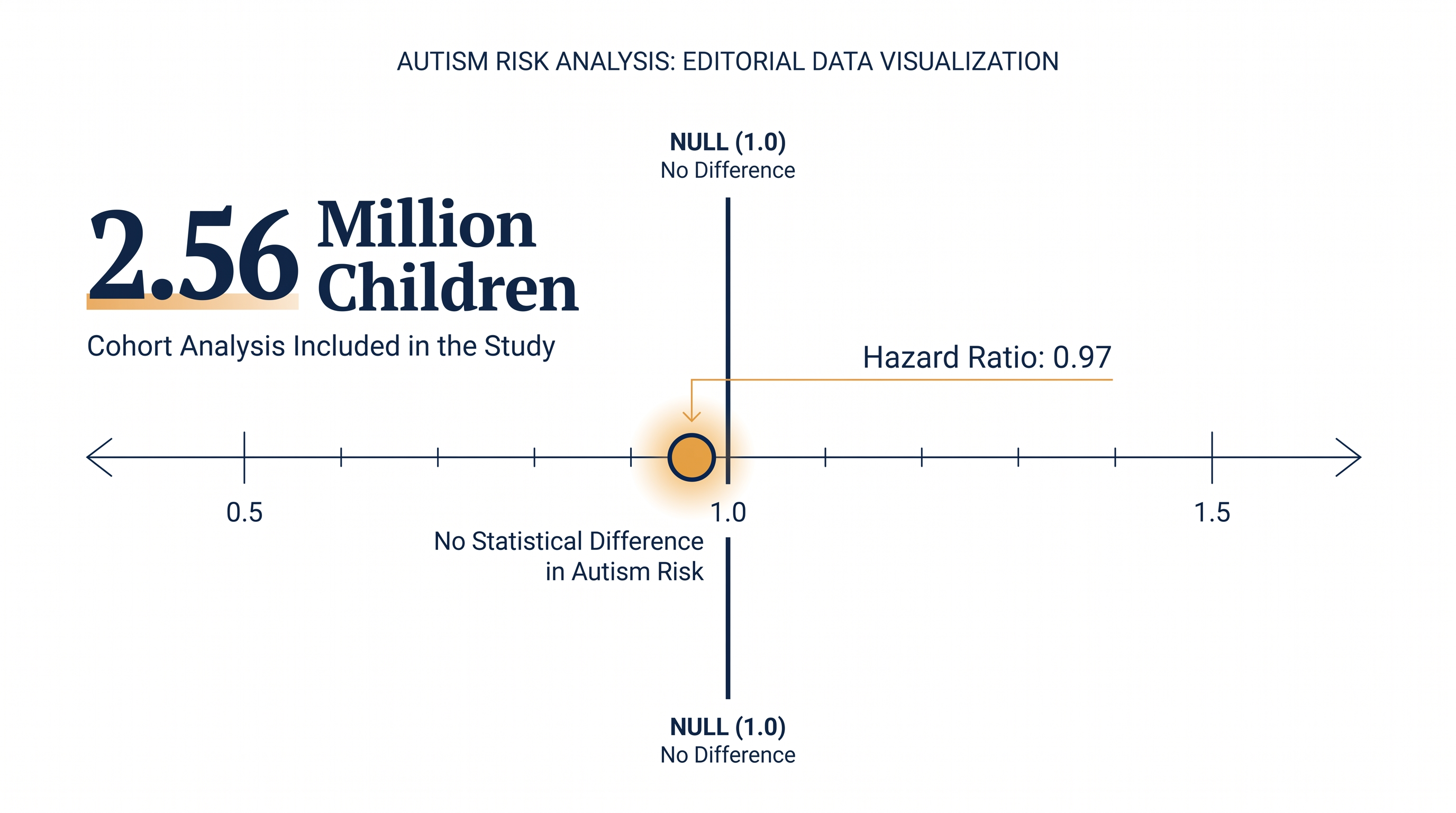
- The adjusted hazard ratio was 0.97, indicating statistically zero difference in autism risk between vaccinated and unvaccinated children.
- Researchers used a negative control vaccine—the pneumococcal booster—which yielded the exact same result, proving the methodology was free of hidden biases.
- The findings arrive as the U.S. battles a 35-year high in measles cases, with 93 percent of infections occurring in unvaccinated individuals.
A monumental new study of more than 2.5 million children in the United States has delivered a definitive verdict on a persistent parental anxiety: receiving the measles, mumps, and rubella (MMR) vaccine before the age of two does not increase the likelihood of an autism diagnosis. The research, led by scientists at the University of Washington, analyzed a vast trove of electronic health records to provide one of the most statistically powerful reassurances of vaccine safety to date.[1][4][6]
While decades of research have already debunked the broader myth that vaccines cause autism, this new paper targeted a narrower, highly practical question that many parents still ask pediatricians: Is it safer to delay the first MMR shot? Some parents, acting out of an abundance of caution, choose to push the vaccination back a few months or years. The researchers specifically looked at children who received their first MMR dose between 11.5 and 24 months of age to see if early administration carried any hidden risks.[1][6]
The data provided a flatly reassuring answer. Across the 2,560,035 children followed to age eight, the adjusted hazard ratio for an autism diagnosis was 0.97. In statistical terms, this means the risk was about 3 percent lower in the vaccinated group compared to those who had not yet been vaccinated—a difference so small that it comfortably includes "no change at all." The honest reading of the data is that early MMR vaccination neither raised nor lowered the risk of autism.[6]
Answering this question is notoriously difficult because observational studies are easily skewed by human behavior. Children who receive their vaccines exactly on schedule tend to see doctors more frequently, which might lead to higher rates of early diagnoses for any condition. Conversely, children whose parents already notice early signs of developmental delays might intentionally postpone vaccinations. These patterns can make a perfectly safe vaccine look falsely risky, or vice versa.[6]
To ensure their findings were not the result of these hidden behavioral biases, the University of Washington team deployed a clever methodological check. They ran the exact same analysis on a completely different shot: the pneumococcal booster, which is typically given between 12 and 15 months of age and has never been widely associated with autism fears. The negative control test yielded the exact same near-null result, proving that the study's methodology was sound and not simply picking up on background noise.[6]
The publication of these findings arrives at a critical and fraught moment for public health in the United States. Federal data reveals that routine childhood vaccination rates have been steadily declining since the onset of the COVID-19 pandemic. Consequently, the U.S. is experiencing a record-breaking year for measles, a highly contagious and potentially life-threatening respiratory virus.[1][2][3]
The Centers for Disease Control and Prevention (CDC) has reported 2,371 measles cases so far in 2026, marking the highest number of infections since 1991. Crucially, 93 percent of these cases have occurred in unvaccinated individuals. Measles is so infectious that a single case in an undervaccinated community can rapidly spiral into a widespread outbreak, making herd immunity essential for protecting infants who are too young to receive the shot.[1][2]
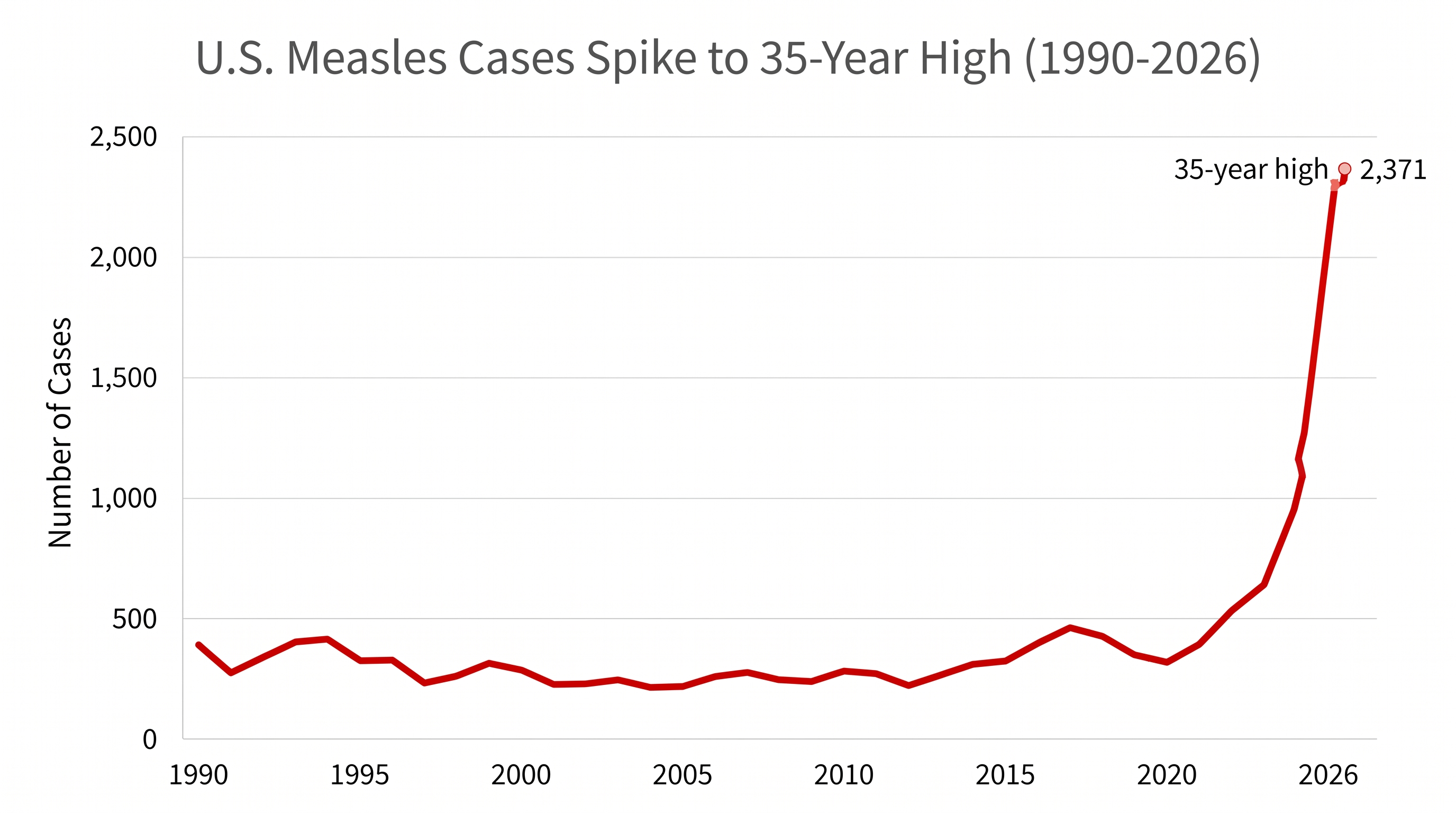
The Centers for Disease Control and Prevention (CDC) has reported 2,371 measles cases so far in 2026, marking the highest number of infections since 1991.
For parents weighing whether to delay their child's first MMR shot, the study's authors emphasize that the choice is not neutral. Waiting to vaccinate buys no reduction in autism risk, but it comes with a steep cost: it leaves a young child entirely unprotected against measles during the exact months when they could otherwise be safely covered.
The scientific reassurance also lands amid a turbulent political environment regarding public health messaging. The debate surrounding vaccine safety has recently resurfaced in the national spotlight, fueled by mixed messages from high-level officials. Health and Human Services Secretary Robert F. Kennedy Jr. has historically questioned the scientific consensus on vaccines and autism, though he recently acknowledged the efficacy of the MMR vaccine in halting measles outbreaks.[2][3]
In recent interviews, Secretary Kennedy encouraged parents to vaccinate their children against measles, noting that the shot is effective in about 97 percent of cases. However, he simultaneously continued to question decades of established research regarding the safety of vaccines, illustrating the ongoing tension between the medical community's consensus and the skepticism harbored by some political figures.[1][3]
The persistent fear linking the MMR vaccine to autism traces its roots back to a heavily flawed and since-retracted 1998 paper by British gastroenterologist Andrew Wakefield. That paper, which relied on manipulated data from just 12 children, sparked a global panic. Despite the paper being thoroughly discredited and its author stripped of his medical license, the psychological seed of doubt proved incredibly difficult to uproot from the public consciousness.[3][5]
Modern medical science has since illuminated why vaccines do not cause autism. Autism spectrum disorder is a complex neurodevelopmental condition with strong, well-documented genetic roots. Advanced imaging and genetic studies indicate that the foundational brain changes associated with autism often begin in utero, long before a child is born, let alone before they receive their first childhood immunizations.[5]
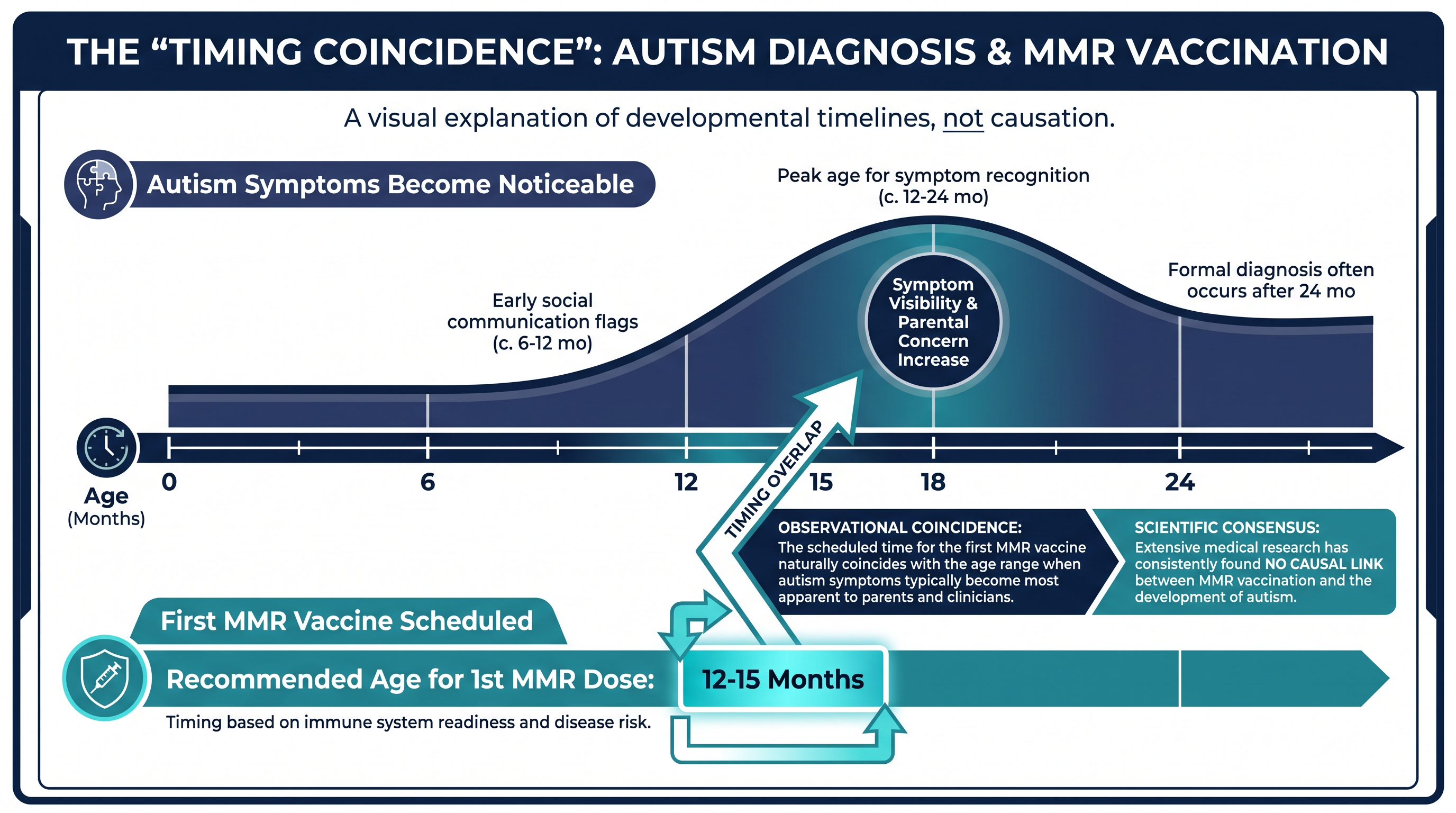
The persistence of the vaccine-autism myth is largely driven by a cruel trick of timing. The behavioral symptoms of autism—such as delayed speech, lack of eye contact, or repetitive movements—typically become noticeable to parents and pediatricians between 12 and 24 months of age. This happens to be the exact same window when children receive their first dose of the MMR vaccine, leading the human brain to falsely link the two events as cause and effect.[5]
The University of Washington study highlights the immense value of modern electronic health records (EHRs) in settling these long-standing medical debates. By utilizing the Cosmos database, researchers were able to track the real-world outcomes of millions of children across diverse demographics and healthcare systems. This massive scale provides a level of statistical certainty that smaller clinical trials simply cannot achieve.[4][6]
Ultimately, the latest research adds a definitive chapter to one of the largest bodies of evidence in modern medicine. Independent studies conducted across different countries, healthcare systems, and decades have repeatedly arrived at the exact same conclusion. The MMR vaccine is safe, it is highly effective, and administering it on schedule is the best way to protect a child's health.[3][5]
How we got here
1998
A British medical journal publishes a fraudulent paper by Andrew Wakefield falsely linking the MMR vaccine to autism, sparking global panic.
2010
The Lancet officially retracts Wakefield's 1998 paper after investigations reveal the data was manipulated and unethical.
January 2015
The start date for the medical records analyzed in the new University of Washington study, tracking children born over the next decade.
Early 2026
U.S. measles cases begin to surge, eventually reaching a 35-year high of 2,371 infections.
August 2026
Researchers publish the massive 2.5 million child study, definitively showing no link between early MMR vaccination and autism.
Viewpoints in depth
Medical Researchers
Focuses on the rigorous methodology and sheer scale of the 2.5 million cohort study.
For the scientific community, the value of this study lies in its unprecedented statistical power and rigorous design. By analyzing over 2.5 million children and utilizing a negative control vaccine, researchers were able to strip away the behavioral biases that often plague observational studies. They argue that a hazard ratio of 0.97 effectively closes the door on the hypothesis that delaying the MMR vaccine offers any protective benefit, providing absolute mathematical reassurance.
Public Health Officials
Emphasizes the urgent real-world stakes of declining vaccination rates amid rising measles cases.
Public health advocates view the study not just as an academic victory, but as a critical tool for combating a live crisis. With U.S. measles cases hitting a 35-year high and 93 percent of infections occurring in unvaccinated individuals, officials stress that delaying the MMR shot is a dangerous gamble. They argue that the persistent fear of a debunked autism link is directly leading to preventable outbreaks of a highly contagious and potentially fatal disease.
Vaccine Skeptics & Political Figures
Continues to question the established medical consensus despite overwhelming data.
Despite the massive scale of the new study, some political figures and advocacy groups maintain a posture of skepticism toward the medical establishment. Figures like HHS Secretary Robert F. Kennedy Jr. have acknowledged that the MMR vaccine effectively stops measles, yet they continue to call for more investigations into the vaccine-autism link. This perspective often argues that institutional science is ignoring hidden variables, reflecting a broader distrust of federal health agencies.
What we don't know
- It remains unclear how the latest scientific findings will influence the public messaging of political figures who have historically questioned vaccine safety.
- Researchers do not yet know the exact combination of genetic and environmental factors that cause autism, though the foundational brain changes are known to begin in utero.
Key terms
- Hazard Ratio
- A statistical measure used to compare the risk of an event happening in one group versus another over time; a ratio of 1.0 means there is no difference in risk.
- Retrospective Cohort Study
- A type of research design that looks back at existing medical records of a specific group of people to identify links between past exposures and current outcomes.
- Electronic Health Record (EHR)
- A digital version of a patient's paper chart, allowing researchers to analyze massive amounts of real-world health data securely and anonymously.
- Negative Control
- A test group or condition in an experiment where no effect is expected, used to prove that the research methods aren't accidentally creating false results.
- Herd Immunity
- When a high enough percentage of a population is vaccinated against a disease, making its spread unlikely and protecting those who cannot be vaccinated.
Frequently asked
Does delaying the MMR vaccine reduce the risk of autism?
No. The study of 2.5 million children found that receiving the vaccine between 11.5 and 24 months did not increase autism risk, meaning there is no protective benefit to waiting.
Why do people think the MMR vaccine causes autism?
The fear largely stems from a fraudulent and retracted 1998 study by Andrew Wakefield. Additionally, autism symptoms naturally become noticeable around 12 to 24 months of age, which coincides with the standard vaccination schedule.
How many measles cases are there in the US right now?
The CDC has reported 2,371 measles cases in 2026, marking a 35-year high. Approximately 93% of these cases are in unvaccinated individuals.
What was the "negative control" in this study?
Researchers tested the pneumococcal booster, a different vaccine given at the same age that is not associated with autism fears. It showed the exact same lack of risk, proving the study's methodology was accurate.
Sources
Source coverage
6 outlets
3 viewpoints surfaced






[1]CIDRAPPublic Health Advocates
No link between MMR vaccination before age 2 and autism, large US study suggests
Read on CIDRAP →[2]The IndependentPolitical Observers
Massive new study delivers fresh verdict on MMR vaccine and autism
Read on The Independent →[3]Yahoo NewsPolitical Observers
There is no link between receiving the measles, mumps and rubella (MMR) vaccine before age 2 and being diagnosed with autism
Read on Yahoo News →[4]Technology NetworksMedical Consensus
No Link Between MMR Vaccine and Autism, Study Finds
Read on Technology Networks →[5]Rejoy HealthMedical Consensus
Large Study Finds No Association Between MMR Vaccine and Autism
Read on Rejoy Health →[6]Pediatric Infectious Disease JournalMedical Consensus
Association Between First MMR Vaccination Before Age 2 Years and Childhood Autism in a U.S. EHR Cohort of 2.5 Million Children
Read on Pediatric Infectious Disease Journal →
Comments
Every angle. Every day.
Get health stories with full source coverage and perspective breakdowns delivered to your inbox.