
AI Copyright Lawsuits Top 100 as Courts Adopt 'Market Harm' Standard for Training Data
With over 118 active copyright lawsuits against AI companies, federal courts are coalescing around a 'market harm' standard to determine fair use. The legal focus has shifted from the backend ingestion of training data to whether AI outputs economically substitute for original human creations.
By Factlen Editorial Team
- AI Developers
- Advocates for broad fair use protections to enable the training of frontier AI models.
- Copyright Holders
- Advocates for strict licensing requirements and protection against AI-generated market dilution.
- Legal Analysts
- Focuses on the nuanced application of existing fair use precedent to novel AI technologies.
Why this matters
The establishment of a 'market harm' standard provides much-needed clarity for both technology builders and creative professionals. By shifting the legal focus to economic substitution, courts are creating a framework where AI innovation can proceed while protecting the actual livelihoods of human creators.
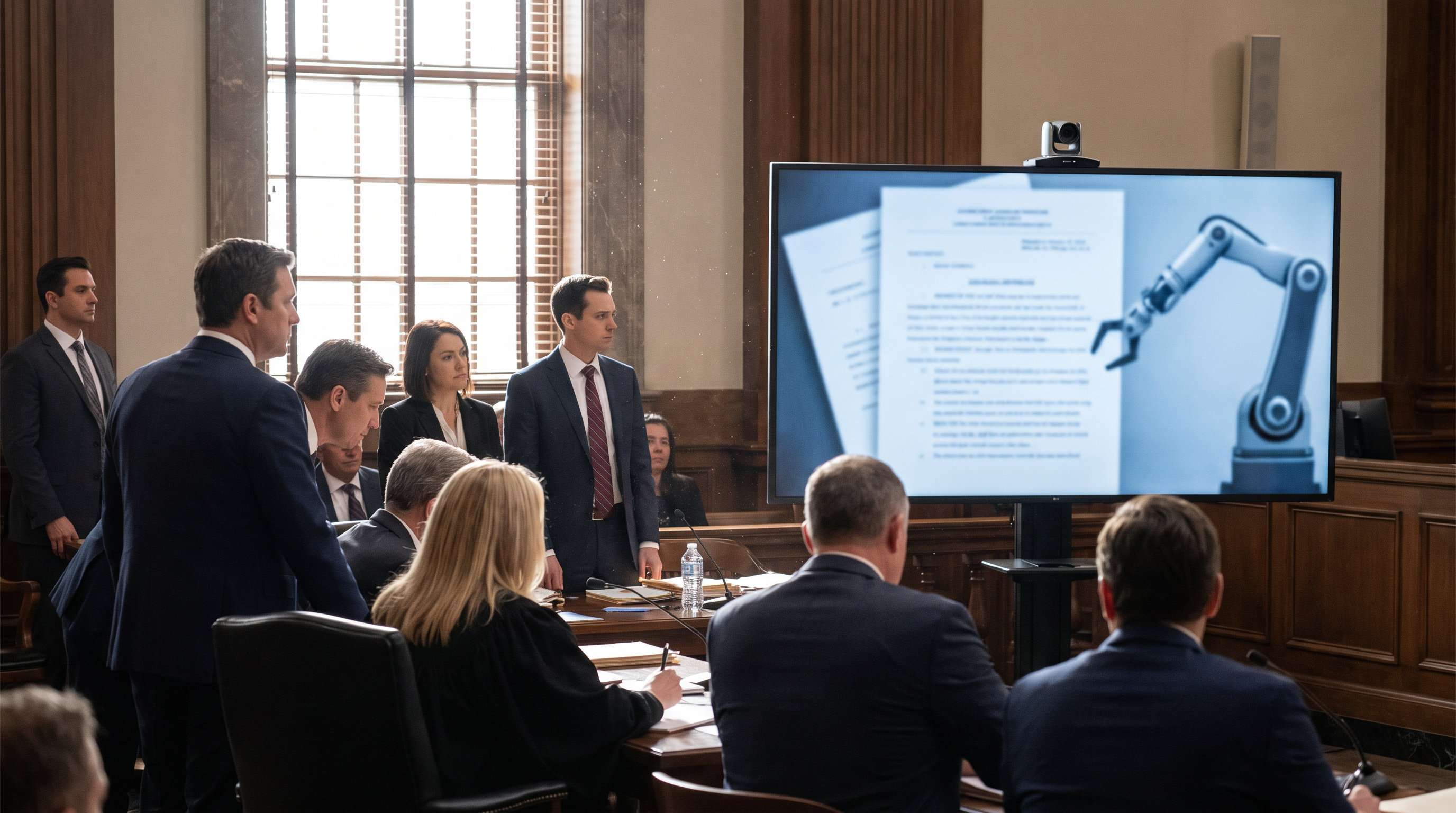
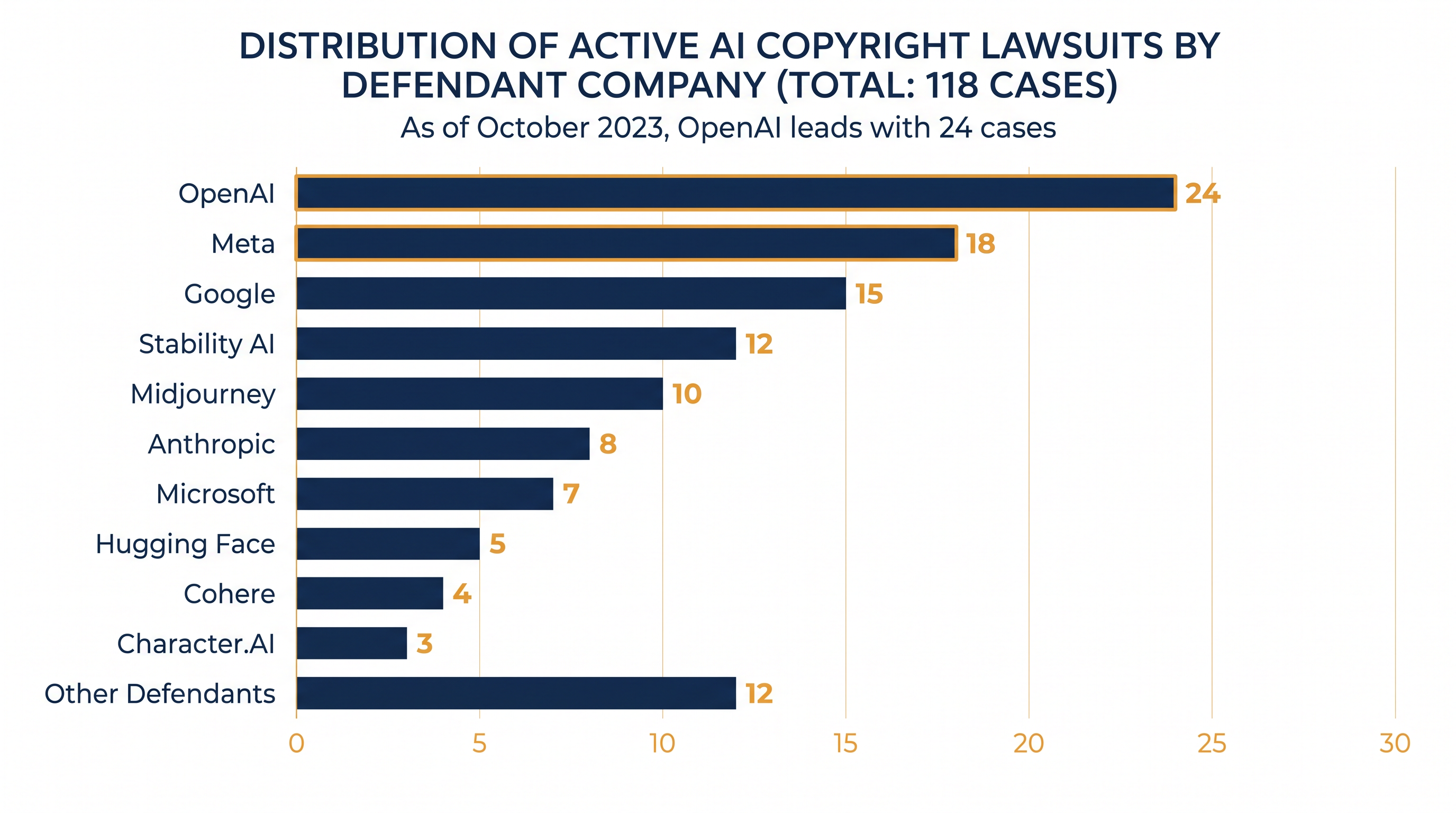
The legal collision between artificial intelligence and intellectual property has officially reached a historic milestone. As of mid-2026, the number of active copyright lawsuits filed against generative AI companies in the United States has surpassed 100, with legal trackers identifying 118 parallel cases winding through federal courts. This unprecedented volume of litigation represents the most significant stress test of American copyright law since the advent of the internet, pitting the world's most valuable technology companies against authors, publishers, musicians, and visual artists.[6]
This wave of litigation, targeting industry leaders like OpenAI, Meta, Anthropic, and Midjourney, initially seemed poised to outlaw generative AI entirely. Early plaintiffs argued that the mere act of ingesting copyrighted works to train a large language model constituted massive, willful infringement. They contended that because a model's weights are mathematically derived from human expression, the resulting software is essentially an unauthorized derivative work. Under this early theory, developers would require a bespoke license for every single piece of data consumed during the multi-month training phase, a logistical impossibility that would effectively halt the development of frontier AI models.[2][4]
But as these cases have matured past initial motions to dismiss, the federal judiciary has begun to coalesce around a more nuanced, fact-specific framework. Courts are increasingly adopting a "market harm" standard to determine whether AI training qualifies as fair use, shifting the legal battleground from the backend ingestion of data to the economic impact of the AI's output. This shift acknowledges that while AI companies are undeniably copying data, the legal consequence of that copying depends entirely on whether the resulting product competes with the original human creator.[1][3]
To understand this judicial shift, one must look at the bedrock of United States copyright defense: the fair use doctrine. Fair use allows the limited, unlicensed use of protected works under certain conditions, primarily to foster innovation, commentary, criticism, and education. It is the legal mechanism that allows a book reviewer to quote a novel, or a search engine to display snippets of a website. For AI developers, fair use is the only viable shield against statutory damages that could easily reach into the trillions of dollars.[5]
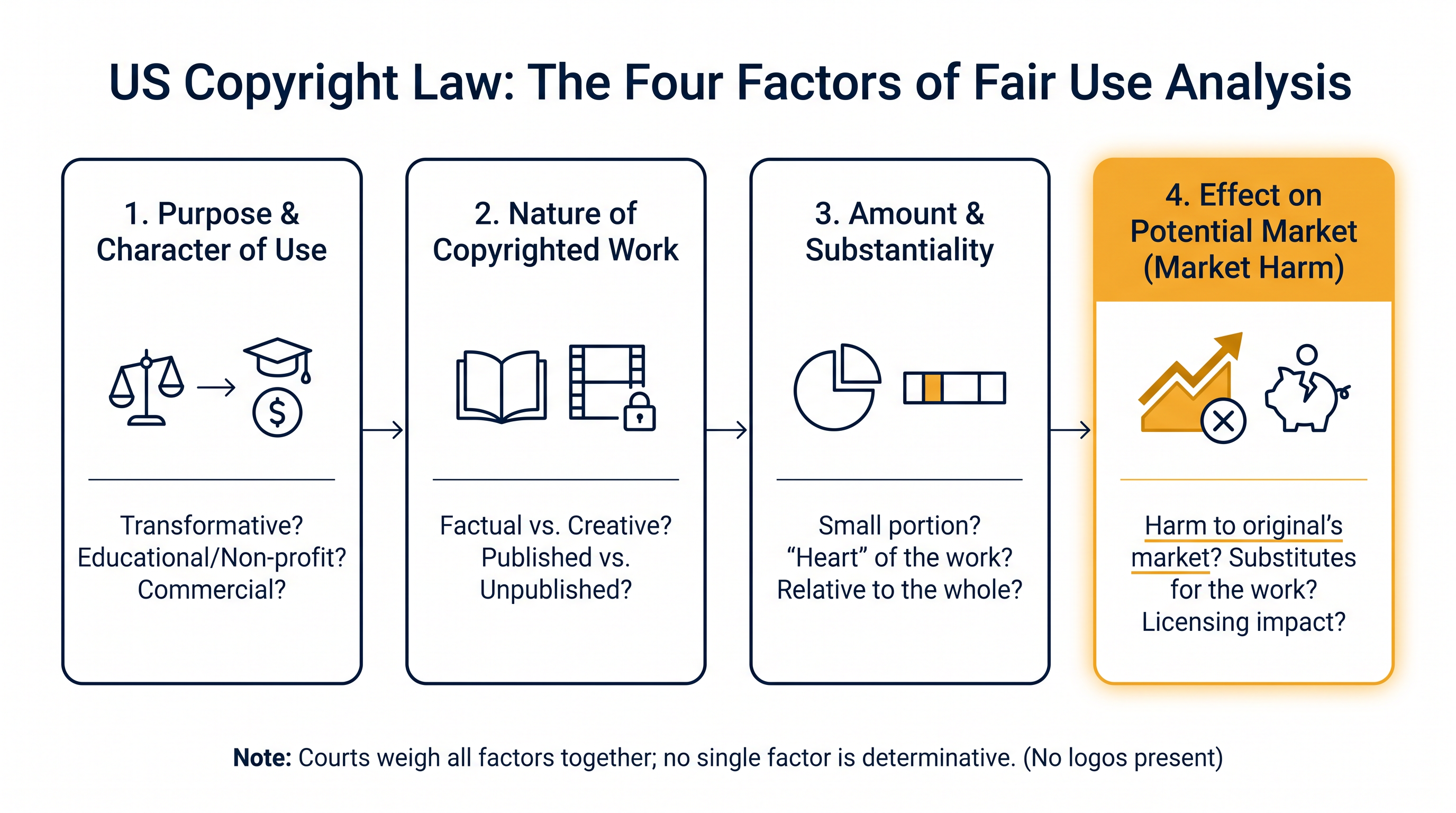
Judges evaluate fair use claims using a strict four-factor test mandated by Congress. Factor one examines the purpose and character of the use, specifically whether the new application is "transformative" and adds new meaning or utility. Factor two looks at the nature of the copyrighted work itself, offering more protection to highly creative fiction than to factual compilations. Factor three assesses the amount and substantiality of the portion used in relation to the whole. Finally, factor four evaluates the effect of the use upon the potential market for, or value of, the original copyrighted work.[5]
In the first wave of major rulings—such as the landmark 2025 decisions in Bartz v. Anthropic and Kadrey v. Meta—federal judges in California signaled that the first factor heavily favors AI developers. Training an artificial intelligence model to understand language patterns, syntax, and conceptual relationships is generally viewed by the courts as a highly transformative purpose. The judges reasoned that the AI is not reading the books for entertainment or human education, which was the author's original purpose, but rather analyzing them as raw computational data to build a new technological tool.[1][4]
With the transformative nature of AI training largely recognized by the courts, the legal spotlight has intensely focused on factor four: market harm. Legal scholars and intellectual property practitioners now view this economic test as the definitive standard that will make or break the generative AI industry. If a court finds that an AI model's outputs serve as a direct market substitute for the works it was trained on, the transformative nature of the backend training will not be enough to save the developer from crippling infringement liability.[1][3]
The market harm standard asks a deceptively simple question: does the artificial intelligence system's output substitute for the original work in the commercial marketplace? If a consumer can prompt an AI chatbot to generate a product that perfectly satisfies their need for the plaintiff's specific copyrighted material, the fair use defense begins to crumble. This forces courts to look at what the AI actually produces when prompted by users, rather than just looking at the massive datasets sitting on corporate servers.[3]
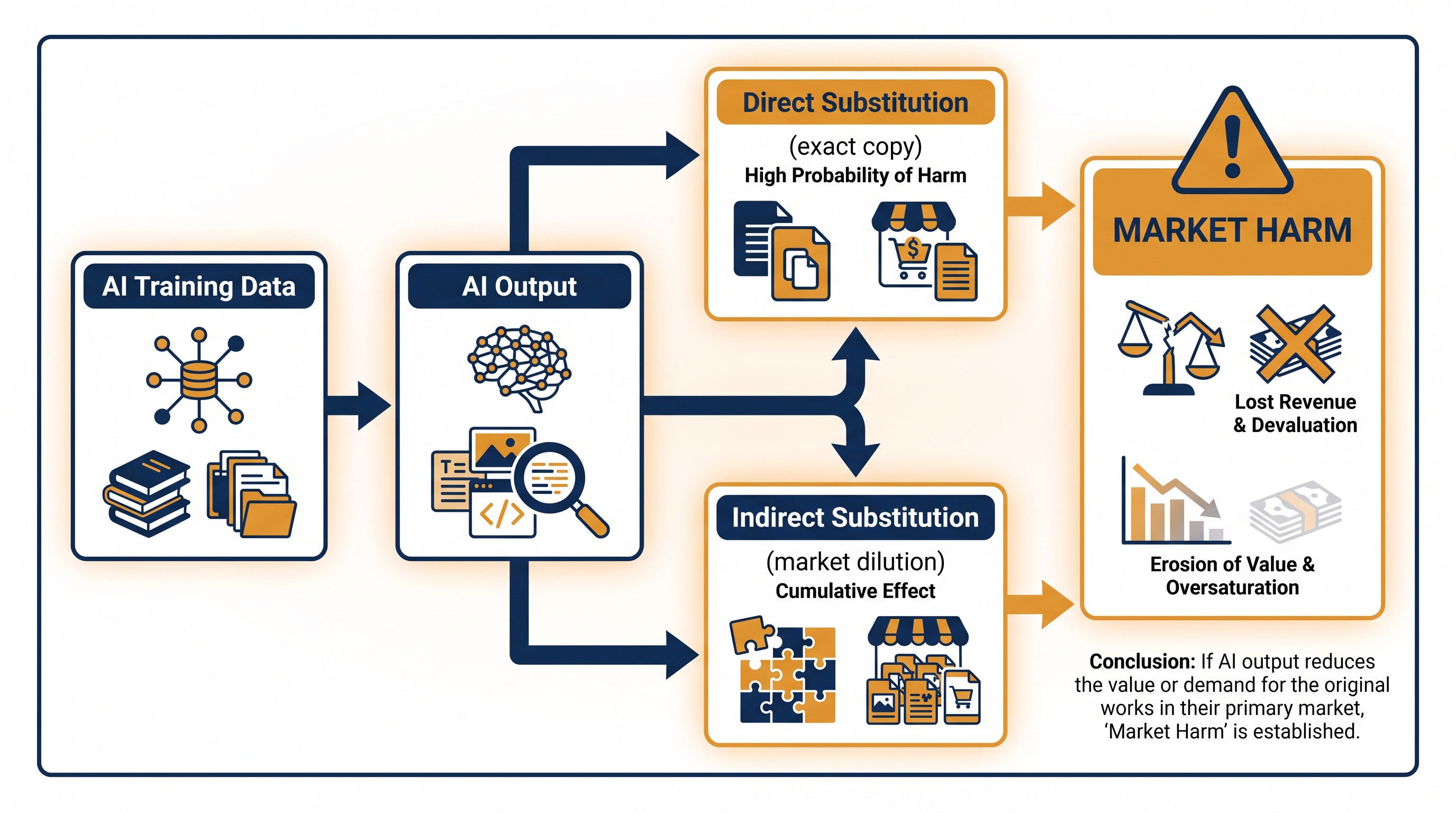
Courts have identified two primary theories of market harm in these complex disputes. The first is "direct substitution," which occurs if an AI model regurgitates exact or near-exact copies of the training data. If a user prompts a model and it outputs the verbatim text of a Stephen King novel or a paywalled New York Times investigation, it directly replaces the consumer's need to purchase that original content. Direct substitution is universally recognized as fatal to a fair use defense.[1]
Courts have identified two primary theories of market harm in these complex disputes.
However, because leading AI developers have implemented strict guardrails to prevent direct regurgitation of training data, plaintiffs are increasingly relying on a second, more expansive theory: "indirect substitution" or "market dilution." Under the market dilution theory, creators argue that even if an AI does not output exact copies, it generates stylistically similar works at such a massive scale and low cost that it effectively crowds human creators out of their own markets. For instance, if an AI can instantly generate a 100-page murder mystery in the exact style of a bestselling author for mere pennies, the market for that author's future original works is arguably diluted and devalued.[1]
Judge Vince Chhabria, presiding over the Kadrey v. Meta litigation, explicitly recognized indirect substitution as a cognizable harm under the fourth fair use factor. He noted in his ruling that if plaintiffs can present concrete evidence that AI-generated works are successfully crowding out lesser-known authors or depressing the overall market for human-authored books, the fair use defense could fail. This ruling opened the door for plaintiffs to survive early motions to dismiss by plausibly alleging that generative AI models are flooding the market with cheap, synthetic substitutes.[1]
Proving this dilution, however, remains a steep evidentiary hurdle for the creative class. Plaintiffs must demonstrate actual, quantifiable economic damage linked specifically to the AI's outputs, rather than relying on hypothetical fears of future competition. In several early dismissals, federal judges chided plaintiffs for failing to provide meaningful evidence that AI outputs were actually serving as market substitutes for their specific books, noting that a generalized fear of technological progress does not constitute legal market harm under the Copyright Act.[1][4]
Another critical dimension of the evolving market harm standard involves the provenance of the training data itself. While courts have shown a willingness to protect AI training under fair use when the data is legally acquired, that judicial protection evaporates entirely if the underlying data was obtained through piracy. The courts have drawn a sharp distinction between scraping publicly available websites and downloading massive archives of stolen intellectual property to bypass paywalls and licensing fees. If a developer uses pirated data, the market harm is considered inherent, as they have actively circumvented the legitimate retail market for those works.[4][5]
This distinction is at the heart of a massive class-action lawsuit filed in May 2026 by five major publishing houses—including Elsevier, Macmillan, and McGraw Hill—against Meta Platforms. The publishers allege that Meta deliberately utilized "shadow libraries," such as the notorious Books3 dataset, which contain millions of pirated books stripped of their digital rights management protections. By focusing on the unlawful acquisition of the data rather than just the training process, the publishers are attempting to bypass the transformative use defense entirely.[7]
Legal analysts note that using pirated materials severely weakens an AI company's fair use defense, regardless of how advanced the resulting model becomes. As one federal judge noted in an earlier ruling, the retention and use of inherently pirated copies is "irredeemably infringing." Even if the AI model never outputs a single line of a pirated book, the act of downloading and storing a shadow library to avoid paying for the books constitutes a direct harm to the publishers' primary retail market.[4]
The plaintiffs in these newer cases are also testing a third theory of market harm: the destruction of the licensing market. They argue that by scraping data for free, AI companies are bypassing a legitimate, emerging market for licensing training data. Major platforms like Reddit, Stack Overflow, and various news conglomerates have already established multi-million dollar licensing agreements with AI developers. Plaintiffs argue this proves that a viable, lucrative market for training data exists, and that unauthorized scraping directly deprives creators of this new revenue stream, satisfying the fourth factor's requirement for market harm.[1][3]
However, courts have so far viewed the licensing market argument with a degree of skepticism. Several judges have noted that a copyright holder is not legally entitled to monopolize a theoretical licensing market that only exists because of the defendant's new technological invention. If the underlying use of the data is deemed fair use, the AI company is not legally obligated to pay a licensing fee, making the argument somewhat circular. The courts are demanding proof of harm to the original market, not just the loss of a hypothetical windfall.[1][3]
To manage the sheer volume and complexity of these overlapping disputes, the federal judicial system has begun aggressively consolidating cases. The Judicial Panel on Multidistrict Litigation recently transferred dozens of lawsuits against OpenAI—which currently faces at least 24 separate copyright actions—into a single venue in the Southern District of New York under Judge Sidney H. Stein. This consolidation aims to prevent inconsistent rulings on the core fair use questions and streamline the massive discovery process required to audit AI training runs.[6]
This multidistrict litigation forces plaintiffs to unify their theories of market harm, presenting a cohesive economic argument against the AI giant rather than a fractured series of individual complaints. It also allows the court to establish a unified standard for what constitutes acceptable evidence of market dilution, setting a precedent that will likely govern the entire generative AI industry for the next decade. The outcome of this consolidated docket will serve as the definitive guide for how copyright law applies to machine learning.[6]
As 2026 progresses, the generative AI industry is operating under a new, clearer legal reality. The existential threat that all AI training is inherently illegal has largely faded, replaced by a rigorous, evidence-based economic standard. AI developers must now ensure their training data is legally acquired and, crucially, that their models are designed to assist human creativity rather than economically replace it. The era of reckless data scraping has ended, giving way to an era of calculated legal compliance and market coexistence.[3][5]
Viewpoints in depth
AI Developers' View
Generative AI training is a highly transformative process that analyzes data for patterns, not for human consumption.
AI companies argue that their models do not store or reproduce the copyrighted works they ingest. Instead, they extract mathematical patterns to build a completely new technological tool. They maintain that this backend analysis is the ultimate 'transformative use' under copyright law, and that forcing them to license billions of data points would make the development of frontier AI impossible and cede technological leadership to other nations.
Copyright Holders' View
AI models are commercial products built on uncompensated human labor that now threaten to replace the original creators.
Authors, publishers, and artists argue that AI companies have executed the largest mass-theft of intellectual property in history. They contend that 'market harm' is already occurring, as AI models can instantly generate stylistically similar text, code, and images that dilute the market for human creators. Furthermore, they argue that AI companies are deliberately destroying a lucrative new market for licensing training data by scraping it for free.
Legal Scholars' View
The fair use doctrine is flexible enough to handle AI, but courts must carefully balance innovation with creator protection.
Intellectual property experts observe that courts are correctly moving away from blanket bans on AI training and toward a nuanced, output-focused analysis. Scholars emphasize that the 'market harm' standard forces a necessary compromise: AI developers can build their models, but they must implement strict guardrails to prevent direct regurgitation and ensure they are not simply building synthetic substitutes for the human creators whose data they relied upon.
What we don't know
- How courts will precisely quantify 'indirect substitution' or market dilution when an AI generates a work in the style of a specific author.
- Whether the Supreme Court will eventually take up an AI copyright case to establish a binding national precedent on the four fair use factors.
- How international jurisdictions, which often lack a broad 'fair use' equivalent, will align with the emerging US market harm standard.
Sources
Source coverage
7 outlets
3 viewpoints surfaced







[1]Ropes & GrayAI Developers
A Tale of Three Cases: How Fair Use Is Playing Out in AI Copyright Lawsuits
Read on Ropes & Gray →[2]ETB LawCopyright Holders
Fair Use and AI Training
Read on ETB Law →[3]AI VortexLegal Analysts
AI Copyright Training Data Lawsuits 2026: Status and Risk Map
Read on AI Vortex →[4]Baker BottsLegal Analysts
Fair Use in Current Artificial Intelligence Lawsuits
Read on Baker Botts →[5]Knobbe MartensAI Developers
AI Training and Fair Use
Read on Knobbe Martens →[6]ChatGPT Is Eating The WorldLegal Analysts
AI Status Copyright Cases Tracker
Read on ChatGPT Is Eating The World →[7]Holland & KnightCopyright Holders
Major Publishing Houses Sue Meta Over AI Training
Read on Holland & Knight →
Comments


Every angle. Every day.
Get ai stories with full source coverage and perspective breakdowns delivered to your inbox.