
Mapping the Power Law: How Network Hubs Drive Viral Spread and Why True Scale-Free Structures Are Rare
While the concept of scale-free networks has driven two decades of viral marketing and epidemiology, comprehensive data analysis reveals that pure power-law distributions are exceptionally rare in the real world.

Share this story
In short
- The 1999 Barabási-Albert model popularized the idea that most complex networks follow a scale-free power law.
- This theory became the mathematical foundation for tech industry promises of infinite viral marketing spread.
- A comprehensive 2019 analysis of 927 networks found that only 4 percent strictly fit the scale-free definition.
For a network to truly drive viral spread through a pure power-law distribution, a strict mathematical condition must hold: new nodes must continuously and preferentially attach to already well-connected hubs without any capacity limits. If this mechanism breaks down due to physical constraints or algorithm changes, the network cannot sustain a scale-free structure. Empirical analysis of real-world systems—from social media platforms to biological ecosystems—demonstrates that this unbounded condition almost never exists in nature.[2][4]
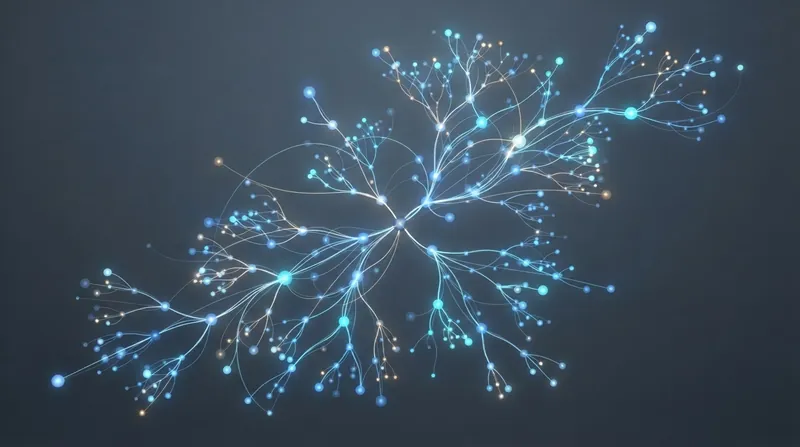
The modern fascination with these structures began in 1999, when physicists Albert-László Barabási and Réka Albert published a seminal paper in the journal Science. They proposed that complex systems organize themselves through a "rich get richer" dynamic, creating a topology where a few highly connected hubs dominate the landscape. This model suggested that the World Wide Web, citation networks, and social circles all shared a universal architecture governed by a power law.[1]
This theoretical framework quickly escaped academia and became a foundational doctrine for the technology sector. Marketing agencies and platform engineers adopted the scale-free model to promise exponential, viral spread for content and products. The logic dictated that if a message reached a massive hub—a user with millions of connections—it would cascade effortlessly through the rest of the network, bypassing the need for traditional, linear distribution channels.[4]
However, as data collection improved, network scientists began to adopt a more skeptical, curious approach to these claims. Researchers started distinguishing between the theoretical capability of a mathematically perfect power law and the actual, messy topologies of shipped digital platforms. The marketing language of guaranteed virality often relied on assumptions that did not survive rigorous statistical testing.[3]
The most comprehensive challenge to the scale-free consensus arrived via a 2019 study published in Nature Communications by Anna Broido and Aaron Clauset. The researchers analyzed a massive dataset of 927 diverse real-world networks, applying strict statistical criteria to determine if their degree distributions genuinely followed a power law. Their methodology required the data to fit the model across multiple orders of magnitude, rather than just approximating a curve on a graph.[2]
The results dismantled the prevailing assumption of universality. Broido and Clauset found that only 4 percent of the analyzed networks exhibited "strong" evidence of being scale-free. Another 39 percent showed weak evidence, while the majority—57 percent—were definitively not scale-free. The mathematical signature that had defined two decades of network theory was revealed to be an exception rather than the rule.[2]
Reporting on the shift in consensus, Quanta Magazine highlighted the friction between the elegant theory and the empirical reality. In 2018, discussing the preliminary findings, Clauset noted that while the scale-free concept was highly influential, researchers had found "scant evidence of power laws" when applying rigorous statistical tools to actual network data. The gap between the announced universality of the model and the verified reality of the networks was substantial.[3]
The primary reason real networks deviate from the Barabási-Albert model is the physical and cognitive cost of maintaining connections. In a pure scale-free network, a hub can acquire infinite links. In reality, a router has a limited number of ports, a human has a finite capacity for social relationships, and a biological cell can only sustain a specific volume of protein interactions before degrading.[4]
When the power law fails, other mathematical distributions often provide a more accurate map of the territory. The log-normal distribution, for instance, frequently offers a better fit for social and biological networks. This model still allows for the existence of significant hubs and highly skewed connectivity, but it accounts for the natural decay and bounded capacity that prevents any single node from capturing an infinite share of the network.[2]
Educational materials and academic reviews have gradually updated to reflect this nuance. Resources from FutureLearn and analyses published by Cornell University now emphasize that while power laws are a useful heuristic for understanding inequality in networks, they are rarely absolute. These institutions teach that identifying a heavy-tailed distribution is only the first step; proving it follows a strict power law requires ruling out exponential cutoffs and log-normal alternatives.[4]
Further analysis by computer scientist Massimo Franceschet underscores that the specific mechanism of network growth matters just as much as the final topology. If a network grows through random attachment rather than strict preferential attachment, or if nodes are removed over time, the resulting structure will inevitably diverge from a pure scale-free state. The history of the network dictates its mathematical signature.
The realization that true scale-free networks are rare does not eliminate the importance of hubs, but it does enforce a ceiling on viral spread. Network engineers and epidemiologists are now building models that incorporate capacity constraints and local clustering, moving away from the assumption of infinite reach. The next phase of network science relies on mapping the specific, bounded constraints of individual systems, rather than searching for a universal law that the data no longer supports.[2][5]
Jargon, explained
- Power Law
- A mathematical relationship where the frequency of an event varies inversely as a power of some attribute, often resulting in extreme inequality.
- Preferential Attachment
- A network growth mechanism where new nodes are more likely to connect to existing nodes that already have a high number of connections.
- Hub Node
- A component within a network that possesses a significantly higher number of connections than the average node.
- Log-Normal Distribution
- A statistical distribution that appears similar to a power law but features a natural decay or cutoff at the extremes, reflecting capacity limits.
Common questions
What is a scale-free network?
A scale-free network is a system where the distribution of connections follows a power law, meaning a tiny number of 'hub' nodes hold a massive percentage of all connections, while the vast majority of nodes have very few.
Why do real networks deviate from the power law?
Real-world networks face physical, biological, and cognitive constraints. A router has a limited number of ports, and a human has a limited capacity for relationships, preventing any single hub from acquiring infinite connections.
Does this mean viral marketing is impossible?
No, highly connected hubs still exist and can amplify messages significantly. However, the lack of a pure power law means that viral spread has a mathematical ceiling and cannot cascade infinitely without friction.
Competing readings
Network Fundamentalists
Argue that despite empirical noise, the power law remains the most vital universal organizing principle of complex systems.
Proponents of the original Barabási-Albert model argue that strict statistical tests miss the forest for the trees. They maintain that even if a network fails a rigorous goodness-of-fit test for a pure power law, the underlying mechanism of preferential attachment is still the primary driver of the system's architecture. From this perspective, the existence of massive hubs that dictate network behavior is the crucial takeaway, and minor deviations at the extreme tails of the distribution do not invalidate the broader theory of scale-free self-organization.
Empirical Skeptics
Maintain that rigorous statistical testing invalidates the pure power law in the vast majority of real-world cases.
Statisticians and data scientists in this camp argue that calling a network 'scale-free' when it actually follows a log-normal distribution is mathematically sloppy and leads to flawed predictions. They point to the 2019 Broido and Clauset study as definitive proof that the 'universal' power law was largely an artifact of early, limited datasets and confirmation bias. By demanding rigorous statistical thresholds, this group insists that network science must abandon the elegant but inaccurate power law in favor of models that accurately reflect physical capacity constraints.
Applied Network Theorists
Focus on the practical utility of heavy-tailed distributions, accepting that models don't need to be mathematically perfect to be useful.
This pragmatic camp bridges the gap between theory and data. They acknowledge that pure scale-free networks are rare, but argue that 'heavy-tailed' distributions—where hubs are significantly larger than average nodes—are ubiquitous enough to warrant similar applied strategies. For these engineers and epidemiologists, whether a network is strictly power-law or log-normal matters less than the operational reality: targeting the top 1 percent of connected nodes remains the most efficient way to spread information or halt a contagion, even if those nodes have an eventual capacity limit.
- Empirical Skeptics
- Maintain that rigorous statistical testing invalidates the pure power law in the vast majority of real-world cases.
- Applied Network Theorists
- Focus on the practical utility of heavy-tailed distributions, accepting that models don't need to be mathematically perfect to be useful.
- Network Fundamentalists
- Argue that despite empirical noise, the power law remains the most vital universal organizing principle of complex systems.
Perspectives this story doesn't cover
- Social Media Algorithm Engineers
- Epidemiological Forecasters
Sources
Source coverage
5 outlets
3 viewpoints surfaced





- [1]ScienceNetwork Fundamentalists
Emergence of scaling in random networks
Read on Science → - [2]Nature CommunicationsEmpirical Skeptics
Scale-free networks are rare
Read on Nature Communications → - [3]Quanta MagazineEmpirical Skeptics
Scant Evidence of Power Laws Found in Real-World Networks
Read on Quanta Magazine → - [4]Cornell UniversityApplied Network Theorists
Power Laws in the Real World
Read on Cornell University → - [5]Factlen Editorial Team
Synthesis by Factlen editorial team
Read on Factlen Editorial Team →
More in Content Types
See all →Viral Mathematics
The Mathematical Limit of Virality: Why a K-Factor Below 1.0 Caps Total Reach
4 sources

Cognitive Security
Illusory Truth Effect: Why Repetition Overrides Prior Knowledge in Memory
8 sources

Machine Learning
How Precision and Recall Separate True Positives from False Alarms in Classification Systems
6 sources

Cognitive Psychology
Petty and Cacioppo's ELM Shows How Motivation and Ability Dictate Persuasion Routes
6 sources

Comments
Every angle. Every day.
Get Content Types stories with full source coverage and perspective breakdowns, free every day.