
Los Angeles City Council Votes to Remove Anti-Camping Zones, Reversing Controversial Homelessness Policy
The Los Angeles City Council voted 10-3 to erase 12 anti-camping zones in Hollywood, marking the first time the city has rolled back its Section 41.18 ordinance in favor of service-led outreach.
By Ivan Smirnov

The Los Angeles City Council has officially erased 12 anti-camping zones in Hollywood, voting 10-3 to roll back enforcement areas that previously banned unhoused individuals from sitting or sleeping on designated sidewalks. The move marks the first time the city has dismantled a discretionary zone under its controversial Section 41.18 ordinance.[1][2]
For residents and local businesses, the immediate takeaway is a shift in how street homelessness will be managed in Council District 13. Instead of relying on police sweeps and citations to clear underpasses in Silver Lake, Echo Park, and Hollywood, the district will exclusively rely on service-led outreach and interim housing placements.[1][3]
The resolution was introduced by Councilmember Hugo Soto-Martínez, whose district encompasses the affected neighborhoods. The rollback targets specific high-visibility corridors, including the 101 Freeway overpasses, where unhoused individuals were previously subject to fines or arrest for maintaining encampments.[1][3]
For Soto-Martínez, the vote fulfills a central campaign promise made before he took office in 2022. He unseated the zones' original architect, former Councilmember Mitch O'Farrell, following widespread public backlash over the militarized clearing of a massive encampment at Echo Park Lake.[1][4]
Soto-Martínez framed the repeal as a necessary step to prioritize social services over police enforcement. He argued that displacing unhoused individuals through citations and sweeps only exacerbates the crisis by disconnecting them from outreach workers, medical care, and housing pipelines.[1][2]
According to his office, District 13 has seen a 40% drop in homelessness since he took office. Soto-Martínez attributes this decline to expanded interim housing and care-first strategies, arguing that building trust yields better long-term results than pushing people from one block to another.[1][2]
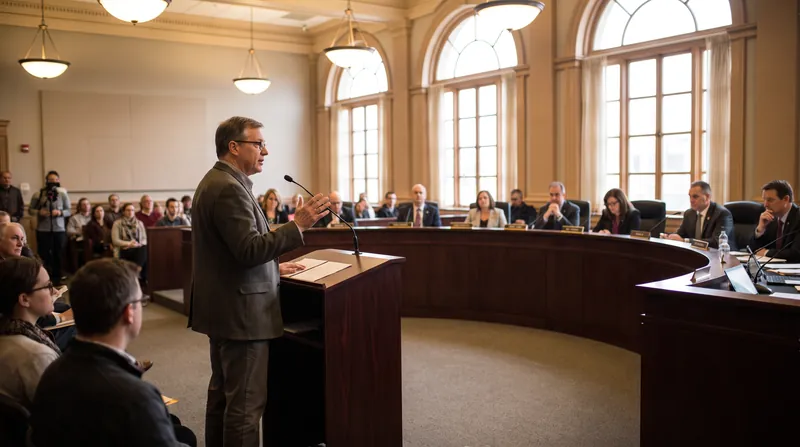
The vote exposed deep ideological divides within the council over how to manage public spaces. Councilmembers Traci Park, Monica Rodriguez, and Imelda Padilla voted against the rollback, defending Section 41.18 as a fundamental tool for managing streets and sidewalks.[1][3]
Park argued that the city has a civic obligation to keep public infrastructure clear and safe for all residents. She has previously pushed to expand the anti-camping policy to cover critical infrastructure, environmentally sensitive areas, and high-severity fire zones.[1][5]
Rodriguez echoed those concerns during the meeting, stating that while the ordinance was never intended to solve the root causes of homelessness, it serves to protect public spaces so families can access parks and pedestrian corridors without exposure to encampments.[3]
The efficacy of the anti-camping law has faced mounting scrutiny in recent months, bolstered by new data on its financial and human costs. A report by the city's Chief Legislative Analyst estimated that enforcing the ordinance cost Los Angeles at least $3 million between September 2021 and December 2023.[1]
Despite that multimillion-dollar investment, the report found that the enforcement resulted in only two unhoused individuals being placed into permanent housing, raising serious questions among council members about the policy's return on investment.[1]
Furthermore, a May 2026 study from the RAND Corporation found that "rough sleeping"—unhoused people sleeping without a tent, vehicle, or shelter—rose 20% to a four-year high in neighborhoods like Hollywood, Skid Row, and Venice. Nearly half of the surveyed individuals reported that their shelters had been confiscated or towed by government workers, fueling renewed activism against the sweeps.[1]
Mutual aid organizations and homeless advocates have long pressured the council to repeal the zones. Earlier this year, activists confronted Soto-Martínez, demanding he act faster to dismantle the enforcement areas and criticizing the four-year timeline it took to finally rescind the Hollywood zones.[2][4]
Despite the rollback in District 13, Section 41.18 remains heavily utilized in other parts of Los Angeles. Just months prior, the council approved 26 new anti-camping zones in the San Fernando Valley by an 11-4 margin, underscoring the city's fragmented, district-by-district approach to the homelessness crisis.[1]
Where opinion splits
Care-First Advocates
Activists and progressive council members argue that enforcement-heavy policies fail to solve homelessness.
Opponents of Section 41.18 argue that the ordinance effectively criminalizes poverty without addressing its root causes. By relying on police sweeps and citations, the city forces unhoused individuals to move from block to block, often resulting in the loss of vital personal property, identification documents, and survival gear. Advocates point to data showing that these displacement tactics sever relationships between unhoused residents and outreach workers, making it significantly harder to transition individuals into permanent housing or provide consistent medical care.
Public Space Defenders
Moderate council members and neighborhood groups maintain that the city has a duty to keep public infrastructure clear.
Supporters of the anti-camping zones emphasize the necessity of maintaining safe, accessible public spaces for all Angelenos. They argue that unregulated encampments near schools, daycares, and parks pose public safety and sanitation risks, including blocked ADA-compliant walkways and exposure to hazardous waste. For these defenders, Section 41.18 is not intended to cure the homelessness crisis, but rather to serve as a pragmatic management tool that balances the needs of unhoused individuals with the civic obligation to preserve functional neighborhoods.
Key points
- The LA City Council voted 10-3 to rescind 12 anti-camping zones in Hollywood's Council District 13.
- The zones were originally established under Section 41.18, which bans sitting or sleeping in designated public areas.
- Councilmember Hugo Soto-Martínez introduced the resolution, fulfilling a 2021 campaign promise to prioritize services over enforcement.
- Dissenting council members argued the zones are necessary to manage public spaces and protect sensitive areas.
Unanswered questions
- Whether the removal of the 12 zones will lead to a measurable increase in permanent housing placements in District 13.
- How the Los Angeles Police Department will adjust its patrol and outreach strategies in the rescinded areas without the 41.18 enforcement tool.
How we got here
1963
Los Angeles introduces the original version of Municipal Code Section 41.18 as a general anti-loitering law.
2021
The City Council amends Section 41.18 to specifically ban encampments within 500 feet of sensitive locations like schools and libraries.
August 2022
The council votes to expand the ordinance, sparking widespread protests and debates over the criminalization of homelessness.
December 2022
Hugo Soto-Martínez takes office in District 13, having campaigned on a promise to dismantle the anti-camping zones established by his predecessor.
August 2026
The City Council votes 10-3 to erase 12 discretionary anti-camping zones in Hollywood, marking the first rollback of the policy.
- Care-First Advocates
- Argue that anti-camping laws criminalize poverty, displace unhoused individuals, and disconnect them from vital medical care and housing services.
- Public Space Defenders
- Maintain that anti-camping zones are essential civic tools for keeping sidewalks, parks, and school perimeters safe and accessible for all residents.
- Local Government Officials
- Focus on the logistical and financial efficacy of homelessness policies, weighing the high costs of enforcement against the outcomes of permanent housing placements.
Perspectives this story doesn't cover
- Unhoused individuals directly affected by the removal of the Hollywood zones.
- Local business owners operating near the rescinded anti-camping areas.
Sources
Source coverage
6 outlets
3 viewpoints surfaced






- [1]HoodlineCare-First Advocates
LA Council Erases 12 Hollywood No-Camping Zones After Years of Pressure
Read on Hoodline → - [2]MyNewsLA.comLocal Government Officials
LA City Council Rescinds Anti-Camping Zones in Hollywood
Read on MyNewsLA.com → - [3]LAistLocal Government Officials
Why the LA City Council is canceling homelessness anti-camping rules in some neighborhoods
Read on LAist → - [4]L.A. TACOCare-First Advocates
Activists Confront Councilmember Hugo Soto-Martinez Over 41.18 Zones
Read on L.A. TACO → - [5]CBS NewsPublic Space Defenders
LA City Council votes to impose anti-camping law in the Westside
Read on CBS News → - [6]Fox 11 Los AngelesPublic Space Defenders
LA City bans encampments near schools
Read on Fox 11 Los Angeles →

More in Community
See all →Housing Policy
The HUD-Adjusted 50th Percentile Formula That Calculates the Area Median Income (AMI) for Affordable Housing
5 sources
First Amendment
The 'Traditional,' 'Designated,' 'Limited,' and 'Non-Public' Categories That Define a Public Forum
6 sources
Housing Affordability
The Ground Lease and Resale Formula That Keep Community Land Trust Housing Permanently Affordable
5 sources
Eminent Domain
The 'Physical Deterioration' and 'Economic Disuse' Criteria That Legally Define Blight for Urban Renewal
5 sources

Comments
Every angle. Every day.
Get Community stories with full source coverage and perspective breakdowns, free every day.