
Inside the Buffalo Bills' New $2.1 Billion Highmark Stadium
The Buffalo Bills have officially opened their new $2.1 billion stadium, featuring innovative weather-mitigation architecture and heated concourses instead of a traditional dome. The state-of-the-art facility secures the franchise's long-term future in Western New York while setting a new standard for cold-weather NFL venues.
By Factlen Editorial Team
- Local Fans & Community
- Celebrates the retention of the team and the preservation of outdoor football, while adjusting to the realities of higher ticket prices.
- Sports Business Analysts
- Focuses on the financial mechanics of the deal, the shift toward smaller capacities, and the maximization of premium seating revenue.
- Architects & Planners
- Views the stadium as a triumph of engineering, proving that bespoke aerodynamic design can solve microclimate challenges without a dome.
What's not represented
- · Taxpayer Advocacy Groups
- · Local Small Business Owners
Why this matters
The completion of the stadium ends years of relocation anxiety for Western New York and introduces a new architectural model for cold-weather sports. By rejecting a dome in favor of aerodynamic weather mitigation, the project proves that cities can retain outdoor football traditions while meeting modern comfort standards.
Key points
- The Buffalo Bills have officially opened their new $2.1 billion stadium in Orchard Park.
- The open-air facility uses aerodynamic design to deflect wind and snow away from the seating bowl.
- Capacity has been reduced to roughly 60,000 to prioritize wider concourses and premium seating.
- The project was funded by $850 million in public money, with the team covering the remaining $1.25 billion.
- The old stadium will be demolished to create modernized parking and tailgating spaces.
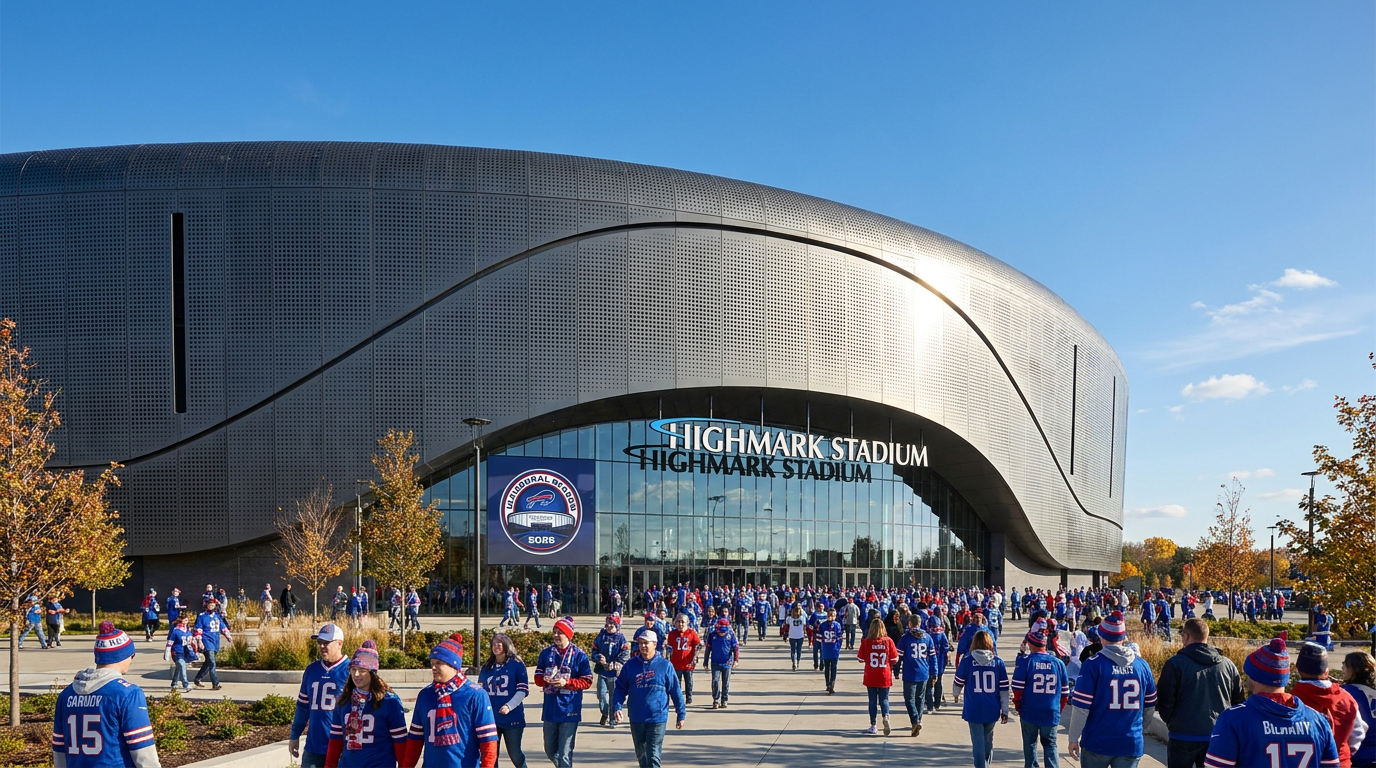
For decades, attending a late-season football game in Orchard Park, New York, was a test of endurance. Fans braved lake-effect snow, sub-zero wind chills, and concrete concourses that seemed to amplify the cold. On Tuesday, that era officially ended. The Buffalo Bills cut the ribbon on their new $2.1 billion Highmark Stadium, located directly across the street from their former home, ushering in a radically different game-day experience for Western New York.[1][2]
The opening ceremony marks the culmination of a complex, years-long saga to secure the franchise's future in Buffalo. With the old stadium rapidly deteriorating and lacking the premium revenue streams required by modern NFL economics, the threat of relocation had loomed over the region. The new facility, locked in by an ironclad 30-year lease, permanently anchors the team to its historic fan base.[2]
When planning began, the most fiercely debated question was whether to build a dome. Ownership and a vocal segment of the fan base insisted that "Bills football is outdoor football," arguing that the harsh winter weather provides a distinct competitive advantage. However, the NFL and premium ticket buyers demanded modern comforts. The resulting design is a massive architectural compromise: an open-air stadium engineered to fight the weather.[1]

The centerpiece of this strategy is the stadium's "weather mitigation" canopy. Designed by the global architectural firm Populous, the sweeping, perforated metal exterior is aerodynamically shaped to catch the prevailing winds off Lake Erie. Instead of swirling into the seating bowl, the wind is channeled up and over the stadium's roofline. Fluid dynamics modeling suggests this will reduce wind speeds inside the bowl by up to 60%.
This aerodynamic design also alters how snow falls inside the venue. By manipulating the air currents above the open roof, the architecture forces the heaviest lake-effect snow bands to bypass the majority of the seating areas. While the field itself remains exposed to the elements—preserving the team's cold-weather identity—roughly 65% of the seats are physically covered by the overhanging canopy, protecting fans from direct precipitation.

Beyond the canopy, the stadium utilizes extensive radiant heating technology. The concourses, previously exposed to the biting wind, are now fully enclosed and climate-controlled. In the premium seating sections and club levels, overhead radiant heaters and heated seats ensure that fans can comfortably watch a January playoff game without wearing heavy winter gear. This hybrid approach allows the Bills to charge premium prices while keeping the sky visible.[1]
Beyond the canopy, the stadium utilizes extensive radiant heating technology.
Economically, the new Highmark Stadium represents a broader shift in NFL venue philosophy. The capacity has actually been reduced from over 71,000 in the old building to approximately 60,000 in the new one. This intentional shrinkage creates ticket scarcity and allows for wider concourses, larger seats, and a significantly higher percentage of luxury suites and club seating, which are the primary drivers of local revenue in the modern NFL.
The financing of the $2.1 billion project remains its most scrutinized element. The construction was supported by a record-setting $850 million in public funds—$600 million from New York State and $250 million from Erie County. The remaining $1.25 billion, including hundreds of millions in cost overruns caused by inflation and supply chain issues, was covered by Bills ownership and an NFL G-4 loan.[2]

To offset the public expenditure, Erie County negotiated a comprehensive Community Benefits Agreement (CBA). The agreement mandates that a percentage of stadium concessions be sourced from local minority- and women-owned businesses. It also includes investments in local public transit infrastructure, ensuring that game days are more accessible to residents of the city of Buffalo, located roughly 15 miles north of the Orchard Park site.
For the players, the facility offers a staggering upgrade in sports science and recovery technology. The home locker room spans over 15,000 square feet, featuring hydrotherapy pools, cryotherapy chambers, and dedicated sleep pods. The playing surface utilizes a state-of-the-art heated natural grass system, designed to remain soft and forgiving even when temperatures drop below freezing, theoretically reducing the risk of lower-body injuries late in the season.[1]
The fan experience outside the stadium is also undergoing a massive transformation. The old stadium is scheduled for demolition later this year, and its footprint will be converted into a sprawling, modernized tailgating zone. While the Bills' famous tailgating culture will remain, the new layout includes dedicated infrastructure for power and waste, aiming to organize the pre-game festivities while maintaining their legendary energy.[2]

Acoustically, the new building is designed to be a nightmare for opposing quarterbacks. The steep vertical pitch of the seating bowl, combined with the reflective underside of the metal canopy, traps crowd noise and directs it straight down onto the field. Early acoustic testing suggests the new Highmark Stadium will easily surpass the decibel levels of the old concrete bowl, despite holding 11,000 fewer people.
The opening of the stadium sets a precedent for other cold-weather franchises currently exploring new venues, such as the Chicago Bears and Cleveland Browns. It proves that a billion-dollar dome is not the only way to modernize. By blending cutting-edge aerodynamics with traditional outdoor football, Buffalo has created a bespoke solution tailored specifically to its unique microclimate and cultural identity.
As the Bills prepare for their first preseason game in the new building, the regional mood is overwhelmingly celebratory. The decades of rumors regarding a move to Toronto or Austin have been permanently silenced. The new Highmark Stadium stands as a monument to Western New York's resilience—a high-tech fortress that embraces the winter rather than hiding from it.[1][2]
How we got here
March 2022
An $850 million public funding agreement is reached between New York State, Erie County, and the Bills.
June 2023
Official groundbreaking ceremony takes place across the street from the original stadium.
Late 2024
Structural steel completion is achieved and installation of the weather-mitigation canopy begins.
June 2026
The Bills officially cut the ribbon, opening the $2.1 billion facility to the public.
Viewpoints in depth
Traditionalist Fans
Relieved that the team stayed in Buffalo and avoided a dome, but wary of the gentrification of the game-day experience.
For decades, Bills fandom has been defined by its blue-collar, weather-defying toughness. Many legacy fans view the lack of a dome as a massive victory, preserving the distinct home-field advantage of winter football. However, this group expresses concern over the financial realities of the new building. The introduction of expensive Personal Seat Licenses (PSLs) and a reduction in overall capacity means that some long-time season ticket holders have been priced out of the new venue, shifting the demographic of the crowd.
Economic Realists
Focuses on the necessity of the public-private partnership to prevent the franchise from relocating to a larger market.
From a purely economic standpoint, analysts note that Buffalo is one of the smallest markets in major North American professional sports. Without the record-setting $850 million public subsidy, it is highly unlikely the Pegula family could have privately financed a $2.1 billion stadium. This camp argues that while the taxpayer burden is steep, the alternative—losing the region's most significant cultural and economic anchor to a city like Austin or Toronto—would have been devastating to Western New York's identity and local economy.
Architectural Innovators
Views the stadium as a groundbreaking case study in climate-responsive sports design.
Architects and urban planners see Highmark Stadium as a template for future infrastructure in extreme climates. Rather than defaulting to a massive, energy-intensive climate-controlled dome, the design uses passive aerodynamics to solve the specific microclimate challenges of Orchard Park. By modeling fluid dynamics to push lake-effect snow over the roofline and utilizing targeted radiant heating only where necessary, the building achieves modern comfort standards with a significantly smaller carbon footprint than a fully enclosed arena.
What we don't know
- How the aerodynamic canopy will specifically affect the flight of the football during high-wind kicking situations.
- Whether the reduced seating capacity will permanently alter the notoriously loud and rowdy atmosphere of Bills home games.
- The exact timeline for the complete demolition of the old stadium and the opening of the new tailgating zones.
Key terms
- Weather Mitigation Architecture
- Building design that uses aerodynamics and structural shapes to redirect wind and precipitation away from specific areas, rather than fully enclosing the space.
- Community Benefits Agreement (CBA)
- A contract signed by community groups and a real estate developer that requires the developer to provide specific amenities or mitigations to the local community.
- Personal Seat License (PSL)
- A paid license that entitles the holder to the right to buy season tickets for a certain seat in a stadium, commonly used to help finance new venue construction.
Frequently asked
Does the new Bills stadium have a roof?
No, it is an open-air stadium. However, it features a massive canopy that covers roughly 65% of the seats, protecting the majority of fans from direct rain and snow.
How much did taxpayers pay for the stadium?
New York State contributed $600 million and Erie County contributed $250 million, bringing the total public investment to $850 million.
What will happen to the old Highmark Stadium?
The old stadium, located directly across the street, is scheduled to be demolished to make way for expanded parking and modernized tailgating zones.
Why is the capacity smaller than the old stadium?
The NFL trend is to build smaller stadiums with wider concourses, larger seats, and more premium luxury suites, which generate significantly more revenue than standard upper-deck seating.
Sources
Source coverage
2 outlets
3 viewpoints surfaced


[1]ESPNSports Business Analysts
Inside the Bills' new $2.1 billion stadium: Heated seats, weather mitigation and a new era
Read on ESPN →[2]The Buffalo NewsLocal Fans & Community
A monumental day for Western New York: Bills cut the ribbon on new Highmark Stadium
Read on The Buffalo News →

More in sports
See all 17 stories →Global Hoops
EuroLeague Undergoes 'Massive Paradigm Shift' as High-Profile NBA Players Flood European Market
3 sources

Youth Weightlifting
13-Year-Old Phenom Rory van Ulft Shatters Two World Records on International Debut at IWF Youth Championships
3 sources

Football Finance
LVMH-Backed Paris FC Becomes Ligue 1's Biggest Spender, Fueling New Rivalry with PSG
3 sources

F1 Tech Rules
Drivers Blast F1's Race Algorithms for 'Neutering' Thrills of Belgian Grand Prix
4 sources

Every angle. Every day.
Get sports stories with full source coverage and perspective breakdowns delivered to your inbox.