
Inside SpaceX's $75 Billion IPO: How the 'Everything Company' Transitioned to Public Markets
SpaceX has officially debuted on the Nasdaq in the largest public offering in history, opening at $150 a share. The listing not only makes Elon Musk the world's first trillionaire, but also introduces a massive new combined space, AI, and social media conglomerate to retail investors.
By Factlen Editorial Team
- Retail & Tech Optimists
- View the IPO as a long-overdue opportunity for the public to invest in the space economy and frontier AI.
- Market Structurists
- Focus on the mechanics of the mega-IPO, warning that its massive scale will distort passive index funds and force capital rotation.
- Aerospace Traditionalists
- Worry that the short-term earnings pressure of public markets could hinder SpaceX's high-risk, iterative engineering approach.
What's not represented
- · Legacy aerospace competitors
- · Regulatory agencies monitoring market concentration
Why this matters
For two decades, the exponential growth of the commercial space industry was locked behind private equity doors. This IPO finally allows everyday investors to participate in the space economy, while injecting $75 billion of public capital into the development of Mars colonization and next-generation AI.
Key points
- SpaceX debuted on the Nasdaq at $150 a share, 11% above its offering price.
- The $75 billion IPO is the largest in history, pushing Elon Musk's net worth past $1 trillion.
- The newly public entity is a conglomerate combining SpaceX, Starlink, xAI, and X.
- Despite its size, SpaceX was not immediately added to the S&P 500 due to strict earnings criteria.
- The IPO features super-voting shares to protect the company's long-term Mars colonization goals from short-term market pressures.
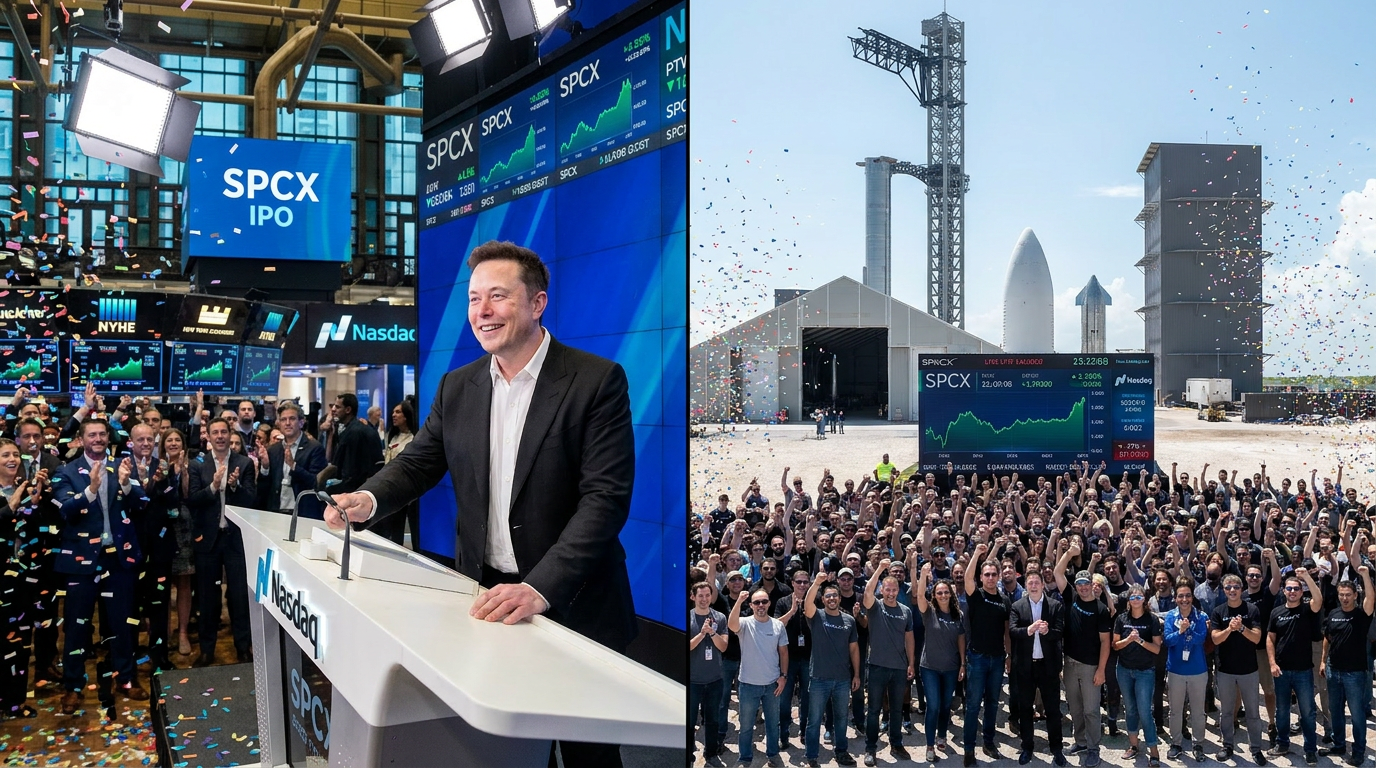
On Friday morning, the landscape of public equities experienced a seismic shift as SpaceX officially began trading on the Nasdaq under the ticker SPCX. The highly anticipated debut shattered historical records, raising a staggering $75 billion in its initial public offering.[1][9]
The stock priced at $135 late Thursday night, but immense institutional and retail demand drove the opening trade to $150 by 11:46 a.m. in New York. Within the first few minutes of trading, shares surged as high as $168.75, representing a massive 11% pop from the offering price.[1][3]
This is not merely the public debut of a rocket manufacturer. Over the past year, the corporate structure was quietly reorganized, allowing the public to buy shares in a combined entity that houses SpaceX's launch services, the Starlink satellite internet constellation, the artificial intelligence firm xAI, and the social media platform X.[4]
By merging aerospace hardware, global internet distribution, frontier AI compute, and a massive social data engine, the newly public SpaceX operates as a modern tech conglomerate. This unique structure is designed to cross-pollinate resources—using Starlink's recurring revenue to fund Starship development, and X's real-time data to train xAI's models.[4][8]

The sheer scale of the valuation has triggered a historic wealth milestone. With his 4.8 billion shares in the newly listed entity, alongside his holdings in Tesla, CEO Elon Musk's net worth has officially surpassed the $1 trillion mark, making him the world's first trillionaire.[2][4]
Musk celebrated the milestone by hosting a dual-listed Nasdaq bell-ringing ceremony, broadcast simultaneously from the exchange in New York and SpaceX's Starbase facility in Texas. Addressing employees during the livestream, he framed the IPO not as an exit, but as a capital-raising mechanism for the ultimate goal of Mars colonization.[7]
For retail investors, the IPO represents the end of a two-decade lock-out. Since its founding in 2002, SpaceX's exponential growth has been captured entirely by private equity, venture capital, and early employees. Now, everyday investors can directly allocate capital to the space economy.[10]
However, the mechanics of integrating a company of this size into the public markets present unprecedented challenges for index providers and passive funds. Despite its massive market capitalization, SpaceX was not immediately added to the S&P 500.[5]
However, the mechanics of integrating a company of this size into the public markets present unprecedented challenges for index providers and passive funds.
Bloomberg Opinion columnist Nir Kaissar noted that the S&P 500's strict inclusion criteria—which typically require a history of positive GAAP earnings—should not be waived even for a mega-cap tech debut. Keeping these criteria intact protects the integrity of the index from highly valued but potentially unprofitable new entrants.[5]
The eventual inclusion of SpaceX into major indices will trigger a phenomenon known as "passive flow distortion." Campbell Harvey, a finance professor at Duke University, explains that when index funds are eventually forced to buy SPCX to match their benchmarks, they will have to sell billions of dollars of other equities to make room.[6]

This structural reality means the SpaceX IPO will create ripple effects across the entire stock market, potentially depressing the share prices of legacy companies as capital mechanically rotates into the new aerospace giant.[6][9]
Beyond market mechanics, the transition to a public company introduces a fundamental tension in SpaceX's operating philosophy. The company's success was built on rapid, iterative testing—often resulting in highly visible rocket explosions that were treated as valuable data-gathering exercises.[8]
In private markets, investors understood this "fail fast" methodology. In public markets, quarterly earnings pressure and the daily scoreboard of a stock price can make Wall Street highly intolerant of short-term failures, even if they serve long-term engineering goals.[8][10]
To insulate the company's core mission, the IPO was structured with super-voting shares, ensuring that Musk and key early executives retain absolute voting control over the company's direction, regardless of fluctuations in the public share price.[9]
This governance structure is crucial for the capital-intensive Starship program. Starship, the fully reusable mega-rocket designed for lunar and Martian missions, requires billions of dollars in continuous research and development.[8]

The $75 billion raised in this offering provides a massive war chest. It effectively derisks the near-term funding requirements for both the Mars program and the rapid expansion of xAI's supercomputing clusters, which are currently competing in an arms race with OpenAI and Anthropic.[4][9]
How we got here
2002
Elon Musk founds Space Exploration Technologies Corp. (SpaceX) with the ultimate goal of reducing space transportation costs to enable the colonization of Mars.
2015
SpaceX successfully lands the first stage of a Falcon 9 rocket, proving the viability of reusable orbital-class boosters.
2019
The first batch of Starlink internet satellites is launched, laying the groundwork for a global broadband network.
2025
SpaceX undergoes a corporate reorganization, bringing the social media platform X and the artificial intelligence firm xAI under a single umbrella.
June 2026
SpaceX debuts on the Nasdaq in a historic $75 billion IPO, opening at $150 per share.
Viewpoints in depth
Retail & Tech Optimists
View the IPO as a long-overdue opportunity for the public to invest in the space economy and frontier AI.
For two decades, retail investors have watched SpaceX achieve historic milestones—from landing orbital boosters to launching astronauts—without any ability to share in the financial upside. This camp views the IPO as a democratization of the space economy. Furthermore, by bundling xAI and X into the offering, retail investors are gaining direct exposure to the frontier AI race, which has largely been dominated by private entities like OpenAI and Anthropic or massive legacy tech giants.
Market Structurists
Focus on the mechanics of the mega-IPO, warning that its massive scale will distort passive index funds and force capital rotation.
Financial analysts and index providers are less focused on rockets and more concerned with market plumbing. A company debuting with a valuation this immense creates a gravitational pull on passive capital. When SpaceX is eventually added to major benchmarks like the Russell 1000 or the S&P 500, trillions of dollars in passive funds will be forced to buy the stock. To afford this, those funds will have to mechanically sell off shares of other companies, potentially causing broad market volatility and depressing the valuations of legacy firms.
Aerospace Traditionalists
Worry that the short-term earnings pressure of public markets could hinder SpaceX's high-risk, iterative engineering approach.
Industry veterans point out that SpaceX's dominance was built on a willingness to blow up rockets in the name of rapid data collection. In the private sector, venture capitalists understood that a destroyed Starship prototype was a step toward progress. In the public markets, a spectacular explosion on the launchpad could instantly wipe billions off the market capitalization. This camp fears that the daily pressure of a stock ticker and quarterly earnings calls might force SpaceX to adopt the slower, more risk-averse engineering culture of legacy aerospace contractors.
What we don't know
- When SpaceX will meet the strict GAAP profitability requirements necessary for inclusion in the S&P 500.
- How public shareholders will react to the inevitable setbacks and hardware losses inherent in the Starship testing program.
- Whether the integration of X and xAI into the aerospace company will face antitrust scrutiny from federal regulators.
Key terms
- Initial Public Offering (IPO)
- The process by which a private company offers shares of its stock to the public for the first time, allowing retail and institutional investors to buy ownership.
- Passive Flow Distortion
- A market phenomenon where index funds are forced to buy a newly added, massive company to match their benchmark, requiring them to sell off shares of other companies to free up capital.
- Super-Voting Shares
- A class of stock that provides its holders with significantly more voting power than regular shares, allowing founders to retain control of a public company.
- GAAP Earnings
- Profitability calculated according to Generally Accepted Accounting Principles, a strict standard required by major indices like the S&P 500 for inclusion.
Frequently asked
Why did SpaceX merge with X and xAI before the IPO?
The merger creates a tech conglomerate where resources are shared. Starlink's revenue funds rocket development, while X's massive real-time data stream is used to train xAI's artificial intelligence models.
Is SpaceX in the S&P 500 now?
No. Despite its massive valuation, the S&P 500 requires a history of positive GAAP earnings for inclusion. SpaceX will likely be added in the future once it meets all profitability criteria.
Will going public change how SpaceX builds rockets?
To protect its iterative 'fail fast' engineering approach from Wall Street's quarterly pressures, the IPO was structured with super-voting shares, giving Elon Musk and early executives absolute control over long-term decisions.
Sources
Source coverage
10 outlets
3 viewpoints surfaced






[1]BloombergMarket Structurists
SpaceX Begins Trading on the Nasdaq After Record IPO
Read on Bloomberg →[2]TechCrunchRetail & Tech Optimists
Elon Musk becomes the world's first trillionaire after SpaceX's historic IPO
Read on TechCrunch →SpaceX opens at $150, an 11% pop for the most anticipated debut in history
Read on TechCrunch →[4]The VergeRetail & Tech Optimists
SpaceX's massive IPO: all the latest news
Read on The Verge →SpaceX Isn't in the S&P 500. That's Good.
Read on Bloomberg →Duke's Harvey on Why SpaceX's IPO Could Distort Passive Flows
Read on Bloomberg →Elon Musk Talks SpaceX, Future, and History on IPO Day
Read on Bloomberg →[8]ReutersAerospace Traditionalists
SpaceX mega-IPO reshapes aerospace sector funding
Read on Reuters →[9]Financial TimesMarket Structurists
The mechanics of a $75 billion public debut
Read on Financial Times →[10]Wall Street JournalRetail & Tech Optimists
Retail investors flock to SpaceX on opening day
Read on Wall Street Journal →
More in technology
See all 83 stories →Infrastructure Defense
How Autonomous AI Agents Are Becoming the Primary Defense for EV Charging Networks
7 sources
AI Metacognition
Google Researchers Propose 'Faithful Uncertainty' to Solve AI Hallucinations
6 sources

Space Economy
SpaceX Completes Historic $75 Billion IPO: How the Space Economy Just Changed
8 sources
AI Reliability
How Google’s 'Faithful Uncertainty' Research Aims to Fix AI Hallucinations
6 sources
Every angle. Every day.
Get technology stories with full source coverage and perspective breakdowns delivered to your inbox.