
How the New Push for Antarctic Visitor Caps Will Reshape Polar Travel
As Antarctic tourist numbers surpass historic highs, international regulators are advancing strict new visitor caps and million-dollar fines to protect the continent's fragile ecosystem.

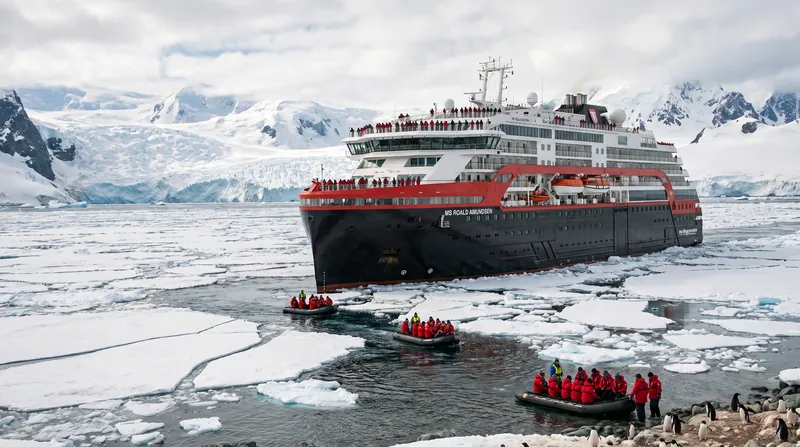
For decades, reaching the White Continent was an endeavor reserved for hardened explorers and well-funded scientific expeditions. Today, it is one of the fastest-growing sectors in luxury adventure travel. During the 2025–2026 austral summer, an estimated 122,000 tourists visited Antarctica, a staggering increase from the 38,000 who made the journey just a decade ago. This boom has transformed the Antarctic Peninsula into a bustling corridor of ice-strengthened cruise ships, zodiacs, and kayaking excursions.[1][3]
But that accessibility has triggered an international alarm. At the recent Antarctic Treaty Consultative Meeting (ATCM), member nations took unprecedented steps to rein in the booming industry. Policymakers are now drafting binding international regulations that would impose hard caps on total annual visitors and establish a framework for million-dollar fines against operators who violate environmental protocols.[1]
The shift marks a profound change in how the continent is governed. Because Antarctica is not owned by any single nation, it is managed by the Antarctic Treaty System (ATS), a consensus-based international agreement. Historically, the ATS has relied heavily on the cruise industry to self-regulate through the International Association of Antarctica Tour Operators (IAATO). However, the sheer volume of modern traffic has convinced treaty members that voluntary guidelines are no longer sufficient.[2][3]
The primary driver behind the new regulations is the invisible footprint of polar travel: black carbon. As diesel-powered expedition ships navigate the ice-choked channels, their engines emit fine particulate matter—soot—that settles onto the pristine white landscape. This darkens the surface, lowering its albedo (reflectivity) and causing the snow to absorb more solar radiation.
Recent glaciological studies have quantified this impact with startling precision. Researchers estimate that the black carbon generated by a single tourist's journey results in approximately 83 millimeters of accelerated snowmelt over the course of a season. When multiplied by 122,000 visitors, the localized melting effect around popular landing sites on the peninsula becomes a measurable ecological stressor.
Beyond emissions, biosecurity has emerged as a critical vulnerability. The isolated Antarctic ecosystem has no natural defenses against invasive species or foreign pathogens. With the global spread of highly pathogenic avian influenza (HPAI), conservationists warn that a single contaminated boot or piece of velcro could introduce a virus capable of devastating entire colonies of Chinstrap and Gentoo penguins.
Under current IAATO rules, the industry already operates with strict parameters. Ships carrying more than 500 passengers are strictly forbidden from making landings, and no more than 100 tourists are allowed ashore at any single site at one time. Visitors must undergo rigorous vacuuming of their outerwear and step through disinfecting boot-washes before boarding zodiacs.[2]
Yet, conservationists argue these site-specific rules fail to address the cumulative pressure of too many ships operating simultaneously. The new ATS proposals aim to establish an absolute ceiling on the number of vessels permitted in Antarctic waters per season, effectively capping the industry's growth and forcing operators to compete for a limited number of permits.[1]
To enforce these caps, the treaty nations are developing a penalty framework with real teeth. The proposed rules include fines of up to $1 million for vessels that breach biosecurity protocols, exceed landing limits, or venture into protected scientific zones. Because the ATS has no police force, these fines would be enforced by the "flag state"—the country where the offending vessel is registered.[3]
The expedition cruise industry has responded with a mix of cooperation and caution. Industry representatives emphasize that their operators are deeply committed to conservation, often hosting scientific researchers on board and facilitating citizen-science projects. They argue that bringing people to Antarctica creates "polar ambassadors" who return home as fierce advocates for climate action.[2]
However, the economic implications of the proposed caps are undeniable. If the supply of Antarctic berths is artificially constrained while global demand continues to rise, the cost of an already expensive expedition will inevitably skyrocket. Travel analysts predict that the new regulations will push the industry further into the ultra-luxury tier, making the continent accessible only to the wealthiest travelers.[2]
The regulations are also aimed squarely at a growing blind spot: unregulated private yachts. While commercial cruise lines adhere to IAATO guidelines, an increasing number of high-net-worth individuals are sailing private superyachts into Antarctic waters without oversight. The million-dollar fine mechanism is specifically designed to deter these rogue operators, who often lack the specialized training required for polar navigation.
Implementing the new rules will require immense diplomatic maneuvering. Under the Antarctic Treaty, any new binding measure requires the unanimous consensus of all 29 consultative parties. A single veto could derail the entire framework, meaning the final text will likely undergo intense negotiation over the next 12 to 18 months.[1][3]
If ratified, the caps and fines are expected to take effect by the 2027–2028 season. For the travel industry, it represents a necessary reckoning. The challenge moving forward will be balancing the human desire to witness the awe-inspiring beauty of the world's last great wilderness with the urgent imperative to leave it exactly as it was found.[3]
Key points
- Antarctic tourist numbers hit a record 122,000 in the 2025–2026 season, up from 38,000 a decade ago.
- Treaty nations are drafting binding international caps on total annual visitors to the continent.
- Proposed penalties include fines up to $1 million for biosecurity and landing violations.
- Scientists warn that ship emissions, known as black carbon, are measurably accelerating local snowmelt.
What we don’t know
- Whether all 29 consultative parties will reach the unanimous consensus required to ratify the caps.
- How the proposed visitor quotas will be allocated among different nations and tour operators.
- If the new penalty framework will successfully deter unregulated private yachts from entering the region.
How we got here
1991
The Environmental Protocol to the Antarctic Treaty is signed, banning mining and establishing baseline ecological protections.
2011
Heavy fuel oil is officially banned in Antarctic waters, forcing ships to use lighter, less polluting marine fuels.
2023
Antarctic tourist numbers cross the 100,000 threshold for the first time in a single season.
May 2026
The Antarctic Treaty Consultative Meeting formally drafts proposals for binding visitor caps and million-dollar fines.
- Conservation Scientists
- Argue that strict, binding caps are urgently needed to mitigate black carbon emissions and protect fragile ecosystems from invasive species.
- Antarctic Treaty Policymakers
- Focus on building international consensus to transition from industry self-regulation to enforceable legal frameworks and heavy fines.
- Expedition Cruise Operators
- Emphasize their successful history of self-regulation and argue that responsible tourism creates crucial 'ambassadors' for polar conservation.
Perspectives this story doesn't cover
- Travelers who may be priced out of visiting the continent
- Shipyard engineers designing the next generation of zero-emission polar vessels
Sources
Source coverage
3 outlets
3 viewpoints surfaced



- [1]ReutersAntarctic Treaty Policymakers
Antarctic Treaty nations weigh strict visitor caps amid tourism surge
Read on Reuters → - [2]Travel WeeklyExpedition Cruise Operators
Expedition cruise lines brace for new Antarctic passenger limits
Read on Travel Weekly → - [3]Secretariat of the Antarctic TreatyAntarctic Treaty Policymakers
Working Paper: Managing Human Footprint in the Antarctic Peninsula
Read on Secretariat of the Antarctic Treaty →

More in Travel
See all →Polar Conservation
The Mechanics of the Ethical Exodus: How Antarctic Guides Are Abandoning Cruise Tourism Over Climate 'Farce'
7 sources
Travel Economy
Adventure Travel Reaches $1.16 Trillion as Cultural Immersion Replaces Extreme Sports
5 sources

Tourism Infrastructure
The Mechanics of the Sacred Valley Airport: How a New Peruvian Hub Threatens Machu Picchu's Heritage
2 sources
Glacier Science
Climate Crisis Forces Permanent Closure of Major Ice-Trekking Route on Chile's Exploradores Glacier
4 sources
Comments
Every angle. Every day.
Get Travel stories with full source coverage and perspective breakdowns, free every day.