
How the Discovery of a 'Gluon Junction' in Protons Rewrites the Rules of Fundamental Particle Physics
Data from the Relativistic Heavy Ion Collider reveals that a proton's stability and identity are carried not by its three quarks, but by a Y-shaped junction of gluons connecting them. The finding challenges decades of textbook physics and provides new insights into the conservation of matter.
By Lila Morgan

Everything you interact with—your own body, the device you are reading this on, the stars in the night sky—is made of matter that refuses to fall apart. For decades, the stability of the universe has been credited to a simple, elegant model taught in every high school physics classroom: the proton is made of three tiny particles called quarks, and those quarks carry the fundamental property that keeps matter intact.[1]
But that textbook picture has always been a polite fiction—a marketing-friendly simplification of a much more chaotic quantum reality. Now, hard data has finally caught up to the theory. In August 2026, the STAR Collaboration—an international team of over 700 researchers—published a landmark study in the journal Science that fundamentally rewrites the rules of particle physics.[1][4]
The researchers discovered that the defining identity of a proton—a strict universal accounting rule known as "baryon number"—is not carried by the three valence quarks at all. Instead, it is carried by a hidden, Y-shaped web of particles called a "gluon junction" that binds those quarks together.[2][3]
To understand why this is a seismic shift, we have to look at what baryon number actually does. In quantum physics, baryon number is the property that distinguishes matter from antimatter and ensures that protons do not spontaneously decay. It is the reason atomic nuclei can form and remain stable over billions of years.[3][5]
Traditionally, scientists assumed that a proton's baryon number of positive one was divided equally among its three primary valence quarks, with each carrying a third of the load. This mirrored how electric charge is distributed within the proton. But quantum chromodynamics (QCD)—the complex mathematical theory describing the strong nuclear force—hinted at a different story.[2]
Inside a real proton, things are far from neat. It is a bustling quantum soup where quarks and antiquarks constantly pop in and out of the vacuum, all held together by a sea of interacting gluons. Gluons are the literal "glue" of the strong force.[2][4]
As early as the 1970s, theoretical physicists proposed that the gluons connecting the three main quarks might form a specific topological structure: a Y-shaped baryon junction. Then, in 1996, theoretical physicist Dmitri Kharzeev proposed something radical: what if this junction, rather than the quarks themselves, was the true carrier of the baryon number?[1][2]
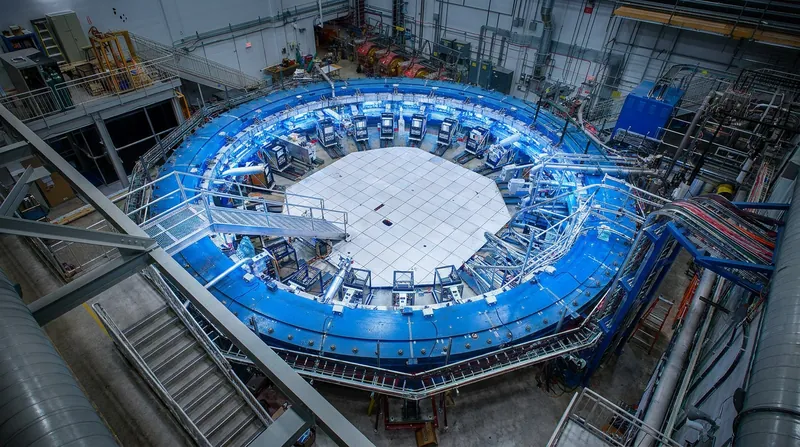
Testing that hypothesis required massive technological leaps. It took the construction of the Relativistic Heavy Ion Collider (RHIC) at the Department of Energy's Brookhaven National Laboratory, and the 1,200-ton STAR detector, to finally capture the evidence.[2][3]
The STAR team's experimental strategy relied on a sleight-of-hand decoupling that occurs when protons are accelerated to nearly the speed of light. As protons gain enormous energy, their internal gluons split and multiply. Each individual gluon carries less and less of the proton's overall forward momentum, while the three valence quarks continue to carry the bulk of the kinetic energy.[2]
When these near-light-speed protons violently collide, the rapid valence quarks are incredibly difficult to stop. They simply zip straight down the beam pipe, continuing their forward trajectory. But the slower-moving, Y-shaped gluon junction gets left behind and halted in the center of the crash.[1][3]
This separation allowed physicists to track where the baryon number actually went. If the quarks carried the baryon number, it should have traveled down the beam pipe with them, matching the path of the proton's electric charge. Instead, the researchers observed a striking mismatch.[1][5]
The collision debris contained roughly twice as many new baryons as could be accounted for by the electric charge of the stopped quarks. The baryon number had moved independently of the electric charge, proving that the stopped gluon junction was the true carrier.[2][5]
What happens next in the collision is a bizarre display of quantum mechanics. Once the Y-shaped gluon junction is violently stopped, its energy must go somewhere. Acting almost like a Y-shaped magnet, the junction reaches into the quantum vacuum and pulls out three brand-new quarks.[1]
These newly materialized quarks bind to the junction to form a completely new baryon, which shoots out sideways, perpendicular to the original beam. Meanwhile, the original valence quarks that flew down the pipe pair up with new partners to form two-quark particles called mesons.[2]
The observation that so many new baryons emerge perpendicular to the beamline provides compelling, undeniable support for the gluon junction model. The "glue" itself is transporting the vital property of matter, upending the long-standing assumption that quarks did all the heavy lifting.[3][4]
This discovery advances human understanding from the basic level of "quark composition" to a much deeper appreciation of "quark-gluon global topological structure." It proves that the non-perturbative structure of the gluon field is what defines the fundamental quantum numbers of baryons.[4]
Beyond the confines of the RHIC tunnel, this finding has profound implications for cosmology. Since the Big Bang, the total number of protons and neutrons in the universe has remained strictly conserved. By identifying the true mechanism behind this conservation, physicists are one step closer to understanding why our universe is dominated by stable matter rather than dissolving into radiation.[2][3]
Key points
- A proton's stability is carried by a Y-shaped 'gluon junction', not its three valence quarks.
- The discovery challenges decades of textbook physics regarding the conservation of baryon number.
- During near-light-speed collisions, the gluon junction stops while the quarks continue flying forward.
- The stopped junction acts like a magnet, pulling new quarks from the quantum vacuum to form new matter.
Unanswered questions
- How exactly the gluon junction interacts with the quantum vacuum to pull out new quarks.
- Whether similar topological gluon structures exist in other, more exotic subatomic particles.
- How quickly educational institutions will update their textbooks to reflect this more complex quantum reality.
How we got here
1970s
Theoretical physicists first propose the existence of a Y-shaped baryon junction connecting quarks.
1996
Theoretical physicist Dmitri Kharzeev proposes that the gluon junction, not the quarks, carries the baryon number.
2000
The Relativistic Heavy Ion Collider (RHIC) begins operations at Brookhaven National Laboratory.
2020
Researchers begin adapting new analytical methods for the STAR detector to track baryon number transport.
August 2026
The STAR collaboration publishes hard evidence in Science confirming the gluon junction model.
- Experimental Nuclear Physicists
- Focus on the data, detector capabilities, and physical evidence from the collider.
- Theoretical Physicists
- Focus on the mathematical models of quantum chromodynamics and topological structures.
- Science Communicators
- Focus on translating complex quantum mechanics into understandable textbook models.
Perspectives this story doesn't cover
- High school physics curriculum designers
- Standard Model critics
Sources
Source coverage
5 outlets
3 viewpoints surfaced





- [1]ScienceDailyExperimental Nuclear Physicists
Physicists discover a hidden gluon structure inside protons that could rewrite textbooks
Read on ScienceDaily → - [2]Brookhaven National LaboratoryTheoretical Physicists
Gluons May Play Central Role in Baryon Number Conservation
Read on Brookhaven National Laboratory → - [3]Rice UniversityExperimental Nuclear Physicists
Quark-connecting 'gluon junction' could be primary carrier of baryon number
Read on Rice University → - [4]Central China Normal UniversityTheoretical Physicists
Tracking the baryon number with nuclear collisions
Read on Central China Normal University → - [5]EurekAlertExperimental Nuclear Physicists
A series of high-energy particle collision experiments tests a decades-old hypothesis
Read on EurekAlert →
More in Content Types
See all →Social Cognition
How Perceptual Salience and Effortful Correction Separate Dispositional from Situational Attributions in Social Perception
7 sources

Lie Detection Science
How the Polygraph Actually Measures Physiological Arousal Instead of Deception
6 sources

Media Myths
The Backfire Effect Myth: Why Factual Corrections Actually Work
7 sources

Intellectual Property
Function, Source, and Expression: How Intellectual Property Law Separates Patents, Trademarks, and Copyrights
5 sources
Comments
Every angle. Every day.
Get Content Types stories with full source coverage and perspective breakdowns, free every day.