
How AI and Smart Gloves Are Saving Olympic Boxing for LA 2028
After decades of judging scandals nearly cost boxing its Olympic status, a new governing body is turning to artificial intelligence and biomechanical sensors to guarantee transparent scoring.
By Factlen Editorial Team
- Sports Technologists
- Advocates for digitizing combat sports to eliminate human bias.
- Boxing Traditionalists
- Skeptics who believe the 'Sweet Science' cannot be fully quantified.
- Olympic Officials
- Administrators prioritizing governance and transparency over tradition.
What's not represented
- · Amateur boxers adjusting to how their fighting styles are scored by algorithms.
- · Human judges whose roles are being augmented or scrutinized by AI.
Why this matters
For decades, the 'Sweet Science' has been marred by subjective judging and corruption. By digitizing the scoring process, boxing is not only securing its Olympic future but creating a blueprint for how technology can eliminate human bias in all subjectively scored sports.
Key points
- The IOC reinstated boxing for the LA 2028 Olympics after the newly formed World Boxing federation promised sweeping governance reforms.
- To eliminate the judging corruption that plagued the sport's past, World Boxing plans to introduce AI-assisted scoring by late 2026.
- Computer vision systems will track punch accuracy, balance, and impact in real-time to flag anomalies in human scorecards.
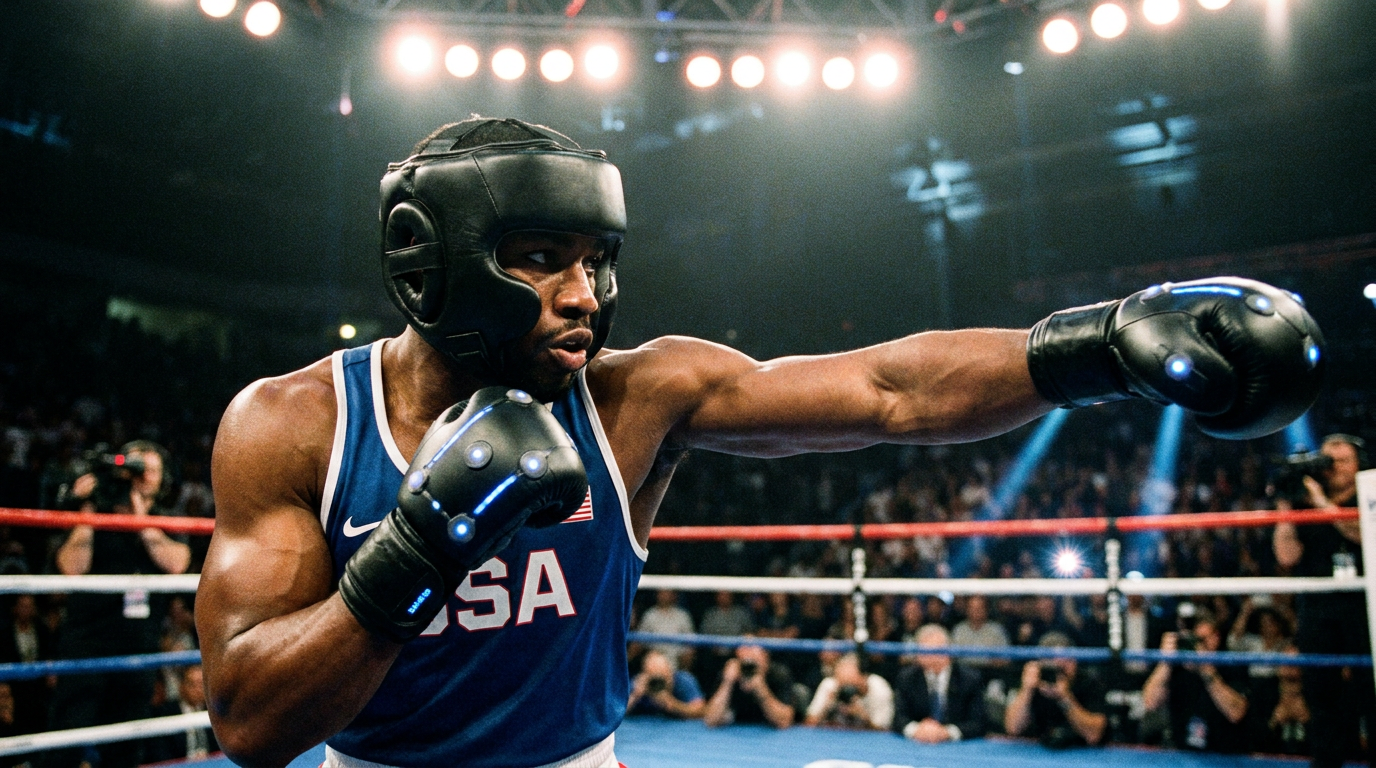
- Researchers are also developing smart gloves equipped with micro-sensors to directly measure the force and speed of every strike.
For over a century, Olympic boxing has been the ultimate proving ground for the world's greatest fighters, launching the careers of Muhammad Ali, Sugar Ray Leonard, and Claressa Shields. But in recent years, the 'Sweet Science' found itself on the ropes, fighting an existential battle for its very survival. Plagued by decades of opaque governance and egregious judging scandals—most notably during the 2016 Rio Games—the sport's former governing body, the International Boxing Association (IBA), was permanently expelled by the International Olympic Committee (IOC) in 2023.[3][4]
The expulsion left boxing off the initial program for the 2028 Los Angeles Olympics. The IOC delivered a stark ultimatum: unless the sport's national federations could build a new, incorruptible governing body, boxing's Olympic story would end. In response, a coalition of nations formed 'World Boxing,' a breakaway federation dedicated to transparency, athlete welfare, and clean competition.[3][4]
Their efforts paid off. In March 2025, the IOC unanimously voted to reinstate boxing for the LA 2028 Games, granting World Boxing provisional recognition. But securing a spot on the Olympic roster was only the first hurdle. To keep it there, World Boxing must solve the sport's most intractable problem: the subjective nature of human judging.[4]
Boxing has traditionally relied on the '10-point must' system, where three to five ringside judges score rounds based on clean punching, effective aggressiveness, and ring generalship. It is a system inherently vulnerable to human error, crowd influence, and outright corruption. A judge's viewing angle, fatigue, or unconscious bias can turn a clear victory into a controversial split decision.[6]

To permanently sever ties with its scandalous past, World Boxing is turning to Silicon Valley. The federation has announced plans to introduce artificial intelligence and advanced biomechanical sensors to the judging table. By digitizing the scoring process, the sport aims to replace subjective guesswork with hard, incorruptible data.[1][6]
The technological overhaul operates on two fronts: external computer vision and internal wearable sensors. On the outside, AI-driven computer vision systems are being trained to watch fights exactly as human judges do, but with mathematical precision. These systems process live video feeds to track the exact number of punches thrown, the cleanness of the connections, and the fighters' balance.[2][6]
Advanced models map round-by-round statistics to predict and analyze scorecards. By analyzing thousands of hours of professional bouts, these AI models have learned to differentiate between a glancing blow and a flush power shot, weighting high-impact punches exponentially higher in their scoring algorithms.[6]

But video analysis alone cannot feel the weight of a punch. That is where the second technological leap comes in: smart gloves. For years, wearable technology in combat sports was limited to wrist-strapped accelerometers used strictly for fitness tracking. Today, researchers are embedding sophisticated Inertial Measurement Units (IMUs) and force sensors directly into the padding of competition gloves.[2][5]
That is where the second technological leap comes in: smart gloves.
Prototypes like the 'Rise Dynamics Alpha' (RD α) glove represent a massive leap forward in biomechanical tracking. Rather than simply estimating force based on arm acceleration, these smart gloves measure the direct impact of the strike. They generate full force, speed, and acceleration curves for every single target contact, capturing up to 6,000 data points per punch.[2][5]
In the ring, this means the difference between a blocked combination and a devastating body shot is instantly quantified. If a fighter lands a flurry of punches on their opponent's guard, the sensors will register the low impact on the target, preventing judges from being swayed by the sheer volume of ineffective aggression or the roar of the crowd.[2][6]

World Boxing executives are moving aggressively to implement these tools. Alimzhan Akayev, Vice President for International Relations at the Kazakhstan Boxing Federation, recently confirmed that World Boxing plans to introduce AI-assisted judging as a supplementary tool in official tournaments by late 2026 or early 2027.[1]
The system will initially serve as an oversight mechanism rather than an autonomous referee. AI will analyze strike accuracy and impact power in real-time, providing a secondary data feed to the ringside officials. If a human judge's scorecard deviates wildly from the AI's objective metrics, tournament supervisors will immediately have the data required to flag potential bias or corruption.[1][6]
Beyond competitive fairness, the sensor revolution is driving massive improvements in athlete safety. Smart gloves and instrumented headguards allow medical staff to track the cumulative concussive forces a fighter absorbs over the course of a bout or a training camp. If a boxer sustains a dangerous threshold of impact, ringside doctors can intervene with objective medical data rather than relying solely on visual assessments.[2][5]
Aligning with this renewed focus on fighter welfare, World Boxing is also considering the reintroduction of protective headgear for elite Olympic-style bouts, a practice that was abandoned for male fighters in 2016. Combined with impact-tracking sensors, the sport is building a comprehensive, data-driven concussion protocol.[1][5]

Despite the enthusiasm from technologists and Olympic officials, the AI revolution faces skepticism from boxing traditionalists. Critics argue that fighting is an art form that cannot be entirely reduced to algorithms. They question how a computer vision system can accurately score 'ring generalship'—the subtle mastery of controlling distance, dictating the pace, and neutralizing an opponent's offense through head movement and footwork.[6]
There are also concerns about execution. While AI excels at measuring the raw physics of a punch, it may struggle with the chaotic, tangled reality of inside fighting, where clinches and obscured camera angles make visual tracking incredibly difficult.[6]
Nevertheless, the consensus within the Olympic movement is that the perfect cannot be the enemy of the good. The integration of AI and smart sensors does not need to be flawless; it simply needs to be more transparent, consistent, and accountable than the deeply flawed human systems of the past.[3][4]
As the road to Los Angeles 2028 begins, the athletes stepping into the ring will be fighting under a fundamentally different paradigm. By embracing the silicon chip alongside the canvas and the leather, World Boxing is ensuring that the hand raised at the end of the bout belongs to the fighter who truly earned it.[1][6]
How we got here
2016
Judging controversies at the Rio Olympics spark widespread investigations into corruption.
April 2023
'World Boxing' is launched by a coalition of national federations to save the sport.
June 2023
The IOC permanently expels the International Boxing Association (IBA).
March 2025
The IOC officially reinstates boxing for the LA 2028 Games under World Boxing.
Late 2026
Target date for World Boxing to introduce AI-assisted judging in official tournaments.
Viewpoints in depth
Sports Technologists
Advocates for digitizing combat sports to eliminate human bias.
This camp argues that human eyes are simply incapable of accurately tracking the speed and impact of professional combinations in real-time. By utilizing computer vision and IMU sensors, they believe boxing can transition from a subjective art to an objective science, permanently eradicating the corruption that has historically plagued ringside judging.
Boxing Traditionalists
Skeptics who believe the 'Sweet Science' cannot be fully quantified.
Traditionalists worry that algorithms will incentivize a robotic style of fighting. They argue that AI struggles to quantify 'ring generalship'—the ability to control the pace, dictate distance, and slip punches. For this camp, a fighter who masterfully defends and controls the center of the ring might be unfairly penalized by a machine that only values raw impact data.
Olympic Officials
Administrators prioritizing governance and transparency over tradition.
For the IOC and World Boxing executives, the technological shift is an existential necessity. After decades of scandals under the IBA, Olympic officials view AI and sensor data as the only viable mechanism to restore public trust. They are willing to accept the growing pains of new technology if it guarantees that the judging process is transparent, auditable, and free from external manipulation.
What we don't know
- How heavily human judges will be required to weigh the AI's real-time data during official Olympic bouts.
- Whether computer vision systems can accurately track inside fighting and clinches where camera angles are frequently obscured.
- How the adoption of impact-based algorithmic scoring will alter the training and fighting styles of elite amateur boxers.
Key terms
- World Boxing
- The new international governing body formed to replace the expelled IBA and manage Olympic boxing.
- Inertial Measurement Unit (IMU)
- An electronic device inside smart gloves that measures a punch's specific force, angular rate, and acceleration.
- Computer Vision
- AI technology that analyzes video feeds in real-time to track fighter movements, punch accuracy, and impact.
- Ring Generalship
- A subjective scoring criterion based on which fighter is controlling the pace, distance, and style of the bout.
Frequently asked
Will AI completely replace human boxing judges?
Not immediately. World Boxing plans to use AI as a supplementary tool to assist human judges and flag scoring anomalies in real-time.
How do smart gloves measure punches?
They use embedded micro-sensors, including Inertial Measurement Units (IMUs) and force sensors, to calculate the exact speed, trajectory, and impact of every strike.
Why was boxing almost removed from the Olympics?
The previous governing body, the IBA, was expelled by the IOC due to severe, uncorrected issues with financial transparency, governance, and judging corruption.
Sources
Source coverage
6 outlets
3 viewpoints surfaced






[1]QazinformOlympic Officials
Olympic boxing may introduce AI-assisted judging and restore headgear
Read on Qazinform →[2]MDPISports Technologists
Integrating Machine Learning Models for Striking Technique and Target Object Classification in Smart Boxing Gloves
Read on MDPI →[3]The Washington PostOlympic Officials
U.S., Britain, others form new boxing group to save sport's Olympic future
Read on The Washington Post →[4]DawnOlympic Officials
Boxing secures LA 2028 Olympics spot after IOC vote
Read on Dawn →[5]Sports Technology BlogSports Technologists
Wearables in Combat Sports: Tracking Punches and Impacts
Read on Sports Technology Blog →[6]Factlen Editorial TeamBoxing Traditionalists
Synthesis by Factlen editorial team
Read on Factlen Editorial Team →

More in sports
See all 10 stories →Standings
The Global Fencing Standings Shakeup: Zonal Championships Set the Stage for Hong Kong
6 sources
Injury
Global Equestrian Injury Report: Delestre Sidelined, King Returns, and Shifting Leaderboards
8 sources
Standings
Abdel Saïd Holds Narrow Lead in 2026 Longines Global Champions Tour as Circuit Hits Paris
8 sources
Injury
Figure Skating Injury Report: Pinzarrone, Petrokina, and Daleman Cleared for 2026-2027 Season
7 sources
Every angle. Every day.
Get sports stories with full source coverage and perspective breakdowns delivered to your inbox.