
Grand Egyptian Museum Opening Forces Reckoning on Rosetta Stone and Global Repatriation Claims
The inauguration of the world's largest archaeological museum in Giza has dismantled the long-standing Western argument that Egypt lacks the facilities to protect its own heritage. As the Grand Egyptian Museum opens its doors, a renewed push to repatriate the Rosetta Stone, the Nefertiti bust, and the Dendera Zodiac is testing the legal and ethical boundaries of European institutions.
By Jana Rami

In short
- The opening of the Grand Egyptian Museum has dismantled the argument that Egypt lacks the facilities to protect its ancient artifacts.
- Egyptian archaeologists are leading a renewed push to repatriate the Rosetta Stone, Nefertiti Bust, and Dendera Zodiac.
- European museums rely on different historical mechanisms—from military treaties to excavation splits—to justify their ownership.
The opening of the Grand Egyptian Museum (GEM) in late 2025 marked a monumental shift in the global cultural landscape. Spanning 5.4 million square feet at the edge of the Giza Plateau, the billion-dollar facility is the largest archaeological museum in the world dedicated to a single civilization.
Its striking modern architecture, designed to align perfectly with the ancient Pyramids of Giza just two kilometers away, serves as a bridge between Egypt's deep past and its ambitious future. Inside, the museum boasts state-of-the-art climate control, advanced conservation laboratories, and expansive exhibition halls designed to handle massive crowds while meticulously preserving delicate antiquities.[1][8]
For decades, the world's elite museums relied on a standard, if patronizing, defense to deny repatriation requests from Cairo: Egypt simply lacked the world-class, secure facilities necessary to safely house and display its most priceless antiquities. European curators frequently pointed to the aging, overcrowded Egyptian Museum in Tahrir Square as evidence that returning fragile masterpieces would put them at risk of damage or neglect. This practical argument provided a convenient shield, allowing Western institutions to sidestep the deeper moral questions surrounding how those artifacts were acquired in the first place.[5]
With the GEM now fully operational and housing over 100,000 artifacts—including the first-ever complete display of the Tutankhamun collection—that long-standing excuse has officially crumbled. The museum stands as a gleaming, undeniable rebuttal to the argument that Egypt cannot protect its own history. As millions of visitors walk through its towering atrium, the conversation surrounding cultural heritage has fundamentally shifted. The practical barriers to repatriation have been dismantled, leaving European institutions to defend their ownership on purely legal and ethical grounds.[1][8]
This architectural milestone has triggered a renewed, highly coordinated push by Egyptian archaeologists and cultural heritage advocates to reclaim the nation's most iconic exported treasures. The campaign is not focused on emptying Western museums of every Egyptian artifact, but rather on securing the return of a select few masterpieces that hold unparalleled historical and symbolic weight.
These items are viewed not just as ancient art, but as stolen fragments of the Egyptian national identity that were taken during periods of profound vulnerability. For the advocates leading this charge, the GEM represents the perfect, long-awaited home for these displaced monuments.[5]
At the center of this campaign are three specific artifacts that have become global symbols of ancient Egypt, yet reside in European capitals: the Rosetta Stone in London, the Nefertiti Bust in Berlin, and the Dendera Zodiac in Paris.
Former Egyptian Minister of Antiquities Zahi Hawass and other prominent Egyptologists have launched international petitions demanding the return of these three items, arguing that their continued presence in Western museums represents an ongoing legacy of colonial violence. They assert that the laws governing the removal of these artifacts were drafted by imperial powers without the equitable consent of the Egyptian people.[2][3][4]
However, the legal battle for repatriation is far more complex than a simple demand for return. A comparative analysis of how these three artifacts left Egypt reveals that European museums rely on entirely different historical mechanisms to justify their ownership.
While the public often views colonial-era acquisitions as a monolith of theft, the actual paperwork ranges from explicit military treaties to asymmetric excavation splits. Because there is no single international legal precedent that can retroactively invalidate all of these distinct colonial mechanisms, resolving the claims requires navigating a labyrinth of 19th-century law.[5]
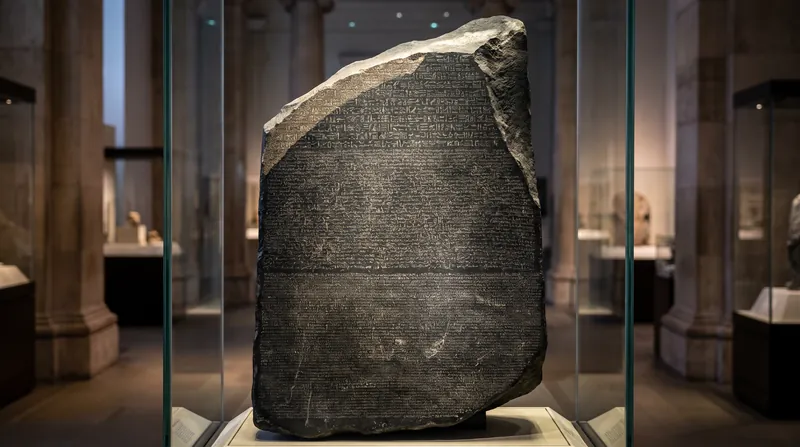
The Rosetta Stone, perhaps the most famous of the three, was discovered by French soldiers in 1799 during Napoleon's military campaign in Egypt. Its subsequent acquisition by the British Museum was not a standard archaeological transfer, but the direct result of a military surrender. Under the 1801 Treaty of Alexandria, the defeated French forces capitulated to the British and Ottoman armies, and the Rosetta Stone was handed over to the British as a spoil of war. It arrived in London the following year and has remained there ever since.[2][6]
The British Museum maintains that the treaty, which included the signature of an Ottoman representative who nominally ruled Egypt at the time, makes the acquisition legally binding. Repatriation advocates counter that Egypt itself had no voice in this agreement, framing the treaty as an imperial transaction between foreign powers fighting over Egyptian soil.
Yet, because the transfer was formalized in a recognized military treaty, challenging it under modern international law remains exceptionally difficult. The British Museum Act of 1963 further complicates matters, explicitly forbidding the museum from permanently deaccessioning objects from its collection.[2][6]
The Nefertiti Bust, currently the star attraction of Berlin's Neues Museum, presents a completely different legal framework. Excavated in 1912 by German archaeologist Ludwig Borchardt at Tell el-Amarna, the 3,300-year-old limestone bust left Egypt under the colonial-era system known as partage.
This was a legal arrangement where foreign archaeological teams were allowed to split their finds evenly with the local Egyptian antiquities authority. German officials argue that the bust was acquired entirely legally under the laws of the time, having been formally awarded to the German team during the division of the spoils.[3][7]
Egyptian researchers, however, allege that Borchardt deliberately downplayed the bust's significance during the inspection to ensure it ended up in the German share. Historical accounts suggest he covered the masterpiece in clay and described it merely as a "painted princess," misleading the French administrator who was overseeing the division for the Egyptian government. Even if the partage process was followed to the letter, modern museum ethicists increasingly question the legitimacy of such agreements, arguing that the system operated under severe imperial power imbalances that lacked true equity and informed consent.[3][7]
Egyptian researchers, however, allege that Borchardt deliberately downplayed the bust's significance during the inspection to ensure it ended up in the German share.
The third major artifact, the Dendera Zodiac, was removed from the ceiling of the Temple of Hathor in Upper Egypt in 1821. It now resides in the Louvre Museum in Paris, where it is recognized as one of the most important ancient depictions of the observable stars.
Unlike the Rosetta Stone's military treaty or the Nefertiti Bust's excavation split, the Zodiac was extracted by a French collector with the explicit permission of the ruling authority in Egypt at the time, Muhammad Ali Pasha. Because it was transported to France with official approval, the Louvre considers it legally acquired public property.[4]
Under French law, state-owned artifacts are considered inalienable, meaning they cannot be permanently removed from national collections without specific parliamentary legislation. A new French restitution bill, debated in early 2026, aims to streamline the return of colonial-era artifacts, reigniting hopes that the Dendera Zodiac might eventually qualify for repatriation. However, the law's application to items acquired with the nominal consent of past rulers remains a thorny legal gray area, leaving the Zodiac's future uncertain despite mounting public pressure.[4]
Ultimately, the lack of a unified international legal framework means that repatriation is largely left to the voluntary discretion of individual museums and their host governments. While some institutions have begun returning stolen artifacts—such as the Benin Bronzes—these cases often involve clear evidence of illegal looting or violence that violates even the standards of the era. The Rosetta Stone, Nefertiti Bust, and Dendera Zodiac occupy a much more difficult space: they were taken under the color of law, however coercive or asymmetric those laws may have been.[5]
As the Grand Egyptian Museum welcomes millions of visitors to its sprawling galleries, the conversation has fundamentally shifted from practical conservation to moral ownership. The question facing European institutions is no longer whether Egypt has the capacity to care for its heritage, but whether the legal frameworks of the 19th and early 20th centuries can still provide ethical cover in the 21st. With the physical barriers to repatriation removed, the world is watching to see if the moral barriers will be the next to fall.[5]
To bridge the gap between strict legal ownership and ethical restitution, a growing chorus of modern museum professionals is proposing alternative frameworks. Rather than engaging in zero-sum battles over physical possession, some ethicists advocate for transferring the legal title of these artifacts back to Egypt while arranging long-term loans that allow them to remain on display in Europe. This approach acknowledges Egypt's rightful ownership while preserving the artifacts' role as global ambassadors of human history in some of the world's most visited cities.[5]
Another proposed solution involves the use of high-fidelity replicas and twin-exhibition models. In this scenario, the original artifacts would be returned to the Grand Egyptian Museum, while European institutions would install exact, laser-scanned facsimiles. These replicas would be accompanied by new permanent exhibitions that transparently narrate the history of the object's excavation, the mechanics of colonial-era laws like partage, and the ethical process of its eventual restitution. Proponents argue that this would transform a story of imperial extraction into a powerful lesson on modern cultural diplomacy.[5]
For European museum administrations, however, yielding on these three iconic artifacts represents a terrifying slippery slope. Curators privately express fears that returning the Rosetta Stone or the Nefertiti Bust would open the floodgates for thousands of similar claims, effectively emptying the halls of universal museums. They argue that institutions like the Louvre and the British Museum serve a vital purpose by allowing visitors to view the interconnected history of global civilizations in a single space, transcending modern national borders.[5]
Yet, this "universal museum" defense rings increasingly hollow to nations in the Global South, whose citizens often face insurmountable visa restrictions and financial barriers to traveling to London, Paris, or Berlin.
For the average Egyptian, the fact that the key to deciphering their ancestors' language or the most famous bust of their ancient queen is locked away in a European capital is a source of profound cultural disenfranchisement. The opening of the GEM was driven, in part, by a desire to ensure that Egyptians could finally experience the pinnacle of their own heritage on their own soil.[5]
The sheer scale and ambition of the Grand Egyptian Museum have permanently altered the diplomatic calculus. By investing over a billion dollars into a facility that rivals or exceeds the capabilities of any Western institution, Egypt has called Europe's bluff. The GEM is not just a museum; it is a geopolitical statement. It forces the international community to reckon with the uncomfortable reality that the continued retention of these artifacts is rooted not in preservation, but in power.[1][8]
As the debate moves forward, the resolution of these claims will likely require unprecedented political will from European lawmakers. Until parliaments in Britain, France, and Germany are willing to amend their strict national heritage laws, the Rosetta Stone, Dendera Zodiac, and Nefertiti Bust will remain legally tethered to their current displays. But with the Grand Egyptian Museum now standing as a monument to Egypt's readiness, the moral pressure on Western institutions has never been heavier, ensuring that the campaign for repatriation will only grow louder in the years to come.[5]
How we did this
- Method
- A comparative legal analysis of the acquisition frameworks for the three major contested Egyptian artifacts (Rosetta Stone, Nefertiti Bust, Dendera Zodiac) to identify the specific colonial-era mechanisms used to justify their retention.
- What we found
- While European museums often present a unified defense against repatriation based on 'legal acquisition,' the actual mechanisms of acquisition range from explicit military treaties to asymmetric excavation splits, meaning no single international legal precedent can resolve all three claims simultaneously.
- What we worked from
- Acquisition mechanism for Rosetta Stone: 1801 Treaty of Alexandria (military surrender) — Wikipedia
- Acquisition mechanism for Nefertiti Bust: 1912 Partage system (50-50 split of excavated finds) — Wikipedia
- Acquisition mechanism for Dendera Zodiac: 1821 French colonial removal approved by ruling authority — Wikipedia
- Limits of this analysis
- This analysis relies on historical acquisition records and does not account for future rulings by international courts or bilateral diplomatic agreements.
Terms to know
- Partage
- A colonial-era legal arrangement that allowed foreign archaeological teams to split excavated artifacts evenly with the local antiquities authority.
- Repatriation
- The process of returning cultural artifacts or human remains to their country or culture of origin.
- Treaty of Alexandria
- An 1801 military agreement in which French forces surrendered to the British in Egypt, resulting in the transfer of the Rosetta Stone to British possession.
- Deaccessioning
- The formal, legal process by which a museum permanently removes an object from its collection.
Questions readers ask
Why is the Rosetta Stone in the British Museum?
It was discovered by French soldiers in 1799 but surrendered to the British in 1801 under the Treaty of Alexandria after the French military defeat in Egypt.
What is the Grand Egyptian Museum?
Opened in late 2025, it is the world's largest archaeological museum dedicated to a single civilization, located near the Pyramids of Giza and housing over 100,000 artifacts.
How did the Nefertiti Bust end up in Germany?
It was excavated in 1912 by a German team and left Egypt under the partage system, which allowed foreign archaeologists to keep half of their discoveries.
Can European museums legally return these items?
It is legally difficult. Many institutions, such as the British Museum and the Louvre, are bound by national heritage laws that explicitly forbid the permanent removal of state-owned property without special parliamentary legislation.
Different angles
European Museum Administrations
Argue that the artifacts were acquired legally under the laws of their respective eras and serve as global ambassadors of human history.
Institutions like the British Museum and the Prussian Cultural Heritage Foundation maintain that their acquisitions—whether through the Treaty of Alexandria or the partage system—were legally binding at the time. They emphasize their role as universal museums that provide free access to millions of international visitors, arguing that these artifacts now belong to the shared heritage of humanity rather than a single modern nation-state. Furthermore, they cite strict national heritage laws that legally prevent them from deaccessioning state property.
Egyptian Repatriation Advocates
Contend that colonial-era legal frameworks are inherently illegitimate and that Egypt's heritage belongs in Egypt.
Led by figures like Zahi Hawass, this camp argues that the laws governing the removal of artifacts in the 19th and early 20th centuries were drafted by imperial powers without the equitable consent of the Egyptian people. They view the continued display of items like the Rosetta Stone and the Nefertiti Bust in Western capitals as an ongoing extension of colonial violence. With the opening of the Grand Egyptian Museum, they assert that the practical arguments against repatriation have been entirely dismantled, leaving only an indefensible moral stance.
Modern Restitution Ethicists
Advocate for a shift from strict legal ownership to shared stewardship and ethical restitution.
This growing camp of museum professionals and legal scholars argues that the debate should move beyond the binary of "legal vs. illegal" acquisition. They propose alternative frameworks, such as transferring legal title back to Egypt while arranging long-term loans for European display, or creating twin-exhibition models with high-fidelity replicas. They emphasize that modern museum ethics require addressing the power imbalances of the past, prioritizing informed consent and cultural equity over century-old imperial treaties.
- Egyptian Repatriation Advocates
- Contend that colonial-era legal frameworks are inherently illegitimate and that Egypt's heritage belongs in Egypt.
- European Museum Administrations
- Argue that the artifacts were acquired legally under the laws of their respective eras and serve as global ambassadors of human history.
- Modern Restitution Ethicists
- Advocate for a shift from strict legal ownership to shared stewardship and ethical restitution.
Perspectives this story doesn't cover
- Local Egyptian citizens unable to travel abroad
- Descendants of the colonial-era excavators
Sources
Source coverage
8 outlets
3 viewpoints surfaced





- [1]WikipediaModern Restitution Ethicists
Grand Egyptian Museum - Wikipedia
Read on Wikipedia → - [2]WikipediaModern Restitution Ethicists
Rosetta Stone - Wikipedia
Read on Wikipedia → - [3]WikipediaModern Restitution Ethicists
Nefertiti Bust - Wikipedia
Read on Wikipedia → - [4]WikipediaModern Restitution Ethicists
Dendera zodiac - Wikipedia
Read on Wikipedia → - [5]Factlen Editorial TeamModern Restitution Ethicists
Synthesis by Factlen editorial team
Read on Factlen Editorial Team → - [6]British MuseumEuropean Museum Administrations
The Rosetta Stone - The British Museum
Read on British Museum → - [7]Staatliche Museen zu BerlinEuropean Museum Administrations
Bust of Nefertiti - Ägyptisches Museum und Papyrussammlung
Read on Staatliche Museen zu Berlin → - [8]Grand Egyptian MuseumEgyptian Repatriation Advocates
About the Grand Egyptian Museum
Read on Grand Egyptian Museum →

More in Culture
See all →Egyptology
The Three Scripts and Two Languages: How the Rosetta Stone Provided the Key to Egyptian Hieroglyphs
7 sources
Music Theory
The 12-Step Cycle: How the Circle of Fifths Organizes All Tonal Relationships in Western Music
8 sources
Historical Ecology
Tasmanian Tiger's Reputation as a Livestock Killer Debunked by New Skull Analysis
3 sources

Cultural Erasure
How Korean Hanji Survived a Century of Erasure: The Hidden History of East Asia's Most Durable Paper
5 sources

Comments
Every angle. Every day.
Get Culture stories with full source coverage and perspective breakdowns, free every day.