
Google Cloud's 63% Growth Fuels a Massive $190 Billion Infrastructure Buildout
Alphabet's cloud division crossed $20 billion in quarterly revenue as enterprise AI adoption surges, prompting a historic capital expenditure hike that is reshaping the company's financials.
By Naina Verma

Alphabet's Google Cloud just posted a massive 63 percent year-over-year revenue jump, crossing the $20 billion mark for the first quarter of 2026 in a stunning earnings beat. But to keep that unprecedented momentum going, the company is simultaneously raising its full-year capital expenditure guidance to an eye-watering $180 billion to $190 billion.
That dynamic is the core tension defining the tech giant's current era: historic cloud growth fueled by enterprise artificial intelligence adoption, paired with physical infrastructure costs so high they are actively dragging down the company's free cash flow. Alphabet wants the market to focus on the top-line growth, but the real story is the $190 billion price tag attached to it.[1][4]
The market's reaction tells the story of this financial tension perfectly. Despite delivering one of the strongest top-line beats in recent history—total revenue hit $109.9 billion, well ahead of Wall Street targets—Alphabet's stock actually dipped in after-hours trading following the announcement. Investors looked past the record cloud revenue and fixated entirely on the capex bill.
When a company signals it will spend nearly $200 billion in a single year just to keep the servers running and the data centers cooled, the immediate question becomes when that massive investment will actually yield a return. The market is currently pricing in the pain of near-term cash flow compression rather than the long-term benefits of compounding cloud growth.[1][4]
To understand why Alphabet is spending so aggressively, you have to look at what is actually driving the cloud growth. For the first time, enterprise AI solutions have become the primary growth engine for Google Cloud. This is not just marketing hype about future capabilities; it reflects actual shipped products that companies are paying for today.
Paid monthly active users for Gemini Enterprise jumped 40 percent sequentially, and developers are actively hammering the Gemini API to the tune of billions of tokens per minute. When executives talk about AI demand, they mean large corporations are finally moving beyond pilot programs and standardizing their daily workflows on Google's models.[4][5]
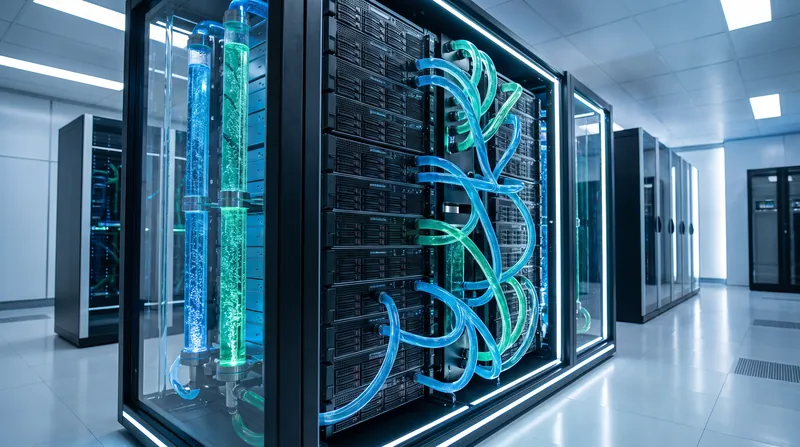
But providing that AI capability at an enterprise scale requires a fundamentally different class of physical infrastructure than traditional cloud hosting. Training and running large language models requires massive clusters of specialized accelerators, primarily Google's custom Tensor Processing Units (TPUs) and high-end GPUs.
In the first quarter alone, Alphabet spent $35.7 billion on capital expenditures, with roughly 60 percent of that money going directly toward servers. The remainder was poured into the physical data centers, advanced networking equipment, and the massive power and cooling systems required to keep those high-density chips from melting under continuous load.[2][3]
The scale of this physical buildout is difficult to overstate. Alphabet's revised 2026 capex guidance of $180 billion to $190 billion is more than double the $91.4 billion the company spent in 2025.
To help fund this historic physical expansion, the company even executed an $80 billion equity raise earlier in the year—a highly unusual move for a tech giant that has historically funded its operations entirely from its own massive cash flows. This is a company pivoting its entire financial structure to ensure it does not lose the infrastructure race.[5]
The immediate casualty of this spending spree is Alphabet's free cash flow margin. A year ago, that margin sat at a comfortable 21 percent. In the wake of the Q1 capex surge, it cratered to just 9.2 percent.
That nearly 12-point drop effectively wiped out the operating margin gains that Google Cloud achieved through its rapid revenue growth. The cloud division's operating margin actually improved from 17.8 percent to 32.9 percent year-over-year, but the sheer cost of the physical hardware required to sustain that business is eating the cash before it can reach the bottom line.[1]
Alphabet executives argue that this spending is not speculative; it is a direct response to contracted, guaranteed demand. The strongest piece of evidence supporting this claim is Google Cloud's backlog, which represents remaining performance obligations—revenue that customers have legally committed to spend but that Google has not yet recognized. That backlog nearly doubled quarter-over-quarter, reaching a staggering $462 billion. Multi-year contracts with AI labs and large enterprises take time to sign and even longer to fully draw down, providing a massive buffer for future earnings.[1][3]
A backlog of that size provides a level of revenue visibility that is rare even in the enterprise software world. According to company leadership, just over 50 percent of that $462 billion is expected to convert into recognized revenue within the next 24 months. This suggests that the current 63 percent growth rate is not a one-off anomaly driven by a few splashy deals, but rather a structural shift as large enterprises lock in multi-year commitments to secure guaranteed access to AI compute.[3][6]
In fact, CEO Sundar Pichai explicitly stated that Google Cloud is currently supply-constrained, not demand-constrained. He noted on the earnings call that cloud revenue would have been even higher in the first quarter if the company had the physical capacity to meet all the incoming customer requests. This flips the traditional narrative: Alphabet is not struggling to find buyers for its AI services; it is struggling to build data centers fast enough to serve the buyers who are already waiting in line with open checkbooks.[1][5]
This capacity crunch is not unique to Google. The entire cloud industry is currently locked in an infrastructure arms race that is reshaping the global hardware market. Amazon is projected to spend roughly $200 billion on capex in 2026, while Microsoft is tracking toward $190 billion.
Meta, which does not even sell public cloud services, is guiding for up to $135 billion in infrastructure spending. Combined, the major hyperscalers are on pace to spend over $700 billion this year just to ensure they do not lose ground in the generative AI transition.[5][6]
For Google, the stakes are particularly high. The company spent nearly two decades running a distant third in the cloud market behind Amazon Web Services and Microsoft Azure. But the shift toward generative AI has served as a reset button for enterprise cloud contracts. Because Google controls the entire stack—from the custom silicon to the foundational models to the consumer applications—it has been able to pitch a highly integrated AI ecosystem that is finally winning over hesitant corporate IT departments and driving unprecedented growth.[3][4]
The question now is whether the physical realities of the AI boom will eventually cap this financial growth. Building a data center in 2026 is not just about buying servers; it requires securing massive amounts of electricity, often necessitating investments in clean energy developers and grid infrastructure. Alphabet's recent $4.75 billion allocation for the acquisition of data center and clean energy developer Intersect highlights how far up the supply chain cloud providers must now reach just to guarantee their future power supply.[2]
Ultimately, Alphabet is asking its investors to trust a very expensive, multi-year process. The 63 percent growth in cloud revenue proves that the company has successfully commercialized its AI research, turning technical prowess into massive enterprise contracts.
But until the $190 billion capex bill begins to level off and the physical infrastructure is fully deployed, the market will likely remain skeptical about how much of that cloud revenue will actually translate into long-term, sustainable profit. The transition from a high-margin software business to a capital-intensive infrastructure provider is a painful one, and Alphabet is currently navigating the most expensive phase of that journey.[1][6]
Key points
- Google Cloud revenue surged 63% year-over-year to $20 billion in Q1 2026, driven by enterprise AI adoption.
- Alphabet raised its 2026 capital expenditure guidance to $180-$190 billion to fund data center and server expansion.
- The massive infrastructure spending caused Alphabet's free cash flow margin to drop from 21% to 9.2%.
- Google Cloud's backlog nearly doubled to $462 billion, with half expected to convert to revenue within 24 months.
Unanswered questions
- Whether the $462 billion backlog will fully convert to revenue if enterprise AI adoption slows down.
- How long the current cycle of $190 billion annual capital expenditures will last before leveling off.
- Whether the physical constraints of the global power grid will prevent Alphabet from deploying all the capacity it is purchasing.
How we got here
Q1 2025
Alphabet reports a comfortable 21% free cash flow margin, with capital expenditures remaining at historically normal levels.
Late 2025
Alphabet begins aggressively scaling its AI infrastructure, pushing total 2025 capital expenditures to $91.4 billion.
Early 2026
Alphabet executes an $80 billion equity raise to help fund its massive physical data center and hardware expansion.
April 2026
Alphabet reports Q1 2026 earnings, revealing 63% Google Cloud growth but raising 2026 capex guidance to $190 billion, causing a stock sell-off.
- Growth Optimists
- The massive capital expenditure is a necessary and justified investment to secure long-term dominance in the enterprise AI market.
- Margin Skeptics
- The unprecedented infrastructure spending is destroying free cash flow with no clear timeline for a return on investment.
- Infrastructure Analysts
- The bottleneck for AI growth is no longer software demand, but the physical constraints of power, cooling, and hardware supply chains.
Perspectives this story doesn't cover
- Environmental advocates concerned about the massive energy and water consumption of the new data centers.
- Enterprise IT buyers facing potential price increases as cloud providers seek to recoup their infrastructure investments.
Sources
Source coverage
6 outlets
3 viewpoints surfaced






- [1]TradingKeyMargin Skeptics
Why Did Alphabet's Stock Fall After Record Cloud Revenue?
Read on TradingKey → - [2]IndiaTimesInfrastructure Analysts
Alphabet Raises 2026 CapEx for AI Infrastructure
Read on IndiaTimes → - [3]ShatteredGrowth Optimists
Alphabet's Capex Bet: $190 Billion and Rising
Read on Shattered → - [4]SiliconANGLEGrowth Optimists
Alphabet delivers a stunning earnings beat
Read on SiliconANGLE → - [5]ValueAddVCMargin Skeptics
Alphabet's 2026 capex guidance jumped to $180-190B
Read on ValueAddVC → - [6]tastyliveInfrastructure Analysts
Alphabet Earnings Preview - July 2026
Read on tastylive →
More in Technology
See all →AI Infrastructure
OpenAI and Broadcom Unveil 'Jalapeño' Custom Chip, Signaling a Major Shift in Cloud Infrastructure
7 sources

Serverless Architecture
The Cold Start Penalty: How Function-as-a-Service Trades Latency for Cost and Operational Simplicity
5 sources
Cloud Economics
The Mechanics of Cloud Egress Fees: Why Data Gravity Traps Enterprise Workloads
6 sources
Kubernetes Architecture
The Reconciliation Loop: How Kubernetes Controllers Maintain Desired State in a Distributed System
6 sources
Comments
Every angle. Every day.
Get Technology stories with full source coverage and perspective breakdowns, free every day.