
Former South Korean President Yoon Convicted of Treason, Sentenced to 30 Years
A Seoul court has found former South Korean President Yoon Suk Yeol guilty of treason over his brief 2024 martial law declaration, handing down a 30-year prison sentence. The landmark ruling marks the first time a South Korean leader has been convicted of rebellion since the 1990s.
By Factlen Editorial Team
- Judicial and Constitutional Authorities
- Argue that the rule of law must be upheld and that mobilizing the military against the legislature is an unforgivable breach of the constitution.
- Pro-Democracy Advocates
- Celebrate the verdict as a triumph of democratic resilience and a necessary deterrent against future authoritarian backsliding.
- Conservative Defenders
- Believe the sentence is overly harsh and politically motivated, framing Yoon's actions as a desperate response to a paralyzed government.
What's not represented
- · Rank-and-file military personnel deployed during the decree
- · International diplomatic partners assessing South Korea's stability
Why this matters
The conviction sets a profound legal and political precedent for South Korea's democracy, demonstrating that the judiciary will severely punish unconstitutional power grabs. It also permanently reshapes the country's conservative political landscape ahead of upcoming legislative battles.
Key points
- Former South Korean President Yoon Suk Yeol has been sentenced to 30 years in prison for treason.
- The conviction stems from his brief, failed declaration of martial law in December 2024.
- The court ruled Yoon's attempt to use the military to block parliament constituted a grave constitutional breach.
- Yoon's defense argued the move was a political maneuver, not a coup, and plans to appeal the verdict.
- The ruling marks the first treason conviction of a South Korean leader since the 1990s trials of former military dictators.
A Seoul court has sentenced former South Korean President Yoon Suk Yeol to 30 years in prison after finding him guilty of treason and abuse of power. The verdict, delivered on Thursday, concludes a historic trial stemming from Yoon's shocking, short-lived declaration of martial law in December 2024. The ruling marks a watershed moment in South Korean political history, closing the legal chapter on a crisis that briefly threatened to upend one of Asia's most vibrant democracies.[1][2]
The Seoul Central District Court ruled that Yoon's attempt to deploy the military to block the National Assembly and arrest political opponents constituted a clear act of rebellion. In a scathing multi-hour reading of the verdict, the presiding judge stated that the former president "gravely violated the constitution and betrayed the trust of the sovereign people." The court determined that the mobilization of special forces to the parliament building met the strict legal threshold for treason.[2][6]
The charges trace back to a chaotic night in late 2024 when Yoon, facing plummeting approval ratings and severe legislative gridlock, abruptly declared emergency martial law on national television. The decree lasted barely six hours. In a dramatic display of defiance, lawmakers bypassed military cordons, scaled the parliament's fences, and unanimously voted to overturn the order before dawn, effectively neutralizing the military deployment.[3][4]

Following the failed decree, Yoon was swiftly impeached by the National Assembly and subsequently removed from office by the Constitutional Court, stripping him of his presidential immunity. He was arrested shortly after, setting the stage for a sprawling 18-month legal battle that gripped the nation. Prosecutors had originally demanded a life sentence, arguing that any leniency would invite future authoritarian subversion.[4][7]
During the trial, Yoon's defense team argued that the martial law declaration was a legitimate, albeit flawed, attempt to protect the state from what they described as "anti-state forces" paralyzing the government. They maintained that Yoon never intended to permanently subvert democratic institutions, framing the act as a desperate political maneuver to break partisan gridlock rather than a premeditated coup d'état.[5][6]
Prosecutors systematically dismantled this defense by presenting internal communications, military logs, and witness testimonies from top brass. The evidence showed premeditated plans to detain opposition leaders, seize control of major broadcast media, and suspend civilian courts. The prosecution successfully argued that these actions went far beyond political maneuvering and represented a coordinated attempt to dismantle the constitutional order.[1][3]
Prosecutors systematically dismantled this defense by presenting internal communications, military logs, and witness testimonies from top brass.
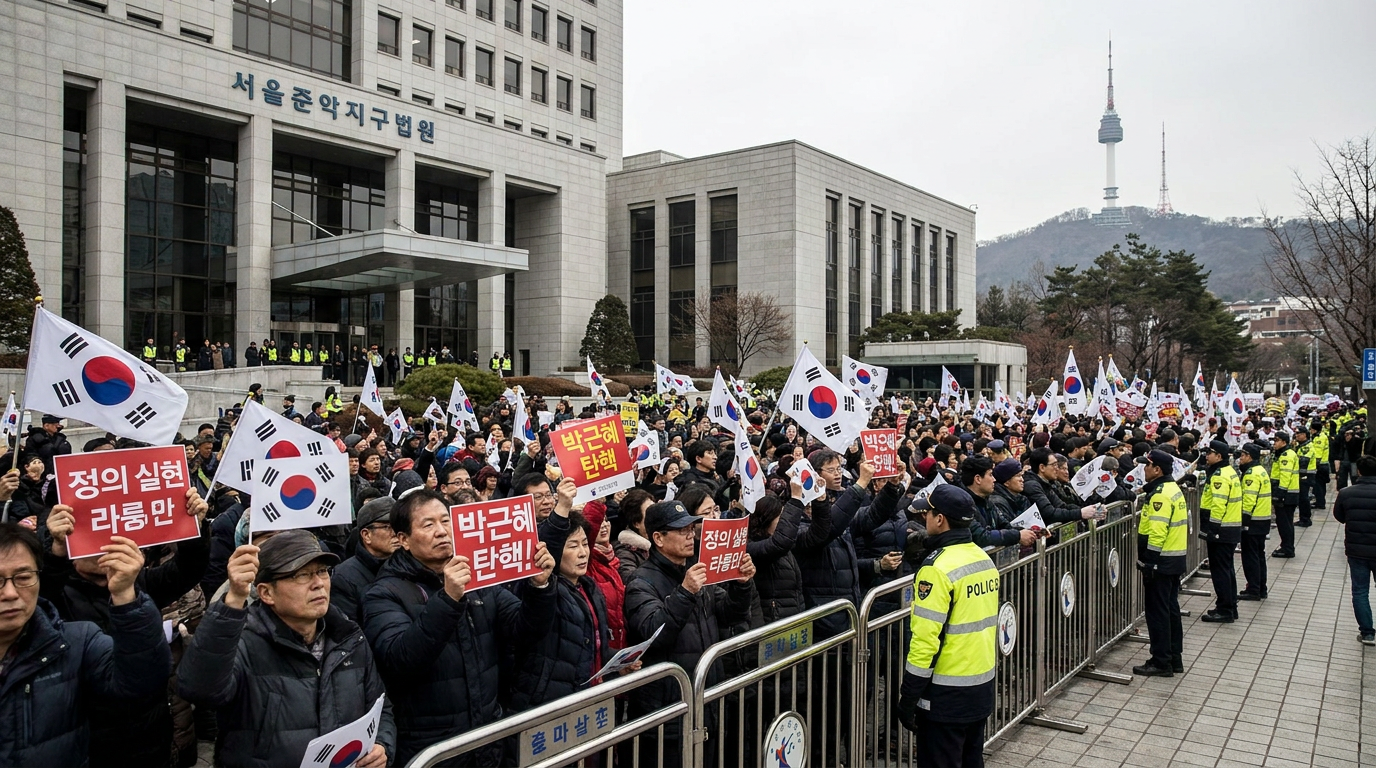
The verdict sparked massive demonstrations outside the courthouse in central Seoul. Thousands of citizens who had participated in the candlelight vigils demanding Yoon's resignation in 2024 celebrated the ruling as a triumph of democratic resilience. Chants of "democracy prevails" echoed through the streets as the sentence was broadcast live on massive screens. Meanwhile, a smaller contingent of Yoon's conservative supporters protested the decision nearby, calling it a politically motivated witch hunt.[2][8]

The 30-year sentence delivers a devastating blow to South Korea's conservative People Power Party (PPP), which has struggled to rebuild its base since the martial law fiasco. Political analysts note that the ruling cements a deep fracture within the conservative movement, forcing current party leaders to definitively distance themselves from the Yoon era if they hope to remain viable in upcoming national elections.[7][8]
Yoon is not the first South Korean president to face prison time—several predecessors, including Park Geun-hye and Lee Myung-bak, have been jailed for corruption or abuse of power. However, he is the first to be convicted of treason since military dictators Chun Doo-hwan and Roh Tae-woo were tried in the 1990s for their roles in the 1979 coup and the 1980 Gwangju massacre, underscoring the severity of Yoon's constitutional breach.[3][5]
Yoon's legal team immediately announced their intention to appeal the verdict to the Seoul High Court, arguing the sentence is disproportionately severe and ignores the political context of his presidency. As the appeals process begins, Yoon will remain in the Seoul Detention Center, where he has been held since his arrest, while the nation turns its focus to the broader institutional and military reforms promised in the wake of the crisis.[1][4]
How we got here
Dec 2024
Yoon declares emergency martial law, which is overturned by parliament within six hours.
Early 2025
The Constitutional Court formally removes Yoon from office, stripping his presidential immunity.
Spring 2025
Yoon is arrested and indicted on charges of treason and abuse of power.
June 2026
A Seoul court convicts Yoon of treason, sentencing him to 30 years in prison.
Viewpoints in depth
Judicial and Constitutional Authorities
Emphasizes the constitutional breach and the necessity of severe punishment to deter future subversion.
Legal scholars and judicial officials view the 30-year sentence as a necessary reaffirmation of South Korea's constitutional order. By treating the mobilization of the military against the legislature as an act of rebellion, the court has established a rigid legal boundary. Proponents of this view argue that any leniency would have set a dangerous precedent, potentially encouraging future leaders to use the military to resolve political disputes.
Yoon's Defense Team
Argues the act was a misguided political maneuver to break legislative gridlock, not a premeditated coup.
Yoon's legal representatives maintain that the martial law declaration, while ultimately unconstitutional, lacked the intent required for a treason conviction. They argue that Yoon was attempting to shock a paralyzed political system into action and protect the state from what he viewed as obstructionist forces. From this perspective, the 30-year sentence is a disproportionate, politically motivated punishment that criminalizes a failed policy decision rather than an actual attempt to overthrow the state.
Civic and Pro-Democracy Groups
Views the conviction as a vital vindication of the public's power and a warning to future leaders.
For the thousands of citizens who protested the martial law decree, the verdict represents the ultimate triumph of civilian oversight over executive overreach. Civic organizations point to the speed with which the public and the legislature mobilized in 2024 as proof of South Korea's democratic maturity. They argue the severe sentence is the rightful conclusion to a crisis that tested the nation's institutions, ensuring that the dark days of military dictatorship remain firmly in the past.
What we don't know
- Whether the Seoul High Court will reduce the 30-year sentence on appeal.
- How the final verdict will impact the long-term electoral viability of the conservative People Power Party.
- If any accomplices in the military command will face similarly severe sentences in ongoing parallel trials.
Key terms
- Treason (Rebellion)
- In South Korean law, the act of organizing or leading a plot to subvert the constitution or overthrow the government, which carries severe penalties including life imprisonment.
- National Assembly
- The unicameral national legislature of South Korea, which successfully voted to block Yoon's martial law decree in 2024.
- People Power Party (PPP)
- The conservative political party to which Yoon belonged, which has faced significant internal turmoil and electoral challenges since the crisis.
Frequently asked
Can Yoon appeal the 30-year sentence?
Yes, his defense team has already announced plans to appeal the decision to the Seoul High Court, arguing the sentence is disproportionately severe.
Is Yoon the first South Korean president to go to prison?
No. Several former presidents, including Park Geun-hye and Lee Myung-bak, have been imprisoned for corruption. However, Yoon is the first convicted of treason since the 1990s.
What happened during the martial law declaration?
In December 2024, Yoon attempted to deploy military forces to the parliament building to arrest political opponents, but lawmakers scaled fences to enter the chamber and voted to nullify the decree within six hours.
Sources
Source coverage
8 outlets
3 viewpoints surfaced








[1]ReutersPro-Democracy Advocates
Former South Korean President Yoon sentenced to 30 years for treason
Read on Reuters →[2]Yonhap News AgencyJudicial and Constitutional Authorities
Yoon found guilty of rebellion, gets 30-year prison term over martial law fiasco
Read on Yonhap News Agency →[3]The New York TimesPro-Democracy Advocates
South Korea Sentences Former President to 30 Years in Martial Law Case
Read on The New York Times →[4]BBC NewsPro-Democracy Advocates
Yoon Suk Yeol: Ex-South Korea president jailed for 30 years for treason
Read on BBC News →[5]Al JazeeraPro-Democracy Advocates
South Korea court convicts former President Yoon of treason
Read on Al Jazeera →[6]The Korea HeraldJudicial and Constitutional Authorities
Court delivers 30-year sentence to Yoon, citing grave constitutional breach
Read on The Korea Herald →[7]The Wall Street JournalConservative Defenders
South Korea's Yoon Convicted of Treason Over Failed Martial Law Bid
Read on The Wall Street Journal →[8]Nikkei AsiaConservative Defenders
Yoon's 30-year sentence sends shockwaves through South Korean politics
Read on Nikkei Asia →
Every angle. Every day.
Get news politics stories with full source coverage and perspective breakdowns delivered to your inbox.