
FIFA Sacks COO Kevin Lamour Following Criticism of World Cup Commercialization Plan
FIFA has dismissed Chief Operating Officer Kevin Lamour weeks after he publicly condemned a controversial $20 billion proposal to sell a stake in the World Cup to private equity investors.
The future of the world’s most watched sporting event is caught in a multi-billion-dollar tug-of-war over who actually owns it. For fans, the stakes are existential: whether the World Cup remains a federation-run global festival or transforms into a private-equity-backed commercial juggernaut driven by quarterly returns.
That philosophical battle just claimed its highest-profile casualty, exposing the deep fractures within the sport's global governance. The tension between maximizing immediate revenue and preserving the traditional, member-owned structure of international football has reached a boiling point, forcing executives to choose sides in a high-stakes boardroom conflict that will define the next era of the game.
On August 17, FIFA abruptly sacked its Chief Operating Officer, Kevin Lamour, severing ties with the executive just weeks after he publicly torched President Gianni Infantino’s controversial commercialization plan.
Lamour, a former UEFA deputy general secretary who joined FIFA’s inner circle in November 2024, had accused the administration of deceiving staff over a proposal to sell a massive stake in the governing body’s tournament business. The dismissal removes the third-highest-ranking official from the organization, sending a clear message about the administration's tolerance for internal dissent during a period of intense commercial restructuring.[1][2][5][6]
The dismissed executive did not go quietly into the Swiss night. In late July, Lamour released a scathing statement to the Associated Press, labeling the sell-off as 'the project of one person' and asserting that FIFA's mission is to serve football, not the personal interests of a president who 'believes he embodies FIFA'.
His departure follows the resignation of senior Infantino adviser Carlos Cordeiro, who walked away calling the initiative a 'bad deal for football'. Lamour had openly acknowledged that his defiance might cost him his job, stating that he would 'sleep well' knowing he had spoken out against the administration's lack of transparency.[1][4][5][6]
At the center of the fallout is the now-abandoned 'FIFA Forward Enterprise' (FFE) proposal, a financial maneuver that would have fundamentally altered the sport's economic landscape. The plan sought to spin off FIFA’s commercial and operations departments—including the crown jewel World Cup—into a new, standalone subsidiary valued at an astonishing $20 billion. By carving out the most lucrative aspects of the governing body's portfolio, the administration aimed to create a highly attractive vehicle for external investment, separating the commercial engine from the bureaucratic and regulatory arms of the federation.[2][3][6]
Under the FFE framework, private investors would have acquired up to a 20 percent stake in the new entity, injecting roughly $4 billion in immediate capital. Reports linked prominent private equity figures, including Joshua Kushner, to the potential acquisition, signaling a shift toward aggressive, Wall Street-style monetization of the sport's biggest events. For proponents, this influx of cash represented a necessary modernization, providing the liquidity needed to aggressively expand global football infrastructure and compete with the rapidly growing valuations of major North American sports leagues and elite European club competitions.[3][6]
However, the backlash from the sport's traditional power brokers was swift, severe, and ultimately fatal to the proposal. European governing body UEFA, alongside CONCACAF and the Asian Football Confederation, viewed the move as a dangerous surrender of control.
The confederations threatened a coordinated boycott of future FIFA events, arguing that the sport belongs to its member associations, not to private equity firms seeking a return on investment. Faced with the prospect of a fractured global calendar and open rebellion from the organizations that supply the World Cup's top talent, Infantino was forced to withdraw the $20 billion proposal.[3][5]
Yet the internal damage was already done, culminating in the terse Monday email from FIFA Secretary General Mattias Grafström confirming that the organization and its COO had 'agreed to part ways'. A formal statement from a FIFA spokesperson offered no further explanation, simply noting that the working relationship had ended and thanking Lamour for his two years of service. The sterile corporate language masked what insiders describe as a total breakdown in trust between the president's office and the operational leadership tasked with executing his vision.[1][2][4][6]
While the FFE plan is officially shelved, the underlying tension that sparked the crisis remains entirely unresolved. The clash exposes a deep ideological divide within global football regarding how to maximize revenue in an increasingly fragmented and competitive media landscape. The governing body is caught between the undeniable financial allure of private equity and the fierce protectionism of its continental federations, who fear that external investors will inevitably push for expanded tournaments, relocated matches, and higher consumer costs to guarantee their margins.
The dismissal of Lamour serves as a stark warning shot across the bow of global football administration, illustrating the perilous nature of challenging the executive vision. It underscores the immense pressure Infantino faces as he navigates the political minefield of his presidency, attempting to balance the demands of wealthy investors against the deeply entrenched traditions of the sport's continental power brokers.
The swift removal of a top lieutenant suggests that the administration is circling the wagons, preparing for the next phase of its commercial strategy without the burden of internal opposition.[2][5]
As the dust settles on this executive shakeup, the fundamental question of the World Cup's commercial future remains wide open. The battle lines have been clearly drawn between the traditionalist member-owned model and the aggressive private equity approach. While Lamour's tenure has ended, the debate that cost him his job is only just beginning, leaving the sport's most lucrative asset hanging in the balance as stakeholders wait to see which financial philosophy will ultimately dictate the future of the global game.
Key points
- FIFA sacked Chief Operating Officer Kevin Lamour on August 17 following his public criticism of a controversial commercialization plan.
- Lamour accused the administration of deceiving staff over the 'FIFA Forward Enterprise' proposal to sell a 20% stake in tournament operations.
- The $20 billion private equity plan was abandoned after UEFA, CONCACAF, and the AFC threatened a coordinated boycott.
- The executive fallout highlights a deep ideological divide between traditional federation control and aggressive private equity monetization.
Open questions
- Whether FIFA will attempt a restructured, smaller-scale commercial sell-off in the future.
- How Lamour's dismissal will impact Infantino's relationship with the dissenting continental confederations.
- If other senior executives will resign or be removed in the wake of the FFE proposal's collapse.
- Traditionalist Confederations
- Continental bodies arguing that global football belongs to its member associations, not private equity.
- Internal FIFA Dissenters
- Executives demanding transparency and opposing the centralization of power within the presidency.
- Commercial Reformers
- Proponents of leveraging private investment to aggressively modernize the sport's commercial operations.
Perspectives this story doesn't cover
- Private equity firms targeting sports assets
- Grassroots football associations reliant on FIFA funding
Sources
Source coverage
6 outlets
3 viewpoints surfaced






- [1]The GuardianTraditionalist Confederations
Fifa chief sacked after criticism of Infantino's World Cup sell-off plan
Read on The Guardian → - [2]GoalInternal FIFA Dissenters
FIFA has confirmed the departure of its chief operating officer Kevin Lamour following a period of intense friction
Read on Goal → - [3]Fox Sports AustraliaCommercial Reformers
World Cup 2026: FIFA sack chief operating officer Kevin Lamour over Gianni Infantino criticism
Read on Fox Sports Australia → - [4]AP NewsInternal FIFA Dissenters
FIFA's chief operating officer, Kevin Lamour, has reportedly left his role weeks after accusing president Gianni Infantino of deceiving staff
Read on AP News → - [5]The IndependentTraditionalist Confederations
Fifa's chief operating officer leaves after scathing criticism of Gianni Infantino
Read on The Independent → - [6]The StandardInternal FIFA Dissenters
FIFA confirmed on Monday that Chief Operating Officer Kevin Lamour has left the governing body
Read on The Standard →
More in Sports
See all →UEFA Nations League
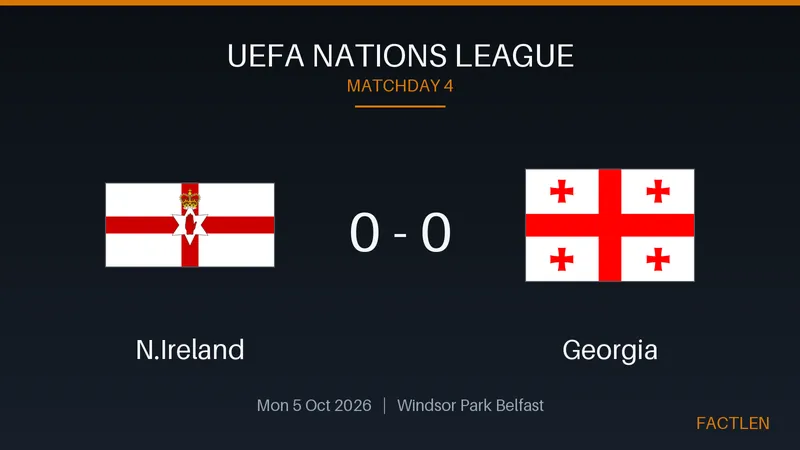
Northern Ireland Held to 0-0 Draw by Georgia as Mamardashvili Saves Late Penalty
2 sources
Standings
MLS Playoff Bubble Boils Over: Three-Way Tie in the East as Decision Day Looms
3 sources

UEFA Nations League
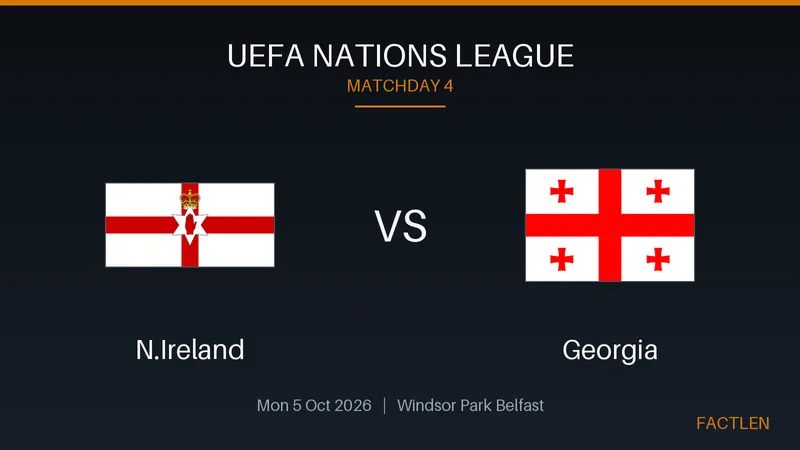
Northern Ireland Chases Nations League Promotion Against Struggling Georgia
6 sources
UEFA Nations League
Ukraine and Hungary Face Defining Nations League Clash in Trnava
6 sources
Comments
Every angle. Every day.
Get Sports stories with full source coverage and perspective breakdowns, free every day.