
Evidence Pack: Evaluating Claims of a $19.2 Trillion Investment Boom in the US Economy
A detailed review of federal data and independent trackers reveals that while the U.S. is securing hundreds of billions in real manufacturing investments, political claims of a $19.2 trillion influx are off by an order of magnitude.
By Factlen Editorial Team
- Economic Data Analysts
- Focuses on strict definitions of deployed capital and Foreign Direct Investment.
- Independent Fact-Checkers
- Focuses on verifying political claims against primary federal and corporate data.
- Administration Officials
- Focuses on the aggregate value of all economic activity, trade, and pledges as a measure of confidence.
What's not represented
- · Local Municipal Planners
- · Foreign Corporate Investors
Why this matters
Understanding the difference between political pledges and actual deployed capital is crucial for economic literacy. When investment figures are exaggerated by an order of magnitude, it distorts public understanding of the economy's true scale and makes it harder for local governments to accurately forecast infrastructure needs and tax revenues.
Key points
- The administration has repeatedly claimed that $19.2 trillion in new investment is pouring into the U.S. economy.
- The White House's own internal tracker lists a much lower $10.6 trillion in 'major investment announcements.'
- Independent reviews found that even the $10.6 trillion figure heavily aggregates non-binding pledges and bilateral trade goals.
- Actual new Foreign Direct Investment (FDI) into the U.S. was approximately $232 billion last year, according to federal data.
- While the U.S. is experiencing a genuine boom in manufacturing construction, the scale is measured in the hundreds of billions, not trillions.
The figure $19.2 trillion has become a recurring centerpiece in recent economic addresses, framed as a historic flood of capital pouring into the United States from across the globe.
The administration asserts that this unprecedented sum—roughly equivalent to two-thirds of the entire U.S. Gross Domestic Product—is the direct result of recent tariff policies and tax incentives designed to reshore manufacturing.[1]
However, a rigorous examination of primary economic data reveals a massive chasm between political rhetoric and deployed capital, highlighting the critical difference between a binding capital expenditure and a vague memorandum of understanding.[1]
To understand the discrepancy, economists point to the administration's own internal metrics. The White House's investment tracker recently listed $10.6 trillion in "major investment announcements," a number that itself falls nearly $9 trillion short of the public claims.

Detailed reviews of that $10.6 trillion list by independent fact-checkers found that it heavily aggregates non-binding pledges, broad bilateral trade goals, and statements of economic cooperation that do not represent actual domestic investment.[1]
When evaluating true economic inflows, the gold standard is Foreign Direct Investment (FDI), tracked meticulously by the Bureau of Economic Analysis to measure money that has actually crossed borders to build facilities or acquire assets.
According to the latest federal data, new foreign direct investment into the United States hovered around $232 billion annually, with the first half of the current year seeing roughly $145 billion in actual deployed capital.
Even when expanding the lens to look at announced projects that have not yet broken ground, the numbers remain anchored in the billions, not trillions.[2]

Even when expanding the lens to look at announced projects that have not yet broken ground, the numbers remain anchored in the billions, not trillions.
Data from fDi Intelligence, a specialized division of the Financial Times, tracked approximately $270 billion in promised foreign investments over a recent ten-month period.[1][2]
While this $270 billion figure represents a robust doubling of the previous baseline and a genuine economic tailwind for the American workforce, it is still off by an order of magnitude from the $19.2 trillion claim.[2]
Adam Posen, president of the Peterson Institute for International Economics, notes that while the U.S. is indeed seeing a "meaningful increase" in targeted manufacturing investments, the scale is measured in hundreds of billions.
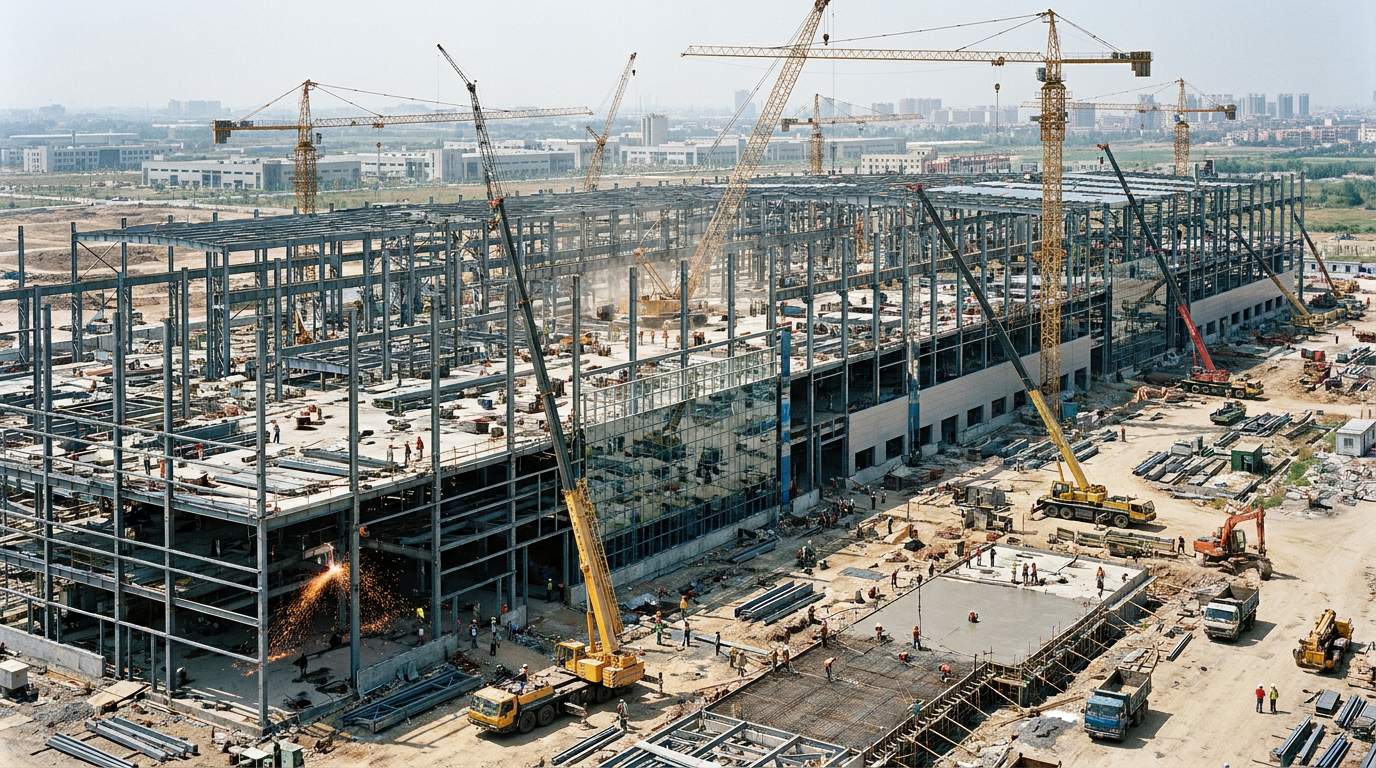
The administration frequently points to a boom in factory construction as visual evidence of the multi-trillion-dollar influx, citing new plants rising in the Midwest and Sun Belt.
It is undeniably true that specific sectors, particularly semiconductor fabrication and electric vehicle infrastructure, have seen historic spikes in facility construction over the past three years.
Yet, total spending on manufacturing construction across the entire U.S. economy, while strong, simply does not mathematically approach the multi-trillion-dollar threshold required to validate the political claims.

Ultimately, the $19.2 trillion figure appears to be an amalgamation of stock market capitalization gains, routine trade volumes, and speculative pledges, rather than a measure of actual investment.[1]
For local governments and infrastructure planners, distinguishing between a political announcement and committed capital is vital for accurately forecasting tax revenues and job creation.
The transparent reality is that the United States remains the world's premier destination for global capital, securing hundreds of billions in real, job-creating investments—a highly successful economic narrative that requires no mathematical exaggeration.[2]
How we got here
2024-2025
Initial waves of major semiconductor and green-energy manufacturing investments are announced across the U.S.
Late 2025
Administration officials begin citing investment figures ranging from $17 trillion to $21 trillion in public speeches.
May 2026
The White House's internal investment tracker lists $10.6 trillion in 'major investment announcements.'
July 2026
The $19.2 trillion figure is repeatedly cited, prompting detailed reviews by economic data analysts and fact-checkers.
Viewpoints in depth
Administration's View
Focuses on the aggregate value of all economic activity, trade, and pledges as a measure of confidence.
Administration officials argue that traditional economic metrics like FDI are too narrow to capture the full scope of their economic agenda. By aggregating stock market gains, bilateral trade agreements, and long-term memorandums of understanding, they present a holistic picture of global confidence in the U.S. market, even if those figures do not represent immediate capital expenditures.
Economic Analysts' View
Focuses on strict definitions of deployed capital and Foreign Direct Investment.
Economists and data analysts emphasize that a pledge is not a factory. They rely on strict metrics like Foreign Direct Investment (FDI) and Capital Expenditure (CapEx) to track money that has actually entered the economy to build facilities, purchase equipment, and hire workers. From this perspective, conflating trade volume or stock valuation with 'investment' fundamentally distorts macroeconomic reality.
Corporate Forecasters' View
Focuses on the gap between announced memorandums of understanding and actual ground-breaking.
Industry analysts track the 'conversion rate' of political announcements. They note that many multi-billion-dollar pledges made at high-profile summits are quietly scaled back or abandoned when market conditions change. Consequently, corporate forecasters heavily discount political investment claims, relying instead on permitted construction projects and finalized corporate earnings guidance.
What we don't know
- Exactly how the administration mathematically calculated the $19.2 trillion figure, as the White House has not released a detailed ledger of the claim.
- What percentage of the $10.6 trillion in 'major announcements' tracked by the White House will ultimately materialize into deployed capital over the next decade.
Key terms
- Foreign Direct Investment (FDI)
- An investment made by a firm or individual in one country into business interests located in another country.
- Capital Expenditure (CapEx)
- Funds used by a company to acquire, upgrade, and maintain physical assets such as property, plants, buildings, or equipment.
- Memorandum of Understanding (MOU)
- A non-binding agreement that outlines the broad outlines of an intent to invest or cooperate, which may never materialize into actual spending.
Frequently asked
What is Foreign Direct Investment (FDI)?
FDI is when a company or individual from one country establishes business operations or acquires business assets in another country, such as building a new factory.
Why do political investment claims often exceed actual data?
Political figures often aggregate non-binding pledges, bilateral trade goals, and general economic activity, whereas economists only count capital that has actually been deployed.
Is investment in the US currently growing?
Yes. While not in the trillions, independent trackers show a significant increase in announced foreign investments, particularly in manufacturing and technology.
Sources
Source coverage
2 outlets
3 viewpoints surfaced


[1]CBS NewsIndependent Fact-Checkers
Evaluating the administration's trillion-dollar investment figures
Read on CBS News →[2]fDi IntelligenceEconomic Data Analysts
US Foreign Investment Tracker and Pledges
Read on fDi Intelligence →



Every angle. Every day.
Get news politics stories with full source coverage and perspective breakdowns delivered to your inbox.