
Esports World Cup Relocates to Paris for $75 Million Tournament Amid Middle East Tensions
The world's richest esports festival has shifted its 2026 operations from Riyadh to France, accelerating its global rotation plans while unlocking new mainstream European broadcast deals.
By Factlen Editorial Team
- Tournament Organizers
- The relocation was a necessary logistical pivot that ultimately accelerated the event's long-term global ambitions.
- Host City Officials
- Hosting the world's largest esports tournament is a major cultural and economic victory for Paris.
- Esports Industry & Clubs
- The unprecedented $75M prize pool and Club Championship model remain the primary focus despite the venue change.
- Digital Asset Sponsors
- The move to a regulated European market opens lucrative new sponsorship avenues for cryptocurrency firms.
Why this matters
The relocation of the world's richest esports tournament demonstrates the industry's growing logistical resilience and opens the door for mainstream European broadcasting and regulated digital asset sponsorships.
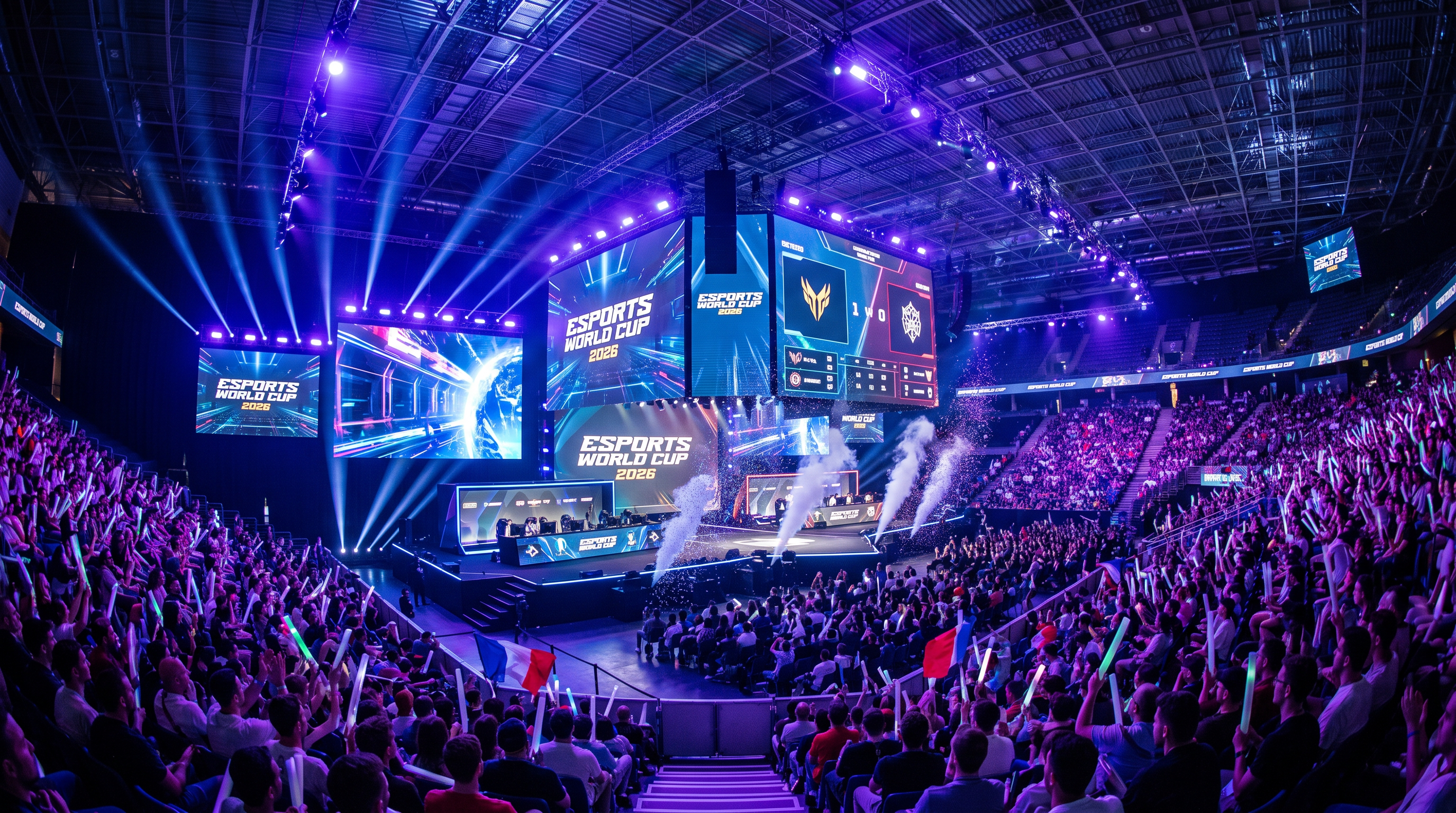
The 2026 Esports World Cup (EWC) has officially commenced, transforming the sprawling Paris Expo Porte de Versailles into the undisputed epicenter of competitive gaming for the next seven weeks. Featuring a record-breaking $75 million prize pool, the massive festival brings together more than 2,000 professional players and 200 elite esports clubs representing over 100 countries. The opening ceremonies, attended by Paris Mayor Emmanuel Grégoire, marked a historic milestone for the industry: the first time the global tournament has been hosted outside of Saudi Arabia, signaling a new era of international expansion for the event.[2][8]
The road to the French capital, however, was born out of geopolitical necessity rather than initial design. Originally scheduled to take place in Riyadh, as it had for its highly successful first two iterations, the event faced mounting logistical hurdles throughout the winter and spring. Escalating military conflict in the Middle East, including targeted drone and missile strikes near Riyadh and the King Khalid International Airport, severely disrupted international air travel. Multiple major airlines reduced or suspended flights to the region, creating an untenable situation for an event reliant on global participation.[1][4][6]
Faced with the daunting prospect of flying thousands of competitors, support staff, and broadcast personnel into a volatile airspace, the Esports Foundation—the Saudi-backed nonprofit organization that operates the tournament—made the unprecedented decision in May to relocate the entire operation. Ralf Reichert, CEO of the Esports Foundation, cited the absolute necessity of providing clarity and stability for players, clubs, and fans who were planning their summer travel. Organizers quickly determined that delaying the massive seven-week event was simply not an option, forcing a rapid pivot to a European host city.[4][5][6]
While the relocation was undeniably forced by regional instability, tournament organizers have publicly embraced the shift as a welcome acceleration of their long-term strategic vision. The Foundation had always planned to eventually transition the EWC into a rotating global roadshow, akin to traditional sporting mega-events like the Olympic Games or the FIFA World Cup. Moving to the French capital simply pushed that timeline forward by a few years, turning Paris into what Reichert described as the 'first international chapter' of the tournament's evolving history.[5]

The sheer scale of the event remains entirely intact despite the rapid venue change. Competitors will battle across 25 distinct tournaments spanning 24 of the world's most popular game titles, including heavyweights like League of Legends, Dota 2, Counter-Strike 2, and Valorant. The qualification process leading up to the Paris finals was the largest in esports history, with more than 1.5 million players participating in 330 globally hosted 'Road to EWC' events, publisher leagues, and international circuits to secure their spot on the main stage.[2][3][8]
The economic engine driving the EWC is its unique prize distribution model, which heavily incentivizes organizational breadth rather than single-game specialization. Of the staggering $75 million total purse—the largest in the history of competitive gaming—$30 million is dedicated exclusively to the Club Championship. This cross-game leaderboard rewards overarching esports organizations that field highly competitive rosters across multiple different titles, fundamentally changing how teams approach roster building and talent acquisition throughout the year. By linking success across different genres, the tournament elevates the brand value of the clubs themselves.[2][8]
The economic engine driving the EWC is its unique prize distribution model, which heavily incentivizes organizational breadth rather than single-game specialization.
The winning organization of the Club Championship will take home a massive $7 million top prize, cementing their status as the dominant force in global esports. Saudi-owned Team Falcons enters the Paris tournament as the heavy favorite, looking to defend its title after securing consecutive Club Championship victories in 2024 and 2025. The remaining $45 million of the prize pool is distributed across the individual game tournaments, MVP awards, and qualifier bounties, with specific prize pools varying sharply depending on the global popularity and publisher backing of each title.[2][8]
The relocation to France has also unlocked unprecedented mainstream media integration for the tournament, bridging the gap between digital platforms and traditional television. In a landmark broadcast deal brokered by European esports promoter N.E.O., France Télévisions—the country's public national broadcaster—is airing daily highlights of the competition. The dedicated program, titled 'La Minute EWC,' will run on mainstream television throughout the entire seven-week festival, exposing the complexities of competitive gaming to a broader, traditional European audience that might never tune into a Twitch or YouTube stream.[7]

Beyond traditional broadcasting, the Paris venue has opened lucrative new financial avenues for the tournament through France's specific regulatory environment. Under the country's PSAN (Prestataires de Services sur Actifs Numériques) framework, licensed cryptocurrency companies are legally permitted to sponsor the event. This regulatory green light has allowed major digital asset firms like Coinbase and Bitget to secure high-visibility jersey placements and digital content campaigns, tapping into a revenue stream that was previously restricted or legally ambiguous in other global jurisdictions.[7]
The global broadcast footprint for the 2026 EWC is set to be the largest and most accessible in esports history, ensuring that the venue change does not hinder viewership. Fans in 160 countries can watch the action live across more than 100 broadcast and over-the-top (OTT) streaming partners. The organizers anticipate producing more than 7,000 hours of live programming over the next two months, with expert commentary, player interviews, and strategic analysis offered in over 40 languages to accommodate the truly international fanbase that follows these top-tier organizations.[2][8]
Furthermore, the tournament is leaning heavily into community-driven broadcasting to maximize its digital reach. The Esports Foundation expects up to 5,000 official co-streamers to broadcast the event on their personal channels—a massive 42% year-over-year increase. This allows fans to watch the matches alongside their favorite internet personalities, creating a more interactive viewing experience. Global ambassadors, including football icon Cristiano Ronaldo and chess grandmaster Magnus Carlsen, have also returned to promote the event's international reach across their massive social media followings.[2]
French officials have welcomed the sudden influx of esports tourism with open arms, recognizing the substantial economic windfall of hosting a seven-week global festival on such short notice. President Emmanuel Macron celebrated the relocation as a 'historic first and an honour' for France, highlighting the country's capability to host mega-events. Local authorities anticipate a significant economic boost for the Paris region's hospitality sector, as thousands of players, support staff, and dedicated fans occupy the city's hotels, restaurants, and transit systems through late August, effectively extending the summer tourism peak.[3]

The successful launch of the Paris event proves that the esports industry can execute massive logistical pivots without sacrificing scale, competitive integrity, or production value. However, the long-term geographic future of the Esports World Cup remains an open question. While the Foundation has proven the immense viability of a European host city, it remains to be seen whether the tournament will return to its native Riyadh in 2027 once regional stability improves, or if the 'global rotation' model will see it land in North America or Asia next.[3][5]
Viewpoints in depth
Tournament Organizers' view
The relocation was a necessary logistical pivot that ultimately accelerated the event's long-term global ambitions.
For the Esports Foundation, the primary concern was the safety and logistical feasibility of flying thousands of international competitors into a region experiencing active airspace disruptions. By moving the event to Paris, organizers not only secured a stable environment but also fast-tracked their pre-existing vision of turning the Esports World Cup into a traveling global festival, similar to the Olympics.
French Officials' view
Hosting the world's largest esports tournament is a major cultural and economic victory for Paris.
French leadership, including President Emmanuel Macron, view the relocation as a testament to the country's strong gaming culture and infrastructure. The seven-week festival is expected to drive significant tourism and hospitality revenue, while the integration of daily highlights on public television signals a broader mainstream acceptance of competitive gaming in European culture.
Digital Asset Industry's view
The move to a regulated European market opens lucrative new sponsorship avenues for cryptocurrency firms.
Because France operates under the clear PSAN regulatory framework for digital assets, licensed cryptocurrency exchanges can legally sponsor the Paris event. This provides firms like Coinbase and Bitget with a massive, highly engaged global audience, establishing a new template for how digital finance can integrate with mainstream esports broadcasts without running afoul of local advertising laws.
What we don't know
- It remains unclear whether the Esports World Cup will return to Riyadh in 2027 or continue its global rotation to a new host city.
- The exact impact of the European timezone shift on global viewership metrics compared to previous Middle Eastern broadcasts is yet to be determined.
Sources
Source coverage
8 outlets
4 viewpoints surfaced








[1]ESChartsEsports Industry & Clubs
Esports World Cup 2026 Relocated to France: Paris Hosts EWC
Read on ESCharts →[2]GamesBeatEsports Industry & Clubs
Esports World Cup 2026 opens in Paris with $75M prize pool
Read on GamesBeat →[3]India TimesHost City Officials
The world's biggest esports tournament will be staged in Paris this summer
Read on India Times →[4]European GamingTournament Organizers
Conflict in the Middle East triggers first EWC relocation
Read on European Gaming →[5]GosuGamersTournament Organizers
The Esports World Cup will take place in Paris in 2026
Read on GosuGamers →[6]WikipediaEsports Industry & Clubs
2026 Esports World Cup
Read on Wikipedia →[7]Crypto BriefingDigital Asset Sponsors
Esports World Cup 2026 opens doors to crypto sponsors as BBL Esports advances in $75M tournament
Read on Crypto Briefing →[8]PocketGamer.bizEsports Industry & Clubs
Esports World Cup 2026 officially opens in Paris
Read on PocketGamer.biz →
Every angle. Every day.
Get gaming esports stories with full source coverage and perspective breakdowns delivered to your inbox.