
DOE Proposes Overhaul of College Accreditation, Tying Federal Aid to 'Intellectual Diversity' Mandates
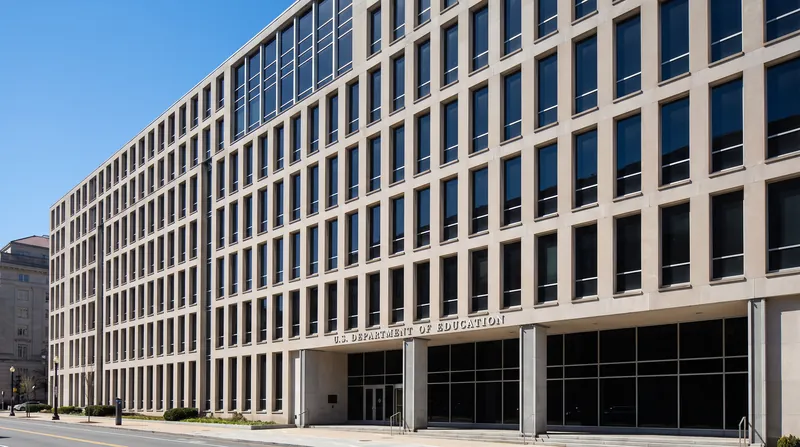
The U.S. Department of Education has released draft regulations that would fundamentally reshape college accreditation, requiring oversight of campus free speech while making it easier for institutions to switch accreditors.
By Ivan Smirnov

Share this story
The U.S. Department of Education (DOE) has formally unveiled a sweeping proposal to overhaul how colleges and universities are accredited, fundamentally altering the regulatory machinery of American higher education. The draft regulations, which emerged from a negotiated rulemaking committee this spring, seek to tie institutional quality control to new mandates regarding "intellectual diversity" and free speech. If finalized, the rules will force thousands of colleges to rewrite their governance policies or risk losing access to federal funding.[3]
To understand the stakes of the proposal, one must understand the mechanics of accreditation. The federal government does not directly certify universities for quality. Instead, it relies on independent, federally recognized accrediting agencies to serve as gatekeepers. Institutions must maintain accreditation for their students to be eligible for Title IV federal financial aid, which includes Pell Grants and federal student loans. Because this aid totals more than $100 billion annually, losing accreditation is effectively a death sentence for a modern university.[1][5]
The proposed regulations would dramatically expand the purview of these accreditors. Under the draft rules, accrediting agencies would be required to evaluate whether institutions maintain policies that "support, promote, and appropriately prioritize intellectual diversity and the free exchange of ideas amongst faculty." This includes monitoring how colleges handle academic freedom and freedom of inquiry in both teaching and research. Public universities would face additional scrutiny regarding their strict compliance with First Amendment obligations.[6]
While the rules mandate the promotion of intellectual diversity, they explicitly prohibit accreditors from requiring colleges to adopt Diversity, Equity, and Inclusion (DEI) standards. The administration argues that such requirements often amount to unlawful discrimination and ideological coercion. By stripping DEI mandates from the accreditation process, the DOE aims to ensure that federal recognition is not contingent upon what it views as partisan compliance.[1][4][7]
Beyond ideological mandates, the overhaul targets the structural economics of the accreditation industry. Historically, the system was dominated by regional accreditors that held effective monopolies over institutions in their geographic areas. The new rules are designed to introduce aggressive competition into this market. They lower the barriers for new accrediting agencies to form, shortening the requirement that a company must conduct accreditation activities for two years before receiving federal approval.[3][7]
In tandem with encouraging new agencies, the regulations make it significantly easier for colleges to switch their accreditors. Proponents of the rules argue that reducing this friction will force accreditors to improve their services and lower compliance costs for universities. Some university administrators have expressed cautious optimism about this specific provision; for example, officials at the University of Pittsburgh noted that reducing friction in the system could streamline administrative burdens, even if they plan to remain with their current agency.[3][7]
The proposed framework also shifts the definition of educational quality toward strict quantitative metrics. Accreditors would be required to place a heavier emphasis on student outcomes, including graduation rates, licensure and certification pass rates, and post-completion economic returns. The administration contends that the current system allows institutions with abysmal graduation rates and high student debt to maintain accreditation simply by checking bureaucratic boxes, a dynamic these new Return on Investment (ROI) metrics are designed to end.[1][6]
Supporters of the overhaul view it as a necessary corrective to a bloated, ideologically captured system. Conservative policymakers and organizations like the American Legislative Exchange Council (ALEC) argue that the traditional accreditation cartel inflates tuition costs while stifling conservative viewpoints on campus. By forcing accreditors to compete and mandating the protection of intellectual diversity, proponents believe the new rules will restore merit-based education and protect students from ideological indoctrination.[1][8]
Conversely, academic freedom organizations and progressive advocates view the regulations as a severe threat to institutional autonomy. PEN America has characterized the draft rules as a "staggering blow" to academic freedom, arguing that the "intellectual diversity" mandate is overly broad and lacks clear measurement standards. Critics warn that giving the federal government the authority to interpret and enforce such policies could allow political appointees to dictate college curricula and protect disfavored or scientifically unsound views under the guise of diversity.[4][5]
Higher education experts also warn of the structural risks associated with frictionless accreditor switching. The Center for American Progress argues that making it easier for colleges to change agencies could trigger a "race to the bottom." In this scenario, failing or predatory institutions might engage in "accreditor shopping," seeking out the most lenient oversight bodies to ensure their federal funding continues flowing without having to improve their actual educational quality.[5]
The implementation of these rules remains fraught with legal and operational hurdles. Legal analysts note that the proposal represents one of the most significant federal interventions into accreditation in decades. The rules are expected to face immediate litigation, particularly concerning whether the DOE has the statutory authority under the Higher Education Act to regulate curricular and viewpoint-related issues through accreditation standards.[6]
The Department of Education is currently preparing to open the formal public comment period for the draft regulations. If the agency finalizes the rules by the statutory deadline of November 1, 2026, the sweeping changes will take effect on July 1, 2027. In the interim, university compliance offices and general counsels are bracing for a massive administrative lift, reviewing faculty handbooks, governance policies, and speech codes to prepare for a fundamentally altered regulatory landscape.[3][6]
Key points
- The DOE's draft rules require accreditors to evaluate colleges on their protection of 'intellectual diversity' and free speech.
- Accreditors are explicitly prohibited from requiring institutions to adopt Diversity, Equity, and Inclusion (DEI) standards.
- The regulations make it easier for colleges to switch accreditors and for new accrediting agencies to form.
- Accreditors must place a heavier emphasis on quantitative student outcomes, including graduation rates and post-completion earnings.
What we don’t know
- How the Department of Education will legally define and measure an acceptable range of 'intellectual diversity' across different academic disciplines.
- Whether the courts will uphold the DOE's authority to regulate campus speech and curricula through the accreditation process under the Higher Education Act.
- How regional accreditors will adapt their evaluation processes to comply with the new mandates without alienating their member institutions.
How we got here
April 2025
President Trump signs an Executive Order directing the overhaul of higher education accreditation.
May 2026
The Accreditation, Innovation, and Modernization (AIM) negotiated rulemaking committee reaches consensus on draft rules.
July 2026
The Department of Education formally releases the proposed regulations for public comment.
November 2026
Statutory deadline for the Department of Education to publish the final rule.
July 2027
Anticipated effective date for the new accreditation mandates.
- Federal Reformers
- Argue that the current accreditation system is a monopolistic cartel that inflates costs and enforces ideological conformity, and that reform will protect free speech.
- Academic Freedom Advocates
- Contend that forcing accreditors to police intellectual diversity undermines institutional autonomy and allows political forces to dictate curricula.
- Institutional Administrators
- Welcome the reduction of bureaucratic friction in switching accreditors, but fear the massive compliance burden and legal uncertainty of the new speech mandates.
Perspectives this story doesn't cover
- Current college students whose financial aid eligibility is tied to these accreditation outcomes.
- Faculty senates who will be tasked with rewriting institutional governance and speech policies.
Sources
Source coverage
8 outlets
3 viewpoints surfaced








- [1]White HouseFederal Reformers
Executive Order on Reforming Accreditation to Strengthen Higher Education
Read on White House → - [2]Department of Education
Proposed Regulations for Accreditation and Institutional Quality
- [3]Higher Ed DiveInstitutional Administrators
Education Department unveils timeline for accreditation, Title VI rules
- [4]PEN AmericaAcademic Freedom Advocates
New Draft Regulations Threaten Academic Freedom Through Accreditation
Read on PEN America → - [5]Center for American ProgressAcademic Freedom Advocates
How the Proposed Accreditation Rules Threaten Higher Education Quality
- [6]Nixon PeabodyInstitutional Administrators
DOE proposes overhauled accreditation rules targeting governance and ROI
- [7]University TimesInstitutional Administrators
New federal accreditation rules could ease switching, add speech oversight
- [8]American Legislative Exchange CouncilFederal Reformers
Protecting Free Speech and Improving Higher Education

More in Education
See all →Head Start Policy
HHS Proposes Sweeping Rule to 'Reduce Federal Burden' and Refocus Head Start Program
6 sources

NIL Reform
Executive Order Mandates NCAA Reform on NIL and Transfers, Tying Compliance to Federal Funding
7 sources

AI Literacy
House Committee Advances Bill to Unlock Federal Funds for K-12 AI Literacy
7 sources

Civil Rights Policy
Education Department Eliminates 'Disparate Impact' Standard, Altering Civil Rights Enforcement for School Policies and EdTech
6 sources
Comments
Every angle. Every day.
Get Education stories with full source coverage and perspective breakdowns, free every day.