
DNA Helix Shape Dictates Repair Failure, Overturning 'Random Mutation' Dogma for Cancer
A landmark study reveals that DNA repair enzymes rely on the physical shape of the double helix to locate damage, explaining why cancer-causing mutations accumulate in specific genetic hotspots rather than at random.

For decades, the foundational dogma of cancer genetics has treated mutations as a game of biological roulette. When DNA is damaged by ultraviolet light, oxidation, or metabolic stress, the prevailing assumption has been that errors accumulate randomly across the genome. Under this model, tumors arise when a stray, unlucky mutation happens to strike a critical gene that controls cell division.
But a landmark study published in Nature Communications fundamentally upends that premise. Researchers have discovered that the accumulation of mutations is not random at all. Instead, it is strictly dictated by the physical shape of the DNA double helix itself, which can either welcome repair enzymes or physically block them from fixing the damage.[1][2]
The research, led by scientists at the Weizmann Institute of Science and Rowan University, focused on a family of repair enzymes called glycosylases. These proteins act as the genome's first responders, constantly patrolling the DNA strand to find and remove chemically altered bases, such as a damaged cytosine.
Previously, biologists believed these enzymes simply scanned the genetic code looking for the chemical signature of the broken base. However, by testing thousands of genetic strands simultaneously on specialized microchips, the team revealed that the enzymes are actually "reading" the structural landscape of the surrounding DNA.[1][2][3][4][5]
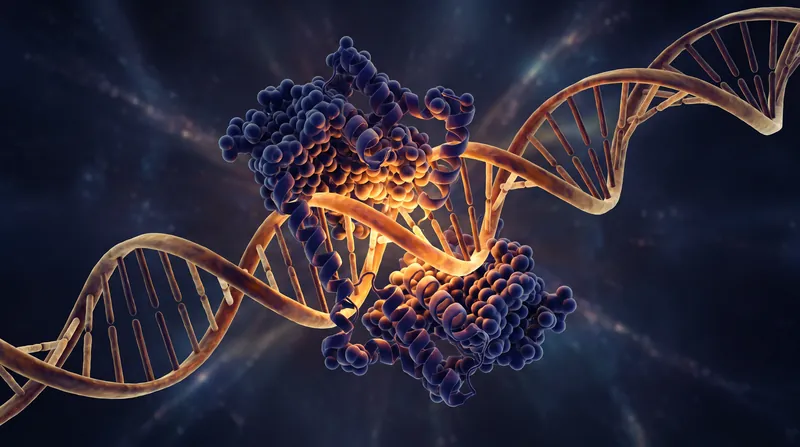
The data shows that the specific sequence of letters surrounding a damaged site subtly alters the physical architecture of the double helix. These surrounding bases can widen or narrow the DNA's grooves, bend the strand, and shift its local electrical charge. Computer simulations demonstrated that a specific amino acid on the repair enzyme acts as a mechanical sensor, physically probing the minor groove of the DNA. If the helix bends favorably and presents the correct negative electrical charge, the enzyme latches on seamlessly and repairs the lesion.[1][2][3][4]
Conversely, if the surrounding genetic sequence creates a flatter shape or lacks that specific negative charge, the enzyme's mechanical sensor fails to engage. The repair protein simply slides right past the damaged site, leaving the mutation entirely intact. The researchers found that this structural mismatch can make the efficiency of the repair process up to a hundred times harder, effectively rendering certain regions of the genome invisible to the cell's natural maintenance machinery. This mechanical bias explains why some genetic "wounds" heal perfectly while others leave permanent scars.[2][5]
This structural bias has profound implications for how cancer develops and progresses. When the researchers matched their laboratory findings against real-world clinical databases, such as the Cancer Genome Atlas, the results aligned perfectly. The exact sequence contexts that hindered repair enzymes in the microchip experiments corresponded precisely with the mutational hotspots observed in actual human tumors. This suggests that cancer cells do not just suffer random genetic breaks; rather, their genomes are shaped by the predictable failure of repair enzymes to access specific, awkwardly folded regions of DNA.[2][5]
Beyond oncology, the findings offer a profoundly new lens on the mechanics of human evolution. Mutations are the fundamental raw material of natural selection, and the study indicates that the uneven efficiency of DNA repair has actively guided which genetic changes were preserved over millions of years. In regions of the genome where repair enzymes bind easily due to favorable helix shapes, the original genetic code is strictly conserved against alteration.[3][6]
Conversely, in structurally "invisible" regions where the helix is flat or lacks the necessary charge, mutations are allowed to accumulate freely. This suggests that the physical architecture of DNA itself acts as an evolutionary filter. By leaving certain regions harder to repair, the DNA structure safely drives genetic diversity in specific areas while protecting the most critical biological instructions from random degradation. The genome's shape, therefore, is not just a storage mechanism, but an active participant in its own evolution.[3][6]
Despite the strength of the microchip data and the clinical correlations, the researchers are explicit about the limits of the current evidence. The study mapped the binding preferences of three specific glycosylases involved in cytosine repair, but human cells rely on dozens of different repair pathways.
It remains unknown whether other major repair mechanisms—such as those that fix double-strand breaks or bulky UV lesions—are governed by the same strict structural rules. Furthermore, while the structural preferences predict mutation patterns, proving a direct causal link to the initiation of specific cancers will require long-term in vivo studies.[1][2][3]
If the physical shape of DNA dictates repair failure, it also presents a novel target for medical intervention. The researchers suggest that understanding these structural preferences could eventually allow scientists to engineer customized repair enzymes that provide enhanced genetic protection for vulnerable regions of the genome. While clinical applications are still years away, decoding the mechanical rules of DNA repair marks a critical step toward therapies that treat the root cause of genetic disease rather than just its symptoms.[2][4][5]
Viewpoints in depth
Molecular Biologists
Focusing on the physical and chemical mechanisms of DNA repair.
Researchers emphasize that DNA repair is a mechanical process as much as a chemical one. By demonstrating that enzymes like glycosylases actively probe the minor groove's width and electrical charge, they argue that the genome's three-dimensional architecture is the primary gatekeeper for genetic maintenance. This perspective shifts the focus from simply reading the genetic code to understanding the physical topography of the DNA molecule itself.
Cancer Geneticists
Focusing on how unrepaired mutations drive tumor formation.
For oncologists, the structural bias of repair enzymes solves a long-standing mystery about why tumors consistently develop mutations in the same genetic hotspots. They view this predictability as a paradigm shift, suggesting that future therapies could be designed to target or bypass these structural blind spots to prevent cancer initiation. If the physical shape of DNA dictates where cancer begins, it also provides a roadmap for where to deploy next-generation genetic interventions.
Evolutionary Biologists
Focusing on the long-term impact of uneven repair rates.
Evolutionary scientists interpret these findings as evidence that the genome's shape actively directs its own evolution. By leaving certain regions structurally invisible to repair enzymes, the DNA architecture allows mutations to accumulate safely in specific areas. This generates the genetic diversity required for natural selection without compromising critical conserved genes, suggesting that the genome is not just a passive storage drive, but an active participant in evolutionary change.
Key points
- DNA repair enzymes rely on the physical shape and electrical charge of the double helix to locate genetic damage.
- Flatter or improperly charged DNA sequences physically prevent enzymes from repairing damaged bases.
- The sequences that hinder repair in the lab perfectly match known mutational hotspots in human cancers.
- The findings overturn the long-held assumption that cancer-causing mutations accumulate purely at random.
What we don’t know
- Whether other major DNA repair pathways, such as those fixing double-strand breaks, follow the same strict structural rules.
- How to safely engineer or deliver customized repair enzymes into living human cells to correct structural blind spots.
- The exact degree to which these structural repair failures contribute to the initiation of specific cancer types in vivo.
How we got here
2022
The Human Genome Project completes the full mapping of the human genetic blueprint.
June 2026
Researchers publish findings in Nature Communications detailing how DNA shape dictates glycosylase binding.
August 2026
The implications for cancer research are widely recognized, challenging the random mutation dogma.
- Molecular Biologists
- Focus on the physical and chemical mechanisms of DNA repair and enzyme binding.
- Cancer Geneticists
- Focus on how unrepaired mutations accumulate to drive tumor formation and new therapies.
- Evolutionary Biologists
- Focus on how uneven repair rates shape the human genome over millions of years.
Perspectives this story doesn't cover
- Pharmacologists developing targeted gene therapies
- Structural chemists specializing in synthetic DNA
Sources
Source coverage
6 outlets
3 viewpoints surfaced






- [1]Nature CommunicationsMolecular Biologists
Mapping DNA glycosylase binding across lesion sequence contexts reveals extended sequence and structural recognition logic
Read on Nature Communications → - [2]The Times of IsraelCancer Geneticists
Breakthrough Israeli cancer study finds mutations break DNA when it doesn't bend
Read on The Times of Israel → - [3]HayadanEvolutionary Biologists
Did repair preferences shape the genome?
Read on Hayadan → - [4]BioengineerMolecular Biologists
DNA repair enzymes favor specific sequences, shaping mutation patterns in the human genome
Read on Bioengineer → - [5]ECWISCancer Geneticists
DNA repair enzymes favor specific sequences, shaping mutation patterns in the human genome
Read on ECWIS → - [6]Phys.orgEvolutionary Biologists
DNA repair enzymes favor specific sequences, shaping mutation patterns in the human genome
Read on Phys.org →

More in Science
See all →Genetic Circuits
The Structural Mechanics of the Lac Repressor: How Allolactose Unlocks Bacterial Gene Expression
8 sources
Labor Onset
How Immune Cells Trigger Childbirth by Donating Mitochondria to Uterine Muscle
4 sources
Statistical Methods
Alpha (α), Beta (β), and Power: How Type I and Type II Errors Define Statistical Significance and Test Sensitivity
7 sources

Psychedelic Medicine
Psilocybin Prevents Chemotherapy Nerve Damage in Mice, Preserving Cancer Treatment Efficacy
3 sources

Comments
Every angle. Every day.
Get Science stories with full source coverage and perspective breakdowns, free every day.