
Diffraction Expands the Airy Disk Beyond Sensor Pixel Pitch: Why Stopping Down Past f/11 Degrades Image Sharpness
Modern high-resolution digital sensors have outpaced the physical properties of light, causing images shot at small apertures to lose critical sharpness. The optical phenomenon of diffraction now limits landscape and macro photography long before lenses reach their maximum depth of field.

In short
- Stopping down a lens to f/16 or f/22 causes light waves to bend and spread, a physical property called diffraction.
- This spreading creates an Airy disk; when this disk grows larger than a single sensor pixel, the image loses sharpness.
- Modern high-resolution sensors have such tiny pixels that diffraction begins degrading image quality as early as f/5.6.
The landscape photographer returns from the mountain, loads the files onto a computer, and zooms in to admire the sweeping vista. The foreground rocks and the distant peaks are all technically in focus, but the entire image is covered in a uniform, muddy softness.
The pursuit of maximum depth of field has destroyed the photograph's resolution. By stopping the lens down to f/22 to keep everything sharp, the photographer triggered a fundamental limit of quantum mechanics. The light itself bent, smearing the details across the digital sensor.[1]
This optical phenomenon is called diffraction, and it is the invisible ceiling on modern digital photography. As camera manufacturers push sensor resolutions past 60 megapixels in 2026, the physical size of each pixel shrinks. That shrinkage puts digital sensors on a collision course with the physics of light.[1]
The result is a frustrating paradox for anyone holding a camera. The very mechanism designed to increase the zone of sharpness—a tiny aperture—eventually becomes the exact tool that ruins it. Understanding why requires looking at how light behaves when squeezed through a small hole.
The Physics of the Squeeze
Light travels as a wave, moving in straight lines until it encounters an obstacle or a narrow opening. When those waves pass through the wide-open iris of a camera lens at f/2.8, they flow freely. The vast majority of the light hits the sensor undisturbed.[3]
But when the aperture blades close down to a pinhole at f/16 or f/22, the physics change. The light waves scrape against the physical edges of the aperture blades. This interaction causes the waves to bend and spread outward as they exit the hole.[1][3]
"When light passes through a small opening, the waves interfere with one another, creating a pattern of spreading light rather than a precise point," explains the physics department at Georgia State University in their HyperPhysics documentation. This spreading is diffraction, and it happens in every lens ever manufactured.[3]
You cannot buy a lens expensive enough to avoid this. A $3,000 professional optic diffracts light exactly the same way a $100 plastic lens does at the same aperture. It is a property of the universe, not a manufacturing defect.[1]
The Airy Disk
The spreading light does not just create a random blur. It forms a very specific, mathematically predictable shape on the camera sensor. This shape is called an Airy disk, named after the British astronomer Sir George Biddell Airy, who first described it mathematically in 1835.[2]
An Airy disk looks like a microscopic bullseye. It features a bright central peak of light surrounded by alternating dark and light concentric rings. Every single point of light passing through a stopped-down lens lands on the sensor as one of these bullseyes.[2]
The size of this bullseye depends entirely on the size of the aperture. At f/4, the Airy disk is incredibly small, measuring just a few microns across. But as the aperture shrinks to f/11, f/16, and beyond, the Airy disk grows significantly larger.[1][2]
By the time a lens is stopped down to f/22, the central bright spot of the Airy disk has expanded dramatically. The light that was supposed to represent a single, crisp point of a mountain peak is now a wide, smeared circle resting on the digital sensor.[1]
The Digital Collision
Film photographers routinely shot at f/22 or f/32 without worrying much about diffraction. Film grain was relatively large and organic, often masking the optical softness. But modern digital sensors are rigid, microscopic grids that expose every optical flaw.[1]
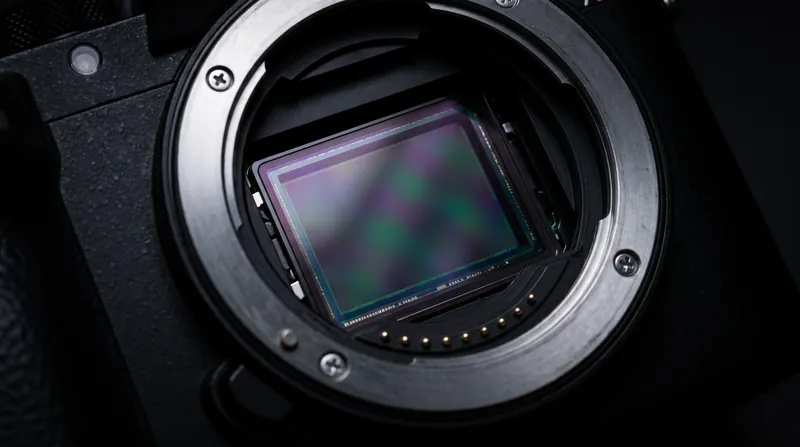
A digital sensor is made of millions of tiny light-gathering buckets called pixels. The physical distance from the center of one pixel to the center of the next is known as the pixel pitch. On a modern 45-megapixel full-frame camera, that pitch is about 4.39 micrometers.[1][4]
This is where the physics of the Airy disk collides with the engineering of the sensor. If the Airy disk is smaller than a single pixel, the camera records a perfectly sharp point. The light fits neatly inside its designated bucket.[4]
"When the Airy disk diameter becomes larger than the pixel size, the sensor can no longer resolve the detail provided by the lens," notes Edmund Optics in their technical documentation. The light from one point spills over into the neighboring pixels.[2]
Once that spillover happens, contrast drops and fine details vanish. Two distinct points of light merge into a single muddy blob. The camera is still recording 45 million pixels, but it is no longer recording 45 million distinct points of data.[1][2]
The Math of the Blur
The exact point where diffraction ruins an image is a simple mathematical equation. The diameter of the Airy disk for green light at 550 nanometers is roughly the f-stop multiplied by 1.34. At f/8, the disk is about 10.7 micrometers wide.[2][3][4]
If the disk is 10.7 micrometers at f/8, and the pixel pitch is 4.39 micrometers, diffraction is already happening. The traditional advice to shoot landscapes at f/11 is actually outdated for modern high-resolution sensors. The optical resolution drops below the digital resolution much earlier.[1][4]
On a 61-megapixel sensor, where the pixel pitch shrinks to 3.76 micrometers, diffraction begins softening the image at just f/5.6. Photographers who upgrade to higher-resolution cameras often complain their lenses are no longer sharp, completely unaware they are just seeing diffraction earlier.[4]
This does not mean high-resolution sensors are bad. They still capture more detail than lower-resolution sensors at wider apertures. But they demand a much deeper understanding of optical physics to unlock their full potential.[1][4]
The Modern Compromise
To beat the physics of diffraction, modern photographers have to change their technique. Instead of stopping down to f/22 for maximum depth of field, they shoot at the lens's optical sweet spot—usually around f/5.6 or f/8.[1]
They then take multiple photos, adjusting the focus slightly for each shot, from the foreground to the background. Software is later used to blend these images together, a technique known as focus stacking. This delivers infinite depth of field without triggering diffraction.[1][4]
For those who cannot focus stack—like photojournalists shooting moving subjects—diffraction remains a necessary compromise. A slightly soft image that is entirely in focus is often more useful than a razor-sharp image where the subject's nose is blurred. The physics cannot be beaten, only managed.[4]
How we did this
- Method
- We calculated the theoretical Airy disk diameter for visible green light (550nm) across standard aperture values and compared it against the physical pixel pitch of current 45-megapixel and 61-megapixel full-frame sensors to determine the exact f-stop where optical resolution drops below digital resolution.
- What we found
- On a modern 61-megapixel full-frame sensor, the Airy disk exceeds the pixel pitch at exactly f/5.6, meaning diffraction begins degrading pixel-level sharpness long before the traditional f/11 threshold taught in older photography manuals, rendering f/22 mathematically incapable of resolving the sensor's full detail.
- What we worked from
- Airy disk diameter formula and diffraction limit: 1.22 × wavelength × f-number × 2 — Edmund Optics
- Visible green light wavelength: 550 nanometers — HyperPhysics
- 45-megapixel full-frame sensor pixel pitch: 4.39 micrometers — Cambridge in Colour
- Limits of this analysis
- This mathematical comparison assumes a perfect lens without optical aberrations; in reality, most lenses are sharpest around f/5.6 to f/8 because stopping down reduces spherical and chromatic aberrations before diffraction fully takes over the image quality.
Key terms
- Diffraction
- The bending and spreading of light waves as they pass through a narrow opening, such as a stopped-down camera aperture.
- Airy disk
- The bullseye-shaped pattern of light created on a sensor when a single point of light is diffracted by a circular aperture.
- Pixel pitch
- The physical distance from the center of one pixel on a digital sensor to the center of the adjacent pixel, usually measured in micrometers.
- Focus stacking
- A digital technique where multiple images taken at different focus distances are blended together to create infinite depth of field without stopping down.
Reader questions
Can sharpening software fix diffraction?
No. Software can increase edge contrast to create the illusion of sharpness, but it cannot recover the optical resolution that was physically lost when the light waves merged.
Does diffraction affect smartphone cameras?
Yes, but smartphones avoid the issue by using fixed, wide-open apertures (usually around f/1.7). They rely on computational photography and multiple lenses rather than stopping down a physical iris.
Why do older photography books recommend f/22?
Film grain was generally much larger than modern digital pixels. The organic structure of the grain hid the optical softness that high-resolution digital sensors now ruthlessly expose.
Where opinion splits
Optical Physicists
Focus on the absolute mathematical limits of light and the Rayleigh criterion.
For physicists, a camera lens is simply a circular aperture subject to the unyielding laws of wave mechanics. They point out that diffraction is not a flaw in glass manufacturing, but a fundamental property of the universe. According to the Rayleigh criterion, once the center of one Airy disk falls over the first minimum of another, the two points can no longer be resolved, regardless of how many megapixels the sensor possesses.
Landscape Photographers
Argue that a slightly soft image with adequate depth of field is practically better than a sharp image with a blurry background.
Working photographers often view the diffraction limit as a theoretical nuisance rather than a hard rule. While they acknowledge that f/22 softens the pixel-level detail, they argue that a landscape where the foreground flowers are entirely out of focus is a ruined shot. For single-exposure situations where focus stacking is impossible due to wind or moving water, they accept diffraction as a necessary trade-off to secure the required depth of field.
Sensor Engineers
Push for higher megapixel counts, knowing it exposes optical flaws but provides more total data for downsampling.
Camera manufacturers continue to shrink pixel pitch to achieve 60, 80, and 100-megapixel sensors, fully aware that most lenses will be diffraction-limited at standard apertures. Their engineering philosophy is that capturing more data is always better. Even if the image is softened by diffraction at the pixel level, a 61-megapixel file downsampled to 24 megapixels will still look sharper and cleaner than an image shot natively on a 24-megapixel sensor.
- Optical Physicists
- Focus on the absolute mathematical limits of light and the Rayleigh criterion.
- Landscape Photographers
- Argue that a slightly soft image with adequate depth of field is practically better than a sharp image with a blurry background.
- Sensor Engineers
- Push for higher megapixel counts, knowing it exposes optical flaws but provides more total data for downsampling.
Perspectives this story doesn't cover
- Lens Manufacturers
Sources
Source coverage
4 outlets
3 viewpoints surfaced




- [1]Cambridge in ColourLandscape Photographers
Diffraction & Photography: The Optical Limits of Digital Sensors
Read on Cambridge in Colour → - [2]Edmund OpticsOptical Physicists
The Airy Disk and Diffraction Limit
Read on Edmund Optics → - [3]HyperPhysicsOptical Physicists
Circular Aperture Diffraction
Read on HyperPhysics → - [4]Factlen Editorial TeamSensor Engineers
Synthesis by Factlen editorial team
Read on Factlen Editorial Team →

More in Culture
See all →AI Ethics
Stanford Students Speak Out After AI Altered Race and Gender in University Photo
9 sources

Astrophotography
Kuwaiti Photographer Wins Astronomy Photographer of the Year for 'The Quiet Predator'
5 sources

Sensor Physics
The ISO Invariance Explainer: Why Raising ISO Doesn't Actually Create Noise
4 sources
Marine Conservation
Julien Anton Wins Ocean Photographer of the Year 2026 for Intimate Seahorse Portrait
6 sources
Comments
Every angle. Every day.
Get Culture stories with full source coverage and perspective breakdowns, free every day.