
China's Revised Mobilization Law Expands State Power to Expropriate Civilian Assets for Military Use
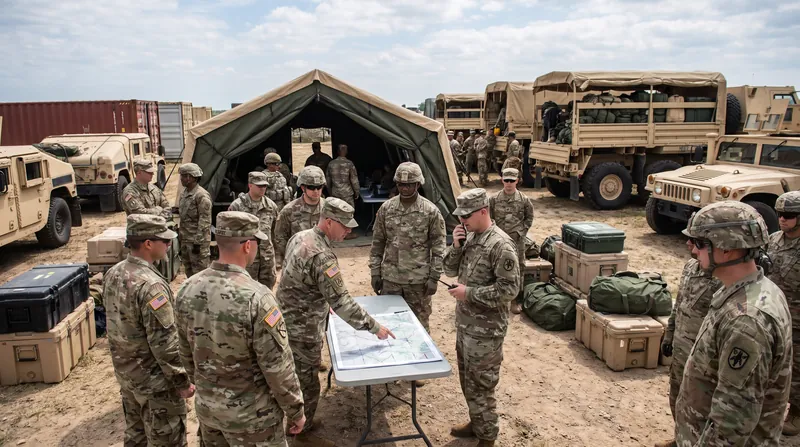
The Chinese government has enacted the first major overhaul of its National Defense Mobilization Law in 16 years, granting the state sweeping authority to requisition civilian technology, infrastructure, and private property. The revision introduces 'development interests' as a trigger for wartime mobilization and legally binds the private sector to national defense preparations.

Share this story
A state cannot wage a sustained modern conflict unless it possesses the legal and logistical architecture to rapidly convert its civilian economy into a military supply chain. On August 28, 2026, the Standing Committee of China's National People's Congress ensured that condition holds by passing the first major revision to the National Defense Mobilization Law since its inception in 2010.[3][6]
The revised legislation, which takes effect on October 1, 2026, fundamentally alters the relationship between the Chinese state and private enterprise. Consisting of 14 chapters and 82 articles, the law grants the government explicit statutory authority to expropriate civilian resources—including transportation networks, telecommunications infrastructure, and advanced technology—to support the People's Liberation Army during a crisis.[1][6]
The 2010 version of the law allowed the state to mobilize resources when China's sovereignty, unity, territorial integrity, or security faced direct threats. The 2026 revision adds a new, broader trigger: "development interests." This addition provides the Chinese Communist Party with the legal flexibility to initiate a national defense mobilization for economic or technological disputes, potentially below the threshold of armed conflict.[1][5]
A critical shift in the legal text is the transition from "requisition" to "expropriation." Under the previous framework, requisition implied that civilian assets would be borrowed and eventually returned or compensated. Expropriation denotes a permanent transfer of property rights to the state. Yang Tai-yuan, a researcher at Tamkang University's Center for Advanced Technology, noted that the change removes previous limitations, stating, "It is essentially giving them a blank check."[1][5]
The legislation explicitly targets the technology sector. A new clause mandates the state to promote the application of advanced technologies in national defense mobilization and develop capabilities in emerging fields. This formalizes China's Military-Civil Fusion strategy, legally obligating companies in artificial intelligence, unmanned aerial vehicles, and cybersecurity to integrate their operations with military requirements.[3][4]
The personnel scope of the mobilization has also been clarified. Under the revised law, Chinese men aged 18 to 60 and women aged 18 to 55 are required to perform national defense duties. Notably, individuals possessing special technical expertise are exempt from these age restrictions, reflecting the military's demand for specialized skills in modern warfare.[1][2][3]
Regional analysts view the legal overhaul as a preparatory measure for potential conflicts along the First Island Chain, particularly concerning Taiwan. A Taiwanese official familiar with cross-strait relations stated that the revisions are designed to help Chinese President Xi Jinping fulfill his "historic mission of national unification" by building "offensive resilience" against international sanctions and logistical bottlenecks.[2]
The law's passage coincides with the implementation of new Exit-Entry Administration regulations scheduled for September 15, 2026, which tighten the government's control over citizens leaving the country. While the legislative framework is now in place, the immediate test of the revised law will be how local governments enforce the new technology integration mandates. Authorities have yet to publish the specific compliance guidelines that will dictate how private artificial intelligence and drone manufacturers must restructure their data sharing with the People's Liberation Army ahead of the October 1 enactment date.[3][5]
Viewpoints in depth
Taiwan's Security Establishment
Views the revision as a direct legal preparation for a cross-strait conflict.
Analysts and officials in Taipei interpret the transition from 'requisition' to 'expropriation' as a signal that Beijing is preparing for a sustained, high-intensity conflict. By adding 'development interests' to the mobilization triggers, Taiwanese researchers argue that the Chinese Communist Party is creating a flexible legal pretext to initiate wartime controls even before a formal declaration of war. They view the law as a mechanism to build 'offensive resilience,' ensuring the People's Liberation Army can absorb international sanctions and maintain supply lines during an invasion.
Indo-Pacific Strategic Observers
Focuses on the law's acceleration of Military-Civil Fusion and its impact on the technology sector.
Observers in India and the broader Indo-Pacific emphasize the law's explicit targeting of emerging technologies. They note that the revision effectively erases any remaining legal firewall between China's civilian tech sector and its military apparatus. By legally obligating private companies to integrate their data and manufacturing capabilities with the state's defense needs, these analysts warn that foreign entities partnering with Chinese firms in sectors like artificial intelligence, telecommunications, and shipping are now inherently exposed to the state's wartime mobilization perimeter.
Key points
- China has passed the first major revision to its National Defense Mobilization Law since 2010, taking effect October 1, 2026.
- The revised law allows the state to 'expropriate' rather than merely 'requisition' civilian assets, implying a permanent transfer of property rights.
- A new trigger for mobilization includes threats to China's 'development interests,' broadening the scope beyond direct security threats.
- The legislation mandates the integration of advanced technologies and emerging fields into the national defense system.
How we got here
Feb 2010
China enacts the original National Defense Mobilization Law, establishing the framework for wartime resource requisition.
Aug 28, 2026
The Standing Committee of the National People's Congress passes the first major revision to the law.
Sep 15, 2026
New Exit-Entry Administration regulations take effect, tightening state control over citizens leaving the country.
Oct 1, 2026
The revised National Defense Mobilization Law officially comes into force.
- Taiwanese Security Establishment
- Argues the revision is a legal precursor to conflict, designed to build offensive resilience and legally justify the seizure of civilian assets for a Taiwan invasion.
- Indo-Pacific Strategic Observers
- Views the law as a broader acceleration of China's Military-Civil Fusion, warning that it removes the firewall between private tech companies and the military.
- Official State Framework
- Frames the revision as a necessary administrative modernization of a 16-year-old law to align the mobilization system with contemporary national security and economic development needs.
Perspectives this story doesn't cover
- Chinese private sector executives
- Multinational corporations operating in China
Sources
Source coverage
6 outlets
3 viewpoints surfaced






- [1]Taiwan NewsTaiwanese Security Establishment
China's revised defense mobilization law expands national wartime powers
Read on Taiwan News → - [2]Taipei TimesTaiwanese Security Establishment
China revises mobilization law for 'national unification': official
Read on Taipei Times → - [3]OrganiserIndo-Pacific Strategic Observers
Annexing Taiwan? China revises defence law to seize assets, tech & enforce military service; Tightens Exit-entry rules
Read on Organiser → - [4]The WeekIndo-Pacific Strategic Observers
Revision of National Defense Mobilization Law of China: A warning signal for India?
Read on The Week → - [5]Focus TaiwanTaiwanese Security Establishment
China defense mobilization law signals preparations for full-scale conflict: Analysts
Read on Focus Taiwan → - [6]WikipediaOfficial State Framework
National Defense Mobilization Law
Read on Wikipedia →
More in World
See all →US-Canada Relations
Canadian Prime Minister Mark Carney Acknowledges Government Studied Risk of US Military Action
6 sources

Global Development
The $1,230 GNI Per Capita Threshold and the Human Assets Index/Economic Vulnerability Index Criteria: How the UN Defines Least Developed Country Status
7 sources

Arabian Sea Standoff
India Summons Pakistani Envoy Following Naval Collision in the Arabian Sea
8 sources

Global Security
UN Global Risk Report Identifies Large-Scale War as Fastest-Rising Global Threat
7 sources
Comments
Every angle. Every day.
Get World stories with full source coverage and perspective breakdowns, free every day.