
CERN Completes Doubly Charmed Baryon Family With Discovery of Final Particle
Physicists at the Large Hadron Collider have discovered the Ωcc+ baryon, completing a trio of particles predicted over 50 years ago and opening a new window into the strong force.
By Mateo Ramos

In short
- The LHCb collaboration at CERN has discovered the Ωcc+ baryon, completing the doubly charmed baryon family.
- The particle contains two heavy charm quarks and one lighter strange quark.
- The discovery was made using data from the upgraded LHCb detector during Run 3 of the Large Hadron Collider.
In a major milestone for particle physics, the LHCb collaboration at CERN has announced the discovery of the Ωcc+ baryon, a long-sought subatomic particle. Revealed at the Beauty 2026 conference in Maastricht, the finding officially completes the "doubly charmed" baryon family, closing a chapter in a scientific quest that spans more than half a century.
To understand the significance of the discovery, one must look at the fundamental building blocks of matter. Baryons are composite particles made of three quarks. The most familiar baryons are protons and neutrons, which are constructed from the lightest quark flavors: "up" and "down." The newly discovered Ωcc+ particle, however, is far more exotic. It is built from two heavy "charm" quarks and one lighter "strange" quark, making it roughly four times heavier than a standard proton.[3]
The Standard Model of particle physics has long predicted a specific trio of these doubly charmed particles. The first member of the family, the Ξcc++ (containing two charms and one up quark), was finally observed in 2017. The second member, the Ξcc+ (two charms and one down quark), was confirmed in March 2026. Now, the discovery of the strange-quark variant completes the set, providing physicists with a full suite of these rare particles to study.[2][4]
The completion of this family is much more than a stamp-collecting exercise for physicists. It offers a unique and highly prized laboratory for testing Quantum Chromodynamics (QCD), the theory that describes the strong force. The strong force is what binds quarks together, but its mathematics are notoriously chaotic and difficult to calculate when all three quarks in a baryon are light and moving at near light-speed.[1][5]
Doubly charmed baryons offer a mathematical loophole. Because the two charm quarks are so massive, they move sluggishly relative to one another. They bind tightly together to form a compact, heavy core known as a "diquark." The third, lighter quark orbits this heavy core from a distance, much like a planet orbiting a binary star system.[5]
This distinctive "planetary" structure simplifies the complex equations of the strong force. It allows theoretical physicists to test QCD at the exact boundary between its calculable (perturbative) and incalculable (non-perturbative) regimes. By comparing the three different members of the doubly charmed family, scientists can turn these particles from isolated discoveries into a precision laboratory for heavy-quark dynamics.[1]
Confirming the existence of these particles experimentally, however, is a monumental challenge. Doubly charmed baryons are incredibly unstable. They decay via the weak force almost instantly, traveling only a fraction of a millimeter inside a detector before breaking apart into a shower of lighter, more stable particles.[3]
To find the Ωcc+, physicists had to sift through the digital debris of billions of high-energy proton-proton collisions at the Large Hadron Collider. They were searching for a highly specific decay chain: the Ωcc+ decaying into an Ωc0 baryon and a pion, which subsequently decay to produce a distinct five-track signature of charged particles.
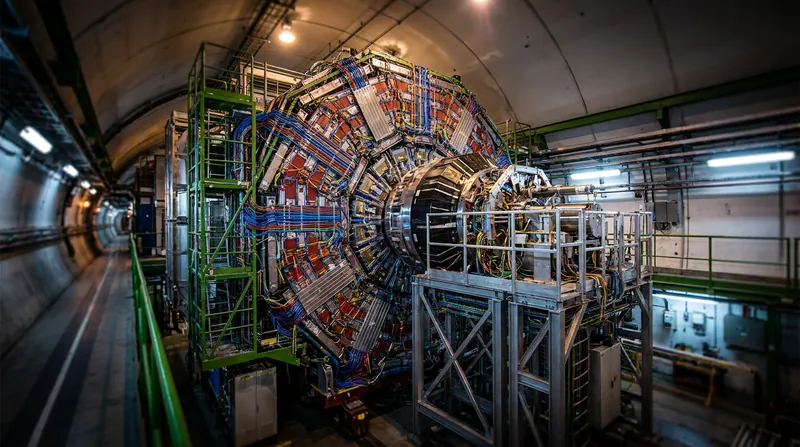
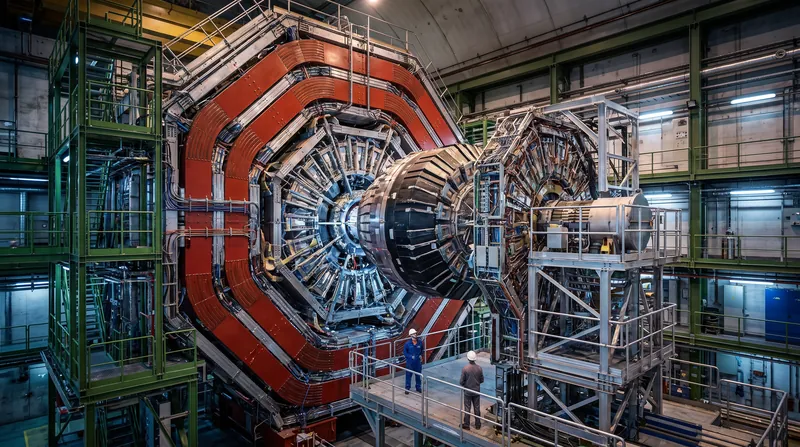
This needle-in-a-haystack discovery was made possible by the recently upgraded LHCb detector, which began collecting data for Run 3 of the collider in 2024. The upgraded silicon sensors provided the unprecedented tracking precision required to trace those five charged tracks back to their microscopic point of origin, proving the particle had traveled a tiny distance before decaying.[3]
The statistical significance of the Ωcc+ observation exceeded 7 sigma. In particle physics, a 5-sigma result is the "gold standard" required to officially claim a discovery, meaning there is less than a one-in-a-million chance the signal is a statistical fluke. The sheer clarity of the data leaves no doubt that the final doubly charmed baryon is real.[2][3]
The discovery represents the culmination of a theoretical arc that began in 1962. That year, physicists proposed the "Eightfold Way," a classification scheme that predicted the existence of the Ω- baryon (a particle with three strange quarks). When the Ω- was discovered in 1964, it proved the theory correct. The Ωcc+ is its charmed cousin, predicted shortly after the charm quark itself was theorized in the 1970s.
With the ground-state spin-1/2 family now complete, physicists can begin comparing the masses and lifetimes of the three siblings. Theoretical models predict a highly non-trivial lifetime pattern: the Ξcc+ should be the shortest-lived, the Ξcc++ the longest-lived, and the Ωcc+ should sit right in the middle. Measuring these exact lifetimes will test whether our understanding of weak decays holds up in a strongly bound multiquark environment.[1][5]
The story of heavy baryons is far from over. With this family complete, the LHCb collaboration is now shifting its focus to hunting for heavier spin-3/2 states of these same baryons. Furthermore, physicists are searching for even more exotic particles containing "beauty" (bottom) quarks, which are expected to come within reach as the High-Luminosity LHC era approaches.[5]
With this family complete, the LHCb collaboration is now shifting its focus to hunting for heavier spin-3/2 states of these same baryons.
Ultimately, the completion of the doubly charmed baryon family is a resounding triumph for the Standard Model. It demonstrates that even after decades of searching, the theoretical framework that describes the universe's fundamental building blocks remains remarkably accurate, continuing to guide experimentalists toward the deepest secrets of matter.[5]
Terms to know
- Baryon
- A type of subatomic particle composed of three quarks. Protons and neutrons are the most common examples.
- Quark
- A fundamental building block of matter. There are six flavors: up, down, charm, strange, top, and bottom.
- Quantum Chromodynamics (QCD)
- The theory in physics that describes the strong force, which binds quarks together inside protons, neutrons, and other hadrons.
- Diquark
- A pair of quarks that are bound so tightly together they act almost as a single entity within a larger particle.
- Sigma (Statistical Significance)
- A measure of confidence in a scientific result. In particle physics, a 5-sigma result is the gold standard required to officially claim a discovery.
Questions readers ask
What is a doubly charmed baryon?
It is a subatomic particle made of three quarks, specifically containing two heavy 'charm' quarks and one lighter quark (up, down, or strange).
Why did it take so long to find them?
These particles are incredibly rare, heavy, and short-lived. They decay in a fraction of a millimeter, requiring highly advanced detectors like the upgraded LHCb to track their signatures.
What does this mean for physics?
It provides a unique 'laboratory' to test Quantum Chromodynamics (QCD), the theory of the strong force, because the two heavy quarks form a simple core that makes mathematical calculations easier to verify.
Different angles
Theoretical Physicists
Viewing the completed family as a crucial laboratory for testing the strong force.
For theorists, the value of the doubly charmed baryon family lies in its unique internal structure. Because the two charm quarks are so massive, they move sluggishly and bind tightly into a 'diquark' core. This simplifies the chaotic mathematics of Quantum Chromodynamics (QCD). Theorists can treat the particle almost like a heavy-light binary system, allowing them to test their calculations of the strong force with unprecedented precision.
Experimental Physicists
Emphasizing the technological triumph of the upgraded LHCb detector.
Experimentalists view this discovery as a validation of the massive engineering effort behind the Large Hadron Collider's Run 3 upgrades. Finding a particle that travels only a fraction of a millimeter before decaying requires extraordinary tracking resolution. The ability to sift through billions of collisions and isolate the exact five-track decay signature of the Ωcc+ demonstrates the sheer power of modern particle detectors.
The Factlen Editorial View
Summarizing the decades-long arc from prediction to discovery.
We see this milestone as a testament to the predictive power of the Standard Model. Over 50 years ago, theorists sketched out the mathematical architecture of quarks, predicting particles that no technology at the time could possibly detect. The completion of the doubly charmed baryon family in 2026 is a reminder that while physics often moves slowly, its foundational theories remain remarkably robust.
- Theoretical Physicists
- View the completed family as a crucial laboratory for testing Quantum Chromodynamics and the diquark model.
- Experimental Physicists
- Emphasize the technological triumph of the upgraded LHCb detector and the complex data analysis required to isolate the signal.
- Science Communicators
- Focus on the historical arc of the Standard Model and the accessible 'planetary system' analogy for the general public.
Perspectives this story doesn't cover
- Particle Accelerator Engineers
- Funding Agencies for High-Energy Physics
Sources
Source coverage
5 outlets
3 viewpoints surfaced





- [1]arXivTheoretical Physicists
Weak decays of double-charmed baryon Ωcc+
Read on arXiv → - [2]Physics WorldTheoretical Physicists
First doubly charmed baryon spotted by LHCb
Read on Physics World → - [3]MediumScience Communicators
A Proton's Heavy Cousin Emerges
Read on Medium → - [4]Physical Review LettersExperimental Physicists
Observation of the doubly charmed baryon Ξcc++
Read on Physical Review Letters → - [5]Factlen Editorial TeamScience Communicators
Synthesis by Factlen editorial team
Read on Factlen Editorial Team →
More in Science
See all →Particle Physics
CERN Physicists Find Evidence for Gluon Saturation Inside Atomic Nuclei
3 sources
Metabolic Science
AI Discovers Naturally Occurring Peptide That Suppresses Appetite Without Ozempic's Side Effects
8 sources

Quantum Tech
First Room-Temperature Quantum Material Created, Unlocking New Era for Computing and Electronics
6 sources
Deep Earth Geophysics
Earth's Inner Core Has Slowed and Begun to Backtrack, USC Study Confirms
6 sources

Comments
Every angle. Every day.
Get Science stories with full source coverage and perspective breakdowns, free every day.