
Buying New Construction vs. Existing Homes: The 2026 Market Comparison
With builder incentives driving down costs and resale inventory remaining tight, the financial math between buying new construction and an existing home has shifted significantly in 2026.
By Factlen Editorial Team
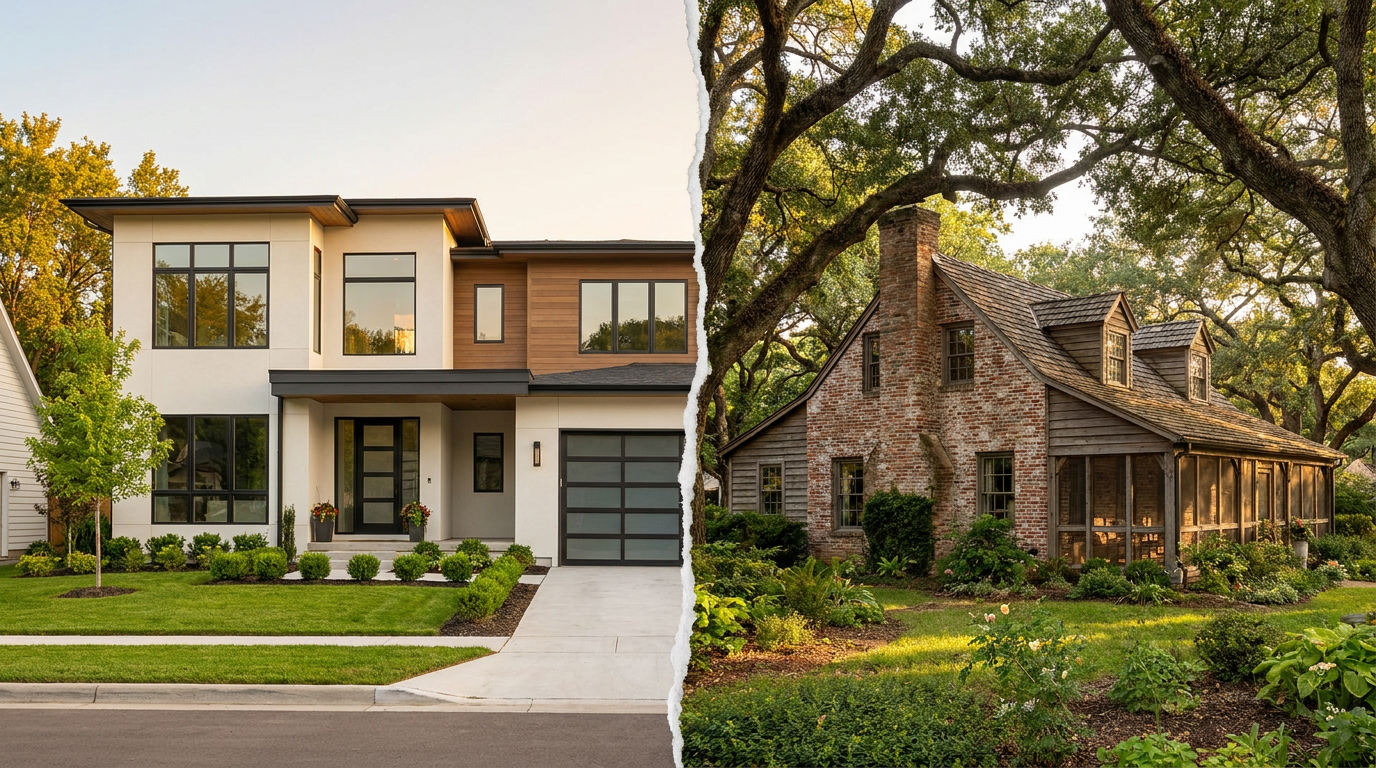
- Turnkey Seekers
- Buyers and builders prioritizing predictable costs, modern amenities, and energy efficiency.
- Location Traditionalists
- Buyers who value established neighborhoods, shorter commutes, and architectural character.
- Renovation Optimists
- Buyers leveraging financing tools to modernize older homes in prime locations.
What's not represented
- · Renters waiting out the market
- · Custom home builders
Why this matters
Choosing between a new build and an existing home is the most consequential decision a buyer will make, dictating not just their daily commute and weekend maintenance, but their long-term financial exposure to repairs and property taxes.
Key points
- The 2026 housing market features an unusual dynamic where the price gap between new construction and existing homes has significantly narrowed.
- Builders are aggressively offering incentives, such as mortgage rate buydowns and closing cost credits, to attract buyers facing high interest rates.
- New construction offers predictable maintenance costs and modern energy efficiency, but often requires longer commutes and waiting through construction delays.
- Existing homes provide immediate move-in timelines and established, centrally located neighborhoods, but carry the risk of deferred maintenance and bidding wars.
- The decision ultimately hinges on a buyer's timeline, willingness to manage repairs, and preference for mature landscaping versus modern floor plans.
The 2026 real estate landscape has inverted a long-standing rule of thumb. Historically, buyers paid a steep premium for the privilege of being the first to live in a home. However, a combination of elevated interest rates, locked-in homeowners, and aggressive builder strategies has narrowed the price gap to historic lows. In some regional markets, the median resale home is now more expensive than a newly built equivalent.[1][4]
This shift is driven primarily by a stark divergence in housing supply. As of early 2026, the market holds roughly 9.7 months of supply for new construction, compared to a historically tight 3.8 months for existing homes. With resale inventory constrained by homeowners unwilling to abandon low mortgage rates secured years ago, about one-third of all homes available for sale are now newly built.[1][3][6]
For buyers evaluating new construction, the most quantifiable advantage lies in builder incentives. To combat affordability challenges, approximately 64 percent of builders are offering concessions, with many utilizing their financial leverage to buy down mortgage rates for the first few years of the loan. These permanent or temporary rate buydowns can save buyers hundreds of dollars a month, altering the fundamental math of the purchase.[1][4][5]

Beyond financing, the argument for new construction is anchored in predictability and reduced immediate maintenance. Modern builders typically provide a 1-2-10 warranty structure, covering workmanship for one year, mechanical systems for two, and structural defects for ten. This coverage shields buyers from the sudden, catastrophic expenses—like a failing HVAC system or a leaking roof—that often plague purchasers of older homes.[2][3]
Energy efficiency provides another measurable financial benefit for new builds. Homes constructed to 2026 codes feature superior insulation, advanced windows, and highly efficient appliances that measurably reduce monthly utility bills compared to homes built even a decade ago. Furthermore, contemporary floor plans reflect modern living, increasingly incorporating drop zones, flexible multipurpose rooms, and pre-wired electric vehicle charging stations.[1][5]
However, the case against new construction centers on location, timeline, and hidden costs. Because land near city centers is scarce and expensive, new developments are frequently pushed to the suburban fringes, potentially increasing commute times. Buyers must also contend with construction timelines that typically range from six to twelve months, leaving them vulnerable to supply chain delays and the logistical headache of coordinating a move around a moving target.[2][5][6]
However, the case against new construction centers on location, timeline, and hidden costs.
Additionally, the pristine nature of a new community comes at the cost of maturity. Buyers of new construction often move into neighborhoods devoid of mature trees, established landscaping, or proven traffic patterns. Early buyers may also live in an active construction zone for years, dealing with noise, dust, and heavy machinery until the development is fully built out. Property taxes can also be higher, as new communities often fund their infrastructure through special assessment districts.[2][3][6]

Conversely, the argument for purchasing an existing home is rooted in immediate availability and established community character. Resale homes are typically located in mature neighborhoods with grown tree canopies, functioning homeowner associations, and known school attendance boundaries. Buyers can walk through the exact physical space they are purchasing, eliminating the visualization challenges associated with buying off a floor plan.[2][5]
Location remains the strongest evidence in favor of existing homes. Resale properties are far more likely to be situated in central, highly desirable urban or inner-suburb locations with shorter commutes and walkable access to amenities. For buyers who prioritize architectural charm, historical character, or unique design elements, the existing home market is the only viable option, as production builders tend to rely on a limited menu of standardized designs.[2][6]
The primary argument against existing homes in 2026 is the fierce competition and the hidden cost of deferred maintenance. Because inventory remains below four months of supply, desirable resale homes often trigger bidding wars, forcing buyers to waive contingencies or pay above asking price. Once the keys are handed over, the buyer assumes all the risk for aging infrastructure, meaning a lower purchase price can quickly be offset by the need for a new roof or updated plumbing.[3][6]

Existing homes also frequently suffer from functional obsolescence. Floor plans from the 1980s or 1990s may feature compartmentalized rooms, inadequate closet space, and a lack of the smart-home integration that modern buyers expect. Upgrading these properties to contemporary standards requires significant capital and the willingness to manage contractors, which can strain both budgets and patience.[3][5]
For buyers caught between these two options, the FHA 203(k) renovation loan has emerged as a compelling middle path. This financial tool allows buyers to purchase a distressed or outdated resale home in a prime, established neighborhood and roll the cost of a full modernization into a single mortgage. It offers the location benefits of an existing home with the customized, updated interior of a new build, though it requires navigating a complex renovation process.[2][7]
Ultimately, the choice requires a clear-eyed assessment of a buyer's timeline, budget flexibility, and lifestyle priorities. New construction fits well when buyers have a flexible move-in date, prioritize energy efficiency, want to avoid unexpected repair bills in the early years of homeownership, and can capitalize on builder rate buydowns. It is the optimal choice for those who value modern functionality over historical charm.[2][5][6]

On the other hand, an existing home fits well when buyers need to move immediately, prioritize a central location with a short commute, and value the character of a mature neighborhood. It is the right choice for buyers who are comfortable taking on maintenance responsibilities and prefer the certainty of walking through a finished home before making the largest financial commitment of their lives.[2][5][6]
Viewpoints in depth
Turnkey Seekers
Buyers and builders prioritizing predictable costs, modern amenities, and energy efficiency.
This camp argues that the hidden costs of existing homes—from failing HVAC systems to poor insulation—make them a financial liability. Supported by builder groups like the NAHB, they emphasize that modern building codes and 1-2-10 warranties provide a decade of predictable housing costs. For these buyers, the ability to secure a builder-subsidized mortgage rate buydown makes new construction the only mathematically sound choice in a high-rate environment.
Location Traditionalists
Buyers who value established neighborhoods, shorter commutes, and architectural character.
Advocates for existing homes argue that real estate's golden rule—location, location, location—heavily favors the resale market. Because new developments are often relegated to the suburban fringes, this camp believes the savings on a new build are quickly erased by longer commutes and higher transportation costs. They also place a premium on the unquantifiable benefits of mature tree canopies, diverse streetscapes, and the immediate integration into a functioning community.
Renovation Optimists
Buyers leveraging financing tools to modernize older homes in prime locations.
This perspective seeks the best of both worlds: the prime location of an existing home and the modern functionality of a new build. By utilizing tools like the FHA 203(k) loan, these buyers purchase outdated or distressed properties at a discount and finance the renovations into their primary mortgage. They argue that while this path requires patience and project management, it ultimately yields the highest return on investment by forcing appreciation in highly desirable, land-locked neighborhoods.
What we don't know
- How long builders will continue to offer aggressive rate buydowns if the Federal Reserve significantly alters its interest rate policy.
- Whether the long-term appreciation of newly built suburban communities will match the historical appreciation rates of established, centrally located neighborhoods.
Key terms
- Mortgage Rate Buydown
- A financing incentive where a builder or seller pays an upfront fee to lower the buyer's interest rate for the first few years, or permanently.
- 1-2-10 Warranty
- A standard new-home warranty covering cosmetic issues for one year, mechanical systems for two, and structural integrity for ten.
- Special Assessment District
- A designated area where homeowners pay additional property taxes to fund local infrastructure improvements like new roads or sewer lines.
- FHA 203(k) Loan
- A government-backed mortgage that allows buyers to finance both the purchase of a home and the cost of its rehabilitation through a single loan.
Frequently asked
Are new construction homes always more expensive than existing ones?
Historically yes, but in 2026, builder incentives and rate buydowns have narrowed the gap, making new builds cheaper month-to-month in some markets.
What is a 1-2-10 builder warranty?
It is a standard guarantee covering workmanship for one year, mechanical systems like plumbing and HVAC for two years, and major structural defects for ten years.
Can I negotiate the price of a new construction home?
Yes, especially in 2026. While builders prefer not to drop the base price to protect neighborhood comps, they frequently negotiate by offering free upgrades, covering closing costs, or buying down mortgage rates.
Why are property taxes sometimes higher on new builds?
New developments often lack established infrastructure. Cities may use special assessment districts to fund new roads and utility grids, passing those costs to the new homeowners through higher tax bills.
Sources
Source coverage
7 outlets
3 viewpoints surfaced







[1]National Association of Home BuildersTurnkey Seekers
The 2026 New-Home Market: A Rare Opportunity for Buyers?
Read on National Association of Home Builders →[2]ChaseLocation Traditionalists
Buying a New Build vs. Existing Home: Pros & Cons
Read on Chase →[3]Realtor.comTurnkey Seekers
Pros and Cons of Buying a New Construction Home
Read on Realtor.com →[4]MarketplaceTurnkey Seekers
Home builders are feeling slightly better headed into 2026
Read on Marketplace →[5]ZillowLocation Traditionalists
New Construction vs Existing Homes: The Pros and Cons of Both
Read on Zillow →[6]Homes.comLocation Traditionalists
Old house vs. new house: Is it better to buy new construction?
Read on Homes.com →[7]Own Luxury HomesRenovation Optimists
New Construction vs Existing Home: 2026
Read on Own Luxury Homes →
More in real estate
See all 44 stories →iBuyer Market
Selling to an iBuyer vs. a Traditional Agent: Which Strategy Fits You Best?
8 sources
Fractional Ownership
How Fractional Real Estate is Dismantling the Housing Market's Capital Walls
8 sources
Adaptive Reuse
The Evidence Pack: How Empty Offices Are Solving the Housing Crisis
8 sources
Office Conversions
The Evidence Pack: How Empty Offices Are Becoming Affordable Housing in 2026
8 sources
Every angle. Every day.
Get real estate stories with full source coverage and perspective breakdowns delivered to your inbox.