
Breakthrough 'Light-Matter' Chip Promises to Slash AI's Massive Energy Appetite
Researchers at the University of Pennsylvania have developed a hybrid particle that processes AI calculations using light instead of electricity, potentially solving the technology's skyrocketing power demands.
By Factlen Editorial Team
- Photonic Physics Researchers
- Scientists focused on the fundamental physics of overcoming the optical-electrical bottleneck.
- Climate & Energy Watchdogs
- Environmental analysts focused on the unsustainable trajectory of AI's power demands.
- Technology & Industry Analysts
- Market watchers focused on the immense logistical challenges of commercializing the technology.
What's not represented
- · Silicon semiconductor manufacturers who have billions invested in traditional electron-based fabrication.
- · Data center operators managing the immediate, near-term energy crisis while waiting for photonic tech to mature.
Why this matters
AI data centers currently consume as much electricity as entire nations, straining power grids and climate goals. If this light-based computing scales, it could make AI exponentially faster and vastly more energy-efficient, decoupling technological progress from environmental cost.
Key points
- Penn researchers created a hybrid 'light-matter' particle to power AI computing.
- The chip performs complex neural network decisions optically, without converting light to electricity.
- This bypasses the major energy bottleneck that previously held back photonic computing.
- The breakthrough could drastically reduce the massive power and cooling demands of AI data centers.
- Commercializing the technology will require significant time and investment to shift away from silicon.
Artificial intelligence's energy consumption is skyrocketing, but a breakthrough at the birthplace of the electronic computer might offer a permanent way out. Researchers at the University of Pennsylvania have successfully created a hybrid "light-matter" particle that could power future AI systems using a fraction of the electricity required today.[1][2]
The timing of the discovery is critical. Modern generative AI models require immense power, with global AI data center capacity reaching an estimated 29.6 gigawatts in 2026—roughly equivalent to the peak power demand of the entire state of New York. Training a single frontier model can emit tens of thousands of tons of carbon dioxide, pushing traditional silicon chips to their absolute thermal and physical limits.[3][7]
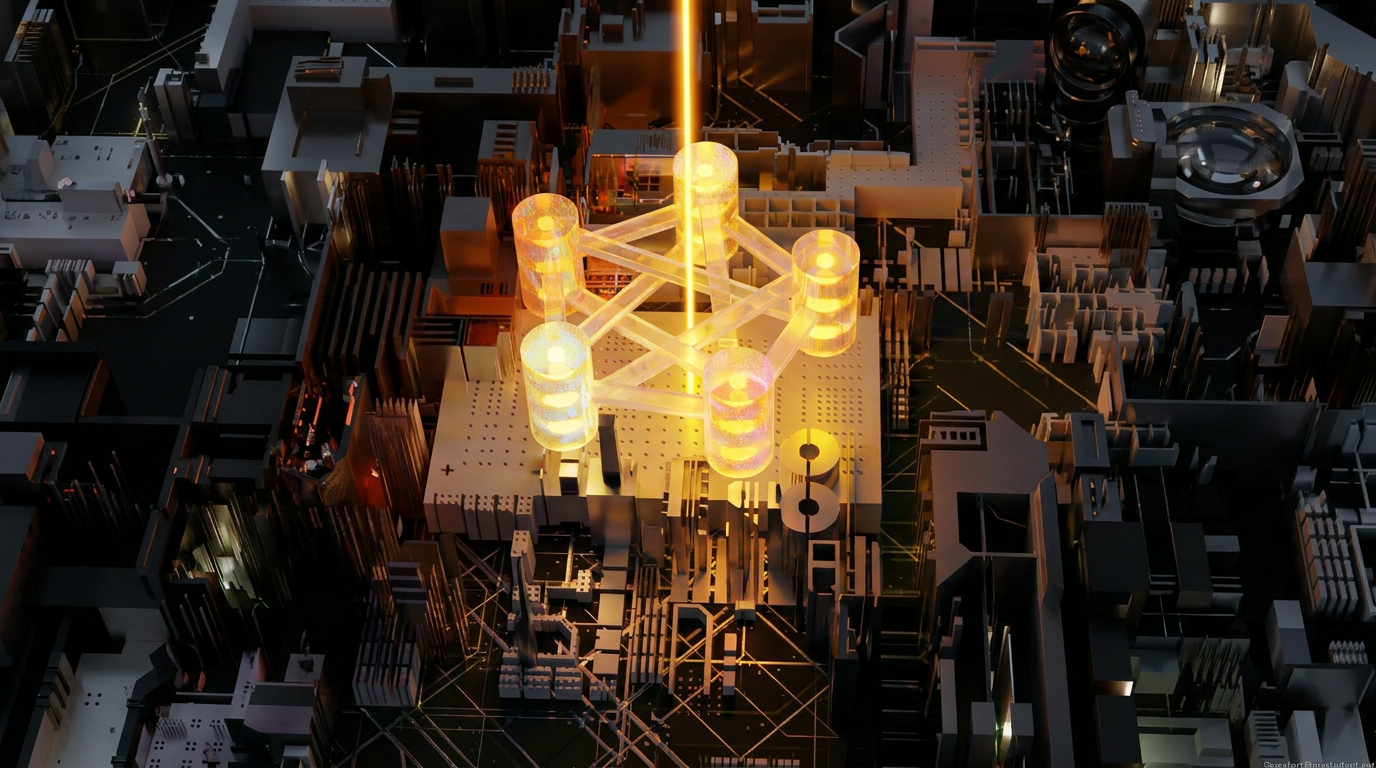
To solve this looming crisis, scientists are turning away from electrons and toward photons. In a study published this spring, a team led by Bo Zhen and Li He developed a method to compute using light. They created "exciton-polaritons"—hybrid particles that combine the sheer speed of light with matter's unique ability to interact and switch states.[1][2][5]

Photonic computing isn't entirely new, but previous iterations hit a stubborn and energy-draining bottleneck. While light is excellent for moving data rapidly from one place to another, artificial intelligence requires "nonlinear activation"—the complex decision-making steps within a neural network that determine how information is processed.[1][4]
Historically, when experimental photonic chips reached these decision-making steps, they had to convert the light signals back into electronic signals, process the decision, and then convert them back to light. That constant conversion slowed the system down and consumed massive amounts of energy, effectively negating the benefits of using light in the first place.[1][2][5]
That constant conversion slowed the system down and consumed massive amounts of energy, effectively negating the benefits of using light in the first place.
The Penn breakthrough solves this exact problem. By coupling light into a nanoscale cavity lined with an atomically thin material, the new chip performs these nonlinear calculations optically. No electrical conversion is needed, meaning the system operates at the speed of light from start to finish.[2][4][6]

The historical poetry of the moment is hard to miss. Eighty years ago, Penn researchers J. Presper Eckert and John Mauchly built ENIAC, the world's first general-purpose electronic computer, launching the era of electron-based computing. Now, the same university is laying the groundwork for the photonic era.[1][2][7]
If successfully scaled, this technology could decouple AI's exponential growth from its massive carbon footprint. Because photonic chips generate almost no heat, they would eliminate the need for the massive, water-guzzling cooling systems that currently define AI data centers and strain municipal resources.[3][5][6]
Furthermore, the technology opens the door to direct optical processing. Future AI systems could process visual information directly from camera lenses without ever converting the images into electrical data, a capability that could revolutionize the reaction times of autonomous vehicles and advanced robotics.[2][4]

However, moving from a nanoscale laboratory demonstration to a commercial data center is a monumental task. The global semiconductor industry is deeply entrenched in silicon manufacturing, and building new fabrication plants for photonic chips will require years of development and billions of dollars in capital investment.[5][6][7]
Despite the long road to commercialization, the research provides a scientifically validated off-ramp from AI's looming energy crisis. As the limits of traditional computing become harder to ignore, the future of artificial intelligence may depend less on harnessing electricity, and more on capturing light.[2][4][7]
How we got here
1946
Penn researchers unveil ENIAC, launching the era of electron-based computing.
Early 2020s
AI models grow exponentially, pushing traditional silicon chips to their physical and thermal limits.
2024-2025
Experimental photonic chips emerge but struggle with the energy cost of converting light back to electricity for decision-making steps.
May 2026
Penn researchers successfully demonstrate a hybrid light-matter particle that performs nonlinear AI calculations entirely optically.
Viewpoints in depth
Photonic Physics Researchers
Scientists focused on the fundamental physics of overcoming the optical-electrical bottleneck.
For decades, physicists have known that light is vastly superior to electricity for transmitting data, which is why fiber optics replaced copper wire for the internet. However, computing requires 'nonlinear' interactions—essentially, making decisions based on data. Because photons don't naturally interact with each other, previous photonic chips had to convert light back into electrons to make these decisions. Researchers view the creation of the exciton-polariton as a monumental physics breakthrough because it forces light to interact with matter just enough to perform these calculations, bypassing the energy-intensive conversion step entirely.
Climate & Energy Watchdogs
Environmental analysts focused on the unsustainable trajectory of AI's power demands.
Environmental groups and energy analysts have been sounding the alarm on AI's physical footprint. With global AI data center capacity approaching 30 gigawatts, the technology is straining regional power grids and threatening to derail corporate climate pledges. From this perspective, the Penn breakthrough is not just a neat technological trick, but a planetary necessity. Because photonic chips generate virtually no heat, they would eliminate the massive water-cooling infrastructure that currently drains local municipal water supplies, offering a path to decouple AI progress from environmental degradation.
Technology & Industry Analysts
Market watchers focused on the immense logistical challenges of commercializing the technology.
While acknowledging the scientific brilliance of the breakthrough, industry analysts urge caution regarding the timeline. The entire modern global economy is built on a deeply entrenched silicon semiconductor supply chain. Transitioning from electron-based silicon wafers to nanoscale photonic cavities requires entirely new fabrication processes, testing equipment, and software architectures. Analysts warn that while light-based computing is the clear long-term future, it will take billions of dollars and potentially a decade of engineering before these chips can be mass-produced and installed in commercial data centers.
What we don't know
- Exactly how long it will take to scale this nanoscale laboratory demonstration into mass-produced commercial chips.
- Whether the existing semiconductor industry will embrace photonic computing or view it as a threat to their silicon investments.
- How easily existing AI software architectures can be adapted to run on entirely optical hardware.
Key terms
- Photonic Computing
- A type of computing that uses photons (particles of light) instead of electrons to process and transmit information.
- Exciton-Polariton
- A hybrid particle created by coupling light with matter, allowing for ultra-fast, low-energy optical switching.
- Nonlinear Activation
- The complex decision-making step in an artificial neural network that determines whether a signal should be passed to the next layer.
- ENIAC
- The world's first general-purpose electronic digital computer, built at the University of Pennsylvania in 1946.
Frequently asked
What is a light-matter particle?
Known as an exciton-polariton, it is a hybrid state that combines a photon (light) with matter, allowing it to move at the speed of light while still interacting with other particles.
Why does AI use so much energy right now?
Modern AI requires billions of mathematical calculations per second. Moving electrons through silicon chips to perform these calculations generates massive heat, requiring huge amounts of electricity for both processing and cooling.
When will these light-based chips be in computers?
The technology is currently in the laboratory phase. Experts estimate it will take several years to scale the manufacturing process before photonic chips can be deployed in commercial AI data centers.
Sources
Source coverage
7 outlets
3 viewpoints surfaced







[1]ScienceDailyPhotonic Physics Researchers
Forget electrons, this breakthrough uses light-matter particles to power AI
Read on ScienceDaily →[2]University of PennsylvaniaPhotonic Physics Researchers
Penn scientists may have found a way to power the future of AI with light instead of electricity
Read on University of Pennsylvania →[3]Stanford UniversityClimate & Energy Watchdogs
Artificial Intelligence Index Report 2026: Power-Hungry Models
Read on Stanford University →[4]IEEE SpectrumTechnology & Industry Analysts
Penn's Exciton-Polariton Breakthrough Could Solve AI's Power Crisis
Read on IEEE Spectrum →[5]MIT Technology ReviewTechnology & Industry Analysts
Why the Future of AI Computing Might Be Made of Light
Read on MIT Technology Review →[6]The VergeTechnology & Industry Analysts
Researchers just built an AI chip powered by light, not electricity
Read on The Verge →[7]Factlen Editorial TeamClimate & Energy Watchdogs
Synthesis by Factlen editorial team
Read on Factlen Editorial Team →

More in ai
See all 134 stories →Agentic AI
How Autonomous AI Agents Are Moving from Chatbots to Action-Takers
8 sources

Local AI
The Rise of Local AI: How to Run Powerful Language Models on Your Own Laptop
6 sources

Open-Source AI
Open-Source AI Models Reach Frontier Parity, Democratizing Access for Developers
7 sources

EU AI Act
Global Tech Faces Operational Reckoning as EU AI Act's August 2026 Deadline Looms
8 sources

Every angle. Every day.
Get ai stories with full source coverage and perspective breakdowns delivered to your inbox.