
AI Researchers Decode 'Phonetic Alphabet' of Sperm Whales in Historic Interspecies Breakthrough
Using advanced machine learning, scientists have identified a complex, grammar-driven linguistic structure in sperm whale vocalizations, paving the way for two-way communication.
By Factlen Editorial Team
- Marine Biologists & Conservationists
- Focus on how decoding language can protect habitats, monitor ecological stress, and prevent fatal ship strikes.
- AI & Linguistics Researchers
- View the breakthrough as a monumental scientific milestone that proves complex syntax and grammar are not uniquely human.
- Legal & Ethical Scholars
- Explore the profound implications for animal rights, arguing that recognized language capabilities could lead to legal personhood.
- Maritime Industry
- Preparing for a future where shipping routes might require negotiation and consent from local whale pods.
What's not represented
- · Indigenous coastal communities with historical ties to whaling or marine conservation
Why this matters
Decoding animal language shatters the long-held belief that complex grammar is uniquely human. Beyond the profound philosophical shift, this breakthrough offers immediate real-world applications for marine conservation, allowing ships to avoid whale pods and potentially granting highly intelligent animals new legal protections.
Key points
- Project CETI has identified a 156-character 'phonetic alphabet' used by sperm whales.
- AI models revealed that whale clicks follow complex grammatical rules similar to human syntax.
- The breakthrough relied on autonomous drones and deep-water buoys collecting millions of vocalizations.
- Researchers project that basic two-way communication could be tested by late 2026.
- The discovery is sparking debates over legal personhood and habitat sovereignty for marine mammals.
For centuries, the rhythmic clicks of sperm whales echoing through the deep ocean were a mystery. Now, artificial intelligence has cracked the code. In a historic milestone for interspecies communication, researchers have successfully identified a "phonetic alphabet" used by sperm whales, proving that their vocalizations possess a complex, grammar-driven linguistic structure.[1][2]
The breakthrough, spearheaded by the Cetacean Translation Initiative (Project CETI), marks a profound shift in how humanity understands animal intelligence. By deploying advanced machine learning models against decades of underwater audio, scientists discovered that whale communication is not merely a collection of simple signals. Instead, it is a highly structured language built from 156 distinct vocal patterns, or "codas," that combine much like human words.[2][6]
"This is not only a technological advancement, but also a critical step in helping us understand the complex communications and behaviors of these creatures," noted Dr. Stephanie Gil, a researcher collaborating with Project CETI. The discovery shatters the long-held linguistic theory that complex syntax and grammar are uniquely human traits, opening the door to a radical reevaluation of life on Earth.[1][6]

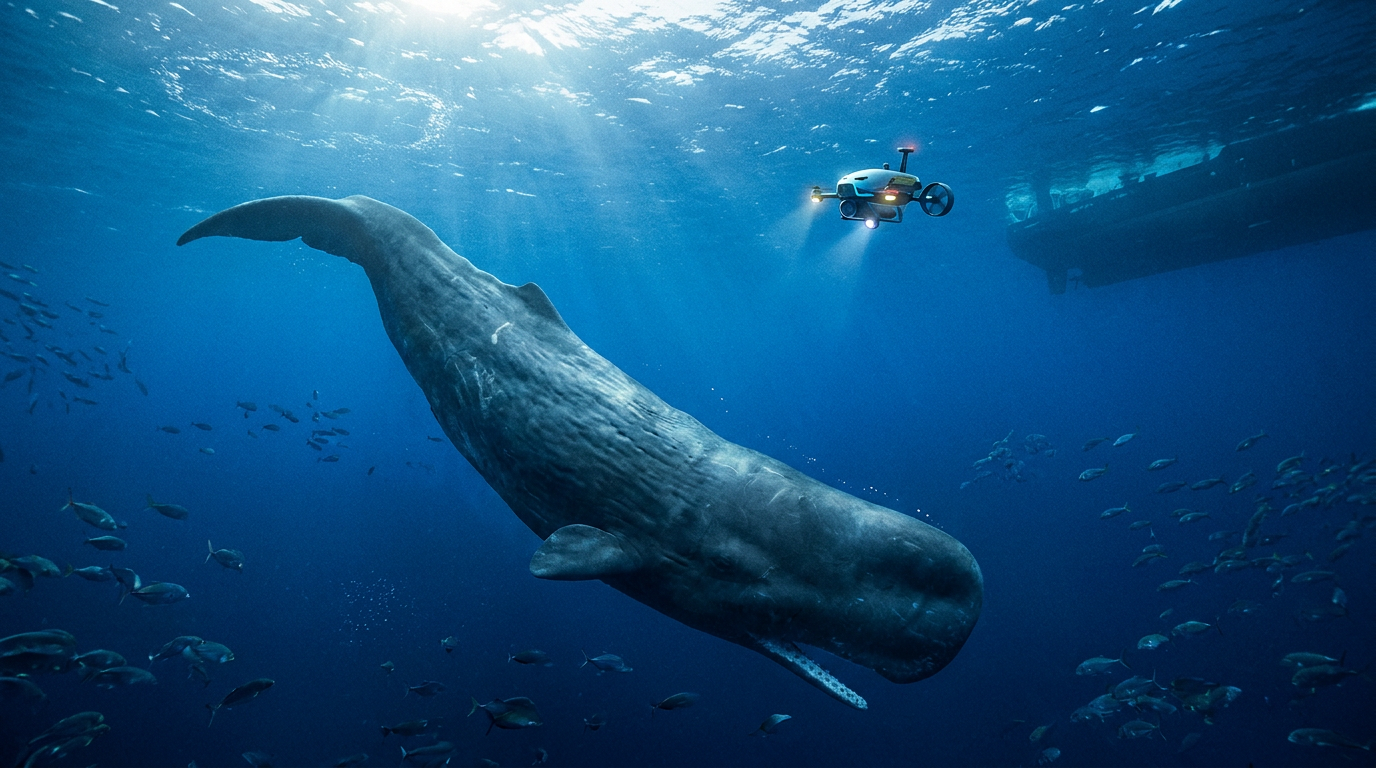
The sheer scale of the data required to train these AI models is staggering. Project CETI deployed autonomous aerial drones and deep-water acoustic buoys—anchored more than 6,000 feet below the surface off the coast of Dominica—to capture millions of high-quality, contextualized vocalizations. These sensors act as an "antenna ray in the air," predicting when and where a whale will surface to record their interactions with unprecedented clarity.[1]
To make sense of this massive acoustic dataset, researchers turned to the same underlying architecture that powers large language models. However, instead of processing human text, these algorithms were trained to find hidden structural patterns in the whales' high-frequency clicks. The AI successfully mapped how individual clicks are layered, modified, and combined to convey specific meanings depending on the social context.[2][3]
Project CETI is not alone in this bioacoustic renaissance. The Earth Species Project recently launched NatureLM-audio, a foundational AI model designed to analyze the vocalizations of multiple species, from zebra finches to beluga whales. By combining acoustic data with visual footage and environmental sensors, these multimodal models are beginning to understand animal communication as a layered symphony of sound, movement, and context.[4][5]
As the algorithms evolve, the timeline for actual interspecies dialogue is accelerating rapidly. Researchers project that basic two-way communication capabilities with sperm whales could be tested as early as late 2026. Scientists are already developing specialized underwater acoustic devices capable of reproducing whale language, hoping to eventually exchange navigational signals or identify the individual "names" whales use for one another.[2][7]

As the algorithms evolve, the timeline for actual interspecies dialogue is accelerating rapidly.
The implications for marine conservation are immediate and profound. If conservationists can understand real-time whale communication, they can detect when a pod is stressed, track their migration routes more accurately, and warn them of impending dangers. This could drastically reduce the number of fatal ship strikes, which remain one of the leading causes of death for large cetaceans.[4][5]
However, the ability to translate whale language is sending shockwaves far beyond the scientific community. Legal scholars are preparing for a future where marine animals might possess recognized language capabilities, a development that could fundamentally disrupt the legal landscape. Organizations are already using these findings to argue for the legal personhood of highly intelligent animals.[2][6]
"Proving that cetaceans have a capacity for language would challenge current linguistic theories that confine language to humans and disrupt the legal landscape," researchers associated with NYU's MOTH (More Than Human) project noted. If whales can legally demand habitat protections, shipping routes and maritime operations could become complex negotiation tables, requiring "consent" from local pods before transiting their territory.[6]
The maritime industry is already taking note of this impending reality. With basic communication breakthroughs on the horizon, shipping companies are exploring how AI-translated whale broadcasts could be integrated into their navigation systems. In the near future, a vessel's AI might receive a direct request from a whale matriarch to delay transit while her calves feed, turning ocean navigation into a shared, cooperative endeavor.[2]

Yet, the prospect of talking back to nature carries significant ethical risks. Bioacoustics experts warn that continuous AI-assisted interaction could stress animals or alter their natural communication patterns. Repeated exposure to AI-generated calls might disrupt social hierarchies, confuse mating instincts, or inadvertently introduce "foreign" concepts into a delicate ecological culture.[5]
To mitigate these risks, researchers are calling for the establishment of strict ethical frameworks before any two-way communication is attempted. At the 2026 World Governments Summit, Aza Raskin of the Earth Species Project even proposed the creation of a "Ministry of Interspecies Diplomacy" to manage the ethical and environmental consequences of humanity's newfound ability to converse with the natural world.[5][7]
Ultimately, the decoding of the sperm whale alphabet is about more than just science; it is about collapsing the distance between humans and the rest of the planet. When beings communicate in languages we cannot understand, they remain abstract and separate. But as AI translates the rich, complex dialogue of the deep ocean, nature moves from an abstraction into a shared reality, fundamentally reshaping humanity's place within the natural world.[7]
How we got here
2021
Project CETI launches with funding from The Audacious Project to decode whale communication.
2024
Autonomous drones and deep-water buoys are deployed off Dominica to capture context-rich behavioral data.
2025
Earth Species Project releases NatureLM-audio, accelerating bioacoustic analysis across multiple species.
May 2026
Researchers confirm the discovery of a 156-character phonetic alphabet with distinct grammatical rules.
Viewpoints in depth
Marine Biologists & Conservationists
Focus on how decoding language can protect habitats and prevent ship strikes.
For conservationists, the ability to understand whale communication is a practical tool for survival. By monitoring real-time acoustic data, researchers can detect when a pod is stressed by ocean noise, track their precise migration routes, and warn them of impending dangers like commercial shipping vessels. This real-time ecological feedback loop could drastically reduce fatal ship strikes and help establish dynamic, rather than static, marine protected areas.
AI & Linguistics Researchers
Focus on the paradigm shift in understanding intelligence and syntax.
Linguists and computer scientists view this breakthrough as a fundamental disruption of human exceptionalism. For decades, the prevailing theory was that complex grammar and syntax were uniquely human traits. By proving that sperm whales use a structured phonetic alphabet with distinct combinatorial rules, researchers are forcing a reevaluation of what constitutes intelligence and language, suggesting that complex communication may be a universal evolutionary trait among highly social species.
Legal & Ethical Scholars
Focus on the push for legal personhood and the ethical risks of two-way communication.
Legal scholars argue that if cetaceans possess recognized language capabilities, they may meet the criteria for legal personhood. Organizations like the Nonhuman Rights Project are preparing to use these findings to demand habitat sovereignty, which could force maritime industries to negotiate transit rights with whale pods. Simultaneously, ethicists warn against the hubris of 'talking back,' cautioning that AI-generated calls could disrupt delicate social hierarchies or introduce harmful behavioral changes into wild populations.
What we don't know
- Whether AI-generated responses will be understood by whales or if they will cause unintended behavioral stress.
- How international maritime law will adapt if highly intelligent marine mammals are granted legal personhood or habitat sovereignty.
- The full extent of the vocabulary and whether it varies significantly between different global whale clans.
Key terms
- Coda
- A distinct sequence of clicks used by sperm whales to communicate, which researchers now understand function like words or phrases.
- Bioacoustics
- The cross-disciplinary science that combines biology and acoustics to study how animals produce and perceive sound.
- NatureLM-audio
- A large-scale artificial intelligence model designed specifically to analyze and decode the vocalizations of various animal species.
Frequently asked
Are whales actually speaking a language?
Yes. AI analysis reveals their clicks follow strict grammatical rules and combine to form complex, context-dependent phrases, much like human language.
How did AI help decode this?
Large language models processed millions of hours of underwater audio, identifying structural patterns and syntax that human researchers could not detect manually.
Will humans be able to talk back to whales?
Scientists are developing underwater acoustic devices capable of reproducing whale language, with basic two-way communication tests projected for late 2026 or 2027.
Sources
Source coverage
7 outlets
4 viewpoints surfaced







[1]Oceanographic MagazineMarine Biologists & Conservationists
Project CETI breakthrough in AI tracking and whale communication
Read on Oceanographic Magazine →[2]Maritime InnovationsMaritime Industry
Project CETI: Decoding the Sperm Whale Phonetic Alphabet
Read on Maritime Innovations →[3]Science FocusAI & Linguistics Researchers
AI used to understand animal communication
Read on Science Focus →[4]MediumMarine Biologists & Conservationists
Pioneering AI Technology in Bioacoustics
Read on Medium →[5]Digital DefyndAI & Linguistics Researchers
AI animal communication breakthrough 2026
Read on Digital Defynd →[6]MOTH LifeLegal & Ethical Scholars
Project CETI and legal implications of whale language
Read on MOTH Life →[7]World Government SummitAI & Linguistics Researchers
The Future of Interspecies Understanding
Read on World Government Summit →

More in ai
See all 9 stories →Prompt Engineering
Beyond the Chatbot: How Chain of Thought and ReAct Are Rewiring AI Reasoning
6 sources
Model Architecture
Beyond the Transformer: How State Space Models Are Rewiring Artificial Intelligence
8 sources

Local AI
How Local AI Works: Running Language Models on Your Own Hardware in 2026
9 sources

Animal Communication
AI-Guided Robots Are Now Tracking and Translating Sperm Whale Conversations in Real Time
8 sources
Every angle. Every day.
Get ai stories with full source coverage and perspective breakdowns delivered to your inbox.