
2026 Rivian R2 vs. Tesla Model Y: Comparing the Top Electric Crossovers
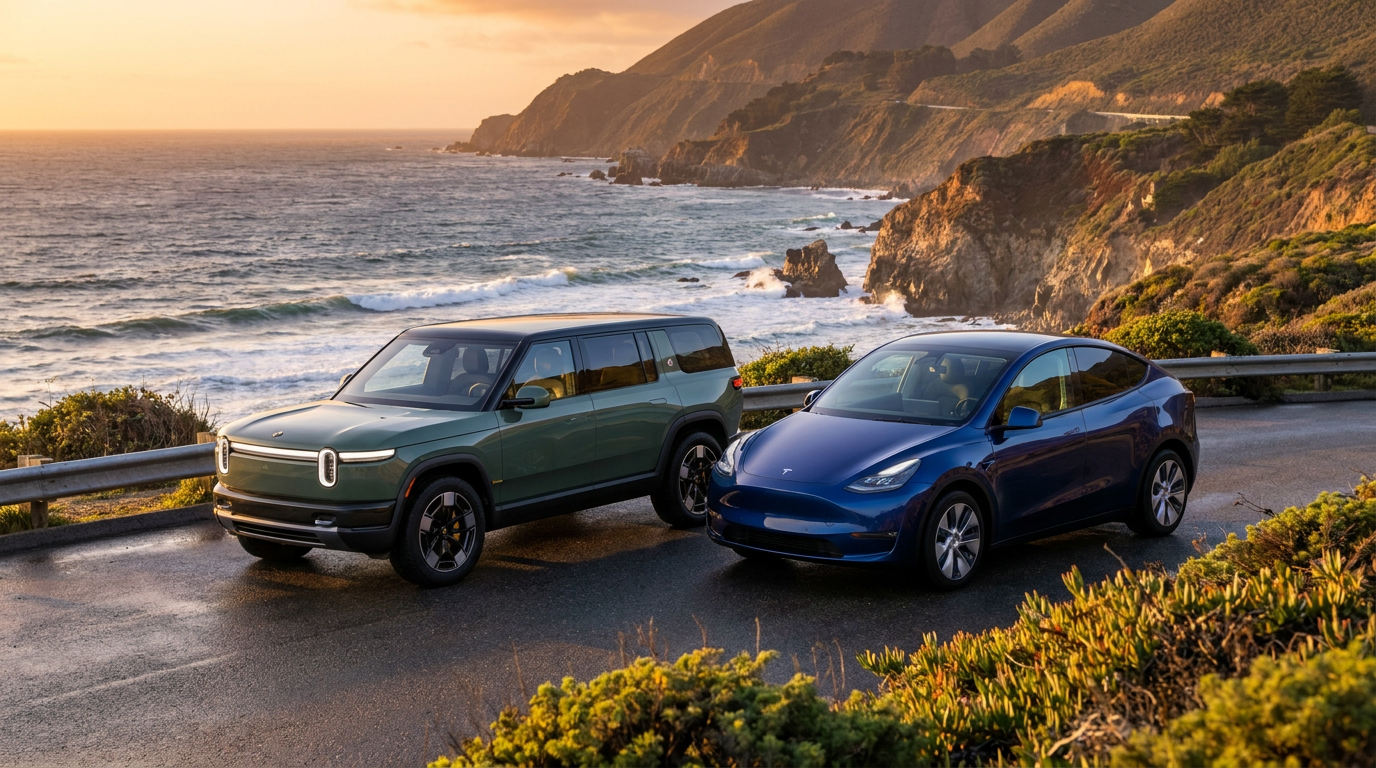
With the Rivian R2 arriving to challenge the refreshed Tesla Model Y, buyers face a choice between rugged off-road versatility and streamlined on-road efficiency.
By Factlen Editorial Team
- Efficiency & Street Performance Advocates
- Prioritizes aerodynamic design, low starting prices, and agile on-road handling.
- Versatility & Off-Road Proponents
- Values maximum cargo space, high ground clearance, and rugged outdoor capability.
- Neutral Market Analysts
- Focuses on the broader market impact, pricing parity, and charging infrastructure.
What's not represented
- · Traditional legacy automakers losing market share to pure EV brands
- · Used EV buyers waiting for depreciation
Why this matters
The midsize electric SUV is the most popular EV segment in the world, serving as the primary family car for millions. As Rivian challenges Tesla's dominance, buyers finally have a stark choice between two distinct philosophies: sleek, affordable on-road efficiency versus rugged, high-capacity outdoor versatility.
Key points
- The 2026 Tesla Model Y starts at $41,630, offering an affordable entry point with 321 miles of range.
- Rivian's R2 launches with a $57,990 Performance trim, while a $44,990 base model arrives in 2027.
- The Rivian R2 provides 90.1 cubic feet of cargo space and 9.6 inches of ground clearance for off-road use.
- Both vehicles utilize the NACS charging port, granting seamless access to Tesla's Supercharger network.
The midsize electric SUV segment has reached a critical inflection point in 2026. For years, the Tesla Model Y has dominated the category, serving as the default choice for buyers seeking a practical, long-range electric family hauler. Now, following Tesla's comprehensive "Juniper" refresh, a formidable challenger has arrived in the form of the highly anticipated Rivian R2.[1][4]
While both vehicles occupy a similar footprint and target the exact same demographic, they represent fundamentally different engineering philosophies. The Model Y continues to prioritize aerodynamic efficiency, street-oriented handling, and a minimalist aesthetic. The Rivian R2, by contrast, brings the rugged, boxy ethos of its larger R1 siblings into a more compact, garage-friendly package.[4][5]
Pricing and availability present the first major divergence for buyers shopping in 2026. Tesla maintains a distinct advantage at the entry level, with the base rear-wheel-drive Model Y starting at $41,630 and offering 321 miles of range. Rivian's rollout strategy begins exclusively at the top of the market, launching the R2 Performance trim at $57,990.[1][4]
Buyers looking for a more affordable Rivian will need to wait until 2027, when the $44,990 standard variant is scheduled to arrive. However, for those shopping in the premium tier today, the pricing aligns almost perfectly, with the top-spec Model Y Performance and the R2 Performance both sitting in the upper $50,000 range.[3][4]

When evaluating the case for the Tesla Model Y, the strongest arguments center on on-road efficiency and proven infrastructure. The Model Y's teardrop shape allows it to slip through the air with minimal resistance, enabling the Premium RWD trim to achieve an impressive 357 miles of range on a single charge.[1][4]
The evidence for Tesla's street superiority is also found in its driving dynamics. The Model Y sits lower to the ground, with a 6.0-inch clearance that contributes to a sportier, more sedan-like handling profile on twisty roads. It remains the more engaging vehicle for drivers who prioritize cornering stability and a firm, connected ride over trail capability.[2][5][7]
Conversely, the case for the Rivian R2 rests on unmatched versatility, cargo capacity, and off-road readiness. The R2's boxy silhouette sacrifices some aerodynamic slipperiness but pays massive dividends in interior volume and passenger headroom.[2]
The evidence for Rivian's utility advantage is stark when looking at the numbers. The R2 offers a cavernous 90.1 cubic feet of total storage space with the seats folded, including a spacious 5.2-cubic-foot front trunk. The Model Y, hampered by its sloping roofline, tops out at roughly 76 cubic feet of total cargo capacity.[2][3][7]

The evidence for Rivian's utility advantage is stark when looking at the numbers.
Off the pavement, the comparison heavily favors the newcomer. The R2 boasts 9.6 inches of ground clearance—a full 60 percent more than the Model Y—along with aggressive 25-degree approach and 26-degree departure angles. This geometry allows the Rivian to tackle rutted trails and steep inclines that would easily scrape the underbelly of the Tesla.[2][5]
Performance metrics reveal a surprisingly tight race between the two flagship trims. The Rivian R2 Performance utilizes a tri-motor setup producing 656 horsepower, allowing it to sprint from zero to 60 mph in 3.6 seconds. The Model Y Performance, while slightly less powerful, leverages its lighter weight to achieve a similar 3.5-second sprint.[1][3][4]
Range estimates at the top end also challenge conventional assumptions. The EPA rates the R2 Performance at 330 miles on 21-inch wheels, which actually edges out the Model Y Performance's 277-mile rating. This gives the Rivian a distinct advantage for buyers who want maximum acceleration without sacrificing long-distance touring capability.[1][3]
Efficiency data provides one of the most unexpected twists in this comparison. Despite its heavier curb weight and upright stance, the R2 Performance achieves a 109 MPGe combined rating, slightly besting the Model Y Performance's 104 MPGe. Industry analysts note that Rivian's next-generation powertrain engineering has effectively closed the efficiency gap that Tesla has historically dominated.[2]
Inside the cabin, the two automakers take divergent approaches to modern minimalism. Tesla's interior remains ultra-clean, relying almost entirely on a single 15-inch central touchscreen to control everything from navigation to wiper speed. The 2026 Juniper update improved cabin materials and sound insulation, but the environment remains stark.[4][5]

Rivian offers a slightly warmer, more tactile environment. While still minimalist, the R2 features a dedicated digital driver's display behind the steering wheel—a feature Tesla continues to omit—and utilizes premium, sustainable materials that evoke high-end outdoor gear. The R2 also features a roll-down rear window, enhancing the open-air feel and allowing for the transport of long items like surfboards.[5][6]
Charging infrastructure, once a decisive victory for Tesla, is now a neutral factor. The Rivian R2 natively incorporates the North American Charging Standard (NACS) port, granting it seamless, adapter-free access to Tesla's expansive Supercharger network. Both vehicles can charge from 10 to 80 percent in roughly 30 minutes under optimal conditions.[4][6]
Ultimately, the Tesla Model Y fits well when a buyer prioritizes immediate availability at a lower starting price, maximum on-road efficiency, and a sporty, car-like driving experience. It remains the sensible, proven choice for urban and suburban commuters who rarely leave the pavement.[4][7]
The Rivian R2 does not fit well when a buyer is strictly bound to a $40,000 budget in 2026, or when they prefer the low-slung dynamics of a sports sedan.[4][5]
However, the Rivian R2 fits perfectly when a buyer needs genuine off-road capability, maximum cargo volume for family gear, and a design that stands out from the ubiquitous teardrop crossovers. For those willing to pay the premium for the launch edition, the R2 successfully merges rugged utility with top-tier electric performance.[2][3][7]
How we got here
2020
Tesla launches the Model Y, which quickly becomes the best-selling electric vehicle globally.
March 2024
Rivian officially unveils the R2 midsize SUV, promising a more affordable entry point to its rugged lineup.
Early 2026
Tesla rolls out the 'Juniper' refresh for the Model Y, updating its styling, interior materials, and efficiency.
Spring 2026
Rivian begins initial customer deliveries of the top-tier R2 Performance launch edition.
Summer 2027
The base $44,990 Rivian R2 Standard trim is slated to arrive, completing the lineup.
Viewpoints in depth
Urban Commuters & Efficiency Maximizers
Drivers who prioritize low running costs, aerodynamic range, and street-oriented handling.
For this camp, the Tesla Model Y remains the undisputed champion. They point to the Model Y's teardrop aerodynamics and lighter curb weight, which allow the Premium RWD trim to extract 357 miles of range from its battery. These buyers value the low 6.0-inch ground clearance for its contribution to sporty, sedan-like cornering and ease of entry. To them, the Rivian's boxy shape and heavy off-road hardware represent unnecessary compromises for a vehicle that will spend 99 percent of its life on paved roads.
Outdoor Enthusiasts & Utility Seekers
Buyers who need a vehicle capable of handling rough terrain, bulky gear, and family road trips.
This group strongly favors the Rivian R2. They argue that an SUV should offer genuine utility, pointing to the R2's 9.6 inches of ground clearance and 90.1 cubic feet of total storage as definitive proof of its superiority. For these drivers, the ability to fold all seats flat, roll down the rear window for long cargo, and confidently navigate rutted trailheads far outweighs the aerodynamic penalties. They view the Model Y as a tall hatchback rather than a true sport utility vehicle.
What we don't know
- How Rivian's production ramp-up will affect the delivery timeline for the more affordable R2 trims slated for 2027.
- Whether Tesla will adjust Model Y pricing in response to the R2's arrival once the lower-priced Rivian trims hit the market.
Key terms
- NACS (North American Charging Standard)
- The charging plug design originally developed by Tesla, which has now been adopted by most major automakers, including Rivian, for seamless access to the Supercharger network.
- MPGe (Miles Per Gallon Equivalent)
- A metric used by the EPA to compare the energy efficiency of electric vehicles to traditional gas-powered cars.
- Approach and Departure Angles
- The maximum angles of an incline or decline a vehicle can drive up or down without the front or rear bumpers scraping the ground.
- Frunk
- A front trunk located under the hood of an electric vehicle, occupying the space where a traditional gas engine would normally sit.
Frequently asked
When can I buy the $45,000 Rivian R2?
The base $44,990 Rivian R2 Standard trim is scheduled to begin deliveries in early to mid-2027. Only the $57,990 Performance trim is available at launch in 2026.
Does the Rivian R2 use Tesla Superchargers?
Yes. The Rivian R2 is built with a native North American Charging Standard (NACS) port, allowing it to plug directly into compatible Tesla Superchargers without needing an adapter.
Which vehicle has more cargo space?
The Rivian R2 offers significantly more storage, with 90.1 cubic feet of total space (including the front trunk) compared to the Model Y's approximately 76 cubic feet.
Is the Tesla Model Y faster than the Rivian R2?
They are nearly identical at the top end. The Model Y Performance hits 60 mph in roughly 3.5 seconds, while the 656-horsepower Rivian R2 Performance achieves it in 3.6 seconds.
Sources
Source coverage
7 outlets
3 viewpoints surfaced







[1]Car and DriverEfficiency & Street Performance Advocates
2026 Tesla Model Y: Pricing, Specs, and Review
Read on Car and Driver →[2]ElectrekVersatility & Off-Road Proponents
Rivian R2 vs Tesla Model Y spotted side-by-side: Detailed size comparison
Read on Electrek →[3]CarBuzzVersatility & Off-Road Proponents
The Rivian R2 Performance Has Up To 24 Miles Of Range On The Model Y Performance
Read on CarBuzz →[4]Road EthosNeutral Market Analysts
Rivian R2 Vs. Tesla Model Y: An Honest Comparison For 2026 Buyers
Read on Road Ethos →[5]CarwowEfficiency & Street Performance Advocates
Rivian R2 vs Tesla Model Y: which electric SUV is best?
Read on Carwow →[6]Kelley Blue BookVersatility & Off-Road Proponents
2026 Rivian R2: Pricing, Range, and Specs
Read on Kelley Blue Book →[7]Car ConfectionsNeutral Market Analysts
Who is best within 2027 Rivian R2 vs. 2026 Tesla Model Y?
Read on Car Confections →
Every angle. Every day.
Get automotive stories with full source coverage and perspective breakdowns delivered to your inbox.