
The Mechanics of the Surcharge: How the New Differential Fee Reshapes International Access to US National Parks
A new $100 per-person surcharge for international visitors at 11 major U.S. national parks aims to fund maintenance backlogs, but introduces new logistical hurdles at the gates. Here is how the new pricing structure works and how global travelers can navigate it.
By Kabir Mehra

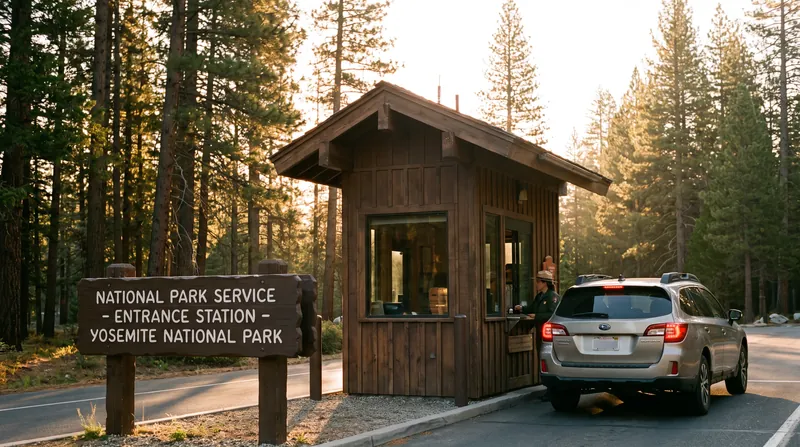
Picture rolling up to the wooden entrance kiosk at Zion National Park, the morning sun just beginning to light up the towering red sandstone cliffs. You have your rental car, your hiking boots, and your itinerary ready. But as you hand over your credit card to pay the standard $35 vehicle fee, the ranger asks to see a U.S. driver's license or passport. For international visitors arriving since January 1, 2026, this moment at the gate represents a fundamental shift in how the United States manages its most treasured landscapes.[1][4]
Under a new differential pricing structure implemented by the Department of the Interior, non-U.S. residents aged 16 and older now face a $100 per-person surcharge to enter 11 of the country's most heavily visited national parks. The list reads like a bucket list of American wilderness: Yosemite, Yellowstone, Grand Canyon, Zion, Bryce Canyon, Glacier, Grand Teton, Rocky Mountain, Acadia, Everglades, and Sequoia & Kings Canyon.[2][4]
The mechanics of the surcharge are straightforward but steep. The $100 fee is applied on top of the standard entrance fee, meaning a visiting couple from London pulling up to the Grand Canyon without an annual pass will pay $235 at the gate rather than the $35 a domestic visitor pays. For families and larger groups, the gate price can quickly escalate into the hundreds of dollars, fundamentally altering the budget of a classic American road trip.[1][2]
However, the National Park Service has built a specific financial off-ramp into the new system: the America the Beautiful Non-Resident Annual Pass. While the standard annual pass for U.S. residents remains $80, the nonresident version now costs $250. Crucially, this pass covers the $100 per-visit surcharge for the passholder and up to three additional adults traveling in the same non-commercial vehicle.[2][3]
For international travelers, this turns park access into an exercise in strategic math. A family of four visiting just a single affected park—like Yosemite—saves $185 by purchasing the $250 annual pass online before their trip, rather than paying four individual $100 surcharges at the gate. Tour operators and state tourism boards are now urgently advising global clients to secure these digital passes well in advance to avoid sticker shock upon arrival.[3][7]
The rationale behind the new pricing tier is rooted in the sheer physical toll that record-breaking crowds have taken on park infrastructure. The National Park Service faces a multi-billion-dollar backlog of deferred maintenance, encompassing crumbling trails, aging wastewater systems, and deteriorating visitor centers. Because U.S. taxpayers already subsidize the park system through federal funding, proponents argue that the surcharge ensures international tourists contribute their fair share to the landscapes they come to enjoy.[2][5]
Conservation groups have largely championed the move as a necessary evolution in public land management. Analysts estimate that the $100 surcharge could generate upwards of $55 million annually at Yellowstone alone, providing a massive influx of dedicated capital to repair failing bridges and expand conservation efforts. They also point out that differential pricing is a global standard; countries from Tanzania to Ecuador have long charged international visitors significantly higher rates to access their premier natural wonders.[1][5]
Yet, the transition from policy to practice has not been entirely smooth. At the gates of parks like Yosemite and Zion, frontline rangers are now tasked with verifying the residency of every visitor. U.S. citizens and residents must present a passport, state-issued ID, or Green Card to secure the domestic rate. This new layer of administrative friction has led to longer lines at entrance stations, occasionally backing up traffic along the scenic approach roads.[1][4]
Some park staff have voiced discomfort with the new protocol, noting that asking for citizenship documents at a recreation site feels contrary to the welcoming spirit of the National Park Service. Reports have emerged of frustrated international tourists turning their vehicles around rather than paying the unexpected surcharge, raising concerns among rangers that the policy might alienate global admirers of the American outdoors.[1]
The commercial travel industry is also navigating a complex new reality. Companies that operate road-based group tours must now account for the $100 per-person fee for every international client on their passenger manifest. Because the fee applies based on the date of entry, tours booked months in advance of the 2026 rollout are suddenly subject to the surcharge, forcing operators to either absorb the cost or pass it along to their guests.[3][6]
Industry groups representing inbound travel have lobbied the Department of the Interior for a delay or modification, warning that targeting international travelers with steep fees could harm the economic vitality of gateway communities. Towns like Springdale, Utah, and West Yellowstone, Montana, rely heavily on the steady flow of global tourists who fill hotel rooms, dine at local restaurants, and purchase gear.[6]
Despite the growing pains, the differential fee structure is now a permanent fixture of the U.S. national park experience. For the savvy international traveler, the American wilderness remains highly accessible—provided they plan ahead, purchase the right passes, and approach the gates prepared. The new system asks global visitors to view their entrance fee not just as a ticket to a viewpoint, but as a direct investment in the preservation of the world's most famous protected lands.[2][7]
Key points
- Non-U.S. residents aged 16 and older now face a $100 per-person surcharge at 11 major national parks.
- The America the Beautiful Non-Resident Annual Pass has increased in price from $80 to $250.
- The $250 annual pass covers the passholder and up to three additional adults, offering significant savings for groups.
- U.S. residents must now present a valid photo ID at entrance gates to secure the standard domestic rate.
What we don’t know
- Whether the steep increase in entrance fees will lead to a measurable decline in international tourism to the United States.
- How the National Park Service will streamline residency verification to reduce wait times at busy summer entrance gates.
- If the Department of the Interior will adjust the policy for commercial tour operators who booked international clients prior to the fee announcement.
How we got here
July 2025
President Trump signs Executive Order 14314 directing the Interior Department to increase fees for nonresidents.
November 2025
The National Park Service officially announces the $100 per-person surcharge and $250 annual pass for international visitors.
January 2026
The new differential fee structure goes into effect at 11 major national parks.
- Conservation & Revenue Advocates
- Argue that the surcharge is a necessary and globally standard mechanism to fund critical park maintenance.
- Inbound Travel Operators
- Warn that the sudden fee increase creates logistical nightmares for tour operators and could deter global tourism.
- Frontline Park Staff
- Express concern over the operational friction and potential alienation caused by verifying residency at busy entrance gates.
Perspectives this story doesn't cover
- Local gateway community businesses
- Domestic U.S. visitors experiencing longer gate lines
Sources
Source coverage
7 outlets
3 viewpoints surfaced







- [1]The GuardianFrontline Park Staff
US national parks staff say new $100 fee for non-residents risks 'alienating visitors for decades'
Read on The Guardian → - [2]National Park ServiceConservation & Revenue Advocates
What is a nonresident fee?
Read on National Park Service → - [3]Visit UtahInbound Travel Operators
2026 National Park Fee Change
Read on Visit Utah → - [4]Legis1Conservation & Revenue Advocates
NPS Fee Hikes for International Park Visitors Create Delays
Read on Legis1 → - [5]BackpackerConservation & Revenue Advocates
National Parks Will Hike Entry Fees by $100 Per Day for Some Visitors in 2026
Read on Backpacker → - [6]International Inbound Travel AssociationInbound Travel Operators
$100 International Visitor Surcharge
Read on International Inbound Travel Association → - [7]Southwest Adventure ToursInbound Travel Operators
Important information for non-U.S. residents
Read on Southwest Adventure Tours →
More in Travel
See all →Wildlife Safety
The 100-Yard/25-Yard Rule: How the National Park Service Actually Defines a Safe Distance from Wildlife
6 sources
Aviation Tech
How Low-Earth Orbit Satellites Are Actually Rewiring In-Flight Wi-Fi
4 sources
Cumberland Island
How the Cumberland Island Land Exchange Trades Federal Parcels for Ecological Consolidation
3 sources

Backcountry Safety
The 60-Minute Breach Test: How the IGBC Actually Certifies Bear Canisters for National Parks
7 sources

Comments
Every angle. Every day.
Get Travel stories with full source coverage and perspective breakdowns, free every day.