
The Mechanics of Market Stabilization: How the U.S. Office Sector Reached Positive Net Absorption
After years of post-pandemic contraction, the U.S. office market achieved positive net absorption in 2026. This stabilization was driven by a combination of returning tenant demand, a flight to quality, and the strategic removal of obsolete inventory.
By Noor Saidi

In short
- The U.S. office market recorded its first sustained period of positive net absorption in three years in early 2026.
- The stabilization is driven heavily by a 'flight to quality,' with tenants favoring premium Class A buildings.
- Older Class B and C properties continue to face high vacancy rates, creating a bifurcated market.
For a local business owner deciding whether to renew a lease, or a regional investor eyeing a half-empty suburban complex, the abstract metrics of the national office market translate directly to the bottom line. After years of structural uncertainty and rising vacancies following the pandemic, a critical and closely watched metric has finally shifted: net absorption.
Understanding how and why this metric turned positive provides a vital roadmap for navigating the next phase of commercial real estate. This shift does not simply mean a return to the old normal; rather, it highlights a fundamental restructuring of how companies use space and how landlords must adapt to survive. By examining the mechanics of this stabilization, stakeholders can better position themselves for a market that rewards quality over quantity.
Net absorption is the definitive measure of commercial real estate health, calculating the total square footage of office space newly occupied minus the space vacated over a specific period. When the number is negative, the market is actively contracting as tenants shed space; when positive, it is expanding.
In early 2026, the U.S. office market recorded its first sustained period of positive net absorption in three years, effectively signaling an end to the prolonged post-pandemic decline. This milestone indicates that the bleeding has stopped and that aggregate demand has finally caught up with, and slightly exceeded, the rate at which companies are downsizing or closing physical offices.[1]
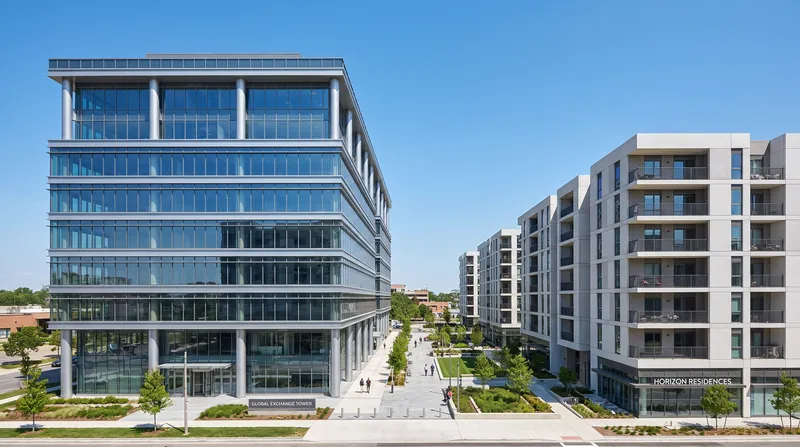
However, this stabilization did not occur uniformly across all property types or submarkets. Instead, it was heavily driven by a pronounced "flight to quality." Corporate tenants are increasingly trading larger, older footprints for smaller, premium spaces in Class A buildings. These modern facilities, equipped with advanced amenities, superior air quality systems, and collaborative layouts, are specifically designed to encourage employees to return to the office.
Companies are realizing that if they want to mandate or encourage in-person attendance, the physical workspace must offer an experience that cannot be easily replicated at home. Consequently, the demand for top-tier assets has surged, pulling the overall market absorption into positive territory.
As a direct result of this flight to quality, the commercial office market has severely bifurcated. While newer, high-quality buildings enjoy robust demand, steady leasing velocity, and positive absorption, older Class B and C properties continue to struggle with elevated vacancy rates and negative absorption.
This divergence means that headline national vacancy numbers often mask the underlying strength and competitiveness of the premium sector. Offices built in the last decade are seeing vacancy rates less than half of those seen in 1980s-vintage assets. For investors, this bifurcation underscores the risk of holding commodity office space that lacks the capital or structural capacity to be upgraded to modern standards.
Another crucial, yet often overlooked, factor in the market's stabilization is the structural adjustment of supply. In early 2026, the amount of office space permanently removed from inventory through demolitions or conversions to residential and mixed-use properties actually exceeded the space delivered through new construction.
This physical reduction of obsolete stock helped balance the market equation from the supply side. By removing millions of square feet of uncompetitive space from the denominator, the overall market fundamentals artificially tightened, contributing to the positive net absorption figures and helping to stabilize aggregate vacancy rates across major metropolitan areas.[1]
The significant slowdown in new construction has also played a vital role in allowing demand to catch up with supply. With elevated construction costs, higher interest rates, and cautious capital markets, the development pipeline for new office buildings has thinned considerably, reaching near-record lows.
This constrained supply environment means that existing premium spaces are absorbing the bulk of active tenant demand without the threat of new towers continuously adding to the vacancy pool. As the supply of the best space is gradually depleted, industry analysts expect that demand will eventually begin to cascade into the broader, upgraded Class B market.
For a mid-sized firm looking to upgrade its headquarters, the window of maximum leverage may be slowly closing in highly desirable submarkets. While landlords of older, unrenovated buildings continue to offer generous concession packages—such as extended periods of free rent and exceptionally high tenant improvement allowances—owners of premium Class A assets are beginning to regain pricing power.
As available top-tier space tightens, the competition among tenants for the best buildings is driving up net effective rents. Tenants waiting too long to execute their real estate strategies may find themselves with limited options and less favorable terms in the premium segment of the market.
Ultimately, the return to positive net absorption marks a psychological and structural turning point for the commercial real estate sector. While the aggregate market remains smaller and far more selective than its pre-pandemic peak, the data clearly indicates that the period of rapid, uncontrolled deterioration has passed.
Ultimately, the return to positive net absorption marks a psychological and structural turning point for the commercial real estate sector.
The office sector is transitioning into a more stable, quality-driven environment where asset management, targeted upgrades, and a deep understanding of tenant needs will dictate success. For both owners and occupiers, the end of the decline requires a shift in strategy from defensive retrenchment to calculated, forward-looking optimization.[2]
Key terms
- Net Absorption
- The net change in occupied commercial space over a given period, calculated by subtracting vacated space from newly occupied space.
- Flight to Quality
- A market trend where tenants relocate from older, lower-tier buildings to newer, premium properties with better amenities.
- Class A Office
- The highest quality office spaces in a market, typically featuring modern design, top-tier amenities, and prime locations.
- Concessions
- Incentives offered by landlords to attract or retain tenants, such as periods of free rent or allowances for office build-outs.
Frequently asked
What does positive net absorption mean for the office market?
It indicates that more office space is being leased and occupied than is being vacated, signaling market growth and stabilizing demand.
Are all office buildings seeing increased demand?
No, demand is highly concentrated in premium Class A buildings, while older Class B and C properties continue to face high vacancy rates.
How are conversions affecting the office market?
Converting obsolete office buildings into residential or mixed-use spaces removes excess supply from the market, helping to balance inventory and lower overall vacancy rates.
Viewpoints in depth
Premium Asset Owners
Capitalizing on the flight to quality and constrained new supply.
For owners of Class A properties, the market stabilization validates the heavy capital investments made to modernize buildings. With new construction at historic lows, these owners are seeing demand concentrate in their assets, allowing them to pull back on generous concession packages and push for higher net effective rents. Their strategy relies on the premise that companies will pay a premium for spaces that actively draw employees back to the office.
Value-Add Investors
Finding opportunity in the obsolescence of older building stock.
Investors focused on distressed or older assets view the current market through the lens of repositioning. The negative absorption in Class B and C buildings is not seen as a permanent failure, but as a signal to convert these properties into residential units, mixed-use spaces, or specialized medical facilities. By physically removing uncompetitive office space from the market, these investors are actively contributing to the overall reduction in supply that is helping to stabilize the sector.
Corporate Tenants
Leveraging market bifurcation to upgrade workspaces while managing costs.
From the tenant's perspective, the bifurcated market offers a unique strategic window. Many companies are choosing to shrink their overall square footage while simultaneously upgrading to premium buildings, effectively keeping their total real estate spend flat while drastically improving the quality of their workspace. However, tenants are acutely aware that as Class A space tightens, the leverage they enjoyed over the past three years is beginning to wane, prompting a push to lock in long-term leases before pricing power fully shifts back to landlords.
- Premium Asset Owners
- Focuses on the flight to quality, tightening supply of Class A space, and regaining pricing power.
- Value-Add Investors
- Focuses on the opportunities in converting or demolishing obsolete Class B/C buildings to reduce overall market supply.
- Corporate Tenants
- Focuses on optimizing footprints, securing concessions, and trading quantity for quality to encourage return-to-office.
Perspectives this story doesn't cover
- Municipal Tax Authorities
- Small Business Subtenants
Sources
Source coverage
2 outlets
3 viewpoints surfaced


- [1]CREDA Research FoundationValue-Add Investors
Office Market Fundamentals Improve Despite Slowing Economy
Read on CREDA Research Foundation → - [2]Factlen Editorial TeamCorporate Tenants
Synthesis by Factlen editorial team
Read on Factlen Editorial Team →

More in Real Estate
See all →1031 Exchanges
How the 'Held for Investment' and 'Like-Kind' Requirements Define Eligible Property for a 1031 Exchange
8 sources
Mortgage Points
Decoding Mortgage Points: Why Buying Down a 6.76% Rate Often Fails the Break-Even Test
6 sources

Property Valuation
The V = I / R Formula: How Direct Capitalization Converts Net Operating Income into Property Value
7 sources

Investment Strategy
Defining the Risk Spectrum: How Core, Value-Add, and Opportunistic Strategies Dictate Real Estate Returns
6 sources

Comments
Every angle. Every day.
Get Real Estate stories with full source coverage and perspective breakdowns, free every day.