
State Department Pauses All Worldwide Immigrant Visa Processing for Public Charge Training
The U.S. State Department has temporarily halted immigrant visa interviews at embassies and consulates globally to train officers on stricter financial self-sufficiency screening.
By Irina Belova

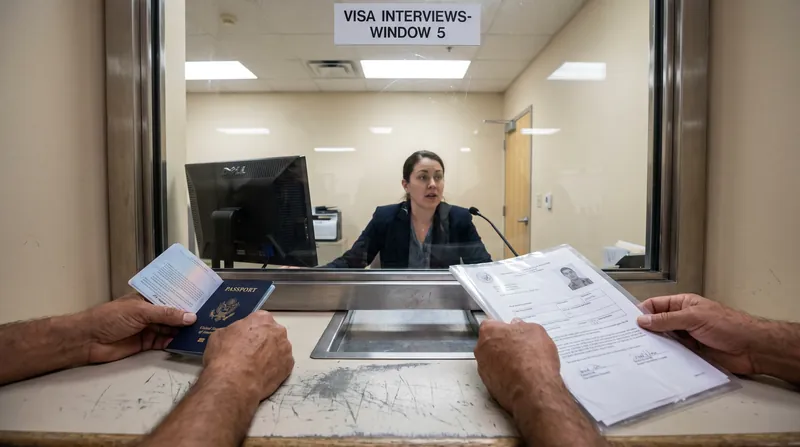
You have the medical exam completed, the financial affidavits signed, and the flights tentatively mapped out in your head. For thousands of families and sponsored workers, the final step to a U.S. green card is a brief, high-stakes conversation at a consular window. But this week, those windows abruptly closed.
On August 25, 2026, the U.S. State Department directed all embassies and consulates worldwide to pause immigrant visa appointments. Applicants who had waited months or years for their interviews suddenly received cancellation emails, with no new dates provided.[1][2]
The reason for the global pause is an "in-depth training" initiative for consular officers. The focus of this training is the "public charge" rule—a long-standing provision of U.S. immigration law that allows the government to deny a visa if an applicant is deemed likely to become primarily dependent on government assistance.[2]
While the public charge concept is not new, the sudden worldwide halt to retrain officers signals a renewed, stricter focus on how financial self-sufficiency is evaluated. Consular officers are being instructed to look comprehensively at an applicant's age, health, family status, financial resources, education, and skills to predict their future reliance on U.S. public benefits.[1]
The timing of the training is not a coincidence. Just four days earlier, on August 21, a federal judge in New York struck down a separate State Department policy that had suspended immigrant visa issuance for nationals of 75 specific countries.[1][3]
In that case, Catholic Legal Immigration Network, Inc. (CLINIC) v. Rubio, U.S. District Judge Jeannette Vargas ruled that the 75-country ban was "patently unlawful." She found that it violated the Immigration and Nationality Act's prohibition against nationality-based discrimination and exceeded the Secretary of State's authority by replacing individualized assessments with a blanket ban.[3][4]
By vacating the 75-country ban, the court forced the State Department to return to case-by-case adjudications. The new worldwide training appears to be the agency's pivot: if they cannot categorically ban applicants from certain countries based on public charge concerns, they will train every consular officer globally to apply the public charge test more rigorously on an individual basis.[3][6]
For applicants navigating this sudden shift, the distinction between immigrant and nonimmigrant visas is crucial right now. The current pause applies exclusively to immigrant visas—those issued to individuals seeking permanent residence, or green cards, through consular processing abroad. This includes family-sponsored relatives and employment-based workers.[1][5]
It does not affect nonimmigrant visas. If you are applying for a tourist visa, a student visa, or a temporary work visa such as an H-1B or L-1, your appointments should proceed as scheduled. The line for temporary visits keeps moving, even as the line for permanent relocation halts.[1][5]
Furthermore, the pause only affects processing at embassies and consulates outside the United States. Foreign nationals who are already inside the U.S. and applying for permanent residence through "adjustment of status" are processed by U.S. Citizenship and Immigration Services (USCIS), a different agency under the Department of Homeland Security.[1][6]
However, USCIS is undergoing its own public charge shifts. The agency is rescinding its 2022 public charge rule, with new, stricter guidance set to take effect on September 18, 2026. While the State Department and USCIS operate on separate tracks, the parallel moves reflect a broader, government-wide tightening of financial requirements for immigrants.[1][6]
The immediate impact of the consular pause is a severe backlog. The State Department has not announced how long the training will take or when normal appointment scheduling will resume. Past administrative pauses of this nature have lasted anywhere from a few weeks to several months, leaving families in a painful state of limbo.[2][4]
The delay is particularly devastating for Diversity Visa applicants. Under federal law, diversity visas are only available through the end of the fiscal year in which they are allocated—September 30, 2026. If these applicants cannot complete their consular interviews before that deadline, their visas are permanently lost and cannot be carried over.[2]
For now, immigration attorneys are advising affected applicants to monitor their emails and embassy portals closely. While the interviews are paused, pre-interview processing at the National Visa Center should continue, meaning applicants should still gather and submit their required documents to ensure they are ready the moment the windows finally reopen.[1][4]
Key points
- The State Department has paused all immigrant visa appointments worldwide to train officers on public charge screening.
- The pause affects family-sponsored and employment-based green card applicants processing at embassies abroad.
- Nonimmigrant visas, such as tourist, student, and temporary work visas, are not affected by the pause.
- The global halt follows an August 21 federal court ruling that struck down a previous 75-country visa ban.
What we don’t know
- When the State Department will conclude the training and resume normal immigrant visa appointment scheduling.
- The specific criteria and thresholds being taught to consular officers during the new public charge training.
- How severely the new training will impact immigrant visa approval rates once interviews restart.
- Whether the government will appeal the August 21 court ruling that struck down the 75-country visa ban.
How we got here
January 21, 2026
The State Department suspends immigrant visa issuance for nationals of 75 countries based on public charge concerns.
July 20, 2026
The Department of Homeland Security announces the rescission of its 2022 domestic public charge rule, effective September 18.
August 21, 2026
A federal judge vacates the 75-country visa ban in CLINIC v. Rubio, ruling it unlawful and discriminatory.
August 25, 2026
The State Department pauses all immigrant visa appointments worldwide to train officers on expanded public charge screening.
September 18, 2026
New, stricter USCIS public charge guidance takes effect for adjustment of status applications inside the United States.
- Immigration Advocates
- Argue that the sudden pause and stricter training are backdoor attempts to limit legal immigration and disproportionately harm lower-income families.
- The State Department
- Maintains that the training ensures consular officers evaluate applicants comprehensively, consistently, and lawfully to protect U.S. public resources.
- U.S. Employers
- Concerned about the operational disruption, as the pause delays start dates and relocation plans for sponsored foreign workers.
Perspectives this story doesn't cover
- Diversity Visa applicants facing the September 30 statutory deadline
- U.S. citizens separated from immediate family members abroad
Sources
Source coverage
6 outlets
3 viewpoints surfaced






- [1]FragomenU.S. Employers
United States: State Department Temporarily Pauses Immigrant Visa Interviews Worldwide
Read on Fragomen → - [2]Yazdi Law
State Department Pauses All Immigrant Visa Appointments Worldwide: What Applicants Need to Know
Read on Yazdi Law → - [3]Mandamus LawyersImmigration Advocates
Federal Court Vacates the 75-Country Immigrant Visa Ban: What CLINIC v. Rubio Means for Refused Applicants
Read on Mandamus Lawyers → - [4]Orange Law
Latest US Immigrant Visa Interview Update — August 26, 2026
Read on Orange Law → - [5]Boundless ImmigrationImmigration Advocates
State Department Pauses Immigrant Visa Appointments Worldwide
Read on Boundless Immigration → - [6]Global Immigration BlogU.S. Employers
State Department Pauses Immigrant Visa Interviews Following Court Ruling Vacating 75-Country Suspension
Read on Global Immigration Blog →

More in Travel
See all →Visa Policy
The 'Immigrant Intent' Presumption: How the 214(b) Rule Actually Dictates Non-Immigrant Visa Approvals
8 sources
Diversity Visa
The 50,000 Visa Cap: How the US Diversity Visa Lottery Selects Entrants and Monthly Cut-Off Numbers Control Interviews
6 sources
Residency Rules
The 180-Day Threshold: How US Border Agencies Actually Measure Green Card Abandonment
7 sources
Visa Mechanics
The 85,000 Annual Cap: How the H-1B Lottery Selects Beneficiaries and the Master's Exemption Works
6 sources
Comments
Every angle. Every day.
Get Travel stories with full source coverage and perspective breakdowns, free every day.