
Seventy Percent of Hiring Decisions Take Longer Than Five Minutes, Refuting the Snap-Judgment Interview Myth
A landmark field study of 691 real-world job interviews reveals that nearly 70 percent of hiring managers take longer than five minutes to reach a decision. The data dismantles the pervasive 90-second evaluation myth, proving that candidates have a substantial runway to demonstrate their qualifications.
By Bo Feng

In short
- A landmark field study of 691 interviews proves that nearly 70 percent of hiring decisions take longer than five minutes, debunking the 90-second myth.
- Experienced interviewers and unstructured formats lead to faster, more subjective judgments, while standardized questions delay decisions and improve accuracy.
- Cognitive load causes interviewers to deliberate longer on early candidates, but mental fatigue forces them to rely on gut instinct by the end of the day.
In May 2015, a research team from Old Dominion, Florida State, and Clemson universities published a field study that dismantled one of the most pervasive myths in corporate hiring. By tracking 691 real-world job interviews, they proved that the legendary 90-second snap judgment is a statistical outlier.[2]
The data revealed that 69.6 percent of hiring decisions take longer than five minutes to formulate. For job seekers, the practical stakes of this finding are immense. A candidate who stumbles through their opening introduction has not automatically forfeited the role, because the evaluation window remains wide open.[1][3]
"There's an urban myth that interviewers make their hiring decisions within the first four minutes of an interview and spend the remaining time seeking information to bolster that gut judgment," the British Psychological Society noted in its review of the findings. The evidence for that folklore was extremely limited.
The myth likely originated with a 1954 doctoral thesis and was amplified by decades of career advice. The 2015 field study replaced that lab-based assumption with empirical observation. The researchers monitored 166 corporate interviewers who were evaluating undergraduate and graduate students for actual employment opportunities.[2]
Each interview was scheduled for 30 minutes. The interviewers, who averaged 36 years of age and possessed an average of 13 years of recruiting experience, answered questions about their methodology before the sessions began. After each conversation, they recorded exactly how long it took them to reach a final hiring conclusion.
The Real Timeline of Hiring
The resulting timeline contradicted the anxiety-inducing advice that candidates must win the job in the first breath. Only 4.9 percent of the interviewers reported making their determination within the first minute of meeting a candidate. The vast majority required significantly more exposure to the applicant's responses.[1]
By the five-minute mark, just 25.5 percent of the hiring managers had finalized their decision. This means that nearly three-quarters of the interviewers were still actively weighing the candidate's merits as the conversation moved past the introductory small talk and into substantive behavioral questions.[1][2]
The 15-minute mark proved to be the median threshold for evaluation. Overall, 59.9 percent of hiring decisions were solidified within the first half of the 30-minute scheduled block. While this confirms that early impressions carry weight, it also guarantees candidates a substantial runway to demonstrate their technical qualifications.[1][2]
Crucially, 40.1 percent of the decisions occurred after the 15-minute mark. This included 17.7 percent of determinations made late in the conversation, and 22.5 percent that were not finalized until after the interview had officially concluded and the candidate had left the room.
"The applicant gets more of a chance to break through subjective filters and demonstrate why they'd be a good candidate," Quartz reported in its 2022 analysis of the data. A longer evaluation period benefits both parties, allowing the employer to base their choice on evidence rather than emotive reactions.[1]
Experience Accelerates Judgment
While the overall averages point to deliberate pacing, the researchers uncovered troubling correlations regarding who decides quickly. Paradoxically, interviewers with more years of experience and higher self-reported confidence in their interviewing abilities were the most likely to render rapid judgments.[2]
"The fact that interviewers with more experience and higher interviewing efficacy tend to make quicker decisions is particularly troubling," the research team noted. These senior individuals often wield disproportionate influence over which applicants are ultimately brought into an organization, meaning their snap judgments carry heavy organizational consequences.
The structure of the interview itself also dictated the speed of the outcome. Hiring managers who utilized unstructured formats—prioritizing casual rapport-building and small talk at the outset—tended to make faster decisions. Personal questions provoke immediate, strong reactions that solidify an interviewer's subjective opinion.[1]
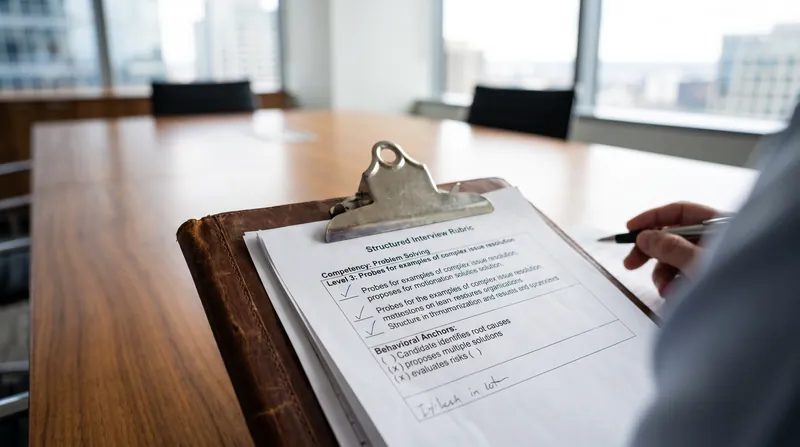
Conversely, structured interviews that required the hiring manager to ask every applicant the exact same sequence of questions actively inhibited quick decisions. By forcing the evaluator to gather specific data points across multiple competencies, structured formats delayed the final judgment until the rubric was complete.[2]
This dynamic highlights a structural flaw in many corporate hiring processes. When companies fail to mandate standardized question sets, they inadvertently encourage their most senior managers to rely on thin-slicing—the psychological phenomenon of drawing sweeping conclusions from narrow windows of social interaction.[3]
The Cognitive Load Curve
The study also revealed that an interviewer's decision time is not static; it fluctuates wildly over the course of a single day. The researchers plotted a curvilinear relationship between the number of candidates interviewed and the time required to evaluate them, driven by cognitive load theory.
During the first few interviews of a schedule, decision times grew progressively longer. As the hiring managers absorbed new information and attempted to juggle the competing profiles of early candidates, their working memory reached capacity, forcing them to deliberate more carefully.
This deliberation peaked around the fourth applicant of the day. After that threshold, the cognitive demands of processing complex behavioral responses became overwhelming. Decision times began to shorten dramatically for subsequent candidates as the interviewers reverted to gut instinct to manage their mental fatigue.
For job seekers, this curve presents a strategic variable. Being the last candidate in a long sequence of interviews often means facing an evaluator who has exhausted their analytical capacity and is more likely to fall back on rapid, subjective filtering.[1]
"Job seekers should attempt to avoid being the last in a long line of interviews," Quartz advised. If scheduling permits, securing a slot in the middle of the hiring manager's day may ensure a more thorough and evidence-based assessment of a candidate's actual skills.[1]
The Candidate's Own Timeline
The evaluation process is entirely mutual, and candidates are often faster to judge the employer than the employer is to judge them. A 2018 study by Robert Half UK found that 53 percent of job seekers make up their minds about a role before the first interview has even finished.
In fact, 24 percent of candidates decide whether a job is right for them within the first five minutes of the meeting. This rapid candidate-side judgment is heavily influenced by the interviewer's punctuality, the structure of the conversation, and the overall candidate experience.
"More and more job interviews are becoming an opportunity for the employer to convince a candidate of the role, as much as the candidate is selling themselves," noted Matt Weston, a managing director at Robert Half. In tight labor markets, skilled candidates evaluate the company at every stage.
When hiring managers rely on unstructured small talk or appear disorganized, candidates interpret those signals as proxies for the company's operational competence. A delayed start or a distracted interviewer can cost an organization a top-tier applicant before the technical evaluation even begins.[3]
This mutual thin-slicing means the opening minutes of an interview remain critical for establishing professional respect, even if the final hiring decision requires another 25 minutes of substantive dialogue to secure. The handshake sets the tone, but the data proves it does not seal the outcome.[3]
The Financial Cost of Inefficiency
The persistence of the snap-judgment myth obscures the massive financial inefficiency of modern hiring practices. If a quarter of decisions are genuinely made in the first five minutes, the remaining 25 minutes of those scheduled interviews represent a staggering waste of corporate resources.
Recruitment research from the Leonid Group indicates that interviewing consumes roughly two-thirds of total hiring time. This includes not just the live conversation, but the preparation, scheduling, internal debriefs, and stakeholder alignment required to process each candidate through the pipeline.
When an interviewer forms a definitive negative view in the opening minutes but carries the conversation to the 30-minute mark out of politeness, they incur a heavy opportunity cost. The remainder of the session becomes an exercise in confirmation bias rather than neutral evaluation.
"The uncomfortable truth is this: hours of interview time are being spent on candidates that hiring managers already know they won't hire," the Leonid Group reported. For each unsuitable candidate who reaches a late-stage interview, organizations lose up to 60 minutes of senior executive time.
To combat this, enterprise human resources departments are increasingly adopting asynchronous video screenings and standardized rubrics for early-stage evaluations. By capturing early data points on communication and role understanding without committing to live interviews, companies can reserve synchronous time for genuinely viable shortlists.
Training programs are also being overhauled to address the specific vulnerabilities identified in the 2015 field study. Organizations are instructing their most senior personnel to actively delay their judgments, emphasizing the value of gathering comprehensive information throughout the entire scheduled block.[3]
The empirical data offers a reassuring reality check for the modern workforce. The 90-second interview is a fiction. Candidates who prepare thoroughly, recover gracefully from early missteps, and deliver consistent value across a 30-minute dialogue are playing the game exactly as the statistics dictate it is won.[1][3]
Key terms
- Thin-slicing
- The psychological phenomenon of drawing sweeping conclusions about a person's competence or status from a very narrow window of social interaction.
- Cognitive load theory
- A framework explaining how the limited capacity of human working memory hinders the ability to process complex information over sustained periods.
- Structured interview
- An evaluation format that requires hiring managers to ask every applicant the exact same sequence of questions to ensure consistent data collection.
Viewpoints in depth
Academic Researchers
Focus on empirical data and the structural flaws in human evaluation.
Organizational psychologists argue that human brains are wired to assess strangers for threat and competence in milliseconds, making objective evaluation difficult. They advocate for highly structured interviews and standardized rubrics to override these evolutionary biases, warning that unstructured small talk merely validates an interviewer's preconceived notions.
Corporate Hiring Managers
Balance the desire for objective assessment with the practical constraints of scheduling and fatigue.
Senior executives acknowledge the risk of confirmation bias but point to the massive financial cost of prolonged interview cycles. They argue that while a final decision may take 30 minutes to formalize on paper, an experienced manager can accurately gauge a candidate's cultural fit and baseline competence early in the conversation, allowing them to protect their time.
- Academic Researchers
- Focus on empirical data and the structural flaws in human evaluation.
- Recruitment Professionals
- Focus on the financial cost of interviews and candidate experience.
- Career Analysts
- Focus on actionable strategies for job seekers navigating the timeline.
Perspectives this story doesn't cover
- Unsuccessful Candidates
- Diversity and Inclusion Advocates
Sources
Source coverage
3 outlets
3 viewpoints surfaced



- [1]QuartzCareer Analysts
How long does it take an interviewer to make a decision?
Read on Quartz → - [2]EntrepreneurCareer Analysts
How Long Does It Take a Hiring Manager to Make a Decision?
Read on Entrepreneur → - [3]Factlen Editorial TeamCareer Analysts
Synthesis by Factlen editorial team
Read on Factlen Editorial Team →

More in Careers & Work
See all →Interview Bias
The 19% Distortion: How the Sequential Contrast Effect Biases Interview Scores Regardless of Candidate Quality
7 sources

Interview Scoring
The Calibration Gap: How Behaviorally Anchored Rating Scales Restructure Interview Scoring
3 sources
Hiring Science
The P-O Fit vs. P-J Fit Trade-Off: How Value Alignment Predicts Turnover While Skills Predict Satisfaction
7 sources

Executive Hiring
How the Crisis Interview Works: Why Boards Hire Turnaround CEOs Without Direct Industry Experience
4 sources

Comments
Every angle. Every day.
Get Careers & Work stories with full source coverage and perspective breakdowns, free every day.