
Individual Interviews Outpredict Panels 0.43 to 0.32: Why Shared Observation Hurts Hiring
Meta-analytic data reveals that individual interviews predict job performance more accurately than panel boards, despite the latter's perceived efficiency. Shared observation artificially inflates interviewer agreement while collapsing the independent data points necessary for valid candidate assessment.

In short
- Individual sequential interviews achieve a predictive validity of 0.43, significantly outperforming the 0.32 validity coefficient of panel board formats.
- Panel interviews artificially inflate interrater reliability to 0.74 because evaluators observe the same performance, masking a lack of independent data.
- Shared observation triggers groupthink and social anchoring, neutralizing the mathematical advantage of having multiple evaluators assess a candidate.
Hiring managers advocating for panel interviews point to a compelling efficiency metric: placing three evaluators in a single room saves hours of calendar coordination and ensures everyone observes the exact same candidate responses. By standardizing the stimulus, they argue, the hiring team eliminates the round-to-round variability that plagues sequential interviews and reaches consensus faster.
Proponents of individual interviews counter that this shared experience is precisely the problem. They argue that placing multiple evaluators in the same room collapses independent observation into a single shared event, allowing dominant personalities to anchor the group's perception. In this view, three separate conversations yield three distinct data points, while a panel yields only one collective impression.
The data settles the debate with a stark numerical gap. According to a comprehensive meta-analysis published in the Journal of Applied Psychology by McDaniel, Whetzel, Schmidt, and Maurer in 1994, individual interviews achieve a predictive validity coefficient of 0.43. In contrast, panel boards manage a predictive validity of just 0.32, meaning the individual format is substantially more accurate at forecasting actual job performance.[1][5]
The 0.11 difference in predictive validity is not a marginal statistical artifact. In the context of personnel selection, a coefficient of 0.43 represents a robust signal capable of distinguishing top-quartile performers from average hires, while 0.32 drops the assessment closer to the predictive power of a generic reference check.[1]
The Illusion of Agreement
The persistence of the panel interview stems from a fundamental misunderstanding of interrater reliability. When multiple interviewers observe a candidate simultaneously, their post-interview scores naturally align, creating a false sense of security for the hiring committee.
Research from Huffcutt, Culbertson, and Weyhrauch's 2013 meta-analysis indicates that panel interviews produce an interrater reliability of 0.74, compared to just 0.44 for sequential interviews conducted by different evaluators. To a hiring manager reviewing the scorecards, this 0.74 agreement feels like objective accuracy.[11]
However, this high agreement is an artifact of the format rather than a signal of predictive power. Because panelists watch the same performance, hear the same answers, and often read each other's body language, they are grading a single shared stimulus.[7]
The 0.74 reliability score simply proves that the evaluators saw the exact same 45-minute performance, not that they extracted a valid predictor of future work output. They are agreeing on the candidate's presentation skills, not their underlying competence or long-term potential.[11]
In a sequential process, a reliability score of 0.44 reflects the reality that candidates perform differently across multiple sessions. One interviewer might test technical depth at 9:00 AM, while another probes problem-solving under pressure at 11:00 AM.[11]
The variance in their scores represents a broader, more comprehensive sampling of the candidate's capabilities. By capturing the candidate in different contexts and energy levels, the sequential format ultimately builds a more robust predictive model.[10]
The Mathematics of Independent Observation
The mathematical benefit of a multi-rater system relies entirely on the concept of independent observation. When data points are gathered in isolation, the random errors and individual biases of each evaluator tend to cancel each other out during aggregation.[2]
In a panel setting, this statistical advantage collapses. Because the evaluators share the same environment and observe the same responses, their judgments become correlated. The panel effectively functions as a single, slightly more observant interviewer rather than a true aggregate of distinct perspectives.[2][5]
This phenomenon explains why adding more interviewers to a panel does not increase its validity. Moving from a three-person board to a five-person board simply crowds the room and increases candidate anxiety, without generating any new, independent data for the hiring matrix.[10]
Conversely, adding a third or fourth sequential individual interview steadily increases the predictive validity of the overall process. Each new session introduces a fresh environment and a novel interaction dynamic, capturing behavioral signals that a single shared session would miss.[10]
How Group Dynamics Erode Validity
The 0.11 validity penalty associated with panel interviews is also heavily driven by groupthink and social anchoring. In a typical board interview, the most senior title in the room often sets the tone for the entire evaluation.[11]
If a department director nods approvingly at a candidate's response, junior panelists are statistically likely to adjust their own internal scoring upward before the debrief even begins. The hierarchy of the organization bleeds into the assessment process, corrupting the data.[11]
Even when panelists attempt to remain objective, the shared environment fosters a phenomenon known as social loafing. Evaluators who are not actively asking a question tend to disengage, assuming that their peers are capturing the critical details and driving the conversation.[11]
Furthermore, the panel format fundamentally alters candidate behavior. As the team at InterviewEdge notes, "Because a group interview can feel more interrogative than a one-on-one interview, candidates may be more defensive or uncomfortable and less likely to provide revealing and honest responses."[12]
Candidates shift from demonstrating their actual problem-solving mechanics to managing the room's collective energy. They prioritize eye contact distribution and diplomatic phrasing, masking the raw behavioral signals that actually predict job success.[12]
The Role of Interview Structure
The predictive gap between the two formats widens or narrows depending on the level of structure applied to the questions. A fully structured interview—where every candidate faces the identical question set—is the gold standard for hiring accuracy.[4][8]
When organizations enforce strict structure, individual interviews maximize their 0.43 predictive validity. Each interviewer operates as an independent sensor, gathering standardized behavioral data without any cross-contamination from other evaluators. This isolation preserves the integrity of the assessment.[1][4]
The subsequent hiring debrief aggregates these isolated signals into a composite score that accurately reflects the candidate's total competency profile. The structure ensures that the variance in scores comes from the candidate's performance, not the interviewer's whims.[3][4]
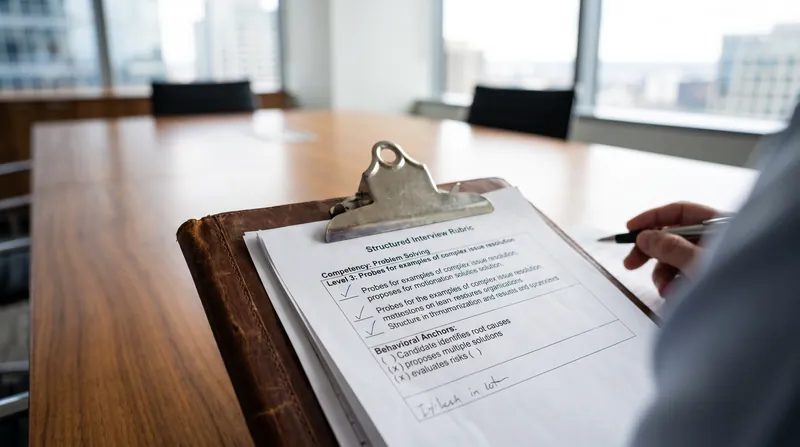
Applying that same structure to a panel interview improves its baseline performance but fails to close the gap with the individual format. Even with a rigid rubric and behaviorally anchored rating scales, panelists in a shared room still suffer from shared observation bias.[5][9]
The only mechanism that partially rescues panel validity is forcing evaluators to submit their scores privately before any verbal discussion occurs. This independent scoring step prevents the loudest voice in the room from anchoring the group's final consensus.[11]
Practical Stakes for Hiring Teams
For talent acquisition teams, the 0.11 difference in predictive validity translates directly into quality-of-hire outcomes and downstream turnover costs. Relying on a 0.32 validity coefficient means a higher percentage of candidates who interview well will ultimately fail in the role.[10]
Simultaneously, highly capable operators are often screened out by the artificial pressure of the board format. The panel interview inadvertently selects for candidates with exceptional public speaking and room-management skills, regardless of whether the actual job requires those competencies.[12]
Transitioning from panel boards to sequential individual interviews requires a deliberate structural shift. Organizations must divide the core competencies among the interview team, ensuring that each evaluator owns a distinct 45-minute block of the assessment.[11]
This division of labor prevents redundant questioning while guaranteeing that the final hiring decision rests on three truly independent evaluations. The organization trades the scheduling convenience of a single block for the mathematical reality of a better hire.[10]
This division of labor prevents redundant questioning while guaranteeing that the final hiring decision rests on three truly independent evaluations.
Ultimately, the goal of an interview process is to predict future work performance, not to reach an easy consensus on a Tuesday afternoon. While panel interviews offer the administrative comfort of immediate agreement, they sacrifice the independent data gathering that makes structured interviewing effective.[10]
How we did this
- Method
- Compared the predictive validity coefficients of individual versus panel interviews across multiple meta-analyses, isolating the effect of shared observation on interrater reliability and ultimate hiring accuracy.
- What we found
- While panel interviews artificially inflate interrater reliability to 0.74 because evaluators observe the exact same performance simultaneously, this shared observation collapses independent data points, ultimately reducing the format's predictive validity (0.32) compared to individual sequential interviews (0.43) where evaluators gather truly independent signals.
- What we worked from
- Individual interview predictive validity: 0.43 — Journal of Applied Psychology
- Panel interview predictive validity: 0.32 — Journal of Applied Psychology
- Panel interview interrater reliability: 0.74 — BrightHire
- Limits of this analysis
- The analysis relies on aggregated meta-analytic data, which may obscure variations in panel structure, interviewer training, and specific job complexities that could alter the validity gap in isolated cases.
Definitions
- Predictive validity
- A statistical measure of how accurately an assessment tool, such as an interview, forecasts a candidate's actual future job performance.
- Interrater reliability
- The degree to which different evaluators agree in their assessment and scoring of the same candidate.
- Shared observation bias
- The phenomenon where multiple evaluators watching the same event develop correlated judgments, eliminating independent data points.
- Social anchoring
- A cognitive bias where junior evaluators adjust their own scores to match the perceived opinion of the most senior person in the room.
- Behaviorally anchored rating scale
- A scoring rubric that defines specific, observable candidate behaviors for each point on the evaluation scale.
Questions & answers
Does adding more interviewers to a panel improve its accuracy?
No. Expanding a panel from three to five members increases candidate anxiety and scheduling complexity without adding independent data, leaving the predictive validity unchanged.
How can hiring teams mitigate bias if they must use a panel format?
Evaluators must score the candidate independently and submit their ratings privately before any group discussion begins, preventing the loudest voice from anchoring the consensus.
Why do panel interviews feel more accurate to hiring managers?
Because panelists observe the exact same performance, they naturally agree on the outcome, creating a high interrater reliability of 0.74 that managers mistake for predictive accuracy.
Which roles are most penalized by the panel interview format?
Highly technical or analytical roles suffer most, as the format inadvertently selects for public speaking and room-management skills rather than the core competencies required for the job.
Analysis by camp
Efficiency Advocates
Hiring managers and recruiters who prioritize speed and calendar consolidation.
This camp argues that sequential interviews drag out the hiring timeline, risking candidate drop-off in competitive labor markets. By placing all decision-makers in one room for 45 minutes, they eliminate the round-to-round variability of candidate performance and force an immediate consensus. For these advocates, the administrative efficiency and speed-to-offer outweigh the statistical penalty in predictive validity.
Psychometricians
Industrial-organizational psychologists focused on maximizing predictive validity.
Researchers in this camp view the panel interview as a flawed instrument that corrupts data gathering. They argue that true assessment requires independent observation, where each evaluator acts as an isolated sensor. By collapsing multiple interviews into a single shared event, psychometricians warn that organizations are trading robust, multi-faceted candidate data for the illusion of agreement.
Candidate Experience Specialists
HR professionals focused on employer branding and candidate psychological safety.
This perspective highlights the adversarial nature of the panel format, often describing it as a 'firing squad.' They argue that facing three or four evaluators simultaneously triggers a defensive posture in candidates, stifling authentic conversation. These specialists advocate for one-on-one sequential interviews to build rapport, allowing candidates to demonstrate their actual working style rather than their stress-management skills.
- Psychometricians
- Focus on maximizing predictive validity through independent observation.
- Efficiency Advocates
- Prioritize speed, calendar consolidation, and immediate consensus in hiring.
- Candidate Experience Specialists
- Advocate for one-on-one formats to reduce candidate anxiety and build rapport.
Perspectives this story doesn't cover
- Candidates subjected to panel interviews
- Employment lawyers evaluating bias claims
Sources
Source coverage
12 outlets
3 viewpoints surfaced







- [1]Journal of Applied PsychologyPsychometricians
The Validity of Employment Interviews: A Comprehensive Review and Meta-Analysis
Read on Journal of Applied Psychology → - [2]PubMedPsychometricians
A counterintuitive hypothesis about employment interview validity and some supporting evidence
Read on PubMed → - [3]University of Nebraska - LincolnCandidate Experience Specialists
Employment Interviews
Read on University of Nebraska - Lincoln → - [4]U.S. Office of Personnel ManagementCandidate Experience Specialists
Structured Interviews
Read on U.S. Office of Personnel Management → - [5]Public Personnel ManagementCandidate Experience Specialists
The Panel Interview: A Review of Empirical Research and Guidelines for Practice
Read on Public Personnel Management → - [6]Journal of Occupational PsychologyPsychometricians
A Meta-Analytic Investigation of the Impact of Interview Format and Degree of Structure on the Validity of the Employment Interview
Read on Journal of Occupational Psychology → - [7]Journal of Applied PsychologyPsychometricians
A Meta-Analysis of Interrater and Internal Consistency Reliability of Selection Interviews
Read on Journal of Applied Psychology → - [8]Personnel PsychologyPsychometricians
A Review of Structure in the Selection Interview
Read on Personnel Psychology → - [9]Journal of Business and PsychologyPsychometricians
The Validity of Unstructured Panel Interviews: More than Meets the Eye?
Read on Journal of Business and Psychology → - [10]Factlen Editorial Team
Synthesis by Factlen editorial team
Read on Factlen Editorial Team → - [11]BrightHireEfficiency Advocates
Panel Interview Guide
Read on BrightHire → - [12]InterviewEdgeCandidate Experience Specialists
Questioning Panel Interviews
Read on InterviewEdge →

More in Careers & Work
See all →Interview Science
Past Behavioral Interview Questions Outpredict Situational Prompts 0.63 to 0.47
4 sources

Interview Psychology
Seventy Percent of Hiring Decisions Take Longer Than Five Minutes, Refuting the Snap-Judgment Interview Myth
3 sources

Interview Bias
The 19% Distortion: How the Sequential Contrast Effect Biases Interview Scores Regardless of Candidate Quality
7 sources

Interview Scoring
The Calibration Gap: How Behaviorally Anchored Rating Scales Restructure Interview Scoring
3 sources
Comments
Every angle. Every day.
Get Careers & Work stories with full source coverage and perspective breakdowns, free every day.