
Psychobiotics and the Gut-Brain Axis: How Food Impacts Mood
Emerging research reveals that specific gut bacteria, known as psychobiotics, can significantly influence mental health. By targeting the microbiome through diet, scientists are uncovering new ways to alleviate anxiety and depression.
By Factlen Editorial Team
- Clinical Microbiologists
- Focuses on identifying specific bacterial strains and their biochemical mechanisms for targeted therapies.
- Nutritional Psychiatrists
- Advocates for using whole foods and dietary interventions as a primary tool to support mental health.
- Cautious Medical Consensus
- Emphasizes the need for more rigorous, long-term human trials before making broad clinical recommendations.
What's not represented
- · Traditional Psychiatrists
- · Agricultural Policy Makers
Why this matters
Understanding the gut-brain connection empowers you to take an active role in your mental well-being. Simple, accessible dietary changes can cultivate a microbiome that naturally supports mood regulation, stress resilience, and cognitive clarity.
Key points
- The gut contains over 500 million neurons and produces roughly 95% of the body's serotonin.
- Psychobiotics are specific strains of live bacteria that provide measurable mental health benefits.
- Microbes break down dietary fiber into neuroactive compounds that reduce inflammation and promote calm.
- Recent meta-analyses show significant reductions in depression and anxiety symptoms using targeted probiotics.
- A diet rich in fiber, whole grains, and fermented foods is the most effective way to cultivate a healthy gut-brain axis.
The idea that the bacteria living in your digestive system could dictate your mood sounds like science fiction. Yet, the concept of treating the mind by feeding the gut is rapidly becoming one of the most robustly researched frontiers in neuroscience. For decades, psychiatry has focused almost exclusively on the brain. Now, a paradigm shift is directing attention downward, revealing that our mental well-being is inextricably linked to the trillions of microorganisms residing in our intestines.[1][8]
To understand this shift, one must look at the sheer scale of the gut's neural architecture. The human digestive tract contains over 500 million neurons—more than the spinal cord—earning it the moniker of the "second brain," or the enteric nervous system. Even more surprisingly, approximately 95% of the body's serotonin, the primary neurotransmitter responsible for regulating mood, is produced in the gut, not the brain.[1][2]
This brings us to "psychobiotics," a term coined to describe live microorganisms that, when consumed in adequate amounts, yield measurable mental health benefits. Unlike standard probiotics aimed solely at digestion, psychobiotics actively interface with the nervous system. They represent a bridge between gastroenterology and psychiatry, offering a new, accessible tool for those looking to optimize their emotional resilience and cognitive function.[1][5]

The communication between the gut and the brain is not a one-way street; it is a constant, bidirectional dialogue known as the gut-brain axis. The primary information superhighway for this chatter is the vagus nerve, a thick bundle of fibers running from the abdomen to the brainstem. Fascinatingly, up to 90% of the traffic along the vagus nerve travels upward—from the gut to the brain—meaning our digestive system is constantly sending status updates that influence how we feel.[2][8]
But how exactly do microscopic bacteria alter human emotion? The mechanism lies in their metabolic byproducts. As beneficial gut microbes break down dietary fiber, they release a cascade of neuroactive compounds, including short-chain fatty acids (SCFAs). These SCFAs help maintain the integrity of the gut lining, reducing systemic inflammation—a known driver of depressive symptoms.[3][5]
Furthermore, specific strains of bacteria, particularly within the Lactobacillus and Bifidobacterium families, have been shown to directly synthesize or stimulate the production of gamma-aminobutyric acid (GABA) and serotonin precursors. GABA is an inhibitory neurotransmitter that promotes relaxation and reduces anxiety. By acting as microscopic pharmacies, these microbes provide the brain with the raw materials it needs to maintain emotional equilibrium.[5][6]

GABA is an inhibitory neurotransmitter that promotes relaxation and reduces anxiety.
The clinical evidence supporting psychobiotics has moved from theoretical to highly compelling over the last few years. A landmark 2025 systematic review and meta-analysis encompassing dozens of randomized controlled trials found that specific probiotic interventions produced statistically significant reductions in both depression and anxiety symptoms. For many participants, the improvements in self-reported happiness and perceived stress were clinically meaningful.[1][6]
Recent trials have even isolated specific strains for targeted outcomes. For example, a 2026 study on the Lactiplantibacillus plantarum KABP-051 strain demonstrated that a single intervention could deliver simultaneous improvements in body composition and mood. Researchers noted that by improving energy levels and mental clarity through the gut-brain axis, participants were better equipped to self-regulate and adhere to healthier daily habits.[4]
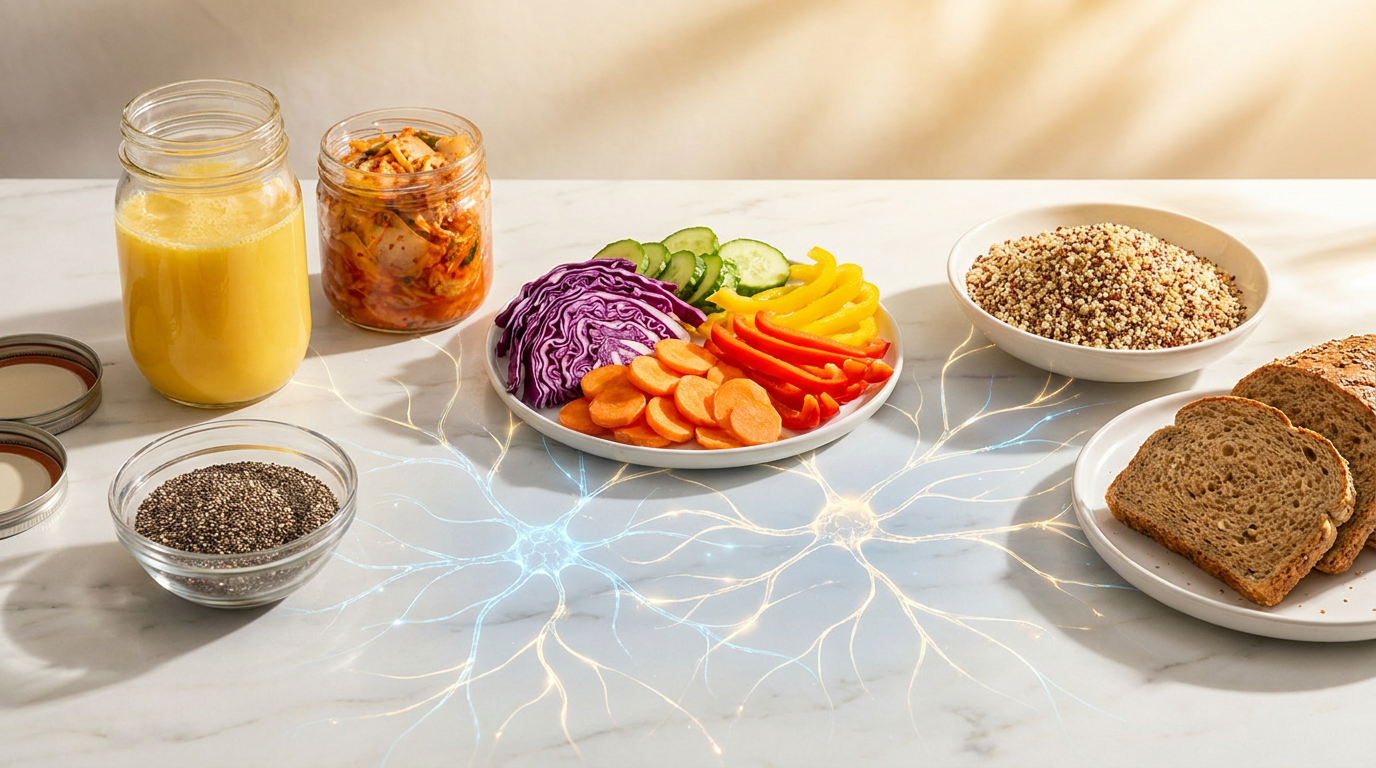
While targeted supplements are showing promise, nutritional psychiatrists emphasize that the most effective way to cultivate a psychobiotic environment is through whole foods. The "psychobiotic diet" is heavily inspired by the traditional Mediterranean diet, prioritizing high-fiber vegetables, whole grains, legumes, and a diverse array of plant polyphenols. These foods act as prebiotics—the essential fertilizer that allows beneficial, mood-boosting bacteria to thrive.[3][7]

Fermented foods are the other pillar of this dietary approach. Foods like kefir, kimchi, sauerkraut, and traditional yogurt are naturally teeming with diverse, live bacterial cultures. Integrating these into a daily routine introduces a steady stream of transient microbes that interact with the resident gut flora, helping to crowd out inflammatory pathogens and reinforce the gut barrier.[2][7]
Conversely, the modern Western diet—characterized by ultra-processed foods, refined sugars, and artificial additives—has been shown to actively disrupt this delicate ecosystem. A diet devoid of fiber starves beneficial microbes, leading to a state of imbalance known as dysbiosis. This imbalance triggers localized gut inflammation, which can cross the intestinal barrier, enter the bloodstream, and ultimately manifest as neuroinflammation and lowered mood.[3][7]
Despite the excitement surrounding psychobiotics, researchers urge a measured approach. The human microbiome is as unique as a fingerprint, meaning a specific bacterial strain that alleviates anxiety in one person might have no discernible effect on another. The science of matching specific microbial profiles to individualized treatments is still in its infancy, requiring much more granular, long-term human data.[2][6]

It is also crucial to contextualize psychobiotics within broader mental health care. They are not a magic pill, nor are they a replacement for standard psychiatric treatments, therapy, or prescribed medications for severe clinical depression. Instead, they are increasingly viewed as a powerful, low-risk adjunct therapy—a foundational layer of biological support that makes other interventions more effective.[1][3]
Looking ahead, the integration of microbiome science into everyday wellness represents a profoundly empowering shift. It suggests that we are not entirely at the mercy of our brain chemistry. By making intentional, accessible choices at the grocery store, we can actively cultivate an internal ecosystem that supports our mental health, proving that a happier mind truly can begin with a healthier gut.[7][8]
How we got here
2013
The term 'psychobiotic' is first coined by researchers to describe bacteria with mental health benefits.
2016
Neuroscientists begin mapping the specific biochemical pathways of the microbiota-gut-brain axis.
2022
Major clinical trials demonstrate the antidepressant effects of a high-fiber, Mediterranean-style diet.
2025-2026
Large-scale meta-analyses confirm the clinical efficacy of specific bacterial strains in reducing anxiety and depression.
Viewpoints in depth
Nutritional Psychiatrists
Advocates for using whole foods and dietary interventions as a primary tool to support mental health.
This camp argues that the modern Western diet is a primary driver of the current mental health crisis. By focusing on whole foods, high-fiber plants, and fermented products, nutritional psychiatrists believe patients can naturally correct gut dysbiosis. They emphasize that while supplements have their place, a 'psychobiotic diet' provides a broader, more sustainable foundation for emotional resilience, as it delivers a complex matrix of nutrients that isolated pills cannot replicate.
Clinical Microbiologists
Focuses on identifying specific bacterial strains and their biochemical mechanisms for targeted therapies.
Researchers in this field are focused on precision. They argue that the future of mental health treatment lies in identifying the exact strains of bacteria—such as specific Lactobacillus or Bifidobacterium variants—that produce targeted neuroactive compounds like GABA or serotonin precursors. Their goal is to develop standardized, pharmaceutical-grade psychobiotics that can be prescribed with the same confidence and predictability as traditional psychiatric medications.
Cautious Medical Consensus
Emphasizes the need for more rigorous, long-term human trials before making broad clinical recommendations.
While acknowledging the exciting potential of the gut-brain axis, cautious voices in the medical community warn against overstating the current evidence. They point out that the human microbiome is highly individualized, meaning a psychobiotic that works for one person may fail for another. This camp stresses that psychobiotics should be viewed as an adjunct to, rather than a replacement for, established psychiatric treatments, and calls for larger, more diverse clinical trials to establish long-term safety and efficacy.
What we don't know
- Which specific bacterial strains work best for individual, highly unique microbiomes.
- The long-term durability of mood improvements once a psychobiotic supplement is discontinued.
- Exactly how much of the benefit comes from the microbes themselves versus the overall improvement in dietary quality.
Key terms
- Psychobiotics
- Live microorganisms that, when consumed in adequate amounts, confer mental health benefits to the host.
- Enteric Nervous System
- A complex network of over 500 million neurons lining the gastrointestinal tract, often called the 'second brain'.
- Vagus Nerve
- A major nerve bundle that serves as the primary communication highway between the gut and the brain.
- Short-Chain Fatty Acids (SCFAs)
- Beneficial compounds produced when gut bacteria ferment dietary fiber, known to reduce inflammation.
- Dysbiosis
- An imbalance in the gut microbial community, often linked to poor diet, which can trigger systemic inflammation.
Frequently asked
What is the difference between a probiotic and a psychobiotic?
While all psychobiotics are probiotics, not all probiotics are psychobiotics. Psychobiotics are specific strains that have been clinically shown to produce neuroactive compounds and improve mental health.
How quickly can changing my diet affect my gut microbiome?
Research indicates that the composition of your gut microbiome can begin to shift within just 24 to 48 hours of significant dietary changes, though lasting mood benefits take longer to manifest.
Can psychobiotics replace my antidepressant medication?
No. Psychobiotics are currently viewed as a complementary therapy. They can provide foundational biological support, but they are not a replacement for prescribed psychiatric medications.
What are the best everyday foods to support the gut-brain axis?
A combination of prebiotic foods (like oats, garlic, and asparagus) to feed the bacteria, and probiotic foods (like kefir, kimchi, and yogurt) to introduce new beneficial microbes.
Sources
Source coverage
8 outlets
3 viewpoints surfaced






[1]PharmaNowClinical Microbiologists
Psychobiotics And Mental Health: Can Bacteria Influence Human Emotions?
Read on PharmaNow →[2]ZOECautious Medical Consensus
Psychobiotics and the gut-brain axis
Read on ZOE →[3]National Institutes of HealthNutritional Psychiatrists
Role of diet and its effects on the gut microbiome in the pathophysiology of mental disorders
Read on National Institutes of Health →[4]Nutritional OutlookClinical Microbiologists
Lactiplantibacillus plantarum KABP-051 probiotic strain shows weight management and mood benefits
Read on Nutritional Outlook →[5]Taylor & FrancisClinical Microbiologists
Psychobiotics and their neuroactive compounds
Read on Taylor & Francis →[6]MDPIClinical Microbiologists
Clinical Human Studies on Psychobiotics
Read on MDPI →[7]Elevate Food CoNutritional Psychiatrists
Food and Mood: Current Evidence on Mental Health and the Microbiota-Gut-Brain Axis
Read on Elevate Food Co →[8]Factlen Editorial TeamCautious Medical Consensus
Synthesis by Factlen editorial team
Read on Factlen Editorial Team →


Every angle. Every day.
Get food drink stories with full source coverage and perspective breakdowns delivered to your inbox.