
HHS Restores Presidential Youth Fitness Test, Re-establishing National K-12 Performance Benchmarks
The federal government has officially reinstated the competitive Presidential Fitness Test in schools, replacing a decade-old program that prioritized personal improvement over peer comparison. While health officials aim to combat childhood obesity, exercise scientists warn that testing without adequate physical education infrastructure could discourage less athletic students.

In short
- HHS has officially reinstated the competitive Presidential Fitness Test for K-12 students, replacing the non-competitive program used since 2012.
- The test measures upper body strength, core endurance, speed, agility, and flexibility, awarding students who hit the 85th percentile.
- While mandatory on military bases, public school adoption is optional and left to individual states.
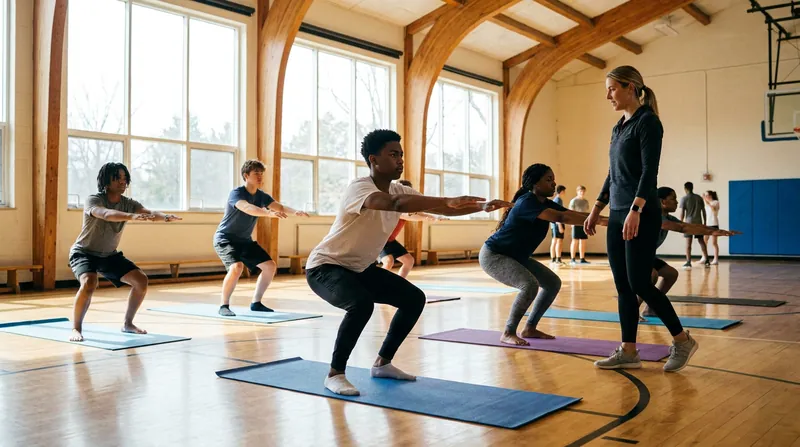
On June 29, 2026, inside the Boys & Girls Club of Atlantic City, Department of Health and Human Services (HHS) Secretary Robert F. Kennedy Jr. dropped to the floor to perform push-ups alongside 75 children. The event marked the official rollout of the reinstated Presidential Fitness Test, a competitive, school-based physical assessment that had been absent from American gymnasiums for over a decade. Beginning this fall, the familiar battery of physical challenges—including the one-mile run, the shuttle run, pull-ups, and sit-ups—will return to physical education curriculums across the country.[1]
The revival represents a sharp pivot in federal health policy. Under the new guidelines, students who score in the 85th percentile for their age and gender across five core components—cardiorespiratory endurance, upper body strength, core strength, speed, and flexibility—will earn the Presidential Fitness Award. This marks a return to the performance-based benchmarks that defined the program from its inception in the 1950s until 2012, when the Obama administration replaced it with the Presidential Youth Fitness Program, an initiative that prioritized personal health education and individual improvement over peer competition.[1]
Federal officials frame the reinstatement as a necessary intervention against a growing public health emergency. During the launch event, Kennedy cited alarming statistics driving the administration's "Make America Healthy Again" agenda: nearly one in five American children is currently overweight or obese, and 77 percent of young adults are ineligible for military service, largely due to poor physical fitness. By re-establishing standardized national benchmarks, HHS aims to motivate students to build foundational strength and cardiovascular capacity.[1]
While the test is mandatory for the 161 schools located on U.S. military installations, its adoption in public schools remains optional and entirely dependent on state-level mandates. Several states have already embraced the initiative; the governors of Mississippi and Virginia, for example, have issued executive orders directing their departments of education to implement the Presidential Fitness Test for the 2026-2027 academic year. To support the rollout, HHS has launched an interactive data portal and partnered with organizations like the Boys & Girls Club and WWE to encourage summer preparation.[1][4]
However, public health researchers warn that the national education infrastructure may not be equipped to handle the sudden return to standardized physical testing. A recent policy analysis published in the Centers for Disease Control and Prevention's Preventing Chronic Disease journal revealed a highly fragmented landscape. Researchers found that 24 states currently have no fitness testing requirements whatsoever, and only five states mandate the federally recommended 150 minutes of weekly physical education for elementary students.[3]
This lack of foundational support has exercise scientists deeply concerned about execution. Hannah Thompson, director of the University of California Nutrition Policy Institute, notes that nearly half the country lacks the basic physical education framework required to prepare students for these assessments. "Until you have a strong physical education program where students are really being taught how to do these things and how to do them well and in a safe way, testing at scale is likely to cause more harm than good," Thompson warned.[2]
The American College of Sports Medicine (ACSM) echoed these concerns, releasing a statement that supported the renewed focus on youth activity but cautioned against relying solely on norm-based testing. The ACSM emphasized that modern exercise science has evolved away from ranking students against one another. Instead, the organization advocates that the new benchmarks be used strictly as educational tools, paired with comprehensive instruction that helps students understand how movement prevents chronic disease.
For many adults, the original Presidential Fitness Test evokes memories of public embarrassment during the flexed-arm hang or the one-mile run. Recognizing this, state education administrators are moving quickly to establish guardrails. The San Diego County Office of Education recently issued guidance clarifying that California public schools will continue to use the state-mandated FITNESSGRAM, which focuses on health zones rather than competitive percentiles.
The California guidance explicitly states that the federal test cannot replace existing state assessments and emphasizes that student privacy must be a priority. Administrators warned that individual scores should never be announced publicly or used to determine academic grades, urging physical education teachers to take proactive steps to prevent the body shaming and bullying historically associated with public fitness testing.
For parents navigating this transition, clinical experts recommend focusing on the underlying goal of the initiative rather than the 85th percentile benchmark. Translating these federal guidelines into practical family habits means prioritizing consistent, daily movement—such as after-school sports, family walks, or playground free play—over specialized training for a shuttle run. Ultimately, while the Presidential Fitness Test provides a standardized metric for physical capability, long-term metabolic health is built through sustainable, enjoyable activity rather than a single day of testing.[4]
Where opinion splits
Federal Health Officials' View
Standardized, competitive testing is necessary to combat a national crisis of childhood obesity and physical inactivity.
Proponents of the reinstated test, led by HHS Secretary Robert F. Kennedy Jr. and the Trump administration, argue that the U.S. is facing a chronic disease emergency. With nearly one in five children classified as obese and a significant majority of youth ineligible for military service due to poor fitness, officials believe that measurable, performance-based benchmarks are essential. They argue that the 85th percentile standard provides a clear, aspirational goal that motivates students to improve their physical capabilities, framing fitness as both a personal health imperative and a matter of national resilience.
Academic and Clinical Researchers' View
Norm-based testing can backfire if not supported by comprehensive physical education infrastructure.
Exercise scientists and public health researchers, including those at the American College of Sports Medicine and the UC Nutrition Policy Institute, caution against relying solely on competitive benchmarks. They point out that the original test was retired in 2012 precisely because public, performance-based assessments often humiliated less athletic students, leading to long-term disengagement from physical activity. These experts advocate for a health-centric approach that emphasizes personal improvement and daily movement over peer comparison, warning that testing at scale without adequate funding for daily physical education could cause more harm than good.
State Education Administrators' View
Federal testing initiatives must navigate a patchwork of existing state laws and privacy concerns.
For local school districts, the federal rollout presents logistical and regulatory challenges. Because the test is optional for non-military public schools, adoption depends entirely on state policy. In places like California, which already mandates the health-focused FITNESSGRAM, education officials have clarified that the federal test will not replace state requirements. Administrators are particularly focused on student privacy, issuing guidance that fitness scores should never be announced publicly or used for academic grading, ensuring that the return to testing does not foster an environment of body shaming or bullying.
- Exercise Science Researchers
- Norm-based testing can cause trauma and disengagement if not supported by comprehensive, health-focused physical education.
- Federal Health Officials
- Standardized, competitive testing is necessary to combat a national crisis of childhood obesity and military ineligibility.
- State Education Administrators
- Federal testing initiatives must navigate existing state laws and prioritize student privacy over public performance.
Perspectives this story doesn't cover
- Students with physical disabilities
- Underfunded public school districts
Sources
Source coverage
4 outlets
3 viewpoints surfaced




- [1]U.S. Department of Health and Human ServicesFederal Health Officials
HHS Secretary Robert F. Kennedy, Jr. Kicks Off Return of Presidential Fitness Test
Read on U.S. Department of Health and Human Services → - [2]University of California Agriculture and Natural ResourcesExercise Science Researchers
U.S. 'not yet ready' to implement school-based Presidential Youth Fitness Test, UC researcher says
Read on University of California Agriculture and Natural Resources → - [3]Preventing Chronic DiseaseExercise Science Researchers
Revitalizing the US Youth Presidential Fitness Test: Are States Prepared to Support Implementation?
Read on Preventing Chronic Disease → - [4]Factlen Editorial TeamState Education Administrators
Synthesis by Factlen editorial team
Read on Factlen Editorial Team →
More in Fitness
See all →Preventive Health
House Committee Passes Bill Allowing HSA and FSA Funds for Gym Memberships and Fitness Expenses
4 sources

Longevity Science
21-Year NIH Trial Finds Lifestyle Intervention Superior to Metformin for Preventing Multiple Chronic Diseases
3 sources

Aging Science
Four Minutes of Daily Resistance Training Quadruples Critical Mobility Indicators in Adults Over 65
3 sources
Metabolic Science
Molecular Switch 'Mitch' Boosts Fat Burning and Endurance, Offering New Path to Solve GLP-1 Muscle Loss
3 sources

Comments
Every angle. Every day.
Get Fitness stories with full source coverage and perspective breakdowns, free every day.