
Global Renewables Surpass Coal for First Time in History to Become Largest Source of Electricity Generation
Driven by an unprecedented expansion in solar photovoltaics, renewable energy has overtaken coal as the world's primary source of electricity, marking a structural shift in global power grids.
By Hao Li

At 10,730 terawatt-hours, the threshold was crossed. For the first time since the inception of the modern power grid, renewable energy sources generated more electricity globally than coal in 2025. The data, compiled in the latest global reviews from the International Energy Agency (IEA) and the energy think tank Ember, confirms that wind, solar, hydropower, and other renewables captured 33.8% of the global power mix, edging out coal's 33.0%.[1][2]
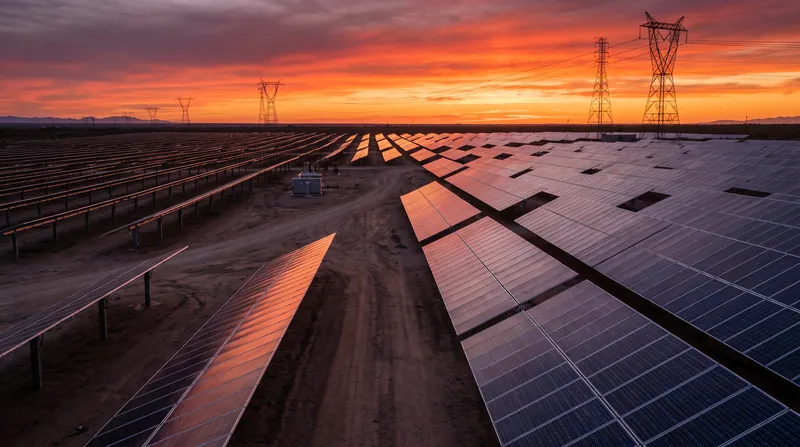
This crossover represents a structural node in the global energy transition rather than a temporary anomaly. Solar photovoltaics acted as the primary engine for this shift, adding an unprecedented 636 terawatt-hours of generation in a single year—enough to meet 75% of the net increase in global electricity demand.[1][4]
The expansion of solar capacity is reshaping grid operations worldwide. The IEA projects that solar generation will grow by another 600 terawatt-hours in 2026, matching its record expansion and positioning it to overtake wind as the second-largest renewable source behind hydropower.[2][6]
The evidence supporting this milestone is robust, though it carries minor statistical margins. The data from Ember relies on generation figures from 91 countries representing 93% of global demand, interpolating the remainder based on historical trends. While the margin between renewables and coal is narrow—just 0.8 percentage points—the upward trajectory of clean energy is unambiguous.[1]
Hydropower remains the largest single component of the renewable mix, but its output has been increasingly volatile. Severe droughts in 2024 and early 2025 suppressed hydro generation across several continents, forcing solar and wind to carry the entirety of the renewable sector's growth to push past coal.[2]
However, the evidence regarding a rapid absolute decline in fossil fuels remains weak. While renewables are now the largest single source of power by share, total global electricity demand is surging. Driven by industrial expansion, the electrification of transport, and the proliferation of energy-intensive data centers, global power demand is forecast to grow by 3.6% in 2026 and 3.8% in 2027.[2][3]
Because overall consumption is expanding so rapidly—projected to reach 30,700 terawatt-hours by 2027—the absolute volume of coal burned for power has not yet entered a steep decline. Coal-fired generation dropped by a marginal 0.6% in 2025, and the IEA forecasts it could actually increase by 1.4% in 2026.[1][3]
This persistence of coal is heavily localized and highly sensitive to market shocks. In the United States and parts of Europe, higher natural gas prices—exacerbated by supply chain disruptions and geopolitical tensions in the Strait of Hormuz—have prompted utilities to switch back to coal to maintain baseload reliability and control costs.[2][5]
Asia remains the only region where coal still exceeds renewables, accounting for 82% of global coal generation. Yet even there, the infrastructure is shifting rapidly. China contributed more than half of the global increase in solar generation in 2025, and India saw its combined solar and wind output rise by over 25% in the first half of 2026.[1][3]
The downstream consequence of this dynamic is a plateau in power-sector emissions rather than a sharp drop. Global carbon emissions from electricity generation remained flat in 2025 and are forecast to rise by roughly 1% in 2026 before leveling off again as clean energy deployment accelerates further.[2][6]
Grid operators are now navigating the physical complexities of integrating massive volumes of variable renewable energy. The rapid deployment of utility-scale battery storage—which added roughly 110 gigawatts of capacity globally in 2025—is becoming the critical infrastructure required to shift solar generation from midday peaks to evening demand hours.[1][2]
Ultimately, the data indicates that clean energy is no longer an alternative supplement but the foundational layer of new power infrastructure. While the complete displacement of fossil fuels remains constrained by rising demand and grid flexibility limits, the era of coal as the dominant force in global electricity has definitively ended.[1][4][7]
Key points
- Renewables generated 33.8% of global electricity in 2025, surpassing coal's 33.0% for the first time.
- Solar power was the primary driver, meeting 75% of the net increase in global electricity demand.
- Global electricity demand is accelerating, forecast to grow by 3.6% in 2026 and 3.8% in 2027.
- Despite losing market share, absolute coal generation remains flat and may slightly increase in 2026 due to rising overall power consumption.
What we don’t know
- Whether the rapid deployment of battery storage can scale fast enough to prevent further coal-to-gas switching during periods of high demand.
- How the massive energy requirements of new AI data centers will alter the long-term trajectory of fossil fuel retirements.
- If emerging economies outside of China and India can secure the financing needed to replicate this renewable growth.
How we got here
2013
Coal generation reaches its peak market share at 62% of the global electricity mix.
2020
Coal power experiences a temporary drop due to the COVID-19 pandemic demand shock.
2024
Solar photovoltaics begin an exponential growth curve, adding record capacity globally.
2025
Renewables officially surpass coal, generating 10,730 TWh compared to coal's 10,476 TWh.
2026
Solar generation is projected to overtake wind to become the second-largest renewable source behind hydropower.
- Energy Transition Analysts
- Argue that the milestone proves clean energy can scale fast enough to meet global demand, provided grid storage keeps pace.
- Grid Reliability Planners
- Focus on the persistent need for dispatchable baseload power, noting that coal and gas remain essential while battery infrastructure catches up.
- Market Forecasters
- Emphasize that surging overall electricity demand from AI and electrification is outpacing the absolute retirement of fossil fuels.
Perspectives this story doesn't cover
- Fossil Fuel Industry Executives
- Communities Reliant on Coal Mining
Sources
Source coverage
7 outlets
3 viewpoints surfaced







- [1]EmberEnergy Transition Analysts
Global Electricity Review 2026
Read on Ember → - [2]International Energy AgencyGrid Reliability Planners
Electricity Mid-Year Update 2026
Read on International Energy Agency → - [3]ReutersMarket Forecasters
Global Power Demand to Accelerate in 2026 and 2027, IEA Says
Read on Reuters → - [4]Carbon BriefEnergy Transition Analysts
Renewable energy has overtaken coal to become the world's largest source of electricity in 2025
Read on Carbon Brief → - [5]Gas OutlookGrid Reliability Planners
Renewables surpass coal in global power sector
Read on Gas Outlook → - [6]ElectrekMarket Forecasters
IEA: Global power demand is surging – and renewables are passing coal
Read on Electrek → - [7]StatistaMarket Forecasters
Renewables Overtake Coal in Global Power Mix
Read on Statista →
More in Energy
See all →Carbon Markets
The Additionality, Permanence, and Leakage Criteria That Validate a Carbon Offset Project
5 sources

Carbon Budget
The 0.45°C Per Trillion Tonne of Carbon (TTC) That Defines the Global Carbon Budget
7 sources

Carbon Pricing
How the Market Stability Reserve and Auctioning Schedule Control the EU Carbon Price
5 sources

Methane Tracking
The Mechanics of the Global Methane Pledge: How Voluntary Commitments and Satellite Monitoring Aim to Cut Emissions by 30%
8 sources

Comments
Every angle. Every day.
Get Energy stories with full source coverage and perspective breakdowns, free every day.